As the founder of WorkOS and co-founder of Nylas, Michael Grinich is best known for defining the "Enterprise Chasm," the infrastructure gap startups hit when selling to large corporations. This profile collects his insights on developer tools, the economics of time, and early-stage company building.
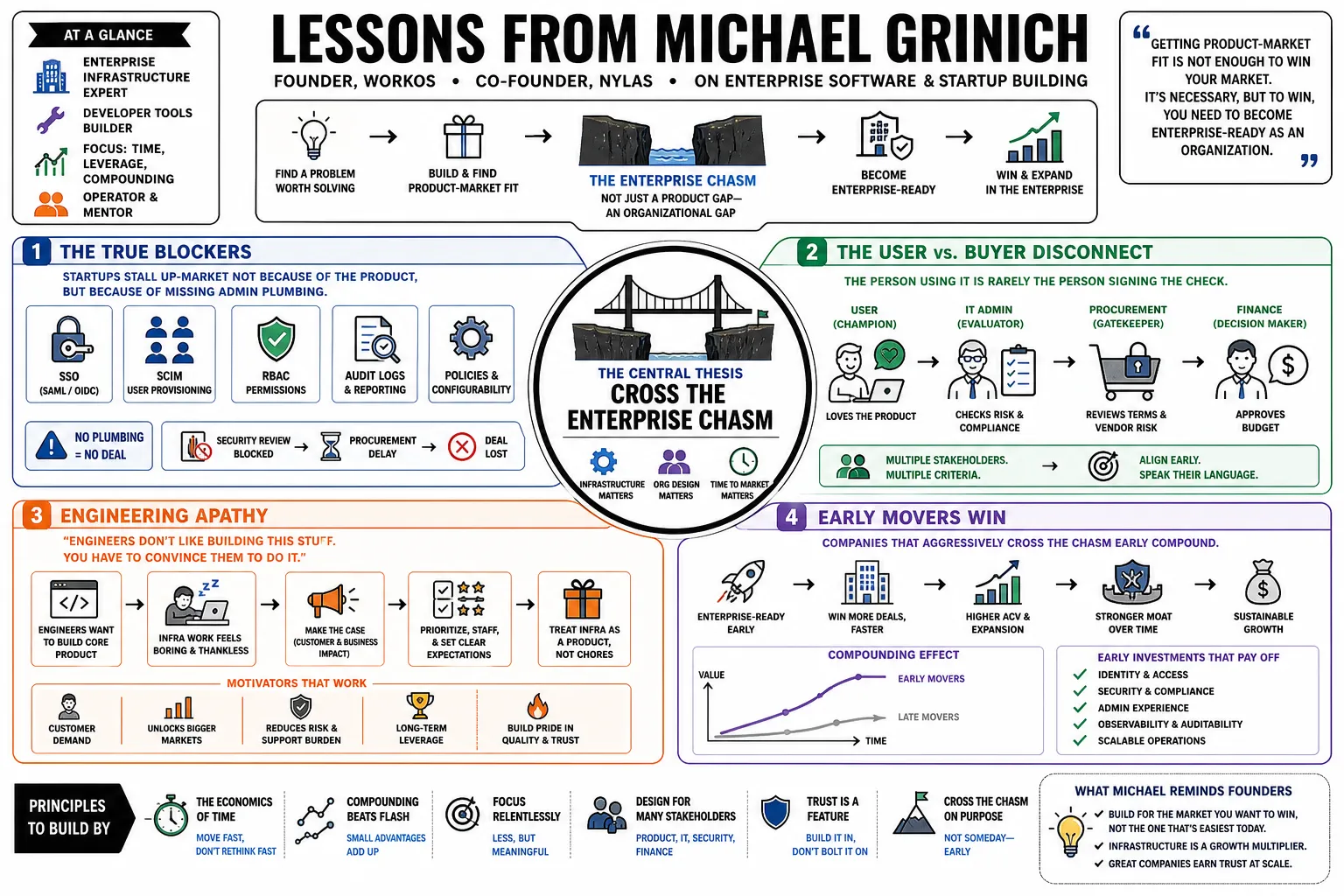
Part 1: Crossing the Enterprise Chasm
- On The Enterprise Chasm: "Getting product-market fit is not enough to win your market. It’s necessary, but to win, you need to become enterprise-ready as an organization." — Source: [Enterprise Ready Conference Keynote]
- On the True Blockers: Startups rarely stall upmarket because their core product is deficient; they stall because they lack the basic administrative plumbing like SSO and SCIM. — Source: [WorkOS Blog]
- On the User vs. Buyer Disconnect: The person eagerly using your software in the enterprise is almost never the person signing the check or the IT admin responsible for approving its security profile. — Source: [Crossing the Enterprise Chasm Podcast]
- On Engineering Apathy: "Engineers don't like building this stuff. They don't wake up in the morning thinking, 'I'm going to go add Role-Based Access Control to the app.' You have to convince them to do it." — Source: [Enterprise Ready Conference Keynote]
- On Early Movers: Companies that aggressively cross the chasm early, like Slack or GitHub, capture the market. Those that delay often fade or are forced into early acquisitions. — Source: [Mang-Git Podcast]
- On Enterprise Readiness as Strategy: Treating enterprise features as an afterthought or a "Phase 2" project is a strategic error; they are the gateway to sticky, high-expansion revenue. — Source: [Software Engineering Daily]
- On the IT Administrator Persona: You have to build empathy for the IT admin; they aren't trying to ruin your UX, they are trying to protect their company's data and manage sprawling risk. — Source: [Crossing the Enterprise Chasm Podcast]
- On Design in the Enterprise: "There’s absolutely no reason enterprise software can’t be as beautiful, seamless, and polished as the consumer products that are out there." — Source: [Dev Propulsion Labs]
- On the Definition of Victory: You haven't truly won a B2B market until your product has been vetted, approved, and deployed across an entire large-scale organization's infrastructure. — Source: [Enterprise Ready Conference Keynote]
- On Boring Features: The features that unlock the most revenue are usually the most boring to build: audit trails, directory sync, and compliance exports. — Source: [WorkOS Blog]
Part 2: The Build vs. Buy Framework
- On Hourly Valuation: "Value your own time at $10,000 per hour. If you’re looking to use a service and it costs $5,000, but you think you can build it in a day—don't. Your day is worth $80,000 in opportunity cost." — Source: [Mang-Git Podcast]
- On Identifying Invariants: Founders must identify the one or two core things their business needs to win the market. Everything else is a distraction that should be outsourced. — Source: [Mang-Git Podcast]
- On the Maintenance Trap: Engineers habitually underestimate the long-term maintenance burden when deciding to build a feature in-house instead of buying it. — Source: [Dev Propulsion Labs]
- On Commodity Infrastructure: If a feature doesn't differentiate your product to the end user, it is a commodity feature. Treat it as such and buy it off the shelf. — Source: [SaaStr]
- On Leverage Through Platforms: Utilizing platforms like AWS, Stripe, or WorkOS is how small engineering teams gain the leverage necessary to compete with massive incumbents. — Source: [WorkOS Blog]
- On Ego-Driven Engineering: Building your own infrastructure when a managed service exists is often driven by engineering ego rather than sound business logic. — Source: [Software Engineering Daily]
- On Invisible Infrastructure: The best infrastructure is entirely invisible to the user; they only notice it when it breaks or is missing. — Source: [Medium]
- On Capital Allocation: You are given funding to solve a specific, hard problem in the market, not to reinvent the wheel on standard authentication or billing systems. — Source: [SaaStr]
- On the Velocity Mandate: The primary advantage a startup has is velocity. Buying infrastructure is the simplest way to artificially increase your engineering velocity. — Source: [Mang-Git Podcast]
Part 3: Hard Lessons from Nylas
- On the Infrastructure Trap: At Nylas, years were spent building complex email sync infrastructure. The hard lesson was that users ultimately just wanted the features to work, making the deep technical achievement a distraction from delivering core value. — Source: [Medium]
- On Premature Marketing Agencies: Hiring a high-end marketing agency before establishing product-market fit is burning cash. An agency cannot manufacture a connection to a technical audience that doesn't yet exist. — Source: [SaaStr Podcast]
- On Firing the Marketing Team: Recognizing a misalignment with the core developer audience necessitated firing the entire marketing team, a difficult but necessary correction away from fluff towards utility. — Source: [SaaStr Podcast]
- On the Security Wall: The genesis of WorkOS came from witnessing Nylas—an email platform handling sensitive data—constantly hit a brick wall with IT departments because it lacked enterprise-grade security. — Source: [Software Engineering Daily]
- On Founder Self-Awareness: A critical leadership moment is recognizing when you are the bottleneck. Stepping down as CEO of Nylas allowed the company to scale effectively under different leadership. — Source: [SaaStr Podcast]
- On Developer Skepticism: Traditional marketing campaigns fail with developers. They crave documentation, utility, and authentic engagement, not glossy ad campaigns. — Source: [SaaStr]
- On Misaligned Capital: Spending $100,000 on an early branding campaign taught the harsh lesson that marketing is an accelerant for an existing fire, not the spark itself. — Source: [SaaStr Podcast]
- On Hard Technical Pivots: Sometimes the technology you are proudest of building is the exact thing you need to abstract away to make the product viable for the market. — Source: [Medium]
- On the Genesis of Ideas: The struggles at Nylas directly formulated the thesis for WorkOS. The hard way is often the only way to deeply understand a structural market deficit. — Source: [Software Engineering Daily]
- On Managing Burn Rate: When marketing outpaces product reality, you aren't building a brand, you are simply accelerating your burn rate toward failure. — Source: [SaaStr Podcast]
Part 4: Managing Time and Opportunity Cost
- On the Cost of Time: "The cost of time is greater than the cost of cost." — Source: [Medium]
- On SpaceX's Philosophy: You don't build quarter-scale rocket prototypes to save cash if it delays the final launch by a month. That month's delay costs tens of millions in lost future revenue. — Source: [Medium]
- On the Limits of Lean Startup: The mantra of running small, cheap experiments can be a trap. For high-growth companies, over-optimizing for capital efficiency actively destroys enterprise value by sacrificing speed. — Source: [Medium]
- On Buying Time: Founders must learn to spend money aggressively to buy time. Hiring, better tooling, and outsourcing are mechanisms to compress the timeline to your core thesis. — Source: [Founders in Arms]
- On Opportunity Cost: Every day spent debating a minor expense is a day you aren't capturing market share or learning from active users. — Source: [Medium]
- On Decisiveness: A sub-optimal decision executed immediately is frequently more valuable than a perfect decision reached three weeks late. — Source: [Dev Propulsion Labs]
- On Market Windows: Technology markets move rapidly. The window to establish dominance is finite, making time your absolute most scarce and expensive resource. — Source: [Founders in Arms]
- On Financial Dilution vs. Time Dilution: Founders worry obsessively about equity dilution, but time dilution—moving too slowly to capture the market—is the far more common company killer. — Source: [Founders in Arms]
- On Artificial Speed Limits: If you are well-funded but moving slowly to save money, you are imposing an artificial speed limit on an asset designed to go fast. — Source: [Medium]
Part 5: Developing for Developers
- On Developer Joy: Software built for developers must prioritize developer joy. In modern SaaS, developers are the primary stakeholders and wield immense purchasing influence. — Source: [Software Engineering Daily]
- On the Ultimate Boss Battle: Building products for other developers is the ultimate boss battle in tech because your users understand exactly how your product is built and will judge its architecture. — Source: [Founders in Arms]
- On Seamless Integration: Developer tools should not require heavy sales intervention. The integration should be so seamless that a developer can implement it on a Sunday afternoon without talking to anyone. — Source: [SaaStr]
- On Plumbers over Prima Donnas: "We hire engineers that are like plumbers. Plumbing as a technology has saved more lives than medicine or transportation. We want the 'theater kid' who isn't on stage in the spotlight, but the one making the show happen behind the scenes." — Source: [Dev Propulsion Labs]
- On Utility as Marketing: The best marketing strategy for a developer-led product is flawless API documentation and a frictionless onboarding experience. — Source: [SaaStr]
- On Building for People You Like: You will spend years talking to your customers. If you are building developer tools, you must genuinely enjoy hanging out with developers, otherwise, the journey is miserable. — Source: [Dev Propulsion Labs]
- On Open Source Contributions: Engaging with the open-source community is not a side project for developer tools; it is the fundamental mechanism for establishing trust and credibility. — Source: [Software Engineering Daily]
- On B2D Pricing: Business-to-Developer pricing must be transparent and usage-based. Hiding pricing behind a "Contact Sales" button immediately alienates the technical buyer. — Source: [SaaStr]
- On the End of the IT Dictator: Software adoption is no longer forced top-down by an IT dictator. It bubbles up from the developers who actually use it. — Source: [Software Engineering Daily]
Part 6: Navigating Early-Stage Dynamics
- On Founder-Led Sales: A founder cannot outsource the figuring out phase of sales. Hiring a sales leader too early is a fatal mistake; the initial motion must be derived from the founder's direct relationships. — Source: [Dev Propulsion Labs]
- On the Leap of Faith: You will never have perfect information before launching. The hardest part is the leap of faith, and you must start building before you feel entirely ready. — Source: [Dev Propulsion Labs]
- On Technical Founder Traps: Technical founders often exhaust every theoretical architectural possibility in a vacuum before actually talking to a real user. — Source: [Dev Propulsion Labs]
- On Inevitable Wrongness: Every initial startup idea is wrong in some direction. Only active user feedback can correct the trajectory. — Source: [Dev Propulsion Labs]
- On the SaaS Apocalypse Myth: Reject the narrative of a SaaS apocalypse. The software industry is not contracting; it is entering a massive new phase of expansion and specialization. — Source: [Founders in Arms]
- On the Value of Early Customers: Your first ten customers are not just revenue sources; they are your actual product management team. — Source: [SaaStr]
- On Discovering Messaging: You don't invent your product's messaging in a whiteboard session. You discover it by listening to the exact words your happiest early users use to describe you to their peers. — Source: [Dev Propulsion Labs]
- On Bootstrapping Trust: Early on, you have no brand. You trade your personal founder credibility and intense support in exchange for a customer taking a risk on your unproven software. — Source: [SaaStr]
- On Iteration Speed: The single most important metric for an early-stage startup is the cycle time between receiving user feedback and shipping a modification based on that feedback. — Source: [Dev Propulsion Labs]
- On the Danger of Glossy Launches: Over-indexing on a perfect TechCrunch launch distracts from the messy, unglamorous work of making sure the product actually solves a painful problem. — Source: [SaaStr Podcast]
Part 7: Ideation and Founder Mechanics
- On the Daily Idea Notebook: Generating ideas requires volume over quality. Maintaining a daily idea notebook, allocating one page per idea, allows you to capture concepts without immediate harsh judgment. — Source: [Founders in Arms]
- On Sticky Ideas: You identify a winning concept not through a spreadsheet, but by noticing which ideas in your notebook are sticky—the ones your mind naturally wanders back to and that gain density over time. — Source: [Founders in Arms]
- On Creative Production: Entrepreneurial ideation mirrors creative professions like comedy or songwriting: you must force constant production to eventually unearth a breakthrough. — Source: [Founders in Arms]
- On the Wandering Phase: The period between companies should be a rigorous exploration phase. It took a year and a half of evaluating disparate concepts—from aerospace to developer tools—to converge on WorkOS. — Source: [Founders in Arms]
- On Physical Notebooks: The tactile nature of carrying a physical notebook everywhere creates a dedicated mental space for observation that digital apps often fail to replicate. — Source: [Founders in Arms]
- On Revisiting Old Pages: A good idea is rarely fully formed on day one. Returning to specific pages to add layers and new angles is how a brief thought becomes a viable thesis. — Source: [Founders in Arms]
- On Embracing Bad Ideas: You have to be comfortable writing down hundreds of bad ideas to clear the mental pipeline for the good ones. — Source: [Founders in Arms]
- On the Subconscious Mind: Your subconscious is an excellent filter. If an idea is truly powerful, it will forcefully remind you of its existence when you are trying to focus on something else. — Source: [Founders in Arms]
- On the Transition to Conviction: The moment to stop exploring and start building is when researching an idea feels less like curiosity and more like an unavoidable compulsion. — Source: [Founders in Arms]
Part 8: The AI and Enterprise Intersection
- On Vibe Coding: While AI enables rapid, prompt-based vibe coding, you cannot vibe code your way into doing corporate taxes, medical surgery, or establishing secure infrastructure. — Source: [The Secure Developer]
- On AI's Upmarket Acceleration: AI startups are being forced to move upmarket incredibly fast—often in 6 to 12 months rather than the 5 to 7 years it took previous SaaS generations. — Source: [The Secure Developer]
- On AI and Sensitive Data: Because AI products inherently touch the most sensitive data in an organization immediately, enterprise-grade security and permissions are table stakes from day one. — Source: [The Secure Developer]
- On Agent Identity: As autonomous agents begin taking actions on behalf of users, the enterprise must solve the complex problem of Agent Identity—managing what a bot is allowed to see and do. — Source: [Enterprise Ready Conference Keynote]
- On AI as Infrastructure: The companies building foundational AI models rely heavily on hardened enterprise infrastructure behind the scenes to sell into corporate environments safely. — Source: [Dev Propulsion Labs]
- On the Limits of Code Generation: AI can generate the application logic, but the strict security boundaries, compliance requirements, and sandboxing must still be rigorously architected by humans. — Source: [The Secure Developer]
- On the Next Generation of SaaS: The next wave of SaaS won't be defined by just workflow software, but by intelligence engines that require vastly more complex access control to prevent data leakage. — Source: [Enterprise Ready Conference Keynote]
- On AI Security Parallels: The current state of AI security is akin to the early days of the web browser—we are still figuring out the fundamental sandboxing models to prevent disastrous breaches. — Source: [The Secure Developer]
- On the Stakes of AI Failure: When standard SaaS fails, a workflow is interrupted. When enterprise AI fails without proper access controls, the entire proprietary knowledge base of a corporation can be exposed. — Source: [The Secure Developer]