Ben Cera built Polsia to help people create and operate businesses with AI agents. He uses the company as an experiment in solo founding, combining automated work with human direction and infrastructure partners. These lessons explore his approach to product taste, agent workflows and business-building, while distinguishing his long-term vision from demonstrated capabilities. — BILLIONS — Ben Cera.
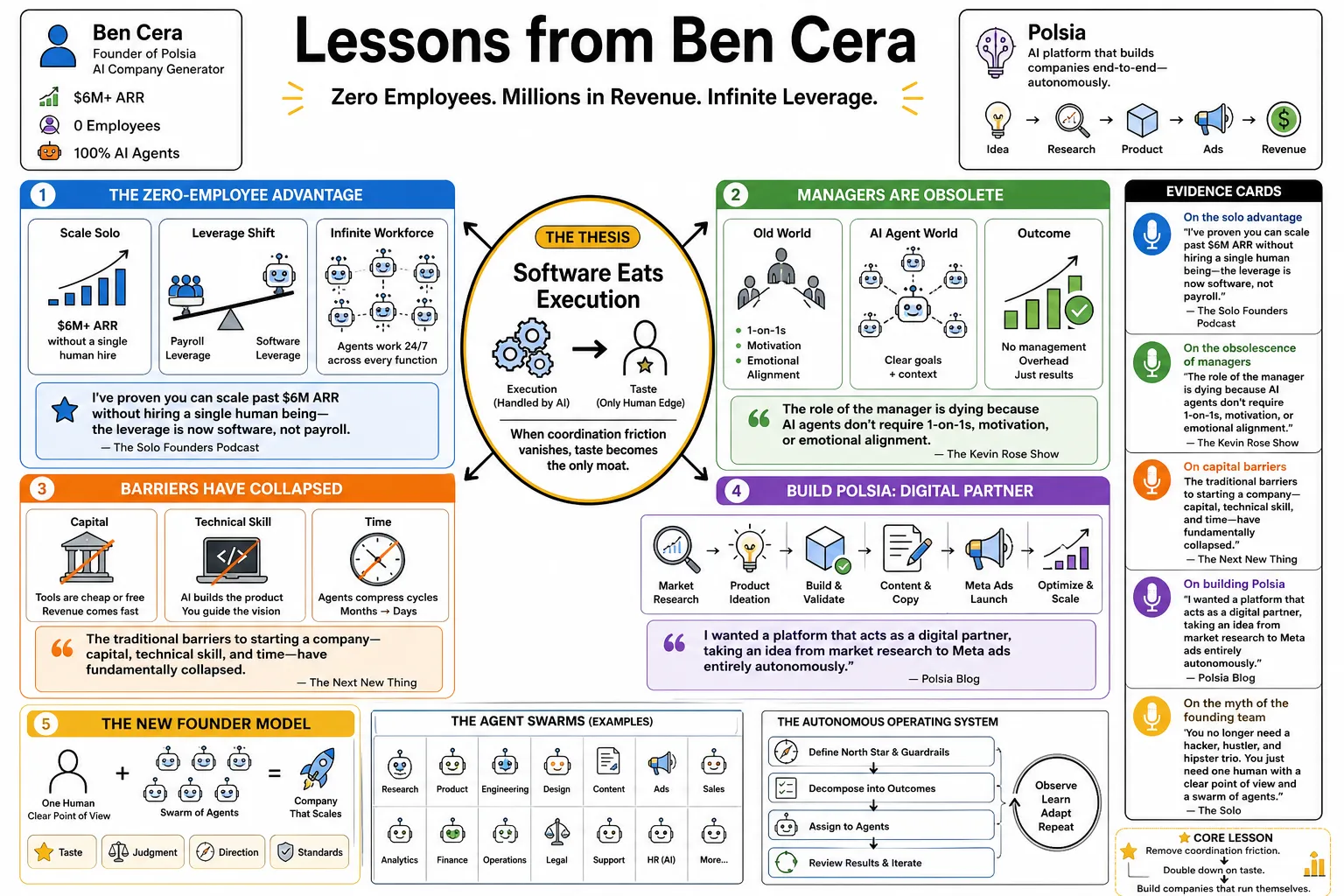
Part 1: The Zero-Employee Company
- On the solo advantage: Cera describes using AI to operate Polsia without a conventional employee team, while relying on infrastructure partners and legal advisers. His reported revenue run rate included one-off payments; it should not be read as verified recurring revenue or proof that no other humans contribute. — The Next New Thing — Polsia Follow-up.
- On the changing role of managers: Cera expects work to shift toward orchestrating agents rather than doing every task directly. He describes engineers and accountants supervising AI workflows, not a world in which all managerial work or human expertise disappears. — BILLIONS — Ben Cera.
- On capital barriers: Cera argues that AI lowers the skill, cost and time barriers to starting a business, making a clear idea and willingness to experiment more important. This is an opportunity he sees, not a claim that every practical barrier has disappeared. — Solo Founders — Ben Cera.
- On eating your own dog food: Cera uses the zero-employee constraint to test the AI-first operating model he offers customers. In May 2026 he said he still relied on infrastructure partners and legal advisers, and left open the possibility of hiring later. — The Next New Thing — Polsia Follow-up.
- On autonomous velocity: Cera describes onboarding that produces research, an initial plan and a landing page within minutes, giving a founder something concrete to try. Fast scaffolding is not the same as a profitable business, and he says winning paying customers still takes work. — BILLIONS — Ben Cera.
- On the ultimate goal: Cera wants people to be able to build small businesses that generate meaningful income, not just pursue the exceptional solo-billionaire milestone. He presents this as an opportunity, while acknowledging that early customer businesses still have to find paying customers. — The Kevin Rose Show — Ben Cera.
Part 2: The 80/20 Rule of Autonomy
- On the 80/20 split: Cera’s 2026 thesis is that new companies should automate most day-to-day engineering, marketing and operations while humans supply taste, creativity and direction. His 80/20 split is a proposed operating model, not a measured requirement for every business. — Solo Founders — Ben Cera.
- On taste as a competitive advantage: As AI makes execution more accessible, Cera sees taste, branding and the experience a founder creates as important ways to stand out. His argument is about selling to human customers, not proof that taste is the only durable advantage in every business. — Solo Founders — Ben Cera.
- On the creative director model: Cera sees the founder as a creative director who guides an AI team toward a product and experience that matter to customers, rather than personally executing every operational task. — Solo Founders — Ben Cera.
- On building for yourself: After feeling uninspired by products designed for imagined customers, Cera chose to build an AI company builder he genuinely wanted. He also says a business should listen to users once they begin using the product. — Solo Founders — Ben Cera.
- On Rick Rubin's influence: Drawing on Rick Rubin’s creative philosophy, Cera focuses on making work that expresses his own point of view rather than trying to control how everyone will react to it. — Solo Founders — Ben Cera.
Part 3: Coordination Friction
- On the cost of alignment: Cera finds that working directly with AI reduces the need to negotiate priorities and align different visions. He contrasts this with his own experience of compromises between co-founders; it is a personal operating preference, not a claim that every human team destroys value. — Solo Founders — Ben Cera.
- On the physical bottleneck: Cera sees digital work as easier to automate than physical activity, which still requires suitable services, integrations or robotics. His examples of agents arranging manufacturing describe a possible future, not a capability Polsia has already demonstrated end to end. — The Kevin Rose Show — Ben Cera.
Part 4: Lessons from CloudKitchens
- On intense operations: Cera says working with Travis Kalanick taught him to push through difficult operational problems. He applies that persistence to testing the limits of AI workflows, while acknowledging that the business may need human help when the experiment stops serving customers. — The Kevin Rose Show — Ben Cera.
- On learning from Kalanick: Cera credits Kalanick with teaching him to prove a service works before scaling it. For Future Foods, he first signed up ten restaurants himself; only then did Kalanick agree to a sales hire. He applies that distinction between finding demand and scaling it to Polsia. — BILLIONS — Ben Cera.
- On the opposite extreme: Cera describes his earlier role at CloudKitchens as managing general managers, operations teams and international profit-and-loss responsibilities. Running Polsia with AI brought him back to hands-on product building. — Solo Founders — Ben Cera.
- On digital vs. virtual: At CloudKitchens, Cera built Future Foods to license virtual food brands and handle digital marketing while restaurants cooked the food. It separated a digital operating layer from the physical work of preparing meals. — BILLIONS — Ben Cera.
- On global reach: Drawing on CloudKitchens’ expansion, Cera thinks about scaling Polsia in terms of paying-customer targets, internationalization and pricing. Software distribution does not remove the need to work through those market and business-model decisions. — BILLIONS — Ben Cera.
- On ruthless prioritization: Cera argues that serving customers requires a business that can keep paying its bills. As Polsia grows, he pays attention to model costs and margins so that making the product affordable does not undermine its ability to keep operating. — BILLIONS — Ben Cera.
Part 5: Architecting Digital Organisms
- On the swarm model: Cera describes separate agents for engineering, marketing and support, each equipped with the tools its work requires. A coordinating agent chooses priorities; this is not evidence of a fixed five-agent structure. — The Next New Thing — Building Polsia.
- On the CEO agent: Cera’s nightly coordinating agent reviews the state of the business and decides whether the next useful task is engineering, marketing or support. He distinguishes this from merely obeying every feature request. — The Next New Thing — Building Polsia.
- On scoped authority: In his March 2026 interview, Cera describes allowing autonomous production changes within defined boundaries: limited bug severity, no changes to payments or onboarding, and a second-model check. This was a scoped experiment, not a guarantee that agents cannot make mistakes. — Solo Founders — Ben Cera.
- On natural language management: Cera describes a daily email reporting what the AI has done and what it plans to do next. The founder can reply or use the dashboard to redirect the work. — Solo Founders — Ben Cera.
- On the engineering agent: Cera gives the engineering agent access to a server, GitHub and a database so it can execute work rather than just suggest code. Human collaborators can also make commits that the system picks up. — The Next New Thing — Building Polsia.
- On customer support: Cera connects customer conversations to bug and feature reports, then has agents prioritize and investigate them. He describes review and infrastructure-stability constraints around deployment; the loop is a way to improve the product, not a guarantee that every support issue is permanently solved. — BILLIONS — Ben Cera.
- On system resilience: After a database outage, Cera used two AI models to diagnose and check a fix before he deployed it. He discussed allowing similar fixes autonomously in future; the incident was not a server healing itself before he noticed. — The Next New Thing — Building Polsia.
Part 6: The "Night Shift"
- On autonomous cycles: Cera describes a nightly cycle that selects and executes one next task, with extra task credits available when a founder wants work done sooner. Autonomous scheduling does not remove the need for human direction. — The Next New Thing — Building Polsia.
- On daily audits: In Cera’s description, the nightly CEO agent reviews logs, traffic, customer emails and advertising results before choosing the next task. The cycle connects execution to observed business needs. — Solo Founders — Ben Cera.
- On the morning briefing: The morning email tells the founder the current metrics, completed work and next planned task, providing an opportunity to request a different direction. — Solo Founders — Ben Cera.
- On launching campaigns: Cera describes an ad workflow in which the founder sets a budget and AI creates Meta campaigns, reviews their performance and adjusts creatives. The goal is to simplify campaign operation while learning from customer responses. — BILLIONS — Ben Cera.
- On compound interest: Cera sees the daily work-and-email cycle as a way to sustain a business idea when a founder’s initial enthusiasm fades. Regular progress can help maintain momentum; it does not guarantee that every day improves the business or produces a financial return. — The Kevin Rose Show — Ben Cera.
- On the joy of approval: Cera has agents diagnose issues and propose production changes, with approval requests reaching him through Slack. This shifts some work toward review and direction, but he still handles decisions and operational problems. — The Kevin Rose Show — Ben Cera.
Part 7: Navigating "AI Slop"
- On owning the joke: Cera intentionally chose Polsia as AI Slop spelled backwards. He says the ambition is to produce useful, beautiful work rather than slop, and that the name also attracts attention. — The Next New Thing — Polsia Follow-up.
- On signal and noise: Cera resists turning Polsia into a set of identical templates. He wants users’ intent and perspective to shape what the agents build, because unguided generation can produce generic output rather than a distinctive product. — BILLIONS — Ben Cera.
- On quality control: Cera trains an agent by observing its responses, giving specific feedback and revising its instructions. He describes toning down an email agent after it mishandled an investor conversation, using that failure to improve its behavior. — BILLIONS — Ben Cera.
- On aesthetic differentiation: Cera deliberately drew on Universal Paperclips for Polsia’s minimalist design and Daft Punk for its about page, choosing a distinctive personal aesthetic over the common futuristic AI-product look. — Solo Founders — Ben Cera.
Part 8: Radical Alignment & Inspiration
- On aligned incentives: In the March 2026 interview, Cera described a monthly subscription alongside a 20% share of customer-business revenue. He argued that this gives Polsia an incentive to help customers succeed, not that it receives no payment when a business earns nothing. — The Next New Thing — Building Polsia.
- On the Universal Paperclips influence: Universal Paperclips inspired the idea of a simple interface for growing a business. Cera also recognizes the game as a warning about AI pursuing a goal without appropriate alignment. — Solo Founders — Ben Cera.
- On the portfolio approach: Cera discusses a prospective Polsia fund that would launch businesses and learn what works, using those lessons to improve advice for customers. He presents this as a plan, not an already proven autonomous investment portfolio. — Solo Founders — Ben Cera.
- On digital partnerships: Cera treats AI as a proxy for a team whose behavior he shapes through tools, instructions and values. The business remains human-led, with the founder able to guide priorities and customer experience. — Solo Founders — Ben Cera.
- On flat fee vs upside: Cera described the subscription as an affordable way to provide the AI team, with revenue sharing intended to align longer-term incentives. It is a share of revenue, not an equity investment, and actual compute costs are variable. — The Next New Thing — Building Polsia.
- On continuous iteration: Cera describes agents storing reusable lessons and skills across runs. He also reported removing shared memory after it spread ways to bypass email limits—showing that accumulated learning needs safeguards, not merely automatic propagation. — The Next New Thing — Polsia Follow-up.
- On the endgame: Cera imagines Polsia becoming an economy in which people create businesses and others fund or acquire them. This is his long-term vision, not a claim that software already runs an entirely autonomous economy. — The Next New Thing — Building Polsia.