Bob Moesta is an engineer and Jobs-to-be-Done practitioner who studies the circumstances that prompt people to seek a new solution. His interviews focus on a customer's struggling moment, desired progress, and the trade-offs behind a real decision. — Business of Software: Understanding Customer Jobs-to-be-Done.
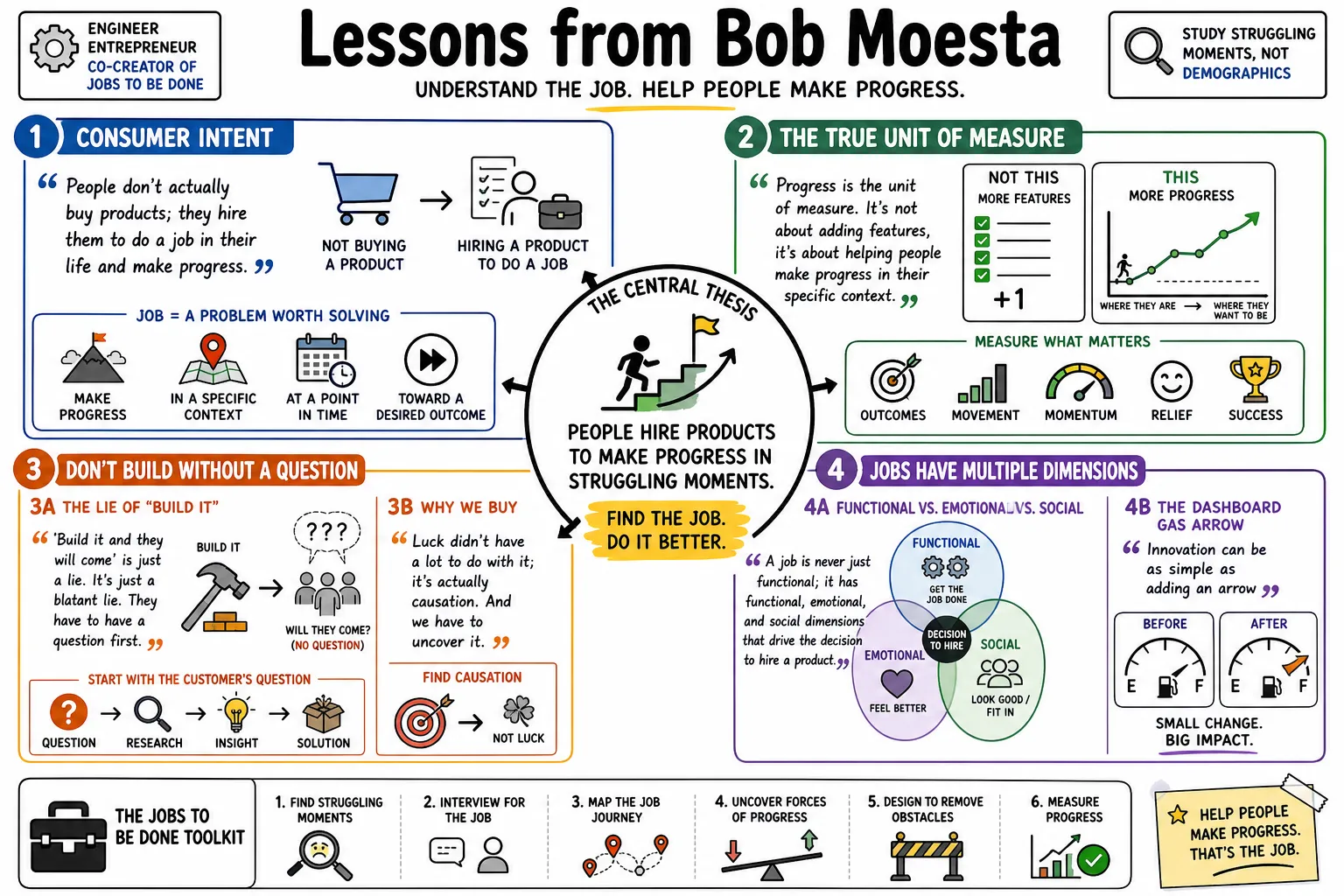
Part 1: The Jobs to be Done Framework
- On Consumer Intent: Moesta frames products as things people hire to make progress in a particular situation; the job, rather than the product category alone, is the useful unit of analysis. — Business of Software: Understanding Customer Jobs-to-be-Done.
- On Measuring Progress: For Moesta, a customer's desired progress is defined by the context they are in and the outcome they seek; starting from a product feature can obscure both. — Business of Software: Understanding Customer Jobs-to-be-Done.
- On Build-It-and-They-Will-Come: Moesta rejects the assumption that a product will attract buyers merely because it is built; he looks for the question or struggle that makes someone ready to seek a solution. — Business of Software: Understanding Customer Jobs-to-be-Done.
- On Causal Purchase Stories: Moesta treats a purchase as a sequence of circumstances and decisions to investigate, not as a random event. He says the goal is to uncover what caused the switch. — Business of Software: Understanding Customer Jobs-to-be-Done.
- On Functional, Emotional, and Social Needs: Moesta says a purchase can involve functional, emotional, and social motivations at once; a mattress, for example, is not chosen only for its physical specifications. — Business of Software: Understanding Customer Jobs-to-be-Done.
- On the Dashboard Gas Arrow: Moesta recounts noticing how rental-car drivers struggled to remember which side held the fuel door and helping develop the dashboard arrow that answers that question. — Bob Moesta Brand Lab Interview.
- On the Basecamp Calendar: Basecamp users asked for a calendar, but Moesta's interviews found that they chiefly needed to see available time slots. The team built a simpler availability view rather than a full editing calendar. — SaaS Club: Bob Moesta Interview.
- On Feature Anxiety: Moesta warns that adding features can increase buyer anxiety, so more functionality is not automatically more persuasive. — Bob Moesta Brand Lab Interview.
- On Subtraction as Innovation: Moesta says removing unnecessary features can reduce buyer anxiety and make a product easier to adopt. — Business of Software: Uncovering Jobs to Be Done.
- On Eliminating Choices: Moesta observes that buyers often reach a choice by eliminating options one by one, rather than selecting from a fixed list in a single step. — SaaS Club: Bob Moesta Interview.
Part 2: The Struggling Moment
- On the Seed of Innovation: Moesta starts innovation work by identifying a customer's struggling moment—the point at which an existing arrangement stops working and the customer becomes open to change. — Business of Software: Uncovering Jobs to Be Done.
- On Customer Visibility: Moesta argues that people absorbed in a satisfactory routine may not even notice a new product; a struggle makes them receptive to an alternative. — Business of Software: Understanding Customer Jobs-to-be-Done.
- On Creating Demand: In Moesta's demand-side framing, a struggling circumstance and a desired improvement create demand; offering more features by itself does not create the underlying need. — The Re-Wired Group: What Is Demand-Side Sales?.
- On Questions Before Solutions: Moesta uses Clayton Christensen's question-before-answer idea to argue that a buyer first needs a reason to search before a proposed solution will register. — Business of Software: Understanding Customer Jobs-to-be-Done.
- On the New-Condo Problem: In Moesta's downsizing case, years of belongings and the effort of moving held buyers back; including moving and temporary storage addressed that barrier better than adding condo features. — Business of Software: Understanding Customer Jobs-to-be-Done.
- On the Morning Milkshake: Moesta's team noticed anomalous morning milkshake sales, interviewed those buyers, and learned that the drink served a distinct commute-and-breakfast job rather than simply acting as dessert. — The Re-Wired Group: Rest of the Milkshake Story.
- On Snickers and Milky Way: Moesta uses Snickers and Milky Way to show that products in the same shelf category may compete against different alternatives in a buyer's actual situation. — Business of Software: Uncovering Jobs to Be Done.
- On Making Progress, Not Just Removing Pain: Moesta distinguishes eliminating a complaint from helping a buyer reach a desired next state: a snowplow can remove the burden of shoveling, while a move may address the wider life change sought. — The Re-Wired Group: What Is Demand-Side Sales?.
Part 3: Demand-Side Sales
- On Selling as Helping: Moesta frames a good salesperson as someone who asks, listens, and helps a customer make progress, not someone who merely pressures a buyer to accept a product. — The Re-Wired Group: What Is Demand-Side Sales?.
- On the Concierge Mindset: Moesta suggests thinking of a salesperson as a concierge, mentor, or coach who helps a buyer understand how a product fits their circumstances. — The Re-Wired Group: What Is Demand-Side Sales?.
- On Buyer Conviction: In demand-side sales, the buyer decides whether a solution fits their own progress and trade-offs; the seller's role is to help clarify that decision rather than force it. — The Re-Wired Group: What Is Demand-Side Sales?.
- On the Hole, Not the Drill: Moesta uses Theodore Levitt's drill-and-hole example to urge sellers to identify the outcome a buyer wants before presenting product features. — The Re-Wired Group: What Is Demand-Side Sales?.
- On Causal Sales Insight: Moesta likens understanding why people buy to gaining night vision: it reveals the causal paths beneath surface-level correlations and feature lists. — The Re-Wired Group: What Is Demand-Side Sales?.
- On Asking Why Now: Moesta's interviews reconstruct a real recent purchase: what changed, why the person began looking, and what made that moment different from earlier ones. — Business of Software: Uncovering Jobs to Be Done.
- On Understanding Trade-offs: Moesta asks sellers and builders to learn what buyers are willing to give up, because a real purchase involves trade-offs rather than an ideal solution. — Business of Software: Uncovering Jobs to Be Done.
- On Demand-Side Thinking: Moesta distinguishes supply-side product/feature thinking from demand-side inquiry into a buyer's context, desired outcome, and struggle. — The Re-Wired Group: What Is Demand-Side Sales?.
Part 4: The Four Forces of Progress
- On The First Moment of Truth: Moesta describes the first moment of truth as the point at which push and pull overcome anxiety and habit; purchase is distinct from the later test of satisfaction. — Jobs-to-be-Done: Brand Lab Interview.
- On The Force of Push: A push begins in the customer's existing situation—such as a slow system, lost sales, or a new constraint—and creates energy to change. — SaaS Club: Bob Moesta Interview.
- On The Force of Pull: Once a customer sees a possible better outcome, that imagined progress creates pull toward a new solution. — SaaS Club: Bob Moesta Interview.
- On The Force of Anxiety: The prospective solution also creates anxiety about cost, data, implementation, and persuading others; addressing that friction can matter as much as adding features. — SaaS Club: Bob Moesta Interview.
- On The Force of Habit: The habit of the present resists switching because adopting a new solution requires stopping established behaviors and processes. — SaaS Club: Bob Moesta Interview.
- On Overcoming Inertia: Moesta uses the four forces as a qualitative way to understand a switch: strengthen the push and pull toward progress while reducing anxiety and habit that impede it. — SaaS Club: Bob Moesta Interview.
- On The Myth of Impulse Buying: Moesta argues that an apparently impulsive purchase can have a long causal history: in one mattress interview, the buyer had struggled with sleep for two years before the purchase. — Jobs-to-be-Done: Brand Lab Interview.
- On The Timeline of a Switch: Moesta traces buying through first thought, passive looking, active looking, and deciding, with later use shaping satisfaction; people can move backward when circumstances change. — SaaS Club: Bob Moesta Interview.
- On The Illusion of Rationality: A purchase that looks irrational from outside can make sense once the buyer's situation, struggle, hoped-for progress, and trade-offs are understood. — SaaS Club: Bob Moesta Interview.
Part 5: The Art of the Interview
- On The Limits of Market Research: Moesta cautions that asking customers what they want can yield unreliable future predictions and polite or superficial answers; he probes past behavior and context instead. — Business of Software: Understanding Your Customer.
- On Intelligence Interrogation: Moesta says he studied criminal and intelligence interrogation techniques to learn how to uncover why someone made a particular purchase. — Jobs-to-be-Done: Brand Lab Interview.
- On Reconstructing a Purchase: Moesta asks recent buyers what happened before the purchase—what they used, what changed, why then, and what they hoped would improve—so the interview follows an actual decision. — SaaS Club: Bob Moesta Interview.
- On The Columbo Technique: Moesta invokes Columbo's 'one more question' approach: after letting interviewees give their prepared account, he asks how they came to get the product and explores the fuller story. — Business of Software: Live Jobs-to-be-Done Case Studies.
- On Uncovering Conflict: Moesta probes vague or inconsistent answers by playing a buyer's story back and inviting correction; the correction reveals more precise causal details. — SaaS Club: Bob Moesta Interview.
- On Tracing the Dominos: Moesta likens a purchase to falling dominoes: the interview seeks the events and accumulated energy that made this particular day the day to buy. — SaaS Club: Bob Moesta Interview.
- On Listening Without Imposing a Solution: Moesta says the interviewer should understand the customer's preferences deeply enough to represent them at the design table, rather than substituting the interviewer's own assumptions. — SaaS Club: Bob Moesta Interview.
- On Avoiding Wishful Thinking: Instead of asking prospective users to predict future wants, Moesta starts with recent buyers or people using a competing solution and investigates the progress behind their real switch. — SaaS Club: Bob Moesta Interview.
- On Learning From Churn: Moesta recommends interviewing both recent buyers and customers who churned; the two groups expose different parts of the switching story. — SaaS Club: Bob Moesta Interview.
Part 6: Prototyping and Learning to Build
- On Prototyping to Learn: Moesta distinguishes prototypes meant to learn from tests designed only to verify a preferred answer; even a failed prototype can expose an important unknown. — Business of Software: Five Skills of an Innovator.
- On Contrast and Meaning: He builds markedly different alternatives so a team can see what it does and does not want; contrast helps clarify selection criteria. — Business of Software: Five Skills of an Innovator.
- On The Value of Context: Moesta argues that context shapes a product's value and that contrast gives its attributes meaning: the right pizza depends on the situation, not an average preference. — Jobs-to-be-Done: Brand Lab Interview.
- On Stress-Testing the System: In Moesta's account, prototypes deliberately test where a system can fail and how its factors interact, so problems surface before launch. — Business of Software: Five Skills of an Innovator.
- On Learning From Failure: A failed prototype is useful when it tests a real uncertainty and teaches the team something about a system's limits; failure by itself is not the goal. — Business of Software: Five Skills of an Innovator.
- On Understanding Limits: Moesta's prototyping method measures critical functions under varied conditions to reveal which controlled factors matter and where the system breaks down. — The Re-Wired Group: Prototyping to Learn.
- On The Red Line vs. Green Line: Moesta contrasts 'red line' one-factor fixes aimed at verification with 'green line' experiments that vary several factors to learn how the whole system works. — The Re-Wired Group: Prototyping to Learn.
- On The Necessity of Trade-offs: Prototyping reveals trade-offs among performance, cost, and other requirements; Moesta uses that evidence to choose a workable design rather than chase an impossible ideal. — The Re-Wired Group: Prototyping to Learn.
Part 7: Choosing College and Education
- On Hiring a College: Horn and Moesta apply Jobs to Be Done to education: before choosing a school, ask what progress you are hiring the experience to help you make. — Christensen Institute: Choosing College.
- On The 'Expected' Job: One of the five jobs is doing what others expect. Horn and Moesta warn that entering an expensive four-year program mainly to satisfy outside expectations can be a poor fit. — Horn and Moesta: When the Next Step Isn't College.
- On The 'Get Away' Job: Some students choose college chiefly to leave an unpleasant circumstance; the authors caution that escaping one situation is not the same as knowing what comes next. — Getting Smart: Michael Horn on Choosing College.
- On The 'Step It Up' Job: The 'step it up' job describes learners who seek education to gain skills or credentials and make a concrete improvement in their work or life. — Getting Smart: Michael Horn on Choosing College.
- On The 'Best School' Job: The 'best school' job centers on reaching a personally defined ideal of college, which may include a traditional campus experience, status, or a new social setting. — Getting Smart: Michael Horn on Choosing College.
- On The 'Extend Myself' Job: The 'extend myself' job is a decision to invest in learning and challenge for its own sake when a person can make room for it in life. — Getting Smart: Michael Horn on Choosing College.
- On Rethinking Rankings: Horn and Moesta argue that rankings and conventional metrics cannot answer why an individual is seeking education; that purpose should guide the choice of program. — Christensen Institute: Choosing College.
- On Lifelong Learning: The authors frame choosing education as a series of learning decisions throughout life, not just the selection of a first college after high school. — Getting Smart: Michael Horn on Choosing College.
Part 8: Personal Growth and Systemic Thinking
- On Causation vs. Correlation: Following W. Edwards Deming's influence, Moesta looks for the causal sequence behind a customer's decision rather than treating demographic correlations as an explanation. — Business of Software: Understanding Your Customer.
- On Finding the Best: Moesta describes seeking out people who are exceptionally good at what he wants to learn and speaking with them directly—a strategy shaped in part by his dyslexia. — Jobs-to-be-Done: Brand Lab Interview.
- On Overcoming Limitations: Moesta says dyslexia and early brain injuries made conventional reading and writing difficult; he learned through mentors, observation, conversation, and collaborators who helped turn his ideas into books. — Business of Software: Five Skills of an Innovator.
- On Innovation as a Skill: Moesta identifies five learnable innovation skills—empathetic perspective, uncovering demand, causal structures, prototyping to learn, and managing trade-offs—and urges deliberate practice. — Business of Software: Five Skills of an Innovator.
- On The Difficulty of Trade-offs: Moesta treats trade-offs as an essential innovation skill: teams need ways to choose among competing requirements rather than assuming one design can maximize everything. — Business of Software: Five Skills of an Innovator.
- On Empathetic Perspective: For Moesta, empathetic perspective means viewing a problem through a customer's and other stakeholders' circumstances, including how those perspectives change across time. — Business of Software: Five Skills of an Innovator.
- On Systemic Focus: Moesta's prototyping method examines interacting functions and variables so teams learn how the system works, rather than repeatedly fixing isolated symptoms. — The Re-Wired Group: Prototyping to Learn.