Becc Holland is the founder and CEO of Flip the Script, a sales training and media company. Her teaching connects researched outreach with buyer-specific relevance and emphasizes diagnosing problems rather than relying on feature pitches or persuasion. This profile covers her approach to prospect research, emails, cold calls and buyer conversations. — The Sidekick Life — Becc Holland.
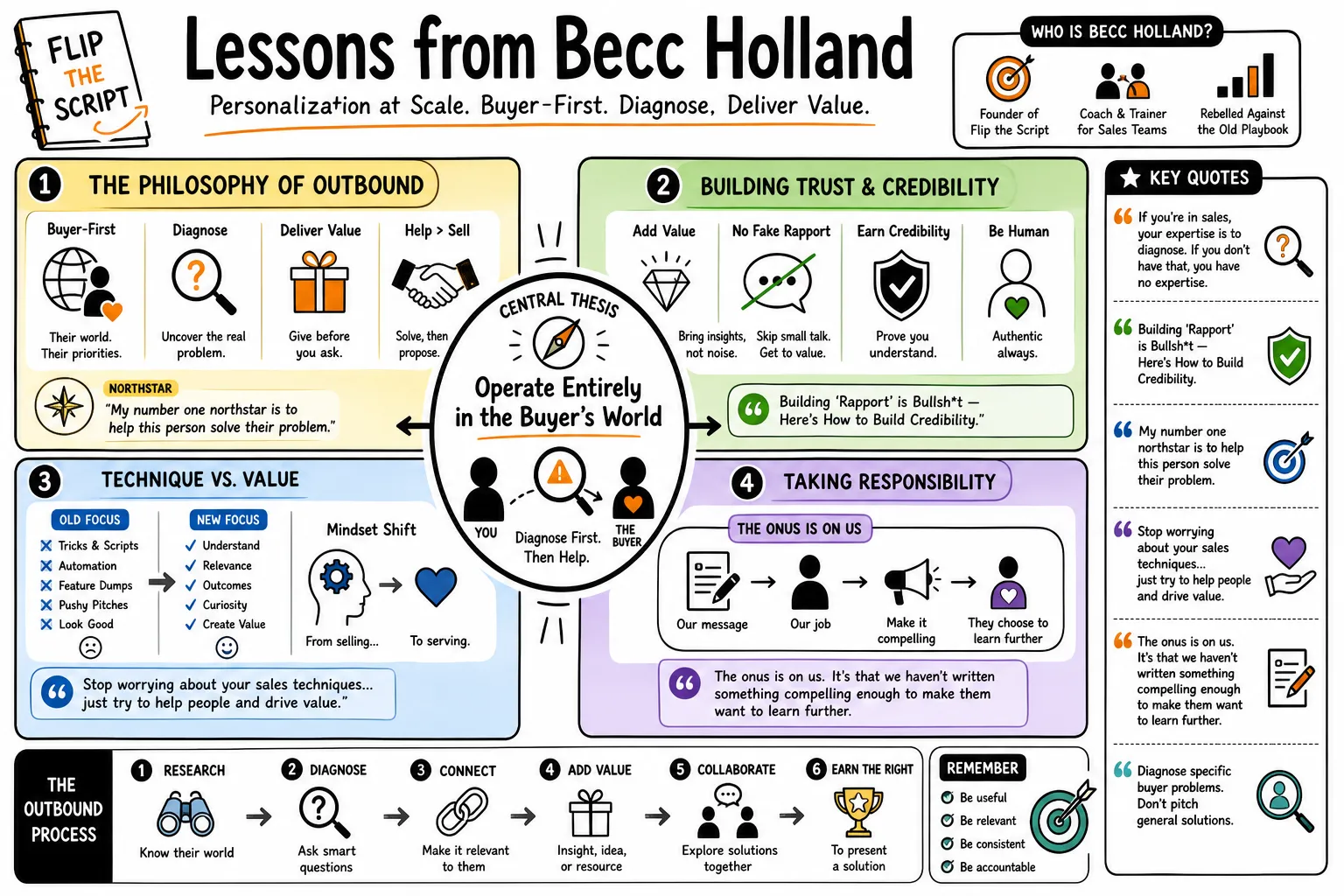
Part 1: The Philosophy of Outbound
- On the True Role of Sales: A seller’s expertise should help identify mistaken assumptions or overlooked problems within the area they sell, rather than merely repeat the buyer’s own diagnosis. — The Transaction — Diagnosing Sales.
- On Building Trust: Build credibility by helping the buyer understand something consequential about their situation that they did not already know, rather than relying on personal small talk. — The Transaction — Diagnosing Sales.
- On Seller Intent: Make the buyer’s problem—not persuading them to buy—the organizing goal of the conversation. — The Transaction — Diagnosing Sales.
- On Technique vs. Value: Judge a sales conversation by the useful diagnosis it provides, not simply by how well it deploys persuasion or objection-handling techniques. — The Transaction — Diagnosing Sales.
- On Taking Responsibility: Take responsibility for whether the outreach gives the prospect a compelling reason to respond. Do not assume silence means the prospect is a bad person. — Flip the Script — Emails.
- On Problem Scale: A buyer’s assessment of a problem affects whether they see a reason to change. Do not treat that assessment as the whole picture: they may have missed a cause or future consequence that careful diagnosis can uncover. — The Transaction — Diagnosing Sales.
- On Pain vs. Problem: Distinguish a negative experience the buyer feels now from a problem that needs solving: some problems can have future consequences before they produce present pain. — The Transaction — Diagnosing Sales.
- On Defining Problems: Learn the buyer’s performance metrics before diagnosing a problem. Identify the outcomes they are judged on and the inputs or intermediate indicators that influence those outcomes. — The Transaction — Diagnosing Sales.
- On Widening the Gap: Help the buyer discover relevant consequences or underlying problems they have overlooked, rather than exaggerating the pain they already describe. — The Transaction — Diagnosing Sales.
Part 2: Personalization vs. Relevance
- On Defining Personalization: Personalization uses information specific to one person; a genuinely individual premise cannot simply be sent unchanged to an entire cohort. — lemlist — Outbound Sales Sequences.
- On Defining Relevance: Relevance connects a message to a group’s role, circumstances or company context. It can be useful without being unique to one individual. — lemlist — Outbound Sales Sequences.
- On Earning Time: Use specific research to give the prospect a reason to pay attention, rather than trying to stand out through a gimmick. Holland argues that knowing the individual can make outreach more welcome. — lemlist — Outbound Sales Sequences.
- On Research Efficiency: Research useful premises at the start, then reuse that research across the sequence. In the sequence Holland describes, she selects three premises rather than one for every touch. — Becc Holland — Prospecting Sequence.
- On Prospect Fandom: Research the prospect’s work and interests before contacting them, so the conversation reflects genuine familiarity rather than empty flattery. — Flip the Script — Emails.
- On Moving the Buyer: Holland compares an outbound buyer to an object at rest: on the information they currently have, they may see no reason to change. Useful diagnosis can reveal a reason they had missed. — The Transaction — Diagnosing Sales.
- On Creating Urgency: Create a reason to reconsider the status quo by uncovering a relevant problem or future impact the buyer did not know about. Repeating a known pain may add little value. — The Transaction — Diagnosing Sales.
- On Genuine Interest: Pair a clear, specific request with a genuine release of pressure: explain the next step while making clear that the prospect can decline further engagement. — lemlist — Outbound Sales Sequences.
Part 3: Research Premises and Relevance
- On the First Bucket: Start with material the prospect created, such as a post, article or webinar. Holland places self-authored content first in her premise hierarchy. — Becc Holland — Personalization at Scale.
- On the Second Bucket: Look for material the prospect has liked, shared or commented on when they have not published useful content themselves. — Becc Holland — Personalization at Scale.
- On the Third Bucket: Use the prospect’s own profile, headline or self-description as another potential research premise. — Becc Holland — Personalization at Scale.
- On the Fourth Bucket: If stronger content-based premises are unavailable, consider personal interests, hobbies or schools attended as a fallback. — Becc Holland — Personalization at Scale.
- On the Fifth Bucket: Company posts, hiring activity or website language can supply a company-level premise. Distinguish that relevance from information unique to the individual. — Becc Holland — Personalization at Scale.
- On Persona-Based Relevance: When an individual premise is unavailable, keep the message relevant to the buyer’s role and context. Holland distinguishes relevance-only messaging from a playbook that also includes a personalized premise. — Flip the Script — Personalization and Relevance.
- On Research Hierarchy: Search the premise buckets in order, beginning with the prospect’s own content before moving to weaker individual signals and company-level information. — Flip the Script — Emails.
- On Consistency: Keep calls and emails connected: reuse the research already gathered and refer to the relevant premise from the recent email rather than starting unrelated conversations. — Becc Holland — Prospecting Sequence.
- On Authenticity: Do not invent a research connection. Use the information the prospect actually provides and adapt when little individual material is available. — lemlist — Outbound Sales Sequences.
Part 4: Email Structure and Sequences
- On Email Length: Keep the message short without losing useful information. In a 2026 post, Holland recommends four or five lines and says each email should contain a piece of distinctive value. — Becc Holland — Five Cold Email Tips.
- On the Premise Line: Open with the researched reason for contacting this prospect or company, rather than with a generic introduction to yourself. — Becc Holland — Personalization at Scale.
- On the Body Line: Connect the body’s value proposition to the researched premise, so the benefit follows from the reason you contacted this buyer. — Becc Holland — Personalization at Scale.
- On the Call to Action: Give the buyer one concrete next step or proposed meeting time, tied to the issue raised in the message. — Becc Holland — Personalization at Scale.
- On Visual Flow: Do not treat an F-shaped layout as an enduring rule. Holland taught it in 2019, then criticized it in a 2023 post and emphasized relevant, meaningful information instead. — Becc Holland — Rethinking F-Shaped Emails.
- On the 21-Day Sequence: Holland describes a 16-step sequence over 21 business days, combining five emails, ten calls and an initial LinkedIn research step. Treat it as her example to test, not a universal optimum. — Becc Holland — Prospecting Sequence.
- On Day One Execution: In Holland’s example, the first day combines research, a personalized email and a call. The cadence begins lighter and becomes more persistent later rather than loading every touch into the start. — Becc Holland — Prospecting Sequence.
- On Thematic Waves: Vary the value proposition across follow-ups rather than cramming every benefit into one message. Keep each email focused on one connected premise, body and next step. — Flip the Script — Emails.
- On Accountable Follow-Up: Acknowledge when your earlier message may not have earned attention and ask respectfully for another chance, rather than blaming the prospect for not replying. — Flip the Script — Emails.
Part 5: The 7 Pillars of Attractive Messaging
- On Being Prospect-Centric: Center the message on the prospect’s situation rather than making your company the main subject. — Becc Holland — Personalization at Scale.
- On Being Pain-Centric: Describe the buyer problem your offering can alleviate rather than presenting a list of pleasant but disconnected benefits. — Becc Holland — Personalization at Scale.
- On Pride Aversion: Make the prospect the central figure in the message. Avoid language that mainly celebrates your own company. — Becc Holland — Personalization at Scale.
- On Fluidity: Make the researched premise, value proposition and requested next step connect logically. — Becc Holland — Personalization at Scale.
- On Relevance Targeting: Adapt the value proposition to what this buyer persona is responsible for, rather than sending the same pitch to every role. — Becc Holland — Personalization at Scale.
- On Extreme Brevity: Cut unnecessary words while preserving the message’s useful meaning. — Becc Holland — Personalization at Scale.
- On Noticeability: Use a subject line that attracts attention without misleading the reader about the email’s content. — Becc Holland — Personalization at Scale.
- On Message Integrity: Use the seven messaging pillars as rules of engagement that let different reps write creatively while keeping outreach consistent. — Flip the Script — Emails.
Part 6: The 7 Deadly Sins of Outreach
- On False Familiarity: Avoid trying to manufacture familiarity through silly GIFs or overly casual language with someone you do not know. — Becc Holland — Personalization at Scale.
- On Wasted Text: Remove stock follow-up language that takes space without adding value, such as announcing that you are just checking in. — Becc Holland — Personalization at Scale.
- On Commanding: Make a respectful request rather than instructing the prospect to report back to you. — Becc Holland — Personalization at Scale.
- On Questioning Authority: Do not imply that a prospect is unimportant merely because they have not answered or may not be the final decision-maker. — Becc Holland — Personalization at Scale.
- On Glorifying Yourself: Avoid making rankings, awards or your company’s achievements the main argument for why the prospect should engage. — Becc Holland — Personalization at Scale.
- On Taking Responsibility: When checking understanding, put the burden on your own explanation rather than the prospect’s ability to follow it. — Flip the Script — Emails.
- On the Cost of Sins: Poorly researched, generic outreach can irritate prospects instead of engaging them. Holland urges reps to improve the research and relevance rather than rely on volume to overcome a weak message. — lemlist — Outbound Sales Sequences.
Part 7: Cold Calling and Pattern Interrupts
- On the Up-Front Contract: Before continuing a call, agree on a brief amount of time, explain what you intend to cover and let the prospect decide whether to continue. Holland’s slides show a thirty-second up-front contract with an explicit consent check. — Becc Holland — Personalization at Scale.
- On Identifying Yourself: Make clear who is calling and give a researched reason for the outreach. Holland’s cold-call example names the caller and company before explaining what prompted the call. — GTMnow — Becc Holland’s Cold Call Structure.
- On the 'Why You' Stage: Use researched context to explain why this particular prospect prompted your call. — Becc Holland — Personalization at Scale.
- On the 'Why Now' Stage: Explain a relevant reason for raising the issue now by showing what the buyer may have overlooked and why it matters to their goals, rather than inventing a deadline. — Chili Piper — Leading with Unknown Problems.
- On the Value Proposition: Connect the call’s value proposition to the goals or problems of the buyer’s role. — Becc Holland — Personalization at Scale.
- On Proving Expertise: Ask a diagnostic question that demonstrates familiarity with the buyer’s work, then explore the relevant problem rather than reciting features. — Becc Holland — Personalization at Scale.
- On the Clean Exit: A meeting request should leave room for the prospect to decline. Holland’s example explicitly reassures the buyer that she will not overwhelm them with follow-ups if they are not impressed. — lemlist — Outbound Sales Sequences.
- On Pitch-Slapping: Use the cold call to establish relevant context and explore whether a further conversation would be useful, rather than launching straight into a feature presentation. — Becc Holland — Personalization at Scale.
- On Conversational Tone: Use the call structure as a guide, not a reason to ignore the person in front of you. Holland describes combining a plan with personalization, creativity and responsiveness in the conversation. — Flip the Script — Seven Steps to a Great Cold Call.
Part 8: The Psychology of the Buyer
- On Buyer Fear: A buyer may recognize a problem yet still hesitate because they are uncertain about the consequences of choosing a solution. Do not assume that acknowledging pain means they are ready to act. — The Transaction — Diagnosing Sales.
- On Decreasing Fear: Reduce uncertainty by demonstrating that you understand the buyer’s situation and can diagnose it accurately; a buyer who must rely entirely on their own judgment may hesitate to proceed. — The Transaction — Diagnosing Sales.
- On Proactive Humility: Take responsibility for the interruption and for how clearly you communicate, rather than blaming the prospect. — Becc Holland — Personalization at Scale.
- On the Velvet Glove: Balance a clear meeting request with a gracious, low-pressure tone. The iron-fist-and-velvet-glove analogy is about that balance, not ignoring a prospect’s refusal. — lemlist — Outbound Sales Sequences.
- On Calling Out the Brush-Off: If a request to send an email seems like a brush-off, politely check whether the prospect wants more information or would rather end the conversation. — lemlist — Outbound Sales Sequences.
- On the Talk Ratio: On an introductory call, Holland recommends that the seller speak only about ten to fifteen percent of the time, leaving room for the buyer to explain their situation and answer diagnostic questions. — The Sidekick Life — Becc Holland.
- On Selling Without Manipulation: Focus on accurately diagnosing the buyer’s situation and improving it, rather than steering them toward a predetermined feeling or purchase. — The Transaction — Diagnosing Sales.