Ben Ford is a former Royal Marine and the founder of Mission Ctrl. His work connects technology leadership with ideas about situational awareness, OODA, and Mission Command, adapting military operating principles to the context of a business. — Ship It! — Optimising Sociotechnical Systems.
On Change and Chaos
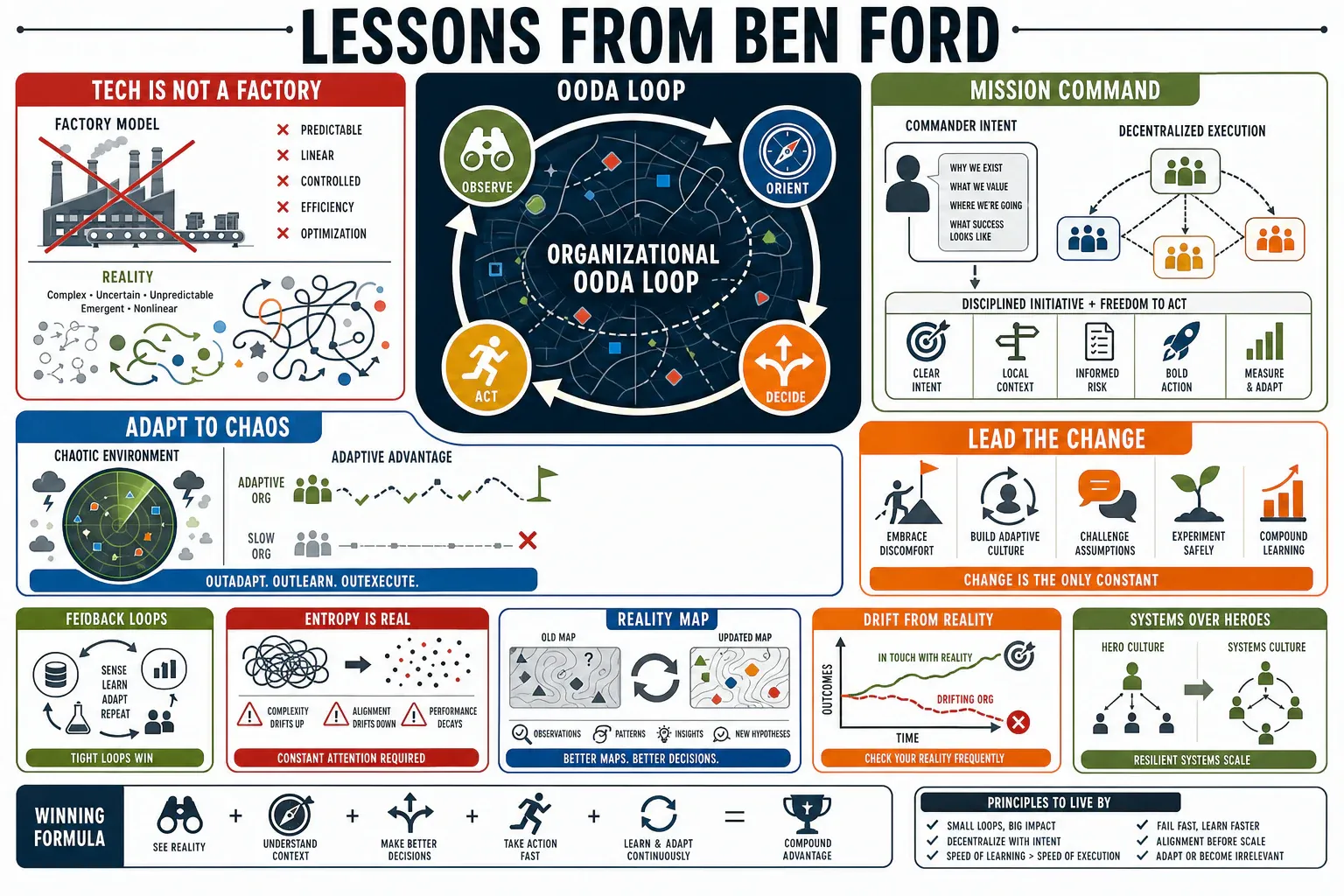
- Learning: Ford challenges the idea that change can simply be controlled. He argues that an organization at least needs to adapt to what is happening around it. — Strategy Meets Reality — Leading Change.
- Learning: Ford urges ambitious organizations to help shape change rather than only react to it, so that the surrounding ecosystem has to respond to their actions. — Strategy Meets Reality — Leading Change.
- Learning: Ford compares fast-moving technology environments to combat zones rather than factory floors. He argues that methods developed for optimizing factories can be a poor fit for that uncertainty. — James Stuber — Navigating Chaos with Ben Ford.
- Learning: Ford looks to military operating principles for ways to work amid uncertainty. He extracts principles for technology teams rather than treating business as literal warfare. — James Stuber — Navigating Chaos with Ben Ford.
On the OODA Loop (Observe, Orient, Decide, Act)
- Learning: Ford treats OODA as a model of adaptation: sensing the environment, updating mental models, deciding, acting, and observing the resulting changes. His interpretation goes beyond a simple four-step circle. — OODAcast — Ben Ford on Tech Leadership.
- Learning: Ford describes organizational agility as a connected cycle of observing, interpreting, deciding, and acting. Teams need to observe the effects of their actions rather than repeatedly debating decisions without closing the loop. — Jimmy Burroughes — Mission Control Strategies.
- Learning: Ford interprets getting inside another OODA loop as disrupting orientation, not merely moving faster. He also warns that a growing company can produce this confusion itself by taking on too much and failing to complete work. — James Stuber — Navigating Chaos with Ben Ford.
- Learning: Ford describes familiar work as an intuitive path through OODA. Surprises require deeper reconsideration of mental models; repeated surprises can leave a business struggling to keep its understanding aligned with reality. — OODAcast — Ben Ford on Tech Leadership.
- Learning: Ford uses OODA as an overarching way to examine how business processes fit together. It helps him look at the whole system rather than treat each operating method as an isolated tool. — James Stuber — Navigating Chaos with Ben Ford.
On Organizational Structure and Leadership
- Learning: Ford uses a biological analogy to examine the feedback between people, decisions, and the environment. He cautions against treating an organization as a machine whose human parts can simply be adjusted by a leader. — Jimmy Burroughes — Mission Control Strategies.
- Learning: Ford argues that technology alone does not resolve organizational complexity. Communication practices and shared ways of interpreting events are the social infrastructure needed to make useful decisions. — Jimmy Burroughes — Mission Control Strategies.
- Learning: A fast technical feedback loop does not resolve unclear business decisions. Ford warns that a good CI/CD pipeline can still be undermined when the business lacks a way to handle the complexity around it. — Ship It! — OODA for Operational Excellence.
- Learning: Ford sees Mission Command as a way to develop fluent operations through trust, alignment, and freedom to act within understood boundaries. Familiarity reduces the need to ask for instructions at every step. — James Stuber — Navigating Chaos with Ben Ford.
- Learning: Ford describes a leadership tension between top-down direction and resources, and bottom-up experimentation. Effective organizational arrangements must connect those needs without demanding certainty from every new idea. — OODAcast — Ben Ford on Tech Leadership.
- Learning: Mission Ctrl advocates small, low-risk improvements that can be tested and iterated instead of relying on a single large business-process transformation. — Mission Ctrl — Why Us.
- Learning: Ford argues that people need spare capacity to improve how a business operates. Automating repetitive reporting can return time for judgment, decisions, and action instead of leaving people permanently reactive. — Ship It! — Optimising Sociotechnical Systems.
- Learning: Ford argues that leadership depends partly on the surrounding system, not only on individual skill. An experienced leader brought into a startup may struggle when the communication and operating structures do not support the role. — OODAcast — Ben Ford on Tech Leadership.
- Learning: Ford argues that complex environments call for attention to relationships and second-order effects. Teams need conditions that support useful emergent behavior, not just simple fixes applied to isolated individuals. — James Stuber — Navigating Chaos with Ben Ford.
On Data and Decision Making
- Learning: Ford calls the connections among observations, interpretation, and action an internal nervous system. He proposes combining information from separate operational tools so people can make sense of the business and decide what to do next. — Jimmy Burroughes — Mission Control Strategies.
- Learning: Mission Ctrl identifies data integration and integrity as major obstacles in its work with complex software and growing businesses. Connecting information reliably is part of the operational capability it offers. — Mission Ctrl — Why Us.
- Learning: Ford advises matching information to the decisions made at each organizational level. Frontline detail should be filtered and aggregated into relevant signals, rather than sending every observation unchanged to senior leaders. — Jimmy Burroughes — Mission Control Strategies.
- Learning: Ford recommends building dashboards on well-formed, well-modeled data rather than repeatedly assembling reports from scattered spreadsheets. This can give teams a current view instead of waiting for a weekly reporting cycle. — Jimmy Burroughes — Mission Control Strategies.
- Learning: Ford warns that expectations shape what people notice. Leaders should question their interpretation of incoming information rather than assume that the picture they see is an unfiltered account of reality. — Jimmy Burroughes — Mission Control Strategies.
On Strategy and Execution
- Learning: Ford recommends Red Team Thinking as a set of communication practices for strategic leadership. Its value, in his account, is improving situational awareness rather than treating one person’s plan as beyond challenge. — Ship It! — OODA for Operational Excellence.
- Learning: Ford applies an evolutionary lens to competition: technologies and market openings can make established organizations vulnerable to new entrants. He uses military comparisons to explore those pressures, not to claim that business is literally war. — OODAcast — Ben Ford on Tech Leadership.
- Learning: Ford began learning Python and Linux from books aboard a ship while serving in the Royal Marines. He used the time available to start learning, rather than waiting until he had a conventional route into a technology career. — Ship It! — OODA for Operational Excellence.
- Learning: Ford suggests that the shortcuts useful for proving an early product may need to be revisited as a company grows. Building additional functions and connecting them is a different task from getting an initial product working. — James Stuber — Navigating Chaos with Ben Ford.
- Learning: Mission Ctrl emphasizes quick improvements that demonstrate value. In a fast-moving company, showing useful results early can help secure support for further operational work. — Mission Ctrl — Why Us.
- Learning: Ford suggests that separate functions can initially help a growing company establish essential capabilities. As it grows further, cross-functional connections become more important than optimizing each silo in isolation. He presents this as a developing model, not a fixed growth law. — James Stuber — Navigating Chaos with Ben Ford.
- Learning: The interview’s after-action review framework compares what was expected with what actually happened, then asks what worked and what could improve. An open, non-blaming discussion helps include different perspectives rather than defend the original decision. — Economics for Business — Situational Awareness.
- Learning: Ford emphasizes practicing in the situation where a skill will be used. Reading or watching an expert is not enough: trying things, receiving feedback, and building an understanding are part of learning. — Ship It! — OODA for Operational Excellence.
- Learning: Ford emphasizes making it safe for junior colleagues to question assumptions. A newcomer may spot something experienced teammates overlook; dismissing that contribution can silence information the team needs. — James Stuber — Navigating Chaos with Ben Ford.
- Learning: Ford recommends buying established commodity tools where appropriate, while keeping the integrations a business builds flexible and under its control. He favors options that reduce dependence on a vendor’s future pricing or product direction. — Jimmy Burroughes — Mission Control Strategies.
- Learning: Ford argues that team performance depends on interactions and the operating system around people, not simply on recruiting exceptional individuals. Individual skill still matters, but it is not a substitute for a well-connected team. — James Stuber — Navigating Chaos with Ben Ford.
- Learning: Ford argues that new technology becomes a building block for further development, increasing the pace of change. He sees technological help with processing information as necessary when ordinary reporting routines cannot keep pace. — Jimmy Burroughes — Mission Control Strategies.
- Learning: Ford expects growing companies to revisit hiring, onboarding, marketing, and other operating practices. These connected functions may require expertise beyond the technical leader’s own domain. — James Stuber — Navigating Chaos with Ben Ford.
- Learning: Ford describes repeated practice as a way to make familiar actions fluent. That familiarity can reduce the need for conscious deliberation, while genuinely surprising situations still require reconsideration. — OODAcast — Ben Ford on Tech Leadership.
- Learning: Ford advises giving teams the context of a decision and the boundaries within which they can act. That makes trade-offs possible without prescribing every detail of the solution. — James Stuber — Navigating Chaos with Ben Ford.
- Learning: Ford suggests planning for how today’s useful functional silos will later reconnect. Shared context about that transition can help teams understand temporary friction and avoid letting a temporary structure become permanent by default. — James Stuber — Navigating Chaos with Ben Ford.
- Learning: Ford advises developers to identify the part of a problem they can influence. That may mean choosing a high-priority technical constraint to address and making the case for the support needed to improve it. — James Stuber — Navigating Chaos with Ben Ford.
- Learning: Ford treats leadership as partly a system of working practices. Orders, after-action review, and other communication processes can support the leader’s role when adapted to a team’s actual context. — OODAcast — Ben Ford on Tech Leadership.
- Learning: Ford distinguishes designing a customer-facing product from removing internal operational friction. Those tasks can call for different priorities, heuristics, and decision processes. — Jimmy Burroughes — Mission Control Strategies.
- Learning: Ford observes that operational leaders may lack current technical expertise or access to the people who could build better internal tools. He recommends drawing on up-to-date technical judgment rather than relying only on the leader’s own experience. — Jimmy Burroughes — Mission Control Strategies.
- Learning: Ford sees a capacity problem when programmers are reserved for customer-facing product work and cannot improve internal operations. He argues that the business needs to consider the connection between its product and the systems that support it. — Jimmy Burroughes — Mission Control Strategies.
- Learning: Ford rejects arriving with a universal consulting fix. He offers mental models and outside perspective, while emphasizing that the organization must discover how those ideas fit its own context. — Ship It! — OODA for Operational Excellence.
- Learning: Ford recommends studying the underlying ideas of OODA rather than relying only on packaged management methods. He sees that deeper understanding as a way to examine how a business senses its environment and responds. — Jimmy Burroughes — Mission Control Strategies.
Learn more:
- Maximizing Efficiency with Data: Ben Ford’s Mission Control Strategies — Jimmy Burroughes
- 171. Ben Ford on Situational Awareness and Managing for Constant Change — Economics for Business
- Ben Ford: What Military Thinking Can Teach Businesses About Thriving in Chaos — Strategy Meets Reality
- Navigating Chaos with Military Strategy — Ben Ford, James Stuber
- Understanding the OODA Loop and How It Applies to Tech Leadership: Ben Ford — OODAcast
- OODA for Operational Excellence with Ben Ford — Ship It! #4
- Why Mission Ctrl? — Small Bets, Quick Wins and Adaptable Infrastructure
- Optimising Sociotechnical Systems with Ben Ford, CEO and Founder of Missionctrl.dev — Ship It! #55