Benjamin Franklin was a writer, printer, inventor, and public servant. His autobiography and Poor Richard writings preserve practical reflections on character, work, learning, civic life, and happiness. — The Autobiography of Benjamin Franklin.
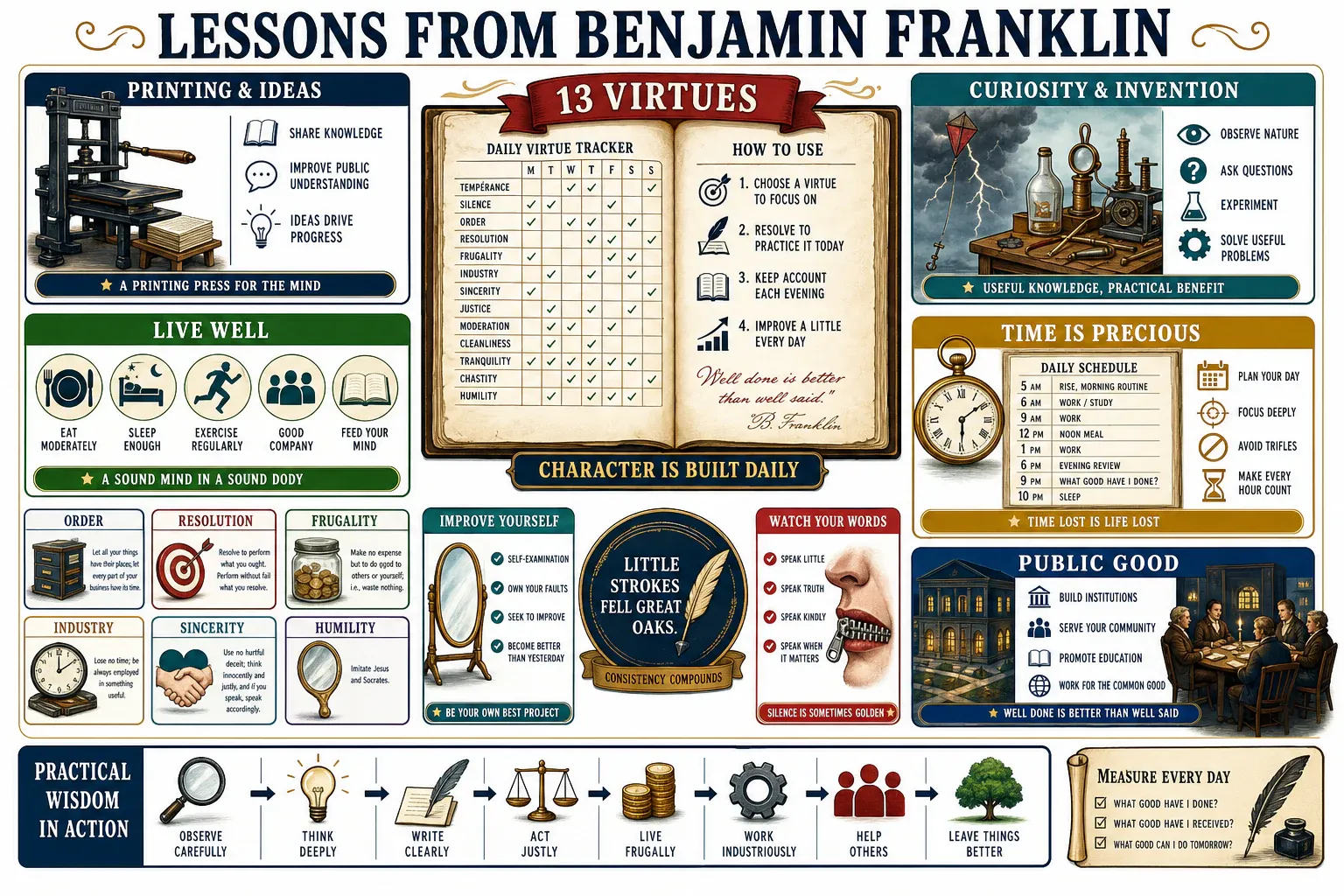
On Virtue and Self-Improvement
In his autobiography, Franklin describes devising thirteen virtues and tracking his conduct as a deliberate, continuing effort at moral improvement. — The Autobiography of Benjamin Franklin.
1. The 13 Virtues: In his autobiography, Franklin set out temperance, silence, order, resolution, frugality, industry, sincerity, justice, moderation, cleanliness, tranquility, chastity, and humility, then tracked his conduct against them. His aim was sustained practice, not a claim of achieved perfection. — The Autobiography of Benjamin Franklin.
2. “Wish not so much to live long as to live well.” The almanac places quality of life ahead of mere length of life. — Poor Richard’s Almanack (1738).
3. “Search others for their virtues, thy self for thy vices.” Franklin urges generous judgment of others and scrutiny of oneself. — Poor Richard’s Almanack (1738).
4. Sincerity: Franklin’s virtue asks him to avoid hurtful deceit and to think justly before speaking. The often-attributed “What you seem to be, be really” is not needed to state that principle. — The Autobiography of Benjamin Franklin.
5. “A right Heart exceeds all.” In its longer almanac passage, Franklin values upright character above beauty, strength, and riches. — Poor Richard’s Almanack: collected texts.
6. “Who is strong? He that can conquer his bad habits.” Self-command, rather than physical power, is the point of the aphorism. — Poor Richard’s Almanack: collected texts.
On Diligence and Prudence
In The Way to Wealth, Franklin gathers advice on industry, care with time, and frugal management of resources. — The Way to Wealth.
7. “Lost time is never found again.” Franklin urges the reader to treat time as a resource that cannot be recovered. — The Way to Wealth.
8. “Dost thou love life? Then do not squander Time; for that is the Stuff Life is made of.” His point is to spend time deliberately. — The Way to Wealth.
9. “Early to bed and early to rise, makes a man healthy, wealthy, and wise.” This is Franklin’s counsel for a disciplined routine, not proof of a causal health or wealth effect. — Poor Richard’s Almanack (1735).
10. Plan the day: In the autobiography, Franklin gives each part of his day a place and opens the morning by asking what good he will do. That documented practice supports preparation without relying on the spurious “failing to prepare” quotation. — The Autobiography of Benjamin Franklin.
11. “Haste makes waste.” Franklin’s short proverb warns that needless rushing can undermine the work. — Poor Richard’s Almanack (1753).
12. “Well done is better than well said.” The almanac favors useful action over promises or display. — Poor Richard’s Almanack (1737).
13. “A penny saved is twopence clear.” The collected almanac gives this wording, emphasizing the tangible value of money not spent. — Poor Richard’s Almanack: collected texts.
14. “Beware of little Expenses; a small Leak will sink a great Ship.” Franklin warns that repeated minor spending can become consequential. — The Way to Wealth.
15. “Industry need not wish.” In The Way to Wealth, sustained work takes precedence over hoping for a result. — The Way to Wealth.
16. “Drive thy Business, or it will drive thee.” Franklin advises keeping active command of one’s affairs. — Poor Richard’s Almanack (1738).
On Knowledge and Wisdom
Franklin’s autobiography describes self-directed study and writing practice; his almanac also praises education and an openness to learning. — The Autobiography of Benjamin Franklin.
17. Learn through practice: Franklin describes teaching himself to write by imitating, reconstructing, and comparing essays. His own method supports active practice, not the often-misattributed “tell me and I forget” wording. — The Autobiography of Benjamin Franklin.
18. “Being ignorant is not so much a shame, as being unwilling to learn.” The proverb distinguishes lack of knowledge from refusing to acquire it. — Poor Richard’s Almanack: collected texts.
19. “The doors of wisdom are never shut.” Franklin leaves room for continuing to learn. — Poor Richard’s Almanack: collected texts.
20. “Hide not your Talents, they for Use were made. What’s a Sun-Dial in the shade!” The couplet asks readers to put abilities to work. — Poor Richard’s Almanack: collected texts.
21. “Genius without education is like silver in the mine.” Franklin’s analogy makes cultivation necessary for talent to show its value. — Poor Richard’s Almanack: collected texts.
On Human Nature and Relationships
Poor Richard uses compact maxims about friends, speech, self-regard, and generosity to examine how people treat one another. — Poor Richard’s Almanack (1738).
22. “Love your Enemies, for they tell you your Faults.” Critics may identify flaws one’s friends do not mention. — Poor Richard’s Almanack: collected texts.
23. “He that falls in love with himself will have no rivals.” Franklin mocks self-absorption. — Poor Richard’s Almanack (1739).
24. “Three may keep a secret, if two of them are dead.” The proverb is a deliberately bleak warning about confidentiality. — Poor Richard’s Almanack (1735).
25. “He that lies down with Dogs, shall rise up with fleas.” Franklin warns that chosen company has consequences. — Poor Richard’s Almanack (1733).
26. “A true Friend is the best Possession.” The aphorism prizes genuine friendship. — Poor Richard’s Almanack: collected texts.
27. “Better slip with foot than tongue.” The proverb counsels care in speech. — Poor Richard’s Almanack (1734).
28. “Don’t throw stones at your neighbors, if your own windows are glass.” The proverb warns against exposing others’ faults while vulnerable to the same criticism. — Poor Richard’s Almanack (1736).
29. “When you’re good to others, you’re best to yourself.” Franklin presents generosity as beneficial to both parties. — Poor Richard’s Almanack: collected texts.
30. “Fish and visitors stink in three days.” The joke cautions against overstaying a welcome. — Poor Richard’s Almanack (1736).
31. Franklin describes the favor-getting effect as “an old maxim I had learned”: someone who has helped you once may be more willing to help again. The autobiography reports his use of this principle; it does not claim he invented it. — The Autobiography of Benjamin Franklin.
On Liberty and Governance
Franklin’s public work included disputes over liberty and government; his 1787 convention speech also reflects on the character needed to sustain government. — Constitutional Convention Closing Speech.
32. In a 1755 Pennsylvania Assembly reply, Franklin argued that people who surrendered essential liberty to obtain a little temporary safety deserved neither. The immediate dispute concerned frontier defense and the proprietors’ tax exemption; it is not a blanket rejection of safety measures. — Pennsylvania Assembly Reply (1755).
33. Writing to Jean-Baptiste Le Roy about the new Constitution in 1789, Franklin quipped that nothing in this world was certain “except death and taxes.” The line appears within his cautious assessment of the constitutional experiment. — Library of Congress: Franklin on Death and Taxes.
34. “There never was a good war nor a bad peace.” In a 1783 letter to Sir Joseph Banks, Franklin expressed his preference for negotiated peace over war. — Letter to Sir Joseph Banks (1783).
35. John Adams reported that Franklin proposed “Rebellion to tyrants is obedience to God” as a motto for a 1776 design of the Great Seal. The proposal was not adopted as the final seal. — U.S. State Department: The Great Seal.
36. In Silence Dogood No. 8, Franklin reproduced a London Journal passage linking freedom of thought to wisdom and freedom of speech to public liberty. The wording belongs to the passage he quoted, not to Franklin as its original author. — Silence Dogood No. 8.
37. In his 1787 closing speech to the Constitutional Convention, Franklin warned that corruption could leave a people unable to sustain any government except a despotic one. His concern connects civic character to self-government without relying on the separately attributed “only a virtuous people” quotation. — Constitutional Convention Closing Speech.
On Life and Happiness
Franklin’s autobiography and almanac offer practical reflections on everyday contentment and self-improvement. — The Autobiography of Benjamin Franklin.
38. “Human felicity is produced not so much by great pieces of good fortune that seldom happen, as by little advantages that occur every day.” Franklin emphasizes recurring practical comforts, not merely fleeting pleasures. — The Autobiography of Benjamin Franklin.
39. “Content makes poor men rich; discontent makes rich men poor.” Franklin’s proverb contrasts satisfaction with possessions. — Poor Richard’s Almanack: collected texts.
40. “Eat to live, and not live to eat.” The almanac recommends moderation in appetite. — Poor Richard’s Almanack (1733).
41. “If you would not be forgotten as soon as you are dead and rotten, either write things worth reading, or do things worth the writing.” Franklin sets valuable writing and deeds beside each other as paths to remembrance. — Poor Richard’s Almanack (1738).
42. “You may delay, but time will not.” Franklin’s proverb warns that putting off action does not stop time. — Poor Richard’s Almanack (1758).
43. “The heart of a fool is in his mouth, but the mouth of a wise man is in his heart.” The saying contrasts impulsive speech with deliberation. — Poor Richard’s Almanack (1733).
44. “God helps them that help themselves.” Franklin reprinted this older proverb in Poor Richard; its practical counsel is self-reliance, not an original saying he coined. — Poor Richard’s Almanack (1736).
45. “Glass, China, and Reputation, are easily crack’d, and never well mended.” The almanac treats reputation as fragile. — Poor Richard’s Almanack: collected texts.
46. “Be at war with your vices, at peace with your neighbors, and let every new year find you a better man.” Franklin’s New Year advice combines self-correction with peaceful coexistence. — Poor Richard’s Almanack: collected texts.
Learn more:
- The Autobiography of Benjamin Franklin
- Benjamin Franklin: The Way to Wealth
- The Prefaces, Proverbs, and Poems of Benjamin Franklin: Poor Richard’s Almanacks, 1733–1758
- Poor Richard’s Almanack (1733), U.S. Information Agency transcription
- Poor Richard’s Almanack (1735), U.S. Information Agency transcription
- Poor Richard’s Almanack (1736), U.S. Information Agency transcription
- Poor Richard’s Almanack (1738), U.S. Information Agency transcription
- Poor Richard’s Almanack (1758), U.S. Information Agency transcription
- Pennsylvania Assembly Reply to Governor Morris (1755)
- Benjamin Franklin to Sir Joseph Banks (1783)
- Silence Dogood No. 8 (1722)
- Benjamin Franklin: Closing Speech at the Constitutional Convention (1787)
- U.S. State Department: The Great Seal