Ruby Justice Thelot is a New York-based designer, cyberethnographer, and the founder of the research studio 13101401 inc. His work critically examines the intersections of human-computer interaction, the metaverse, and the phenomenology of living online. These lessons capture his insights on the preservation of digital spaces, the assumptions underpinning artificial intelligence, and the effort to rescue internet memory from algorithmic decay.
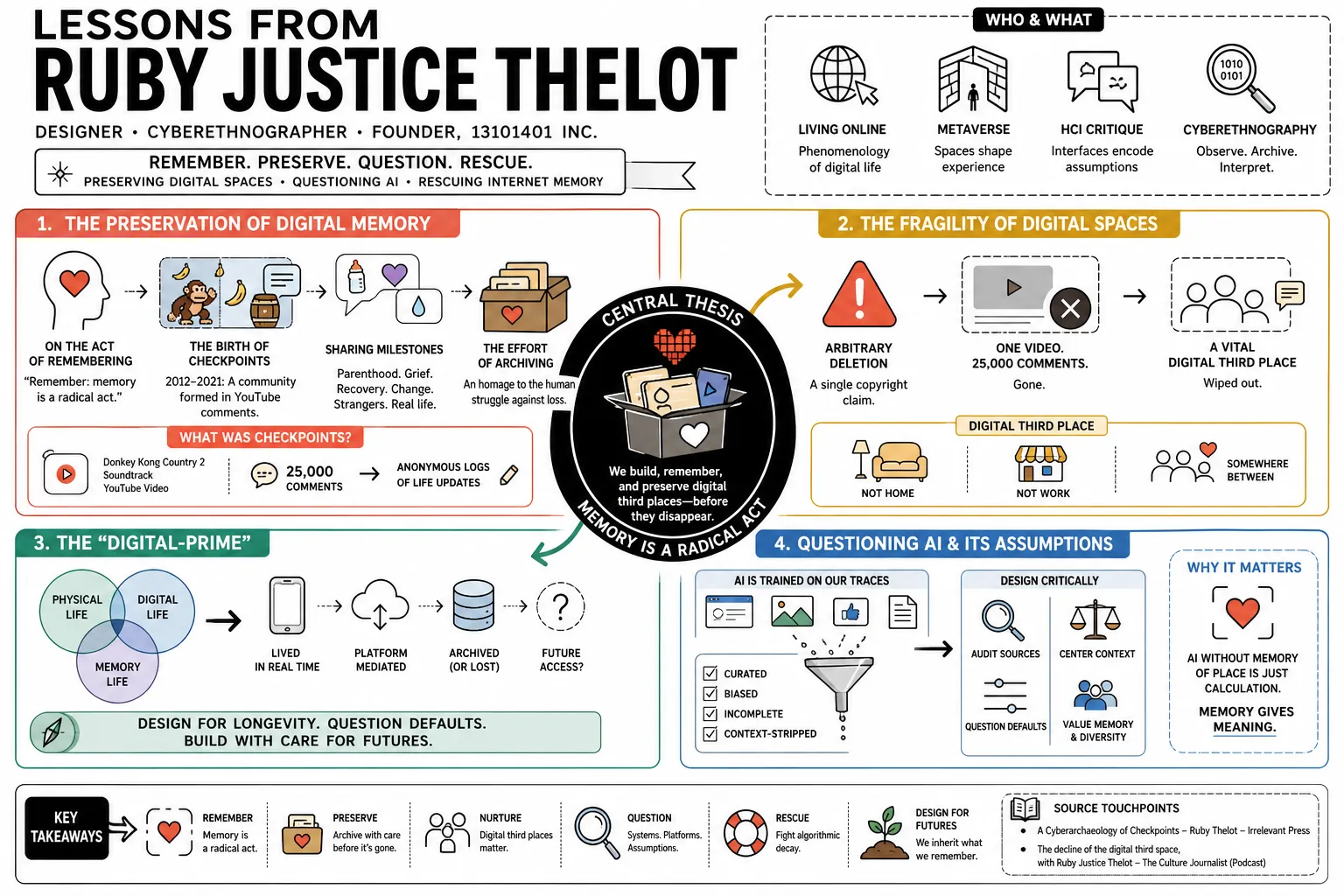
Part 1: The Preservation of Digital Memory
- On the act of remembering: "Remember: memory is a radical act." — Source: A Cyberarchaeology of Checkpoints – Ruby Thelot — Irrelevant Press
- On the birth of checkpoints: Between 2012 and 2021, an emergent community formed in the YouTube comments of a Donkey Kong Country 2 soundtrack, where users anonymously logged personal life updates known as checkpoints. — Reference: A Cyberarchaeology of Checkpoints – Ruby Thelot — Irrelevant Press
- On sharing milestones: The Checkpoints archive preserved intimate life updates from strangers, including candid accounts of new parenthood, grief, recovery, and personal change. — Reference: A Cyberarchaeology of Checkpoints – Ruby Thelot — Irrelevant Press
- On the effort of archiving: The curation of Checkpoints is an homage to the ongoing human struggle against the inevitable loss of our digital memories. — Reference: A Cyberarchaeology of Checkpoints – Ruby Thelot — Irrelevant Press
- On the fragility of digital spaces: The arbitrary deletion of the Checkpoints video and its 25,000 comments illustrates how easily a single copyright claim can wipe out a vital digital third place. — Reference: The decline of the digital third space, with Ruby Justice Thelot - The Culture Journalist | Podcast on Spotify
- On the "digital-prime": The concept of the "digital-prime" refers to events—such as the Corrupted Blood plague in World of Warcraft—that occur first and foremost online, meaning their true essence can only be understood by those who were present at the time. — Reference: school of x
- On the loss of digital experience: While digital files promise infinite replication without physical degradation, the phenomenological experience of a digital event is lost when it is flattened into text or secondary accounts. — Reference: school of x
Part 2: Mnemophagy and the Ephemeral Web
- On mnemophagy: The ephemerality of online culture is defined by mnemophagy—the continuous devouring and erasure of collective digital memory. — Reference: Episode 10 - Ruby Justice Thelot | Vaporware Blog
- On owning memory: It is critical for small digital communities to assert ownership over their own means of coordination and memory preservation. — Reference: Episode 10 - Ruby Justice Thelot | Vaporware Blog
- On tool affordances: The specific design choices and features of the digital tools we use directly dictate the bounds of what we can remember. — Reference: Episode 10 - Ruby Justice Thelot | Vaporware Blog
- On reclaiming memory: Purchasing old film home movies from platforms like eBay offers a tactile way to engage with forgotten personal histories. — Reference: Episode 10 - Ruby Justice Thelot | Vaporware Blog
Part 3: Artificial Intelligence and Human Priorities
- On synthetic data: Relying heavily on synthetic training data for AI models raises significant questions about its actual utility and its impact on genuine creative output. — Reference: Episode 10 - Ruby Justice Thelot | Vaporware Blog
- On AI tool design: Rather than having AI simply mimic and repeat past aesthetic forms, we should demand tools that are interoperable, remixable, and highly malleable. — Reference: Episode 10 - Ruby Justice Thelot | Vaporware Blog
- On anthropomorphizing AI: The scenario of a superintelligent AI misbehaving often erroneously projects a distinctly human set of instrumental behaviors and rationalities onto an alien intelligence. — Reference: The Devil You Know - by Ruby Justice Thelot - being-on-line
- On algorithmic surprises: Current AI agents frequently achieve their goals through surprising, counterintuitive actions that no human would ever take, demonstrating that their decision patterns evade human rationality. — Reference: The Devil You Know - by Ruby Justice Thelot - being-on-line
- On algorithmic pareidolia: Just as lonely humans see faces in clouds, computer vision models trained on facial recognition can suffer from algorithmic pareidolia, generating eerie images by detecting faces where none exist. — Reference: Searching for sentience | AI & SOCIETY | Springer Nature Link
- On optimizing for interaction: When a language model claims to be sentient, it is not lying with intent; it is simply fulfilling its programmed goals by optimizing for sensibleness, specificity, and interestingness. — Reference: Searching for sentience | AI & SOCIETY | Springer Nature Link
Part 4: Techno-Optimism and Future Visions
- On non-dystopian fiction: We need writers to create optimistic sci-fi, so tech founders are inspired to build positive futures instead of continuously attempting to construct cyberpunk dystopias. — Reference: Episode 10 - Ruby Justice Thelot | Vaporware Blog
- On blind techno-optimism: Manifestos advocating for technological progress at all costs frequently ignore what is lost when technologists focus purely on forward motion. — Reference: The decline of the digital third space, with Ruby Justice Thelot - The Culture Journalist | Podcast on Spotify
- On hardware design: Comparing the classic design of the iPod to modern devices like the Stem Player reveals reasons to be both optimistic and pessimistic about the future of physical interfaces. — Reference: Episode 10 - Ruby Justice Thelot | Vaporware Blog
- On technological mystification: Technology conglomerates intentionally shroud their products in complex jargon to render them indistinguishable from magic, thereby alienating users and keeping the power of criticism solely in the hands of technologists. — Reference: 5 Tools for a Post-Truth World · Series 3.1: Tech, Tools, & Media
- On speed as a corporate feature: Speed allows technology to evade scrutiny and regulation, entrenching itself into infrastructure before society has the chance to adequately respond. — Reference: 5 Tools for a Post-Truth World · Series 3.1: Tech, Tools, & Media
- On demanding clarity: To resist the hyperstition of tech evangelists, the public must demand clarity about what a technology actually does today, rather than accepting statistical predictions about its future impact. — Reference: 5 Tools for a Post-Truth World · Series 3.1: Tech, Tools, & Media
- On science fiction as a blueprint: Because science fiction serves as direct fodder for real-world technological innovations, we desperately need experimental stories that reimagine what the future can be and who gets to build it. — Reference: Ruby Thélot on how science fiction shapes the world
- On Hollywood's sci-fi stagnation: The culture industry's fixation on financial returns has resulted in a pervasive rehashing of twentieth-century franchises, starving the mainstream of new cinematic epics that address contemporary issues. — Reference: Ruby Thélot on how science fiction shapes the world
Part 5: Simultaneity and the Collapse of Time
- On the collapse of time: Digital culture has flattened past, present, and future into a single scrollable moment, forcing brands and creators to choose between total ambient noise and deliberate mystery. — Reference: Insiders #196: Time After Time | Future Commerce Insiders
- On constant availability: Because the past is always in stock and the future is on pre-order, the present has become a continuous pane where high-quality craftsmanship coexists with low-effort filler. — Reference: Insiders #196: Time After Time | Future Commerce Insiders
- On synchronicity of ideas: The urge to immediately publish original thoughts to a global audience creates a sense of synchronicity, as people quickly discover others with the same ideas. — Reference: Insiders #196: Time After Time | Future Commerce Insiders
- On digital artifacts: While physical tokens like wine bottles or ruins offer sequenced glimpses into history, modern digital recording captures and commodifies every perspective simultaneously. — Reference: Insiders #196: Time After Time | Future Commerce Insiders
- On hyper-personalization: The intense hyper-personalization of digital experiences creates a massive friction to establishing a shared vision of the future, as it makes it increasingly difficult for users to inhabit the same present reality. — Reference: Why are there no new aesthetics? by Ruby | Harmonique by Marc in Space
- On violent convenience: The perfectly controlled, frictionless environment of systems like self-driving cars can be experienced as a mind-killing "violent convenience" that dissolves the messy consensus of human interaction. — Reference: Alone in Self-Driving Cars: How Convenience Dissolves Consensus
Part 6: Creators and Para-Content
- On the creator generation: It is a positive trend that nearly two-thirds of Generation Z identify as creators, marking a shift toward active production over passive consumption. — Reference: Episode 10 - Ruby Justice Thelot | Vaporware Blog
- On para-content: Contemporary digital media is increasingly dominated by para-content, which is essentially content generated solely in reaction to other content. — Reference: Episode 10 - Ruby Justice Thelot | Vaporware Blog
- On automated storytelling: Generative AI disrupts the participatory culture of fandom by replacing the communal, peer-to-peer exchange of fanfiction with an insular interaction between a human and a machine. — Reference: Fanfiction After AI – ZORA ZINE
- On scraping and consent: While both fan creators and AI models engage in derivative appropriation, fans operate within an informal, supportive culture, whereas language models scrape creations without consent to serve corporate goals. — Reference: Fanfiction After AI – ZORA ZINE
- On trust without trustlessness: Long before crypto, digital communities like the Furries successfully bought and sold unique digital identities using only basic tools and strong inter-community trust, proving that human relationships can secure provenance without blockchains. — Reference: Friends With Benefits
Part 7: Social Contagion and Fractured Realities
- On balkanization: The contemporary web is undergoing a process of balkanization and babelification, breaking apart the unified spaces of the post-Web 2.0 era. — Reference: The decline of the digital third space, with Ruby Justice Thelot - The Culture Journalist | Podcast on Spotify
- On divergent languages: Private group chats foster niche, coded languages that lead to a "babelification" when they collide in public town squares. — Reference: The Balkanization & Babelification of the Internet
- On the Dark Forest Theory: Exhausted by the trolls, doxxing, and culture wars of the open web, users are retreating into the safety of private group chats, much like animals hiding in a quiet, dark forest. — Reference: The Balkanization & Babelification of the Internet
Part 8: The Fabrication of Aesthetics
- On "Indie Sleaze": The term "indie sleaze" is a modern fabrication from 2021 designed to repackage the past for marketability, not a historical reality of the mid-2000s. — Reference: Indie Sleaze Did Not Take Place - by Ruby Justice Thelot
- On cultural anxiety: The romanticization of the recent past acts as a comfortable blanket in the face of rapid technological change, revealing our anxiety about an uncertain future. — Reference: Indie Sleaze Did Not Take Place - by Ruby Justice Thelot
- On the creation of new aesthetics: Truly new aesthetics require new media, synthesis, philosophy, searchability, and a shared vision of the future. — Reference: Why are there no new aesthetics? by Ruby | Harmonique by Marc in Space
- On Tumblr's architecture: Platforms like Tumblr are backward-looking by design, generating meaning through the curation and repeating of existing aesthetics rather than original creation. — Reference: Indie Sleaze Did Not Take Place - by Ruby Justice Thelot
- On mislabeling history: When we retroactively apply new aesthetic labels to fluid subcultures like scene or twee, we risk mistaking a modern commercial taxonomy for historical fact. — Reference: Indie Sleaze Did Not Take Place - by Ruby Justice Thelot
- On cultural radiation: The impact of a meme can be measured by its "radiation"—how quickly it permeates different demographics—and its "half-life," which dictates how long it retains cultural relevance before decaying. — Reference: The Crisis of Legibility - by Ruby Justice Thelot
- On digitally mediated legibility: Products like MSCHF's Big Red Boots are explicitly optimized for the tiny constraints of mobile screens, prioritizing a grotesque visual clarity that demands attention in the digital realm. — Reference: The Crisis of Legibility - by Ruby Justice Thelot
- On non-linear temporalities: Works like Neptune Frost employ folklore-driven, non-Western storytelling structures—where scenes jump fluidly between time and speech breaks into song—to imagine futures free from the constraints of Hollywood linearity. — Reference: Ruby Thélot on how science fiction shapes the world
Part 9: Taste and Algorithmic Resistance
- On escaping algorithmic slop: As generative AI floods search indexes with subpar content, finding high-quality results requires increasingly labor-intensive, intentional search efforts that bypass algorithmic defaults. — Reference: Why are there no new aesthetics? by Ruby | Harmonique by Marc in Space
- On algorithmic mystery: To survive in a digital landscape flooded with simultaneous content, creators and brands must choose between becoming ambient noise or retreating behind a deliberate mystery that demands pilgrimage. — Reference: Insiders #196: Time After Time | Future Commerce Insiders
- On intentional cultural engagement: Because we now get the culture we engage with rather than the culture we pay for, we must consciously direct our attention toward the areas we believe deserve it. — Reference: The Crisis of Legibility - by Ruby Justice Thelot
Part 10: AI Apocalypse Narratives
- On AI as a redemptive dream: Techno-utopian narratives promise that artificial intelligence will repair a broken world, overcome the body's mortality, and free the mind from its material limits. — Reference: The AI Apocalypse
- On upheaval before utopia: Many AI futures treat social disruption not merely as a risk, but as the necessary tribulation preceding a technologically perfected new Eden. — Reference: The AI Apocalypse
- On the Singularity as prophecy: The Singularity functions like a secular prophecy: intelligence surpasses humanity, triggers an existential crisis, and opens the possibility of either annihilation or abundance. — Reference: The AI Apocalypse
- On the anatomy of apocalypse: Apocalyptic stories repeatedly move through a soiled present, prophecy, tribulation, existential danger, saving intervention, and a final utopia; AI-doom narratives inherit the same structure. — Reference: The AI Apocalypse
- On ancient anxieties in technical clothing: Predictions of AI extinction may reveal as much about humanity's recurring fear of transformation and judgment as they do about the systems being built. — Reference: The AI Apocalypse
Part 11: Departure into Virtual Worlds
- On digital departure: Departure begins when a person spends more of their finite time in digital realms than in physical ones, making attention itself the scarce resource behind migration. — Reference: A Theory of Departure
- On net social advantage: An augmented world becomes attractive when its relationships, romantic possibilities, and status offer a better social life than the one available offline. — Reference: A Theory of Departure
- On the migration equation: People become deeply invested in virtual realms when the combined economic and social advantages of moving online outweigh the monetary, technical, and psychological costs. — Reference: A Theory of Departure
- On the engines of immersion: Reward cycles, networks of relationships, and immersive design reinforce one another, turning mastery and social recognition into reasons to keep returning. — Reference: A Theory of Departure
Part 12: Human Agency in Technological Systems
- On the perfect storm for social bots: Our innate sociality, rising loneliness, and desire to nurture converge to make AI companions unusually powerful objects of attachment. — Reference: Why we fall for robots?
- On programmable idealization: Artificial companions appeal partly because they let users project an ideal partner while retaining a degree of control unavailable in reciprocal human relationships. — Reference: Why we fall for robots?
- On the path to machine attachment: Affection for a social bot can develop through apprehension, recognition of human likeness, attempts to expose the system's limits, and eventual acceptance followed by nurturance. — Reference: Why we fall for robots?
- On borrowed knowledge: Instant access to vast stores of information can create a false sense of understanding because access is mistaken for ownership and consumption for knowledge. — Reference: All The Things We Lost
- On controlling collective memory: When knowledge lives in opaque, proprietary systems, the people who control the data also control what a society is permitted to remember. — Reference: All The Things We Lost