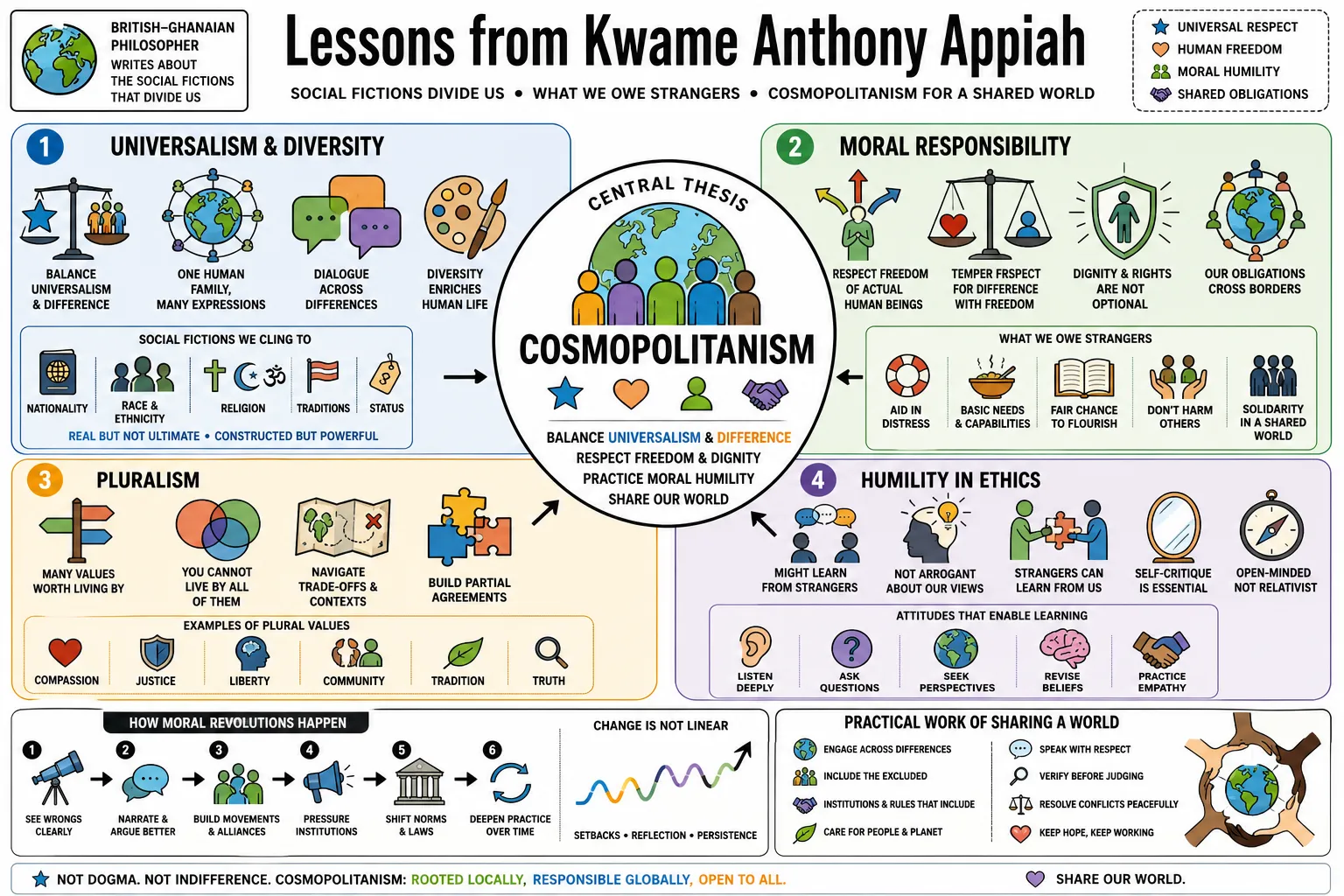
Lessons from Kwame Anthony Appiah
The British-Ghanaian philosopher Kwame Anthony Appiah writes about the social fictions that divide us and what we actually owe to strangers. This collection breaks down his case for a modern cosmopolitanism, exploring why we cling to labels and how moral revolutions actually happen. It also covers the practical work of sharing a world despite deep disagreements.
Part 1: The Nature of Cosmopolitanism
- On Universalism and Diversity: "The version of cosmopolitanism that I favor is exactly about balancing universality and difference." — Source: Cosmopolitanism
- On Moral Responsibility: "A tenable global ethics has to temper a respect for difference with a respect for the freedom of actual human beings to make their own choices." — Source: Stanford Encyclopedia of Philosophy
- On Pluralism: "Cosmopolitans think that there are many values worth living by and that you cannot live by all of them." — Source: Philosophy Bites
- On Humility in Ethics: "They know they don't have all the answers. They're humble enough to think that they might learn from strangers; not too humble to think that strangers can't learn from them." — Source: Cosmopolitanism
- On Shared Obligations: "Our obligation is not to carry the whole burden alone. Each of us should do our fair share, but we cannot be required to do more." — Source: SuperSummary
- On Global Citizenship and Nationalism: "It's just an error of history to say, if you're a nationalist, you can't be a citizen of the world." — Source: BBC Reith Lectures
- On Conversation: "I am urging that we should learn about people in other places, take an interest in their civilizations, their arguments, their errors, their achievements, not because that will bring us to agreement, but because it will help us get used to one another." — Source: Cosmopolitanism
- On Sidling Up to Difference: Instead of confronting moral or religious differences head on, we often make more progress by sidling up to them through shared, mundane interests. — Source: On Being with Krista Tippett
- On Ignorance and Privilege: "Thoroughgoing ignorance about the ways of others is largely a privilege of the powerful." — Source: Spirituality & Practice
- On Being Human: "I am human, I think nothing human alien to me." — Source: The Lies That Bind
Part 2: Navigating Disagreement and Truth
- On the Shattered Mirror of Truth: Truth is like a shattered mirror where each person holds a small piece and mistakenly believes they own the whole. — Source: Goodreads
- On Fallibilism: We must accept fallibilism, the sense that our knowledge is imperfect and subject to revision in the face of new evidence. — Source: Stanford Encyclopedia of Philosophy
- On Relativism: "Relativism of that sort isn't a way to encourage conversation; it's just a reason to fall silent." — Source: Cosmopolitanism
- On Philosophical Progress: Progress in philosophy lies in a clearer delineation of the conceptual options, rather than in reaching determinate conclusions. — Source: QuoteFancy
- On Clarity vs Truth: In Harvard University Press's description of Appiah's As If, his argument is that people use simplified models and proceed as if representations were true while knowing they are not, making useful clarity distinct from literal truth. — Reference: Harvard University Press description of As If on useful idealizations and representations treated as true while known to be imperfect
- On Agreement: We do not all need to agree on the same values, but we must talk about them to understand differing points of view. — Source: WordPress Philosophy Blogs
- On Understanding Other Viewpoints: The goal of conversation is to understand why the other person thinks they are right, rather than to persuade them they are wrong. — Source: Philosophy Bites
- On the Use of Questions: As a philosopher, he began looking for answers but ultimately came to prize the questions themselves. — Source: AZ Quotes
- On Respect for Strangers: A tenable global ethic requires us to respect the freedom of actual human beings to make their own choices, even when we disagree with them. — Source: Stanford Encyclopedia of Philosophy
Part 3: The Illusions of Identity
- On Identity as a Construct: Identities are not static truths but social constructions created by conflict and history. — Source: The Lies That Bind
- On the Lies That Bind: "They are the lies that bind. We need to reform them because, at their best, they make it possible for groups, large and small, to do things together." — Source: The Lies That Bind
- On Reforming Labels: "There's no dispensing with identities, but we need to understand them better if we can hope to reconfigure them." — Source: The Lies That Bind
- On the Contours of Self: "Such affiliations give contours to our sense of self, and shape our polarized world." — Source: The Lies That Bind
- On Modern Identity: Modern identity is a shared social experience, rather than an innate personal characteristic. — Source: Political Society Podcast
- On Identity Play: We should engage in identity play rather than allowing ourselves to be constrained by rigid identity politics. — Source: ThoughtCast
- On the Danger of Essentialism: We must reject the assumption that there is a deep underlying biological or spiritual essence that binds members of a social group together. — Source: Afropean
- On Identity and Conflict: Identities are often formed through active conflict rather than existing as peaceful, pre-defined categories. — Source: CBC Radio
- On Bad Uses of Identity: While identities are necessary for cooperation, they become dangerous when used as tools for exclusion or unquestioned tribalism. — Source: CBC Radio
- On Holding Identity Lightly: We should hold our identities with a lighter touch, recognizing their utility without becoming imprisoned by them. — Source: CBC Radio
Part 4: Honor and Moral Revolutions
- On the Nature of Honor: "A person of honor cares first of all not about being respected but about being worthy of respect." — Source: The Honor Code
- On Honor vs Morality: "Honor and morality are separate systems. They can be aligned, but can easily pull in opposite directions." — Source: Words and Dirt
- On Honor as an Engine: When aligned with morality, honor acts as an engine that drives us to take seriously our responsibilities in a shared world. — Source: Words and Dirt
- On Defining Honor: "To honor a person is to treat her as worthy of respect, as entitled to it." — Source: Reset DOC
- On the Language of Honor: While the language of honor strikes modern readers as obsolete or tied to absurdities like dueling, it remains a vital force today. — Source: Columbia University Press
- On Moral Revolutions: Moral change is often driven by a collective shift in what a society deems honorable or shameful, rather than by new logical arguments. — Source: The Philosophers' Magazine
- On Social Pressure: When a practice is redefined as dishonorable, social pressure often precedes and accelerates formal legal changes. — Source: Philosophical Chat
- On the Withdrawal of Esteem: The threat of losing the respect of one's peers is frequently a stronger motivator for behavioral change than intellectual persuasion. — Source: The Philosophers' Magazine
- On Self-Respect: "If you recognize yourself as honorable, you will have self-respect, paying yourself the respect that is your due." — Source: Reset DOC
Part 5: Values and Everyday Ethics
- On the Utility of Values: "A value is like a fax machine: it's not much use if you're the only one who has one." — Source: The Ethics of Identity
- On the Challenge of Life: "In life, the challenge is not so much to figure out how best to play the game; the challenge is to figure out what game you're playing." — Source: AZ Quotes
- On Individual Agency: "We should begin by taking individuals, not nations, tribes or peoples, as the proper object of moral concern." — Source: Stanford Encyclopedia of Philosophy
- On Practicality in Ethics: An ethical question is fundamentally a query about how one ought to conduct oneself and what one owes to others. — Source: NYU News
- On Forming Hopeful Selves: "We can't be content with knowing the kind of people we are. It matters, too, the kind of people we hope to be." — Source: Experiments in Ethics
- On The Role of the Philosopher: Philosophers are there to provide people with the analytical tools to think about their own lives, rather than to dictate behavior. — Source: Library of Congress
- On Ethical Nuance: Rigid moral edicts often fail, and practical ethics requires navigating the specific, messy facts of a unique situation. — Source: The Faculty Lounge
- On Addressing Everyday Dilemmas: When addressing real world moral dilemmas, it is often best to start with a human hunch and rigorously work backward to examine the underlying obligations. — Source: NYU News
- On Imposing Vision: "Many people who believe rightly in universality, want, wrongly, I think, to impose their vision of the world on others." — Source: AZ Quotes
- On Individual Autonomy: Individuals are ultimately in charge of their own lives and must weigh the ethical trade-offs of their own circumstances. — Source: Medium
Part 6: Culture, Heritage, and Purity
- On Cultural Survival: "Cultures are made of continuities and changes, and the identity of a society can survive through these changes." — Source: The Lies That Bind
- On Authenticity and Change: "Societies without change aren't authentic; they're just dead." — Source: The Lies That Bind
- On Cultural Ownership: In the BBC reflection on Appiah's Culture Reith Lecture, he argues against culture as an essence or birthright and frames culture as a process people join rather than property inherited intact. — Reference: BBC Radio 4 reflection on Appiah's Culture Reith Lecture, culture as process rather than essence or birthright
- On Cultural Purity: The search for cultural purity is a historical illusion, as all cultures are the result of centuries of cross-pollination. — Source: The Lies That Bind
- On the Politicization of Culture: In the BBC Culture lecture material, Appiah challenges the fixed story of Western culture, emphasizes cross-cultural fertilization, and argues that cultural values are actively adopted rather than tracks laid down by destiny. — Reference: BBC Radio 4 reflection on Appiah's Culture Reith Lecture, cross-cultural fertilization and adopted values
- On Transnational Upbringings: "If my sisters and I were children of two worlds no one bothered to tell us this; we lived in one world." — Source: In My Father's House
- On Extended Families Across Borders: Physical distance and cultural differences within a transnational family do not inherently create an insuperable divide. — Source: University of Michigan Press
- On Children of Two Worlds: The narrative of being torn between two worlds is often imposed from the outside rather than felt by those living the experience. — Source: In My Father's House
- On Subjective Nationhood: "To be a nation, it is not enough to meet an objective condition of common descent; you have to meet a subjective condition, a condition that lies in the hearts and minds of its members." — Source: The Lies That Bind
Part 7: Race and the Detritus of Science
- On the Existence of Races: "There are no races: there is nothing in the world that can do all we ask race to do for us." — Source: In My Father's House
- On Race as a Biological Nonsense: "Racial identity is a biological nonsense." — Source: The Guardian
- On Discarded Nineteenth-Century Science: Modern concepts of race are the lingering detritus of discarded nineteenth century pseudoscience, rather than eternal truths. — Source: Afropean
- On Genetic Variation: Modern science has demonstrated that the vast majority of genetic variation exists within so-called racial groups, rather than between them. — Source: CBC Radio
- On the Historical Error of Race: Treating racial categories as natural biological divisions is a fundamental error of modern history. — Source: BBC Reith Lectures
- On Color and Categorization: The categorization of humans by skin color was a tool designed for hierarchy, not an accurate reflection of human difference. — Source: BBC Reith Lectures
- On Moving Beyond Racial Categories: We must move beyond rigid racial categories to understand the true complexity of the African diaspora and human history. — Source: Goodreads
- On Meritocracy and Class: Meritocracy often functions as a deception, masking how social class and structural advantages shape what we perceive as individual merit. — Source: Afropean
- On the Deceptions of Meritocracy: Celebrating a system as a pure meritocracy obscures the systemic inequalities that dictate who gets the opportunity to develop their merits. — Source: Afropean
Part 8: Religion, Education, and Rootedness
- On Creed and Practice: "In religion, we consistently overemphasize the role of scripture at the expense of lived, daily practice." — Source: TapeSearch / BBC Reith Lectures
- On Scripture vs Lived Religion: In Appiah's Creed Reith Lecture, the BBC summarizes his argument that we overestimate scripture and underestimate practice, and that religious writings have been interpreted differently across time. — Reference: BBC World Service page for Appiah's Creed Reith Lecture on scripture, practice, and changing interpretation
- On Liberal Education: The goal of education is to provide students with the tools required to decide for themselves, rather than to tell them what to think. — Source: Vocation Matters
- On Teaching Critical Thinking: Educators must focus on teaching students how to think critically about moral dilemmas rather than handing down predetermined moral answers. — Source: Vocation Matters
- On Vocational Journeys: A vocation is a continuous process of discovering how one's particular skills intersect with the world's needs, rather than merely a career. — Source: Callings Podcast
- On Rooted Cosmopolitanism: One can hold deep, meaningful obligations to a broader human community while remaining profoundly connected to one's own local culture. — Source: Conversations with Tyler
- On Local Obligations: Acknowledging global duties does not require a person to abandon their loyalty to their hometown, nation, or family. — Source: Conversations with Tyler
- On Respecting Universality: The true cosmopolitan ethos combines a profound respect for universal human rights with the recognition that forms of difference should be allowed to persist. — Source: Political Society Podcast
- On Local Belonging and Global Duties: We are capable of being citizens of the world without losing our roots, as we simply expand the radius of our moral concern. — Source: Mindscape Podcast