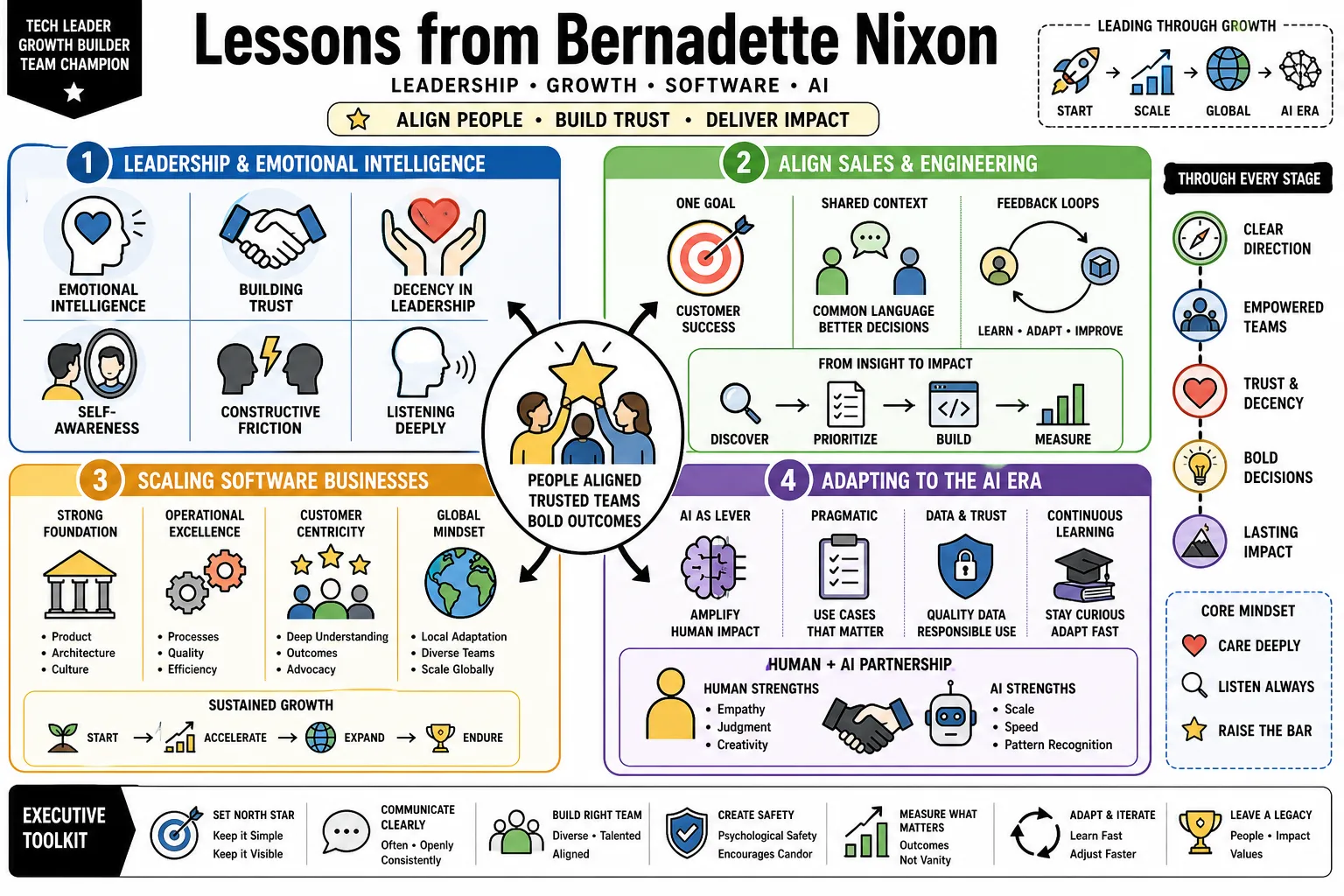
Lessons from Bernadette Nixon
Bernadette Nixon has led Alfresco and Algolia through different phases of enterprise software growth. In her own interviews, she emphasizes building teams, understanding customer problems, and adapting search products and operating practices as markets change. — Algolia CEO Interview.
Part 1: Leadership and Emotional Intelligence
- Make emotional intelligence a leadership skill: Nixon calls emotional intelligence an often-overlooked leadership quality and links it to stronger relationships and a supportive team environment. — Adam Mendler Interview.
- Build supportive relationships: She says leaders should build strong relationships and make it possible for team members to thrive, while setting an example of competence and integrity. — Adam Mendler Interview.
- Keep compassion and decency constant: Nixon argues that compassion, emotional intelligence and decency should remain present in both team interactions and customer concerns as the business changes. — Adam Mendler Interview.
- Learn from teams and peers: She says she learns from her teams and peers and welcomes their advice, including help improving how she leads. — Adam Mendler Interview.
- Allow constructive disagreement: In a discussion with CRO Michelle Adams, Nixon says raised voices do not necessarily mean a lack of harmony when the participants are trying to reach better outcomes. — SaaStr CEO–CRO Session.
- Invite candid feedback: Nixon says she is willing to hear feedback that helps her improve as a leader and encourages a network of peers who will be honest with her. — Adam Mendler Interview.
- Pair customer support with empathy: In the SaaStr customer panel, Nixon argues that customer-success work needs high EQ as well as concrete value; she also urges a humane response when customers are in a bind. — SaaStr Customer Panel Transcript.
- Know your own defining qualities: Asked for three words that describe her, Nixon chose driven, passionate and empathetic. This is her self-description, not a general hiring formula. — Aragon Research Q&A.
- Work deliberately on CEO–CRO rapport: Nixon and CRO Michelle Adams describe their executive relationship as one requiring deliberate interpersonal rapport alongside clarity about their roles and goals. — SaaStr CEO–CRO Session.
- Hire for both competence and EQ: Nixon says relevant technical skills matter, but compassion and emotional intelligence are as important to her teams as IQ. — Adam Mendler Interview.
Part 2: Customer-Centricity and The Humane Touch
- Offer a humane touch in a bind: In the SaaStr panel, Nixon says customers facing difficulty need a humane touch; doing right by them does not mean agreeing to every request. — SaaStr Customer Panel Transcript.
- Remember the long-term customer relationship: Nixon says customers remember when a company treats them well during a difficult period, including after conditions improve. — SaaStr Customer Panel Transcript.
- Make adoption the customer-success goal: Nixon says the goal across customer segments is helping users reach adoption and the value they expected before buying, even though delivery differs by segment. — SaaStr Customer Panel Transcript.
- Break silos to respond to customers: Nixon says functional silos can constrain a company; teams need to work across them to respond to customers and deliver value. — SaaStr Customer Panel Transcript.
- Put customer problems at the center: Nixon says Algolia’s product strategy starts with customer problems and is designed to address current and emerging needs rather than simply push a product. — Algolia CEO Interview.
- Look outside-in: Nixon calls for an outside-in view of the market to avoid becoming an insular vendor blind to customer issues. — Algolia CEO Interview.
- Enable maximum adoption: Nixon emphasizes product simplicity, telemetry and in-product training so customers can reach the value they sought in the pre-sale cycle. — SaaStr Customer Panel Transcript.
- Make the vision serve customers: Nixon says a company’s vision, mission and purpose should be memorable and should serve customers rather than the company itself. — Adam Mendler Interview.
- Design search around evolving expectations: Nixon argues that people increasingly expect search to understand natural-language intent rather than force them into short keyword fragments. — Techstrong AI Retail Interview.
Part 3: Scaling and Speed
- Align before moving quickly: The CEO–CRO discussion emphasizes shared value drivers, transparency and communication so teams can act coherently rather than pull against one another. — SaaStr CEO–CRO Session.
- Use AI to rethink processes: An Alfresco-sponsored article quotes Nixon arguing that AI can go beyond optimizing an existing process and may help design a better one. This is a possibility, not a quantified efficiency result. — CMSWire AI Quick Wins.
- Match the CRO to the customer mix: In a direct SaaStr conversation, Nixon’s CRO choice reflected Algolia’s need for both enterprise deal experience and high-velocity sales across small and large customers. — SaaStr Algolia Growth Conversation.
- Combine self-service and enterprise sales: Nixon describes Algolia as product-led and self-service at its roots while also having developed a top-down enterprise sales motion. — Algolia CEO Interview.
- Start transformation with quick wins: An Alfresco article quotes Nixon saying quick wins can be stepping stones toward a larger vision. The surrounding implementation advice belongs to the article’s authors. — CMSWire AI Quick Wins.
- Make experimentation repeatable: The Nixon–Adams session describes repeatable processes and room to experiment as complementary requirements for revenue-team execution. — SaaStr CEO–CRO Session.
- Clarify the enterprise position: A first-hand attendee at Alfresco’s sales kickoff reports Nixon describing Alfresco as a commercial open-source company focused on enterprise customers. — Xenit Alfresco Event Report.
- Put content to work: The same first-hand event report attributes to Nixon the goal of using enterprise content to create competitive differentiation, rather than merely storing it. — Xenit Alfresco Event Report.
Part 4: Adapting to Change and Artificial Intelligence
- Watch the adoption curve: Algolia’s recap of Nixon’s BBC interview says she framed AI as an unusually rapid innovation wave, with early adopters and laggards. That is her assessment, not a measured universal adoption curve. — Algolia Recap of BBC Interview.
- Treat the AI transition as urgent: In Algolia’s recap of her BBC interview, Nixon calls the AI transition an arms race and urges companies to act. This is her strategic judgment, not a claim that every company faces imminent failure. — Algolia Recap of BBC Interview.
- Prepare for agent-mediated commerce: Algolia’s account of Nixon’s BBC interview says websites may need to serve AI agents that browse and transact on behalf of people. The existing claim about mandatory entirely new infrastructure is not established. — Algolia Recap of BBC Interview.
- Adapt leadership to changing conditions: Nixon says leaders need to adapt to innovation and unpredictable customer behavior, while remaining decisive and accountable. — Adam Mendler Interview.
- Treat change as an opening: Nixon says flexibility can let leaders approach changes as opportunities instead of automatically treating them as setbacks. — Adam Mendler Interview.
- Join keyword and natural-language search: Nixon describes Algolia’s search approach as combining keyword search with vector-based natural-language search so customers can express intent more naturally. — Techstrong AI Retail Interview.
- Understand practical AI applications: Nixon urges leaders to understand AI, machine learning and large language models, especially their potential to improve customer experiences, and to experiment. — Adam Mendler Interview.
- Use enterprise data carefully with AI: In a direct retail-AI interview, Nixon says companies building AI applications around their own data need to consider security, privacy and compliance. The old blanket open-source claim is not supported. — Techstrong AI Retail Interview.
- Assess AI retail gains in context: Nixon reported improvements in conversion and fewer zero-result searches among some Algolia customers using its search product; these are her company’s reported cases, not a universal effect. — Techstrong AI Retail Interview.
Part 5: Career Development and Continuous Learning
- Stay a learner at every career stage: Nixon says leaders are never finished learning and should seek advice from their teams and peers. — Adam Mendler Interview.
- Take a calculated unconventional step: Nixon recounts physically cold-calling the United Nations when seeking work in Switzerland, after considering its hiring constraints and her own lack of political-science background. — Adam Mendler Interview.
- Write down goals and renew them: Nixon says writing a goal down helps her, and that achieving one is a cue to set another. — Adam Mendler Interview.
- Use past progress to build confidence: Nixon says repeatedly pursuing and achieving goals has strengthened her belief that she can reach new ones; this is her personal experience, not a guarantee for others. — Adam Mendler Interview.
- Broaden experience through career rotations: Nixon says rotations through marketing and IT complemented her sales background and helped her understand colleagues and customers from other perspectives. — Algolia Women in Tech Q&A.
Part 6: Overcoming Obstacles and Resilience
- Decide whether a goal merits more effort: Nixon says pushback requires deciding whether the goal is worth the extra time and effort to pursue it. — Adam Mendler Interview.
- Use obstacles to rethink the route: Nixon describes obstacles as prompts to get creative when she remains committed to a goal, rather than automatic reasons to give up. — Adam Mendler Interview.
- Reframe an accident as a career turning point: Nixon says a ski accident led her to redirect her career toward U.S. technology work. This is a personal account, not general advice that setbacks are beneficial. — Adam Mendler Interview.
- Prepare for a cross-border move: Nixon says moving from England to Switzerland required learning enough French for job calls and finding an employer able to sponsor the move. The old quote about communicating without words is unverified. — Aragon Research Q&A.
- Prioritize customers during a downturn: When asked about a downturn, Nixon stresses treating customers humanely and doing right by them when they are in a bind, without promising to meet every demand. — SaaStr Customer Panel Transcript.
- Take difficult assignments: In her own career advice, Nixon urges people to take risks and difficult assignments because she learned and gained most from them. The old market-retreat quotation is unverified. — Algolia Women in Tech Q&A.
Part 7: Culture and Team Dynamics
- Create room for experimentation: The Nixon–Adams session discusses repeatable process together with an environment that gives teams courage to experiment. This is a session-level lesson, not a verified verbatim Nixon quotation. — SaaStr CEO–CRO Session.
- Welcome ideas from teams: Nixon’s direct interview advises leaders to foster a culture where new ideas are welcomed and partnerships help people share strengths and knowledge. — Adam Mendler Interview.
- Use cross-border perspective: Nixon says her European and U.S. experience gave her a useful cross-over perspective, while Algolia’s global origins gave the company reach across many countries. — Algolia Women in Tech Q&A.
- Communicate across functions: The Nixon–Adams session emphasizes sufficient communication and transparency across functional teams so an agreed strategy can be executed together. — SaaStr CEO–CRO Session.
- Model competence and integrity: Nixon says employees need to be able to trust leaders, and that leaders establish credibility by demonstrating competence and integrity. — Adam Mendler Interview.
- Give trust, then protect it: Nixon says she changed Algolia’s stated approach from trust being earned to trust being given at the outset, while treating a breach of trust as serious. This corrects the old lesson’s reversed claim. — Algolia CEO Interview.
Part 8: Work-Life Integration and Personal Values
- Think in terms of work-life integration: Nixon says she prefers integrating work with the rest of life over the idea of a fixed work-life balance. This describes her own practice, not a universal prescription. — Aragon Research Q&A.
- Make integration concrete: Nixon describes using meditation, a change of scenery, and attempts to protect weekends with her husband as practical ways she integrated work and personal life. — Aragon Research Q&A.
- Treat milestones as part of a longer journey: Nixon says an IPO would be a milestone, not the ultimate end goal, in Algolia’s effort to maintain operational excellence. The old definition of success was not her verified wording. — Algolia CEO Interview.
- Teach company values deliberately: Nixon says she kept Algolia’s original values and personally discussed them with new hires, even as the company’s operating practices evolved. — Algolia CEO Interview.
- Make room to disconnect: Nixon says she tried to reserve time with her husband and used painting to disconnect completely. This is a specific personal practice, not an unverified burnout quotation. — Aragon Research Q&A.
- Lead with situational integrity: Nixon rejects rigid command-and-control leadership, favoring adaptation to the person and situation while demonstrating competence and integrity. — Adam Mendler Interview.
- Consider stakeholders beyond shareholders: Nixon says she likes the idea of a business serving employees, partners, customers and wider stakeholders as well as shareholders. This is more precise than the old broad “journey” quotation. — Algolia CEO Interview.