Bill Ackman founded Pershing Square Capital Management and leads a concentrated investment strategy focused on high-quality businesses, predictable cash flow, and long-term value creation. These lessons draw on his direct interviews and Pershing Square’s own letters and presentations. Pershing Square Holdings ↗
Part 1: The Core Philosophy — High-Conviction Value
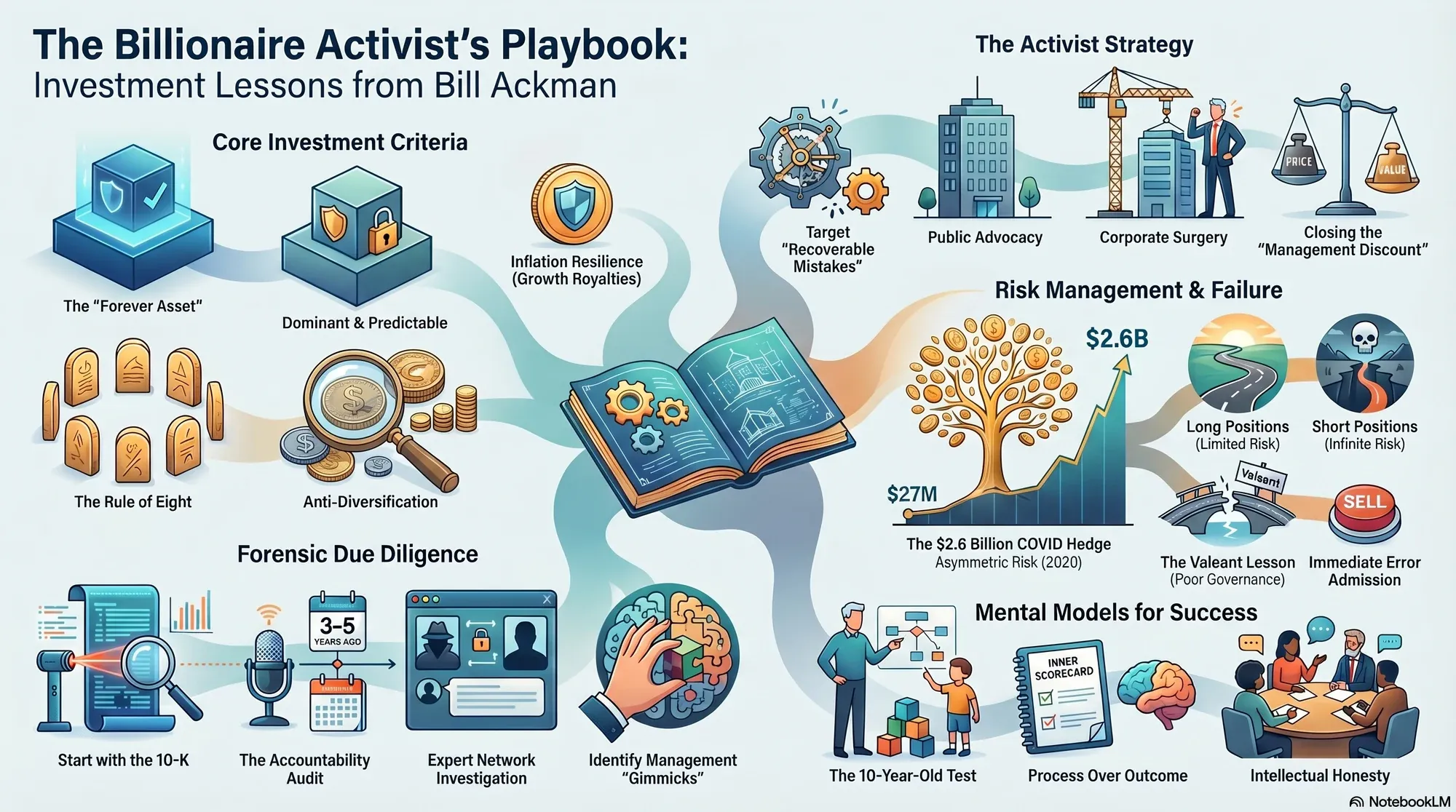
- On Simple Businesses: Pershing Square favors businesses that are simple, predictable, and capable of generating free cash flow. — Pershing Square investment principles ↗
- On Forever Assets: Ackman describes the best businesses as “forever assets,” where decisions that reduce near-term earnings can increase long-term value. — Lex Fridman interview ↗
- On Diversification: Concentration requires deep knowledge and the right temperament. Ackman says most diversification benefits arrive in roughly the first ten to twelve holdings. — Lex Fridman interview ↗
- On Value vs. Price: Ackman credits Benjamin Graham with teaching him to distinguish market price from business value and to let the market serve the investor rather than instruct them. — Lex Fridman interview ↗
- On Capital Allocation: A resilient investment should have low leverage and minimal dependence on capital markets for survival. — Pershing Square investment principles ↗
- On Economic Moats: A durable moat can come from scale, brand recognition, and relationships that would be difficult for a competitor to reproduce. — Lex Fridman interview ↗
- On Inflation Resilience: Pershing Square looks for businesses with limited exposure to external variables it cannot control. — Pershing Square investment principles ↗
- On Long-Term Horizons: Long-term ownership changes the decision horizon: Ackman argues that sacrificing short-term earnings can make a durable business more valuable over several years. — Lex Fridman interview ↗
Part 2: The Art of Due Diligence — Research & Analysis
- On Primary Sources: Pershing Square begins with primary filings: annual and quarterly reports and the proxy statement describing governance and the board. — Lex Fridman interview ↗
- On Tracking Management: Reading several years of earnings-call transcripts reveals what management promised and whether it followed through. — Lex Fridman interview ↗
- On Understanding Incentives: Incentives drive behavior, so understanding the people running a company and what motivates them is part of the investment analysis. — Lex Fridman interview ↗
- On Competitive Dynamics: Study competitors and ask what could dislodge the company; in unfamiliar industries, speak with practitioners and read deeply. — Lex Fridman interview ↗
- On Accounting Clarity: Pershing Square treated a simple business model with limited non-GAAP earnings adjustments as an attractive feature of Chipotle. — Pershing Square 2016 annual report ↗
- On Expert Networks: When a sector is unfamiliar, Pershing Square supplements filings with industry experts, books, and long-form interviews. — Lex Fridman interview ↗
- On Predictability: Predictability is a core filter because a concentrated investor must be able to estimate a business’s future cash generation. — Pershing Square investment principles ↗
- On Board Governance: Governance analysis starts with the proxy and extends to whether directors have the incentives and independence to represent shareholders. — Lex Fridman interview ↗
- On Research Depth: A concentrated portfolio creates time for deep research; Ackman says the team can spend months on an idea without pressure to invest. — The Knowledge Project interview ↗
Part 3: Activist Strategy — Fighting for Change
- On Recoverable Mistakes: Ackman looks for strong businesses that have lost their way and where identifiable managerial, operating, or governance changes can restore value. — Lex Fridman interview ↗
- On Influential Shareholders: Pershing Square’s activist model is to become a large, informed shareholder, propose a plan, and seek influence through the board and other owners. — Lex Fridman interview ↗
- On Corporate Surgery: Chipotle’s turnaround combined new leadership and talent with two fewer management layers and a headquarters relocation intended to improve agility and execution. — Pershing Square 2018 interim letter ↗
- On Public Advocacy: When private engagement fails, an activist can present the case publicly and persuade other shareholders on the merits of the proposed changes. — Lex Fridman interview ↗
- On Persistence: Ackman argues that success is not a straight line and that responding well to failure, then persisting, materially improves the odds of success. — The Knowledge Project interview ↗
- On Permanent Capital: Permanent capital gives an investor time to recover from mistakes and hold through periods when redeemable funds might be forced to sell. — The Knowledge Project interview ↗
- On Board Representation: Board representation can turn an investment thesis into accountable execution; at Canadian Pacific, shareholder-backed directors led a CEO search and operating transformation. — Pershing Square Canadian Pacific case ↗
- On Competitive Battles: A proxy contest is won by persuading shareholders that a specific board and operating plan can produce better results. — Pershing Square Canadian Pacific case ↗
Part 4: Risk Management — The Macro View & Hedging
- On The Big Short: Pershing Square uses small asymmetric instruments when they can reduce permanent-loss risk and create liquidity during severe dislocations. — Pershing Square 2023 annual report ↗
- On The COVID Hedge: In March 2020, Pershing Square exited credit hedges for $2.6 billion after paying $27 million in premiums and commissions, then redeployed most of the proceeds into companies it believed could withstand the crisis. — Pershing Square COVID letter ↗
- On Extrinsic Risk: Limit exposure to extrinsic risks that the business and investor cannot control. — Pershing Square investment principles ↗
- On Asymmetric Returns: A probabilistic investment must offer enough asymmetry to compensate for the possibility of permanent capital loss and should remain small in aggregate. — Pershing Square investment principles ↗
- On Valuation Discipline: Long-term investing still requires valuation discipline: Pershing Square called its failure to trim positions near estimated intrinsic value an important mistake. — Pershing Square 2015 annual letter ↗
- On Liquidity: Hedges are valuable not only for protection but for producing liquidity precisely when attractive assets are under pressure. — Pershing Square 2023 annual report ↗
- On Protecting Principal: Margin of safety matters because avoiding permanent loss leaves the investor able to benefit from the few ideas that work exceptionally well. — Lex Fridman interview ↗
Part 5: Lessons from Failure — Resilience in Public Markets
- On Learning from Mistakes: A serious mistake deserves a written postmortem: Ackman used the Valeant loss to restate the firm’s principles and identify failures in durability, management reliance, and position sizing. — Pershing Square 2016 letter ↗
- On The Valeant Loss: Ackman called Valeant a major mistake, accepted responsibility, and concluded that the business required too much flawless execution and trust in management. — Pershing Square 2016 letter ↗
- On Cutting Losses: When new information damaged the predictability of Netflix’s business, Pershing Square sold promptly rather than defend the original thesis. — Pershing Square Netflix letter ↗
- On Public Criticism: Public criticism may be unavoidable for a visible investor; Ackman says it should not determine what he writes or says when he believes an issue matters. — The Knowledge Project interview ↗
- On The Gotham Collapse: A stable capital base can improve decision-making by reducing redemption pressure and allowing the firm to recover from mistakes without forced selling. — Lex Fridman interview ↗
- On Perspective Under Pressure: During a severe setback, Ackman emphasizes staying balanced, protecting health, relying on supportive relationships, and keeping the loss in perspective. — The Knowledge Project interview ↗
- On Short-Selling Asymmetry: Ackman says short selling reverses the favorable asymmetry of long-term ownership, which is why Pershing Square moved away from single-stock shorts after Herbalife. — CNBC Delivering Alpha transcript ↗
- On Getting Back Up: Recovery begins with the next manageable step rather than trying to reclaim a previous peak all at once. — The Knowledge Project interview ↗
Part 6: Mental Models — The Psychology of Success
- On Rationality: Temperament matters as much as intelligence: an investor must resist panic, avoid leverage that can force a sale, and rely on completed research rather than market noise. — Lex Fridman interview ↗
- On Compounding Progress: After Gotham Partners, Ackman focused on making a little progress each day; he describes that incremental progress as compounding over time. — The Knowledge Project interview ↗
- On Contrarianism: Independent judgment means treating market prices as offers to evaluate, not instructions about what a business is worth. — Lex Fridman interview ↗
- On Focus: Concentration forces selectivity: Pershing Square invests in a small number of businesses it believes it understands deeply. — Lex Fridman interview ↗
- On Thesis Clarity: If months of research do not make an investment case clear and compelling, Ackman treats that lack of clarity as evidence that it may not be a good idea. — The Knowledge Project interview ↗
- On Structured Dissent: Pershing Square gives team members who are not leading an idea an economic incentive to challenge it and help prevent a bad decision. — The Knowledge Project interview ↗
Part 7: Corporate Governance & Leadership
- On Management Quality: Good management combines integrity, a record of success, and incentives aligned with long-term owners. — Pershing Square investment principles ↗
- On Aligning Incentives: Management incentives are part of the investment case, not an afterthought. — Pershing Square investment principles ↗
- On The Role of the Board: A board must be structured and incentivized to represent shareholders and hold management accountable. — Lex Fridman interview ↗
- On Talent Density: Pershing Square emphasizes a small, experienced team and a process designed around a limited number of high-conviction investments. — Pershing Square investment principles ↗
- On Corporate Culture: At Chipotle, Pershing Square described culture change as a concrete operating program: add key talent, simplify management layers, and build a disciplined, results-focused organization. — Pershing Square 2018 interim letter ↗
- On Long-Term Compensation: Pershing Square designed long-vesting incentives to reinforce long-term performance, value creation, retention, and alignment with investors. — Pershing Square 2016 investor presentation ↗
- On Shareholder Rights: Shareholders need meaningful rights because governance fails when boards are insulated from the owners they are meant to represent. — Lex Fridman interview ↗
- On Operational Efficiency: Operational improvement at Chipotle came from specific changes to training, scheduling, decision layers, marketing, testing, and digital execution—not a generic cost-cutting target. — Pershing Square 2018 interim letter ↗
Part 8: Public Advocacy — Education, Society & Free Speech
- On DEI Frameworks: Ackman argues that DEI systems should be judged by whether they preserve equal opportunity, individual treatment, and institutional standards. — Lex Fridman interview ↗
- On Meritocracy: In Ackman’s account, universities damage trust when political or identity goals displace merit and consistent standards. — Lex Fridman interview ↗
- On University Governance: Ackman’s Harvard campaign focused on governance, free expression, and whether institutional leaders were accountable for applying rules consistently. — Lex Fridman interview ↗
- On The Role of X (Twitter): Ackman values X as an independent platform where competing accounts can be compared quickly and public claims can be challenged. — Lex Fridman interview ↗
- On Campus Antisemitism: Ackman argues that campus leaders must protect Jewish and Israeli students from harassment and threats while applying university speech and conduct rules consistently. — Lex Fridman interview ↗
- On Philanthropy: Pershing Square Philanthropies applies investment analysis to social problems, asking whether a problem needs solving and favoring solutions that can scale and sustain their impact. — Pershing Square Philanthropies ↗
Learn more:
- Bill Ackman: Investing, Financial Battles, Harvard, DEI, X & Free Speech
- Pershing Square 2024 Annual Investor Presentation
- Bill Ackman: Getting Back Up — The Knowledge Project
- Pershing Square 2018 Interim Letter
- Pershing Square 2015 Annual Letter
- Pershing Square 2016 Annual Report
- Pershing Square 2016 Annual Investor Presentation
- Pershing Square March 2020 Letter to Investors
- Pershing Square Holdings 2023 Annual Report
- Pershing Square 2016 Letter to Shareholders
- Using Investing Acumen to Put Dollars into Impact