Lessons from Bill Gates
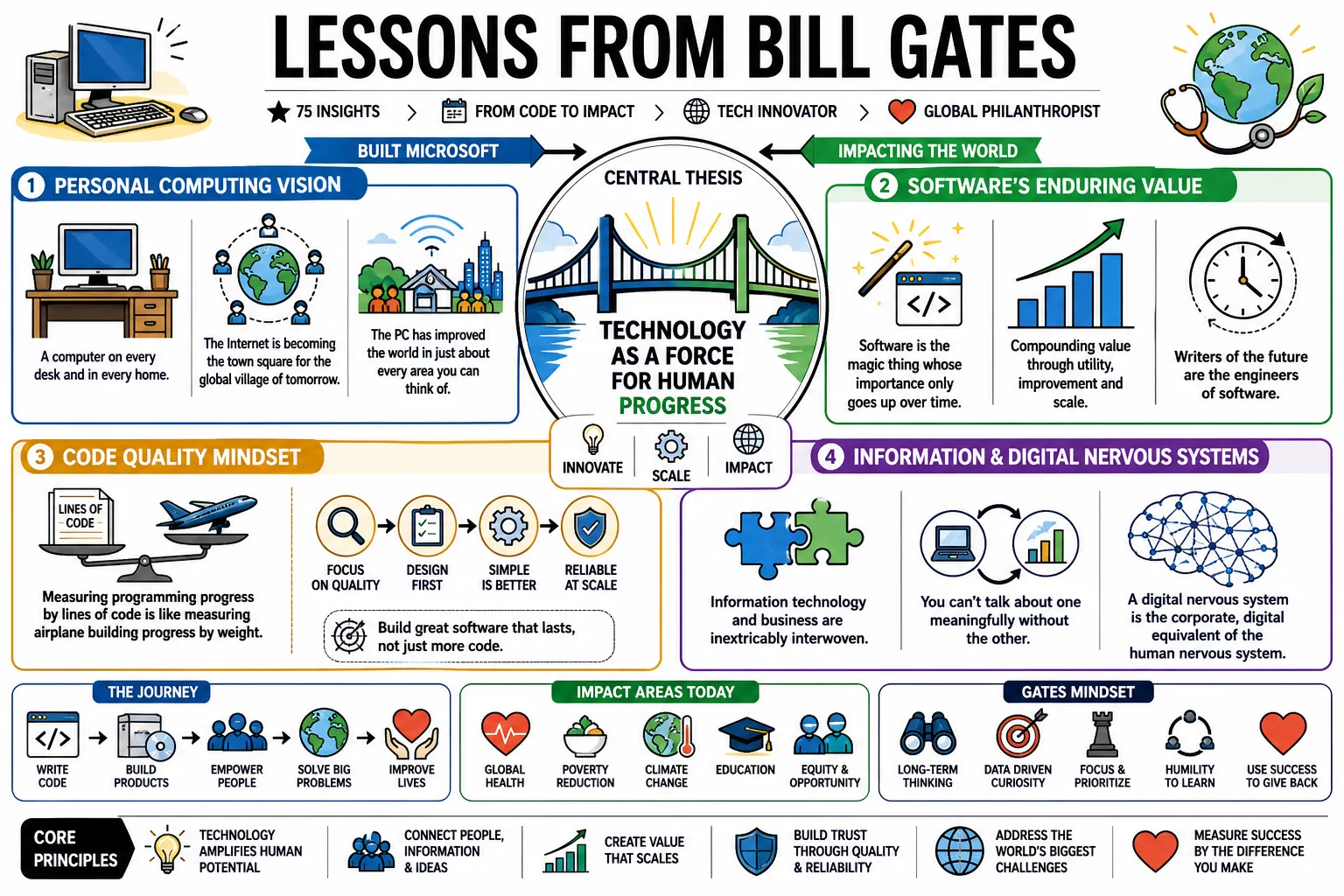
Bill Gates built Microsoft and defined the early personal computing era before shifting his focus to global health, poverty, and climate change. These 75 insights track his evolution from a fierce tech competitor to a methodical philanthropist.
Part 1: Software and Computing
- On Personal Computers: "A computer on every desk and in every home." — Microsoft News: Facts About Microsoft]
- On the Internet: "The Internet is becoming the town square for the global village of tomorrow." — GatesNotes: About Bill Gates]
- On Software's Value: "Software is the magic thing whose importance only goes up over time." — GatesNotes: About Bill Gates]
- On Code Quality: "Measuring programming progress by lines of code is like measuring airplane building progress by weight." — GatesNotes: About Bill Gates]
- On the PC Era: "The PC has improved the world in just about every area you can think of. Amazing developments in communications, collaboration and efficiencies." — Forbes: Bill Gates Profile]
- On Information Access: "Information technology and business are becoming inextricably interwoven. I don't think anybody can talk meaningfully about one without the talking about the other." — GatesNotes: About Bill Gates]
- On Digital Nervous Systems: "A digital nervous system is the corporate, digital equivalent of the human nervous system, providing a well-integrated flow of information to the right part of the organization at the right time." — GatesNotes: About Bill Gates]
- On Automation: "The first rule of any technology used in a business is that automation applied to an efficient operation will magnify the efficiency. The second is that automation applied to an inefficient operation will magnify the inefficiency." — GatesNotes: About Bill Gates]
- On Innovation Cycles: "We always overestimate the change that will occur in the next two years and underestimate the change that will occur in the next ten." — GatesNotes: About Bill Gates]
Part 2: Business Strategy and Competition
- On Customer Feedback: "Your most unhappy customers are your greatest source of learning." — GatesNotes: About Bill Gates]
- On Online Presence: "If your business is not on the internet, then your business will be out of business." — GatesNotes: About Bill Gates]
- On Risk and Rules: "Business is a money game with few rules and a lot of risk." — GatesNotes: About Bill Gates]
- On Competitive Awareness: "Whether it’s Google or Apple or free software, we’ve got some fantastic competitors and it keeps us on our toes." — GatesNotes: About Bill Gates]
- On Success as a Teacher: "Success is a lousy teacher. It seduces smart people into thinking they can't lose." — GatesNotes: About Bill Gates]
- On Capitalizing on Change: "Intellectual property has the shelf life of a banana." — GatesNotes: About Bill Gates]
- On Core Competency: "Our success has really been based on partnerships from the very beginning." — Harvard Business Review: Technology & Analytics]
- On Adapting: "In three years, every product my company makes will be obsolete. The only question is whether we will make them obsolete or somebody else will." — GatesNotes: About Bill Gates]
- On Pricing Strategy: "We are not going to be beaten on price." — GatesNotes: About Bill Gates]
- On Speed: "In the 1980s, the battle was about quality. In the 1990s, it was about reengineering. In the 2000s, it will be about velocity." — GatesNotes: About Bill Gates]
Part 3: Management and Leadership
- On Efficiency: "I choose a lazy person to do a hard job. Because a lazy person will find an easy way to do it." — GatesNotes: About Bill Gates]
- On Team Empowerment: "As we look ahead into the next century, leaders will be those who empower others." — GatesNotes: About Bill Gates]
- On Meetings: "You have a meeting to make a decision, not to decide on the question." — GatesNotes: About Bill Gates]
- On Vision: "A leader's job is to look into the future and see the organization, not as it is, but as it should be." — Harvard Business Review: Technology & Analytics]
- On Mistakes: "It's fine to celebrate success but it is more important to heed the lessons of failure." — GatesNotes: About Bill Gates]
- On Employee Value: "If you take out our top twenty employees, we become a mediocre company." — Forbes: Bill Gates Profile]
- On Sharing Bad News: "I have a natural bias to want to hear the bad news." — GatesNotes: About Bill Gates]
- On Organizational Structure: "The most important speed issue is often not technical but cultural." — GatesNotes: About Bill Gates]
- On Problem Solving: "If you show people the problems and you show them the solutions they will be moved to act." — TED: Bill Gates Speaker Profile]
Part 4: Philanthropy and Global Health
- On Disease Eradication: "Eradicating polio is one of the biggest challenges the world has ever taken on." — GatesNotes: About Bill Gates]
- On Vaccine Efficacy: "Vaccines are a miracle. With just a few doses, they can prevent deadly diseases for a lifetime." — GatesNotes: About Bill Gates]
- On Philanthropic Priorities: "All lives have equal value. We are impatient optimists working to reduce inequity." — Gates Foundation: About]
- On Child Mortality: "The number of children dying under the age of five has been cut in half since 1990, but any increase is a setback we cannot ignore." — GatesNotes: About Bill Gates]
- On Market Failures: "The market does not drive the scientists, the communicators, the thinkers, the government to do the right things. Only by paying attention and making people care can we make as much progress as we need to." — TED: Bill Gates Speaker Profile]
- On Sanitation: "To improve sanitation in developing countries, we need to reinvent the toilet so it operates without connections to water, sewer, or electrical lines." — GatesNotes: About Bill Gates]
- On Malaria: "Malaria is a disease that is a huge killer, but mostly affects people with very little political voice." — TED: Bill Gates Speaker Profile]
- On Global Aid: "Foreign aid is a phenomenal investment. It doesn't just save lives; it lays the groundwork for long-term economic progress." — GatesNotes: About Bill Gates]
- On Pandemic Preparedness: "We are not ready for the next epidemic. We need to invest in infrastructure and research the way we prepare for war." — TED: Bill Gates Speaker Profile]
Part 5: Climate Change and Energy Innovation
- On Urgency: "As passionate as I am about software, the effort to avoid a climate disaster has a whole other level of urgency. Failing to get this right will have bad consequences for humanity." — GatesNotes: About Bill Gates]
- On the Green Premium: "Lowering Green Premiums, the cost difference between a carbon-emitting product and a green alternative, is key to avoid a climate disaster." — GatesNotes: About Bill Gates]
- On Manufacturing Emissions: "Whenever I hear an idea for what we can do to keep global warming in check... I always ask this question: 'What’s your plan for steel?'" — GatesNotes: About Bill Gates]
- On Energy Innovation: "We need an energy miracle. Not something that is impossible, but a fundamental shift in how we generate power." — TED: Bill Gates Speaker Profile]
- On Nuclear Power: "Nuclear energy, in terms of an overall safety record, is better than other energy." — GatesNotes: About Bill Gates]
- On Resistance to Change: "The energy industry is simply enormous—at around $5 trillion a year... Anything that big and complex will resist change." — GatesNotes: About Bill Gates]
- On Climate Adaptation: "We must prioritize human suffering by investing in climate-smart innovations, particularly in agriculture for the world's poorest regions." — GatesNotes: About Bill Gates]
- On Carbon Taxation: "Without a large global carbon tax, market forces do not properly incentivize the creation of technologies to reduce climate-related emissions." — GatesNotes: About Bill Gates]
- On Zero Emissions: "Getting to zero means we need to replace all emitting activities with cheaper, clean alternatives." — GatesNotes: About Bill Gates]
- On Pragmatism vs. Doomsday: "While climate change is a serious threat, 'doomsday' rhetoric can divert necessary funding from immediate, life-saving health interventions." — Gates Foundation: About]
Part 6: Learning and Reading
- On Continuous Learning: "I really had a lot of dreams when I was a kid, and I think a great deal of that grew out of the fact that I had a chance to read a lot." — GatesNotes: About Bill Gates]
- On Book Reviews: "Reading fuels a sense of curiosity about the world, which I think helped drive me forward in my career and in the work that I do now with my foundation." — GatesNotes: About Bill Gates]
- On Curiosity: "I'm a big believer that as much as possible, and wherever possible, you should try to understand the world through numbers." — GatesNotes: About Bill Gates]
- On Educational Access: "Technology is just a tool. In terms of getting the kids working together and motivating them, the teacher is the most important." — GatesNotes: About Bill Gates]
- On Critical Thinking: "Don't compare yourself with anyone in this world... if you do so, you are insulting yourself." — GatesNotes: About Bill Gates]
- On Reading Habits: "I read about 50 books a year, which breaks down to about one a week. It's one of the chief ways that I learn." — GatesNotes: About Bill Gates]
- On Finishing Books: "I strictly refuse to start a book if I don't think I can finish it." — GatesNotes: About Bill Gates]
- On Marginalia: "When you read, you have to be careful that you really are concentrating. Taking notes helps make sure that I’m really thinking hard about what’s in there." — GatesNotes: About Bill Gates]
- On Mentorship: "Everyone needs a coach. It doesn't matter whether you're a basketball player, a tennis player, a gymnast or a bridge player." — TED: Bill Gates Speaker Profile]
Part 7: Wealth and Perspective
- On Inheritance: "Leaving kids massive amounts of money is not a favor to them." — Forbes: Bill Gates Profile]
- On Money's Utility: "I can understand wanting to have millions of dollars, there's a certain freedom, meaningful freedom, that comes with that. But once you get much beyond that, I have to tell you, it's the same hamburger." — GatesNotes: About Bill Gates]
- On Taxing the Rich: "I have paid more taxes than any individual ever, and gladly so, but I believe the wealthiest should pay significantly more." — GatesNotes: About Bill Gates]
- On Giving Back: "With great wealth comes great responsibility to give back to society." — The Giving Pledge: About]
- On Measurement: "I have been struck again and again by how important measurement is to improving the human condition." — Gates Foundation: About]
- On Time: "No matter how much money you have, you can't buy more time." — GatesNotes: About Bill Gates]
- On Ego: "If I'd had some set idea of a finish line, don't you think I would have crossed it years ago?" — GatesNotes: About Bill Gates]
- On Past Mistakes: "My past association with Jeffrey Epstein was a major mistake, a complete dead end, and one of the larger mistakes I have made." — GatesNotes: About Bill Gates]
- On Public Perception: "It's fine to be misunderstood as long as you're making progress on the things that matter." — GatesNotes: About Bill Gates]
- On Optimism with Footnotes: "I remain a long-term optimist regarding human progress, but that outlook is tempered by recent global setbacks in child health and political division." — GatesNotes: About Bill Gates]
Part 8: The Future and Artificial Intelligence
- On AI's Potential: "The development of AI is as fundamental as the creation of the microprocessor, the personal computer, the Internet, and the mobile phone." — GatesNotes: About Bill Gates]
- On AI in Healthcare: "AI will accelerate advancements that can help the world get back on track with global health goals within the next decade." — GatesNotes: About Bill Gates]
- On Software Capabilities: "We are moving from a world where computers help us with simple tasks to one where they assist us in solving some of the hardest problems in science and medicine." — GatesNotes: About Bill Gates]
- On Automation Risks: "We should tax the robot that takes your job to help fund retraining for other types of work." — Quartz: About]
- On Synthetic Biology: "The next great frontier is the intersection of biology and computer science, using digital tools to understand and redesign biological systems." — GatesNotes: About Bill Gates]
- On Agricultural Tech: "Digital soil mapping and advanced crop genetics are essential for adapting farming to a warmer climate." — Gates Foundation: About]
- On Truth and Misinformation: "The ability of digital tools to spread misinformation is one of the most troubling challenges we face in the coming years." — GatesNotes: About Bill Gates]
- On Next-Generation Education: "AI-driven tutors will soon provide personalized learning experiences to any student with a smartphone, anywhere in the world." — GatesNotes: About Bill Gates]
- On the Ultimate Goal: "The overarching purpose of technological advancement must be to reduce inequity and ensure that basic needs are met for everyone." — GatesNotes: About Bill Gates]