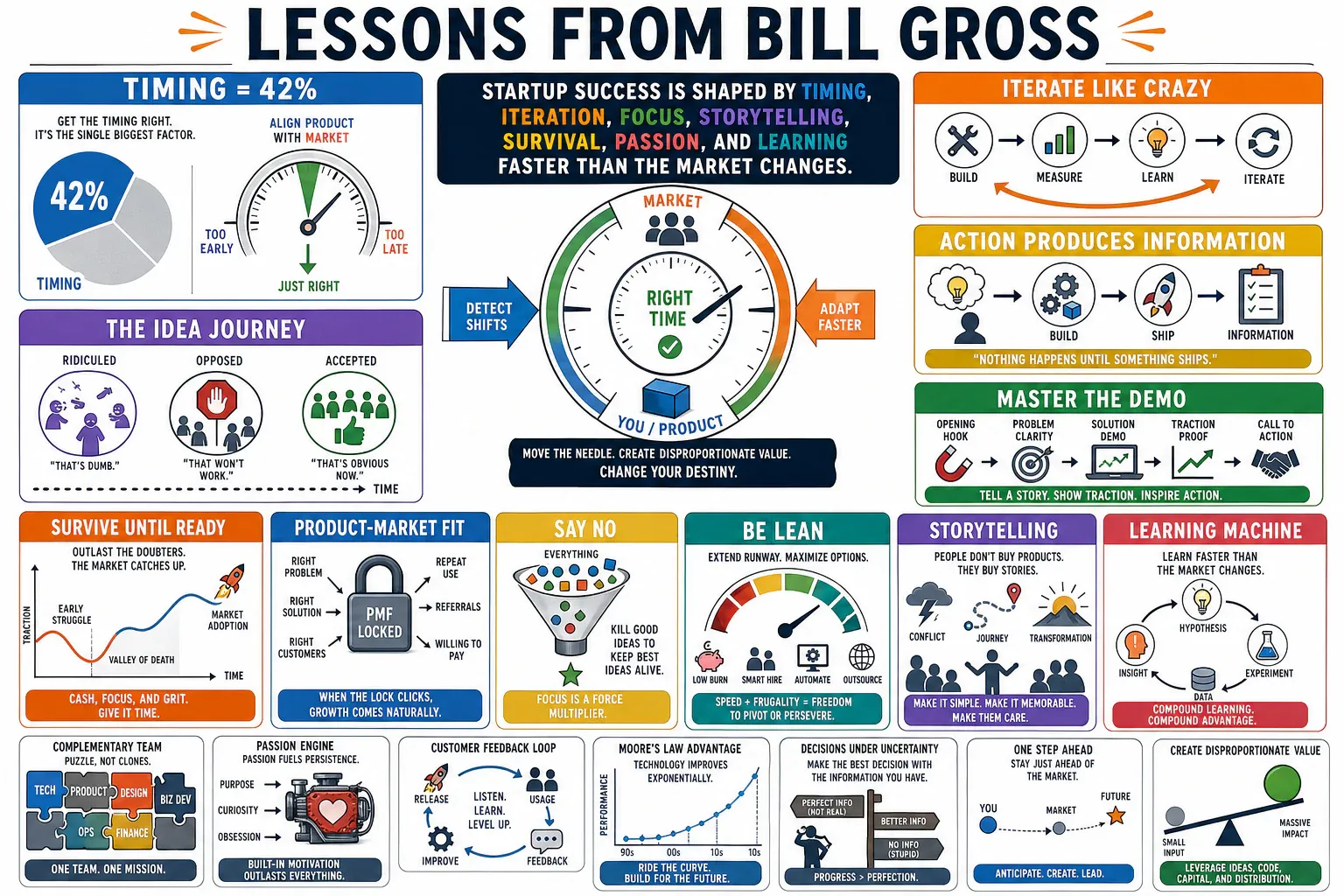
Bill T. Gross founded Idealab in 1996 to test technological solutions to important problems and turn promising ideas into independent companies. His accounts of successes and failures inform these lessons. — Marketplace — Bill Gross Interview.
- Test the timing: Gross’s retrospective comparison of 100 Idealab and 100 other startups ranked timing first among five factors; in his scoring, it accounted for 42% of the difference between success and failure. — TED — The Single Biggest Reason Why Start-Ups Succeed.
- Challenge the status quo: Gross favors ideas that solve important problems in a distinctive way, even though that choice can make the first stages harder. — Idealab — Challenge the Status Quo.
- Expect resistance to a novel idea: Gross invokes a three-stage saying he attributes to Schopenhauer to illustrate that a bold idea can be ridiculed before it gains acceptance; it is not Gross’s original maxim. — Idealab — Challenge the Status Quo.
- Iterate from customer learning: Gross says an initial idea is only a starting point; small adaptations based on customer feedback can matter more than the day-one concept. — Idealab — Iterate Like Crazy.
- Check whether the world is ready: A bold product may be ahead of its time, but Gross says crucial complements—such as broadband or GPS adoption—must be available when customers need them. — Idealab — Find Great Timing.
- Practice the demo: Gross traces his selling skills to demonstrating loudspeakers to customers and says learning to pitch, demonstrate and close was valuable to later ventures. — LeWeb 2011 — Bill Gross on Entrepreneurial Lessons.
- Choose work you care enough to sustain: Gross says purpose and passion matter because startups face difficult periods; they help a founder keep going through those periods. — Idealab — Find Your Purpose.
- Focus a startup’s effort: Gross uses Knowledge Venture to explain how narrowing the company’s scope helped it serve a specific customer base more effectively. — Idealab — Have Laser Focus.
- Build a complementary team: Gross says he initially hired people like himself, then learned to seek colleagues with different working styles and skills held together by mutual trust. — Idealab — Build a Complementary Team.
- Avoid building ahead of demand: Gross describes an Idealab company that overbuilt before the dot-com crash and argues for slower capacity growth when the market may change abruptly. — LeWeb 2011 — Bill Gross on Entrepreneurial Lessons.
- Extend runway if the market is early: Gross says that if an idea is ahead of its time, a team can sometimes wait or slow spending so the company survives until customers are ready. — Marketplace — Bill Gross Interview.
- Give enthusiastic users something to share: Gross’s LeWeb account emphasizes that customer enthusiasm and social sharing can help an offering spread, but only when the underlying experience gives people a reason to recommend it. — LeWeb 2011 — Bill Gross on Entrepreneurial Lessons.
- Use opposition as motivation: Gross’s 2024 Upfront talk urges founders pursuing a defensible bold idea to treat naysayers as motivation while still testing whether demand is real. — Upfront Summit 2024 — Bill Gross.
- Make the offer remarkable: Gross argues that a distinctive offer can reduce the amount of advertising needed to persuade customers and improve the economics of acquisition. — Idealab — Be Remarkable.
- Choose mission-aligned capital and partners: Gross prefers investors and partners who support the mission over a marginally higher valuation, and favors broad equity participation so contributors share in the outcome. — Idealab — Be Success Sensitive.
- Say no to protect focus: Gross urges founders to decide which opportunities, geographies and relationships they will not pursue, then make those boundaries clear to the team. — Idealab — Learn to Say No.
- Look for customer pull: Gross describes product-market fit as customers wanting more without being pushed; founders need close contact with customers to detect and improve it. — Idealab — Find Product-Market Fit.
- Tell the company’s story well: Gross says a clear story helps recruit people, attract investors, win customers and motivate a team; he learned to practice communicating it. — Idealab — Become a Great Storyteller.
- Run cheap learning experiments: Gross recommends stating a hypothesis, testing it with the simplest useful experiment, learning from the result and then revising the next hypothesis. — Idealab — Be Lean.
- Use failure as the next experiment: Gross says a failed attempt need not end an idea; examine what failed and try a changed approach when the underlying opportunity remains compelling. — Idealab — Try Again.
- Identify protectable differentiation: Gross urges teams to think through what is novel about their solution and whether patents or trade secrets can protect a real advantage. — Idealab — Protect Your IP.
- Watch customer demand through downturns: Gross says recessions can create openings with less competition; he recommends tracking actual users and demand while acknowledging that fundraising may get harder. — Idealab — Ignore Downturns.
- Use falling compute costs: Gross argues that embedding computation in a product can become an advantage as the cost of each additional computation falls over time. — Idealab — Use Moore’s Law.
- Spend on product and customers: Gross advises extending runway by spending on the product and customer experience while limiting expenses that do not help reach product-market fit. — Idealab — Be Frugal.
- Build a shared culture deliberately: Gross says leaders should articulate the culture, involve the team, and reinforce it through discussion so day-to-day decisions support strategy. — Idealab — Culture Eats Strategy.
- Make an investor partnership work for both sides: Gross says considering investors’ returns alongside those of founders and employees helps form durable financing relationships. — Idealab — Make Investors Money.
- Keep closing the learning gap: Gross describes a personal skill deficit as a gap to narrow through feedback and repeated improvement, and applies the same attitude to a company. — Idealab — Be a Learning Machine.
- Prepare for the next financing hill: Gross says a closed funding round is enough for the next stage, not the end of capital planning; founders should keep improving their story and relationships. — Idealab — Always Be Fundraising.
- Share enough information for distributed judgment: Gross says open financial and operational information helps team members make decisions independently, while requiring care and explanation to build trust. — Idealab — Be Transparent.
- Change course on validated new evidence: Gross argues that past spending should not force a team to continue on a failing path when credible new information points elsewhere. — Idealab — Ignore Sunk Costs.
- Pair diversity with inclusion: Gross says teams need differing experiences and viewpoints, and must also listen to them so the wider knowledge actually affects decisions. — Idealab — Embrace Diversity.
- Find essential partners for capital-heavy ideas: Gross’s LeWeb case of eSolar describes bringing in GE as a partner to support the financing and deployment that a large energy project required. — LeWeb 2011 — Bill Gross on Entrepreneurial Lessons.
- Acknowledge mistakes candidly: Gross’s direct talk urges leaders to say what they mean and describe outcomes honestly, contrasting that with his earlier over-optimistic commitments. — First Round Capital — Bill Gross on Failure.
- Make timely, revisable decisions: Gross says a reasonably good decision made promptly can beat pursuit of a perfect decision that never arrives; startups use speed against larger rivals. — First Round Capital — Bill Gross on Failure.
- Give collaborators credit: Gross urges founders to acknowledge contributions by teammates, boards and others rather than claim all successes personally. — First Round Capital — Bill Gross on Failure.
- Let the team adapt to customers: Gross says team execution includes learning from customers and adjusting when reality challenges the original plan. — TED — The Single Biggest Reason Why Start-Ups Succeed.
- Validate demand before perfecting monetization: Gross notes that a business model can sometimes be added later if customers strongly demand the product; he does not say monetization is always easy. — TED — The Single Biggest Reason Why Start-Ups Succeed.
- Find ideas in important problems: Gross describes Idealab as looking for consequential problems and prototyping technological answers, while his own passion helps him persist. — Marketplace — Bill Gross Interview.
Quotes from Bill T. Gross
“If you take a group of people with the right equity incentives and organize them in a startup, you can unlock human potential in a way never before possible. You get them to achieve unbelievable things.” — TED — The Single Biggest Reason Why Start-Ups Succeed
“We are trashing the earth.” “The world is completely ready (for clean energy). I am very passionate about making this a reality in my lifetime.” — dot.LA — Upfront Summit Report
“When you first start out with your idea, if it is a bold new idea that challenges status quo, you could be ridiculed. … But if you push through those first 2 phases, and people then look back at what you did as being self-evident, then you have truly changed the world.” — Idealab — Challenge the Status Quo
“I really feel it’s very important to pick an idea that really makes a difference in the world. That makes it harder for sure, but it also in some ways improves your chances of success.” — Idealab — Challenge the Status Quo
“Business really is a journey and you have to take into account everything you learned along the way, to really make something better and better each time.” — Idealab — Try Again
“If you learn from everything you just did, you could turn that into much, much more than what you paid for that class.” — Idealab — Try Again
“I probably even shouldn’t have called it Idealab; I should have called it Iterate Lab.” — Idealab — Iterate Like Crazy
Learn more:
- TED — The Single Biggest Reason Why Start-Ups Succeed
- LeWeb 2011 — Learning From Failure: 20 Years of Entrepreneurial Lessons
- Idealab — Bill Gross’s 25 Lessons From 25 Years of Creating Companies
- Marketplace — Interview Transcript With Bill Gross
- Upfront Summit 2024 — Applying 50 Years of Entrepreneurial Learning to Climate and AI
- First Round Capital — What Bill Gross Learned From Starting 100 Companies
- DLD Munich 2024 — 10 Crucial Lessons for Success
- dot.LA — Bill Gross at the Upfront Summit on Climate Technology