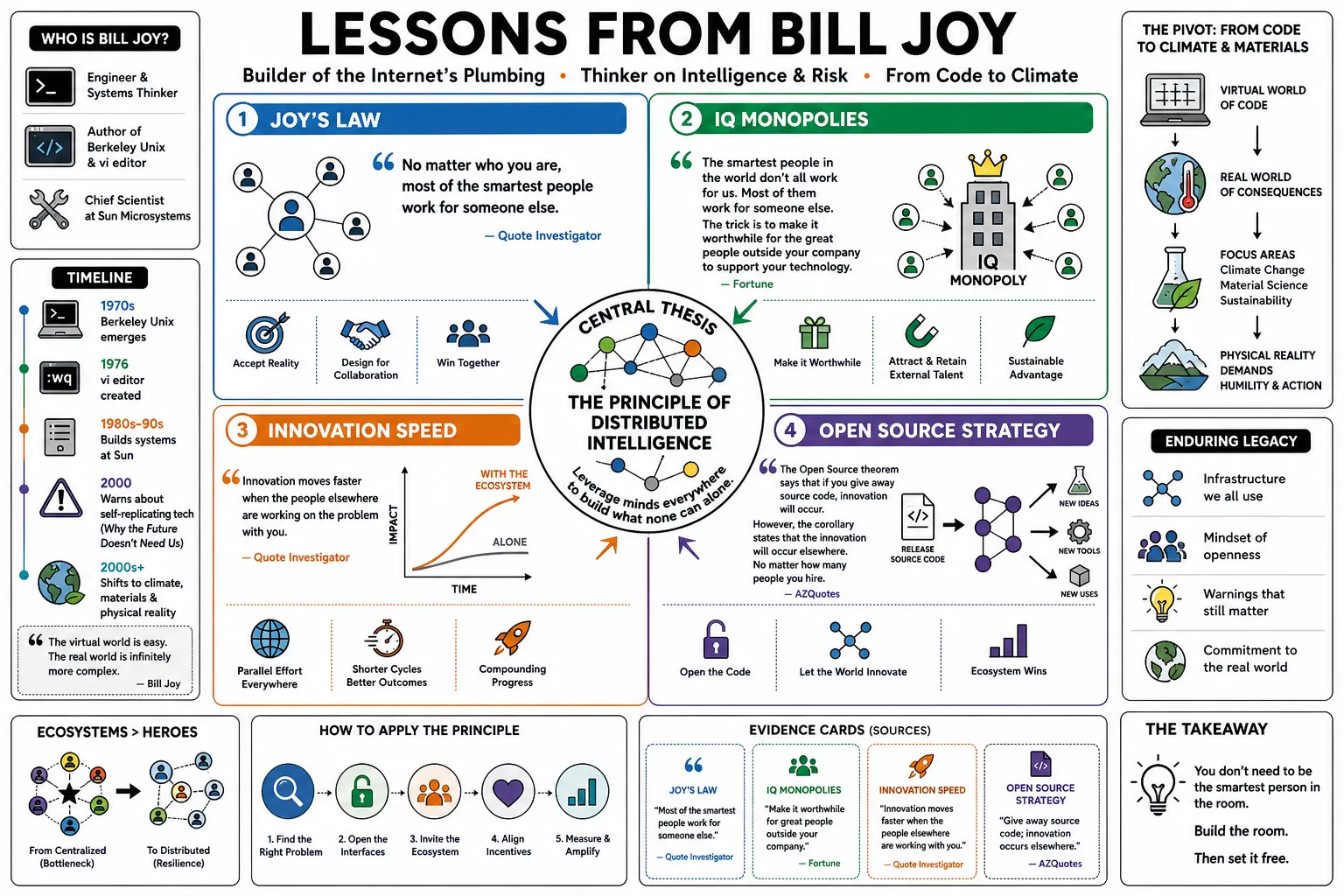
Lessons from Bill Joy
Bill Joy helped develop Berkeley Unix and vi, co-founded Sun Microsystems, and later wrote about the risks of self-replicating technologies. His subsequent investments turned toward difficult physical problems in climate and materials. — Computer History Museum Oral History.
Part 1: The Principle of Distributed Intelligence
- On Joy’s Law: An organization cannot employ all the relevant talent; Joy argues that its technology should give outsiders a way to contribute to progress. — Wired — Creating One Huge Computer.
- On IQ Monopolies: A platform can benefit from talented people beyond its payroll when it makes their contributions worthwhile, rather than trying to monopolize expertise internally. — Wired — Creating One Huge Computer.
- On Open Source Strategy: Joy argues that releasing source can stimulate innovation, while warning that many of the most valuable improvements will happen outside the company that released it. — Wired — Creating One Huge Computer.
- On Ecosystems vs. Monopolies: Joy favors interoperable components and federated systems over a single ever-growing software monolith; the architecture invites more ways for others to build. — Wired — Creating One Huge Computer.
- On Collaborative Platforms: Joy observes that startup teams can solve difficult technical problems faster when they can call on expertise from several disciplines. — Fast Company — 60 Seconds with Bill Joy.
Part 2: The Craft of Software Engineering
- On Operating Systems: Joy criticizes operating systems whose size and complexity make reliable behavior and debugging difficult. — Wired — Creating One Huge Computer.
- On the Creation of vi: Joy developed vi’s screen editor while adapting Berkeley’s earlier Unix editing tools for the terminals available to him. — Unix Review — Bill Joy Interview (archived).
- On User Interface Constraints: Looking back on vi, Joy said using nearly every keyboard key limited what the editor could do later; he also reflected on the costs and benefits of its modes. — Unix Review — Bill Joy Interview (archived).
- On Writing TCP/IP: Berkeley’s TCP/IP implementation needed substantial rewriting to run at Ethernet wire speed; Joy distinguishes protocol limits from weak early implementations. — Computer History Museum Oral History.
- On System Responsiveness: Joy recalls how slow terminal response shaped Unix editing choices: even a prompt could impose a noticeable delay on the hardware then available. — Unix Review — Bill Joy Interview (archived).
- On Software Fragility: Having built software and microprocessors, Joy warns that complex systems can fail in ways their designers did not foresee. — Wired — Why the Future Doesn’t Need Us.
- On Antique Languages: Joy argued in 2003 that network-facing programs written in C were harder to secure than systems built with stronger language rules; this was his contemporary engineering judgment. — Fortune — Joy After Sun.
- On Performance Logic: Joy’s Berkeley team rewrote network code to avoid slow-path behavior and make TCP/IP practical on faster local networks. — Computer History Museum Oral History.
- On Modal Editors: Joy saw vi’s modes as a workable design for their time, but noted that a modeless and programmable editor offered advantages he had not fully built in. — Unix Review — Bill Joy Interview (archived).
- On Software Regret: Joy called vi’s redisplay module almost intractable, an example of how optimizing while learning can leave difficult code behind. — Unix Review — Bill Joy Interview (archived).
Part 3: The Architecture of the Networked World
- On the Networked Computer: Joy anticipated that falling chip and bandwidth costs would make connected devices cheap enough to become pervasive and, eventually, disposable. — Wired — Creating One Huge Computer.
- On Network Objects: Joy wanted to move network programming beyond TCP/IP’s bits and bytes toward objects that join data and code in a more reliable distributed system. — Artima — The Jini Vision.
- On Hardware as a Vessel: Sun recruited Joy because its founding team needed software expertise; the workstation’s usefulness depended on the operating-system and network stack as well as the hardware. — Computer History Museum Oral History.
- On RISC Philosophy: Joy backed a RISC architecture when the existing Motorola processor line no longer met Sun’s performance ambitions, despite the difficulty of chip-development tools at the time. — Computer History Museum Oral History.
- On Jini Federation: Joy argued that varied devices cannot be managed as one monolithic program; Jini’s federation lets services cooperate across a network. — Artima — The Jini Vision.
- On Mobile Code: Joy said the JVM was built to let objects move among machines, a design ambition later reflected in Jini. — Artima — The Jini Vision.
- On Spontaneous Networking: Jini aimed to let networked devices discover and use services without a single controlling machine. — Artima — The Jini Vision.
- On the End of the Desktop: Joy anticipated communications-focused devices that could serve people who did not need a conventional desktop computer. — Artima — The Jini Vision.
- On Java’s Domain: Joy distinguished mature Unix for data centers from Java’s suitability, in his view, for portable software on small networked devices. — Wired — Creating One Huge Computer.
Part 4: The Ethics of Emerging Technologies
- On Existential Threat: Joy warned that robotics, genetic engineering and nanotechnology could create unusually severe risks for humanity; he presented this as a danger to examine, not an observed outcome. — Wired — Why the Future Doesn’t Need Us.
- On Self-Replication: Self-replication makes some new technologies harder to contain than a one-off weapon: a single replicator can multiply and escape control. — Wired — Why the Future Doesn’t Need Us.
- On Knowledge-Enabled Destruction: Joy worried that knowledge-based tools could put destructive capabilities within reach of individuals or small groups without rare materials or large facilities. — Wired — Why the Future Doesn’t Need Us.
- On the Hubris of Progress: Joy argues that the promise of new technology does not remove the duty to examine its misuse and unintended effects before deployment. — Wired — Why the Future Doesn’t Need Us.
- On Machine Dependence: Joy engages with a warning by Theodore Kaczynski about machine dependence, explicitly rejecting Kaczynski’s violence while treating the loss-of-control problem as worth confronting. — Wired — Why the Future Doesn’t Need Us.
- On the Perfection of Evil: Joy warns that knowledge-enabled technologies could empower small groups to cause harm on a scale previously associated with state weapons. — Wired — Why the Future Doesn’t Need Us.
- On Evolutionary Displacement: Joy worries that competition among adaptive systems may favor machines even when people intend to remain in control. — Wired — Why the Future Doesn’t Need Us.
- On Post-Biological Futures: Joy questions whether a person copied into a robotic system would retain recognizably human identity; he separates his concern from Kurzweil’s optimism. — Wired — Why the Future Doesn’t Need Us.
Part 5: The Venture into Physical Reality
- On Bits vs. Atoms: Joy contrasts rapidly distributing an app to millions with the years needed to manufacture and deploy physical technologies such as batteries. — Al Jazeera — Bill Joy on Climate Investing.
- On Green Tech Urgency: Joy treated climate and environmental problems as reasons to back difficult physical technologies, not only fast-growing internet software. — Wired — Bill Joy on Clean Tech.
- On Physical Innovation: Joy turned from the virtual world toward financing physical technologies with the potential to reduce environmental harm. — Al Jazeera — Bill Joy on Climate Investing.
- On 10x Improvements: For grid storage, Joy sought material advances that could make batteries safer and cheaper at scale; he treated the cost targets as aspirations, not achieved results. — IEEE Spectrum — Bill Joy on Batteries.
- On Investment Focus: Joy cautioned that conventional venture investors often backed away from health and environmental technologies because they were difficult and slow to scale; he chose to pursue them nonetheless. — Wired — Bill Joy on Clean Tech.
- On the Green Revolution: Joy hoped that hard clean-tech ventures could become as consequential to sustainability as the leading internet companies had been to the digital economy. — Wired — Bill Joy on Clean Tech.
- On Hard Science: Joy argues that health and environmental problems require dealing with atoms and materials, which is slower but critical compared with purely digital ventures. — Wired — Bill Joy on Clean Tech.
Part 6: The Discipline of Scientific Discovery
- On Naive Problem Solving: Joy sometimes favored trying and shipping a promising idea before every difficulty was settled in theory. — Wired — Creating One Huge Computer.
- On Forward Thinking: Joy sought conceptual breakthroughs in computing rather than merely extending the prevailing desktop and monolithic-software model. — Wired — Creating One Huge Computer.
- On Overestimating Design: Joy warns that engineers may overestimate their ability to design or control powerful, complex technologies. — Wired — Why the Future Doesn’t Need Us.
- On Systematic Failures: Joy emphasizes that accidents in complex systems can arise from feedback and unintended interactions without any malicious actor. — Wired — Why the Future Doesn’t Need Us.
- On Curiosity: Joy separates software architecture from line-by-line coding: stepping away from the terminal helped him decide what the system should do before implementing it. — Computer History Museum Oral History.
- On the Power of Simplicity: Joy argues that large distributed programs need simpler structure and consistent architectural concepts to be understandable and reliable. — Fortune — Joy After Sun.
- On Learning from Failure: When designing mission-critical software, Joy planned for component failure and for preserving clues that would make root causes diagnosable. — Computer History Museum Oral History.
Part 7: The Responsibility of the Creator
- On Personal Responsibility: Joy calls on scientists and engineers to accept personal responsibility for technologies capable of large-scale harm. — Wired — Why the Future Doesn’t Need Us.
- On the Right to Pursue Knowledge: Joy questions whether pursuing every kind of knowledge is justified when some developments may create unacceptable existential risks. — Wired — Why the Future Doesn’t Need Us.
- On Relinquishment: Joy proposes limiting development of the most dangerous applications of genetics, nanotechnology and robotics, while recognizing the difficulty of verification. — Wired — Why the Future Doesn’t Need Us.
- On Atomic Parallelism: Joy cites atomic scientists’ experience as a reason to take responsibility early, before dangerous work outruns ethical and political control. — Wired — Why the Future Doesn’t Need Us.
- On Ethical Lags: Joy argues that scientific capability has advanced faster than society’s ability to assess and govern its possible harms. — Wired — Why the Future Doesn’t Need Us.
- On Designer Pathogens: Joy worries that biological designs could be replicated and shared as knowledge, lowering the barrier for small groups to cause severe harm. — Wired — Why the Future Doesn’t Need Us.
- On Regulatory Precedent: Joy points to the Biological Weapons Convention as a precedent for restraint, but says commercial GNR research would require much harder verification. — Wired — Why the Future Doesn’t Need Us.
- On Problem Anticipation: Joy identified a recurring product mistake of his own: designing solutions before potential users recognized the problem they solved. — Fortune — Joy After Sun.
Part 8: The Strategy for a Sustainable Future
- On Livestock Emissions: Joy backed Beyond Meat as one way to address the climate impact of animal agriculture; the old 14.5% statistic was journalist context, not his verbatim claim. — Al Jazeera — Bill Joy on Climate Investing.
- On the Decarbonization Big Three: Joy linked Beyond Meat, Solidia and Ionic Materials to food, cement and energy emissions, estimating that their target sectors account for roughly half of global greenhouse gases. — Al Jazeera — Bill Joy on Climate Investing.
- On Innovation Speed vs. Moats: Joy described actively searching for hard clean-tech opportunities instead of waiting for deals to arrive; he framed investment advantage as finding and building such solutions. — Wired — Bill Joy on Clean Tech.
- On Investor Impatience: Joy said climate companies often need much longer to scale than software, which can deter venture investors; Ionic Materials was his example. — Al Jazeera — Bill Joy on Climate Investing.
- On Energy Storage: Joy saw safe, inexpensive grid-scale batteries as a way to make wind and solar power more dependable; his cost estimates were goals, not commercial results. — IEEE Spectrum — Bill Joy on Batteries.
- On Materials Science: Joy invested in lower-carbon cement and battery materials because decarbonization requires changes to high-emission physical processes. — Al Jazeera — Bill Joy on Climate Investing.