Bill McDermott is the CEO of ServiceNow, following a near-decade run moving SAP to the cloud. He pairs a hard-driving sales culture with an emphasis on personal relationships. This profile covers his approach to enterprise execution and customer focus, as well as how he led through severe personal adversity.
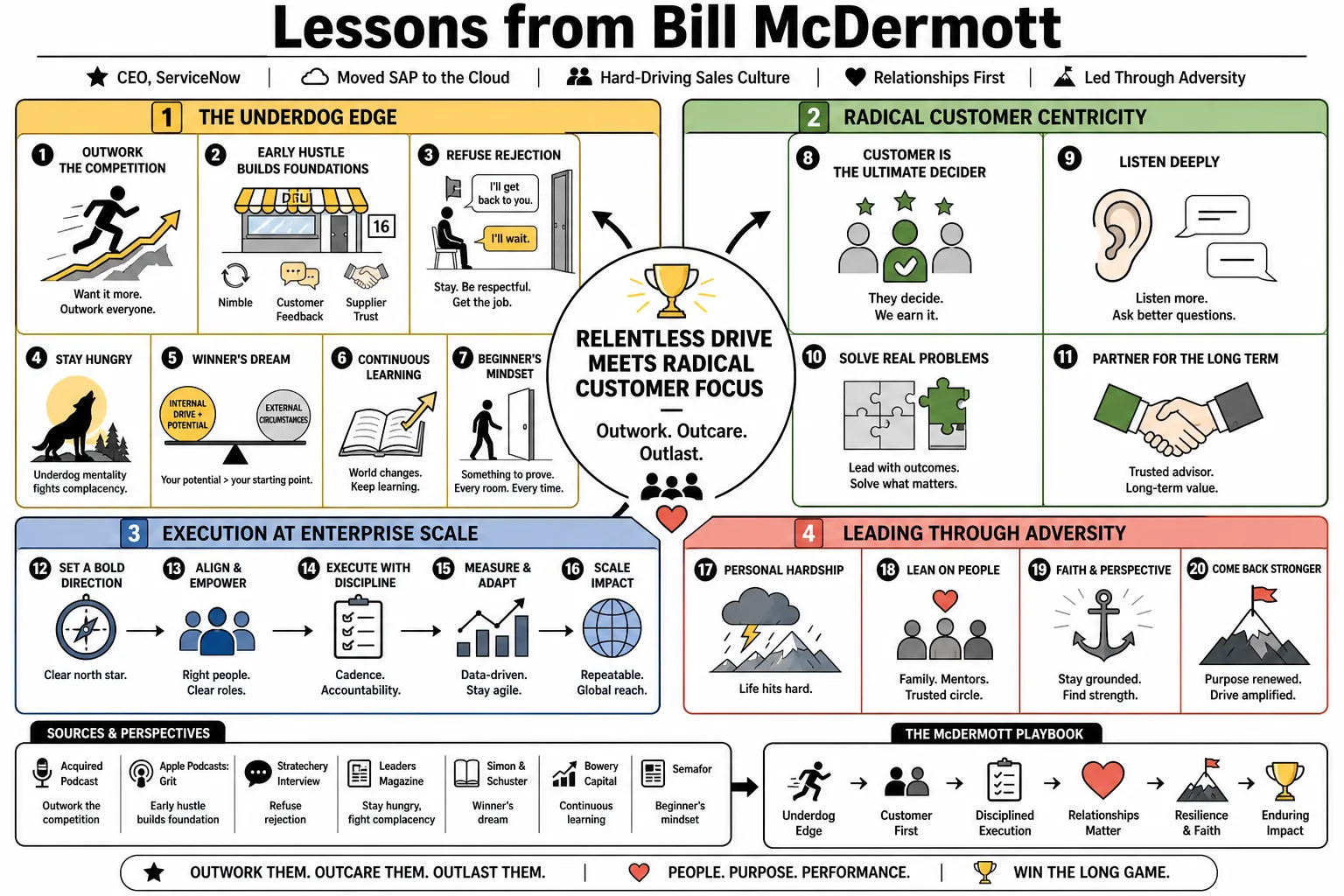
Part 1: The Underdog Edge
- On outworking the competition: Success often comes down to wanting the opportunity more than anyone else in the room and being willing to outwork them to secure it. — Reference: Acquired Podcast
- On the value of early hustle: Running a local deli at age 16 taught the fundamental business lesson that survival requires being nimble, prioritizing customer feedback, and earning trust with suppliers. — Reference: Apple Podcasts: Grit
- On refusing rejection: When a hiring manager tells you they will get back to you, sometimes the most effective response is politely refusing to leave the waiting room until you get the job. — Reference: Stratechery Interview
- On staying hungry: Never take success for granted; an underdog mentality creates a culture that actively fights against complacency. — Reference: Leaders Magazine
- On the definition of a winner's dream: Realize that your internal drive and potential will always be greater than your external circumstances or starting point. — Reference: Simon & Schuster
- On continuous learning: The business landscape shifts constantly, meaning you must stay adaptable and commit to continuous growth to remain relevant. — Reference: Bowery Capital
- On maintaining a beginner's mindset: Approach every room and every challenge as if you still have something to prove, rather than resting on past successes. — Reference: Semafor
Part 2: Radical Customer Centricity
- On the ultimate decider: Your customers are the ones who ultimately determine whether you have a job, making their attitude toward you the single most important factor in your success. — Reference: Success Magazine
- On reducing friction: Empower employees to act quickly to remove obstacles for clients; if a decision is genuinely right for the customer, teams should just execute it. — Reference: Selling Power
- On empathy in sales: You cannot sell to or lead people effectively until you genuinely understand their daily challenges, needs, and perspectives. — Reference: Inc. Magazine
- On sweating the details: Avoid treating client accounts as mere numbers; success requires understanding the granular details of every account and treating each stakeholder with respect. — Reference: Success Magazine
- On aligning goals: Focus entirely on understanding what customers need and delivering it, knowing that revenue growth and market valuation are natural byproducts of that alignment. — Reference: Sierra Ventures
- On the sales-to-CEO path: A background in sales provides a distinct advantage in executive leadership because it grounds your decision-making in the reality of customer needs and market dynamics. — Reference: Selling Power
Part 3: Leadership and Culture
- On setting standards: Treat performance as the basis for autonomy: when people deliver against clear standards, leaders can give them more freedom to act. — Reference: Sierra Ventures
- On hiring philosophies: Hire top-tier talent and get out of their way. If you compromise and hire lower-tier talent, you must invest heavily in immediate coaching rather than moving mediocrity around. — Reference: Sierra Ventures
- On the currency of leadership: Trust is the ultimate human currency, and leaders must build it long before challenges or crises arise. — Reference: Chief Executive
- On clearing the path: A significant portion of an executive's role is providing "air cover"—removing internal bureaucracy and obstacles so teams can focus purely on execution. — Reference: Semafor
- On followership: Great leaders demonstrate to young talent that their personal aspirations and dreams are valued and have a meaningful place within the broader organization. — Reference: Inc. Magazine
- On leadership by presence: A CEO's calendar and physical availability to their team sends a far stronger message about priorities than any company-wide memo. — Reference: Sierra Ventures
- On the necessity of over-communicating: If a strategy or goal is worth communicating at all, it is almost certainly being under-communicated to the broader team. — Reference: Semafor
- On execution over vision: Even the most brilliant strategic ideas will fail if they are not supported by the workforce and backed by disciplined, rigorous execution. — Reference: Simon & Schuster
- On playing for higher stakes: Leaders need to connect their team's daily work to a higher purpose, proving that the organization is playing for stakes that go beyond mere financial return. — Reference: Stratechery Interview
Part 4: AI, Strategy, and Enterprise Execution
- On the AI labor gap: Artificial intelligence is not just a trend but an inevitability driven by a projected massive global labor shortage, making it necessary to fill gaps that humans physically cannot. — Reference: Stratechery Interview
- On enterprise AI governance: The AI race in the enterprise world will be won by the organizations that can make these tools deterministic, governable, and safe for daily operations. — Reference: Silicon Angle
- On technology serving humanity: AI should be deployed to liberate employees from routine, manual labor so they can focus on higher-value tasks that require human ambition and creativity. — Reference: Medium
- On bridging the hype cycle: While AI dominates headlines, only a small fraction of enterprises have actually integrated it into impactful business processes, representing a massive execution opportunity. — Reference: Stratechery Interview
- On disciplined scale: Big dreams are useless without disciplined execution—the ability to take visionary ideas and apply rigorous, repeatable processes to scale them in the real world. — Reference: Simon & Schuster
- On focusing on strengths: Double down on what you and your organization are best at; extreme focus on core competencies makes a business nearly unstoppable. — Reference: Acquired Podcast
- On proving value instead of extending pilots: Enterprise buyers are tired of demonstrations that never scale. Build against a real operational problem, deploy quickly, and measure a business outcome rather than celebrating another proof of concept. — Reference: Sierra Ventures
- On integrating before automating: Business processes cross departmental and technology boundaries, so AI creates more value when the underlying workflow connects models, clouds, and data instead of adding isolated tools. — Reference: Sierra Ventures
- On organizing around the customer: AI adoption should eventually reshape the company around customer outcomes and cross-functional work, rather than preserving an org chart that fragments the workflow. — Reference: Sierra Ventures
Part 5: Resilience and Vulnerability
- On getting back up: People will not judge you for being knocked down by unexpected tragedies or failures; they will judge you entirely by how quickly and with what resolve you stand back up. — Reference: Business Insider
- On transparency during crisis: Leaders should not hide their personal struggles or pain; openly sharing vulnerability builds deeper trust because the soft stuff is the real stuff. — Reference: Chief Executive
- On vision beyond sight: After losing an eye, McDermott argued that leadership capacity rests on curiosity, compassion, knowledge, and feeling rather than physical sight. — Reference: Silicon Angle
- On reframing adversity: When faced with a life-altering tragedy, you have the choice to view the event not as a defeat, but as an opportunity to demonstrate character and forge a new path. — Reference: Leaders Magazine
- On the power of optimism: Maintaining a positive outlook during difficult circumstances is not naive; it is a strategic advantage that serves as a stabilizing rock for your employees. — Reference: Apple Podcasts: Grit
- On defining success: A near-death experience clarifies that material success pales in comparison to the importance of people, family, and love. — Reference: Quartz
- On balance and integrity: Maintaining your personal integrity and keeping a balanced life with loved ones is the true foundation for sustaining long-term professional success. — Reference: Simon & Schuster
- On the true nature of winning: Winning is the continuous process of striving to be kinder, more rigorous, and more inspiring, rather than a final destination to be reached. — Reference: Simon & Schuster