Dr. Bob Rotella is arguably the most influential sport psychologist in the world, particularly in the game of golf. For decades, he has coached top athletes, executives, and performers on how to handle pressure and achieve a mindset geared for success. His philosophy is rooted in concepts of confidence, process-orientation, and optimism.
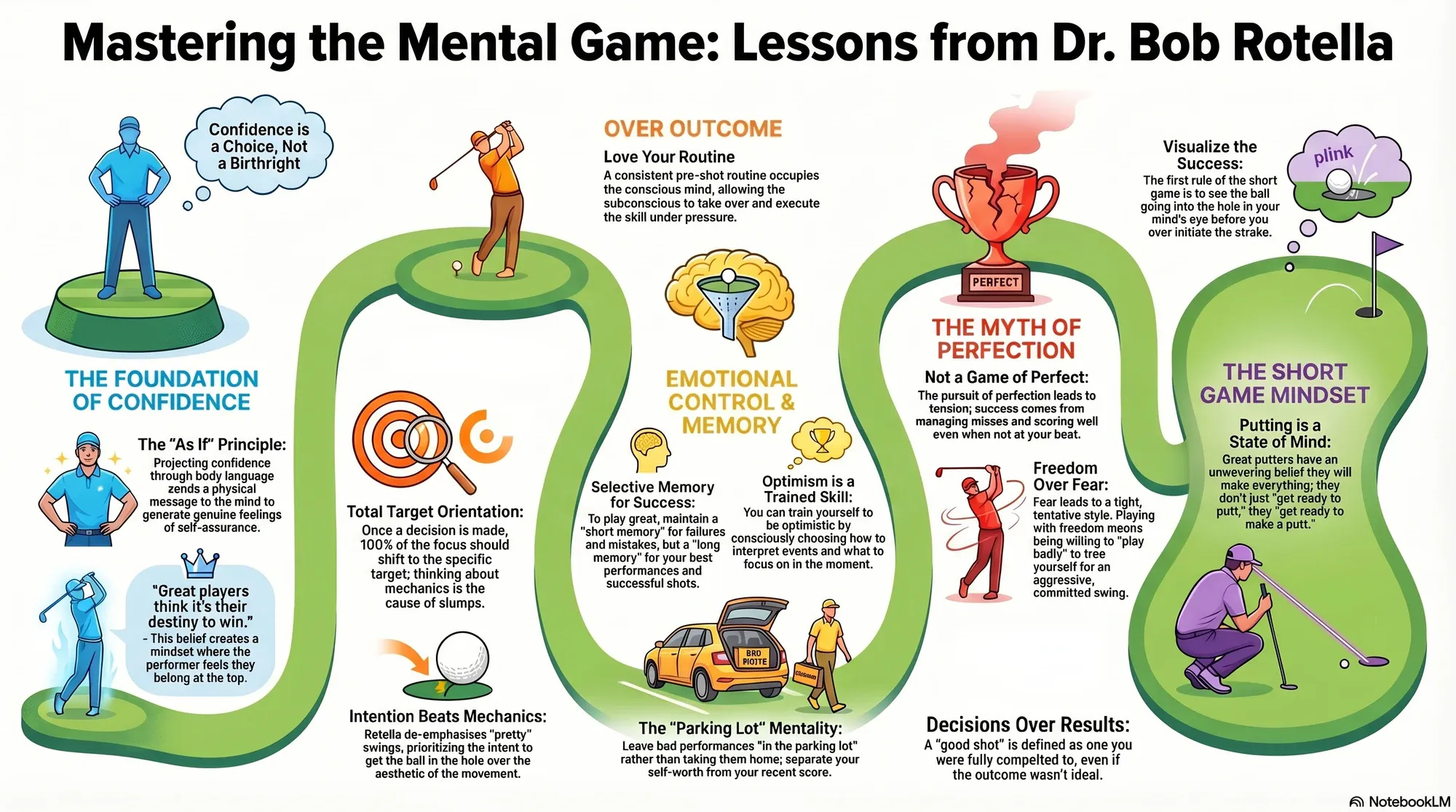
On Confidence and Belief
- “Confidence is the most important single factor in this game, and the most important single factor in either learning it or playing it well.”
- Source: Golf Is Not a Game of Perfect
- Learning: Rotella places unwavering belief in oneself above all else. He argues that talent is useless without the confidence to apply it under pressure.
- “I believe that unconditional self-confidence is a C-skill, not a B-skill or an A-skill. It is the core of your attitude.”
- Source: The Golfer's Mind: Play to Play Great
- Link: Goodreads
- In the same Golf Digest piece he says golfers who understand and love the game accept it rather than fight it, realizing that the essence of golf is reacting well to inevitable mistakes and misfortunes. [4]
- “Your best golf is played with a quiet mind.”
- Source: Golf Is Not a Game of Perfect
- Learning: Confidence quiets the analytical, fearful part of the brain, allowing the subconscious mind and trained skills to take over.
- “Great players think it’s their destiny to win.”
- Source: The Unbeatable Mind
- Learning: This isn't arrogance, but a deep-seated belief that they belong at the top and are meant to succeed.
- “Confidence isn't something you're born with. It's something you choose to have.”
- Source: General teaching, widely attributed.
- Link: Success.com
- “If you don't believe in yourself, nobody else will.”
- Source: A core tenet of his philosophy.
- Learning: Self-belief is the foundation upon which all peak performance is built. It must come from within.
- “Act the way you want to be. Your body language will send a message to your mind.”
- Source: A recurring theme in his coaching.
- Learning: Projecting confidence—walking tall, smiling, keeping your head up—can actually generate genuine feelings of confidence.
On Process and Target-Orientation
- In his own list of rules on mental fitness he calls this staying in the present: not allowing yourself to be seduced by a score or by winning until you run out of holes, but instead getting lost in the process of executing each shot and accepting the result. [1]
- “The target is the only thing you should be thinking about.”
- Source: Putting Out of Your Mind
- Learning: Once you have made a decision, your entire focus should shift to the target, not your technique or the potential for error.
- “Once you address the ball, a child should be able to walk up and ask you where you are aiming, and you should be able to tell him.”
- Source: Golf Is Not a Game of Perfect
- Learning: This illustrates the need for a crystal-clear, specific target in your mind before you initiate your swing or stroke.
- In a Golf Digest column, Rotella framed this as trust rather than aesthetics: one of his own process goals for a round is simply that he will trust himself and his swing on every shot, since he doesn't have absolute control of where the ball goes but does have absolute control of whether he trusts himself. [7]
- “Thinking, not hitting, is the cause of all slumps.”
- Source: The Golfer's Mind: Play to Play Great
- Link: Goodreads
- He puts it this way in his own list of rules on mental fitness: he tells players to follow a mental and physical routine on every shot, because it keeps you focused on what you have to do, and when the pressure is on, it helps you manage your nerves. [2]
On Attitude and Emotional Control
- “I’m going to be a very happy person, and I’m going to have a great attitude, and I’m going to be a person that loves life.”
- Source: A mindset he encourages athletes to adopt daily.
- Link: YouTube - Bob Rotella on Attitude
- He warns in the same rules that the worst thing you can do for your prospects of winning is to get down when things don't go well, since feeling sorry for yourself or thinking the golf gods are conspiring against you just means you aren't focused on the next shot. [3]
- In the same Golf Digest column, Rotella describes staying in the present not with that exact line but in his own words: of all the concepts he teaches, staying in the present is perhaps the simplest, yet also one of the hardest to actually practice on the course. [6]
- In a first-person Golf Digest column, Rotella's actual framing of anger is less permissive than getting angry at the right things: he treats anger and frustration themselves as impediments to good play, arguing that being angry pulls your focus away from the only shot that actually matters, the next one. [5]
- “Optimism is a learned skill, not a personality trait.”
- Source: The Unbeatable Mind
- Learning: You can train yourself to be more optimistic by consciously choosing how you interpret events and what you focus on.
- “If you want to play great, you have to have a short memory for bad shots and a long memory for good ones.”
- Source: A classic Rotella-ism.
- “Never let the last shot affect the next one.”
- Source: Golf Is Not a Game of Perfect
On Putting and the Short Game
- “Great putting is a state of mind.”
- Source: Putting Out of Your Mind
- Learning: Technique is important, but great putters have an unwavering belief that they are going to make everything.
- “Fall in love with the process of making putts.”
- Source: Putting Out of Your Mind
- Link: Amazon
- “The first rule of putting is to see the ball go in the hole in your mind’s eye.”
- Source: Putting Out of Your Mind
- “Don’t get ready to putt. Get ready to make a putt.”
- Source: A subtle but powerful distinction in mindset.
- Learning: Approach every putt with the intention and expectation of making it, not just hitting it close.
- “There are two things you can control in putting: your routine and your attitude.”
- Source: Putting Out of Your Mind
On Perfectionism and Fear
- “Golf is not a game of perfect.”
- Source: Golf Is Not a Game of Perfect
- Learning: His most famous maxim. The pursuit of perfection leads to tension and frustration. The goal is to manage your misses and score well even when you aren't playing your best.
- “Trying to be perfect is the number one enemy of good.”
- Source: A central theme of his work.
- “Freedom is the opposite of fear.”
- Source: The Unbeatable Mind
- Learning: Playing with fear leads to a tight, controlled, and tentative style. Playing with freedom is fluid, athletic, and trusting.
- “To play great, you must be willing to play badly.”
- Source: Golf Is Not a Game of Perfect
- Learning: You cannot be afraid of the consequences of a bad shot. Accepting that possibility frees you to make an aggressive, committed swing.
- “The fear of failure is the number one reason people don’t reach their potential.”
- Source: The Unbeatable Mind
Additional Wisdom and Learnings
- “You have to go out and get it. Nobody is going to give it to you.”
- “Practice doesn't make perfect. Practice makes permanent.” - Emphasizing the need for mindful, high-quality practice.
- “Love your wedges. They are your scoring clubs.”
- Learning: The "Parking Lot" Mentality. "Leave your bad rounds in the parking lot. Don't take them home with you."
- “It’s amazing what you can accomplish when you don’t care who gets the credit.”
- “Stats are for after the round, not during it.”
- “A shot is a thought. A great shot is a great thought.”
- Learning: Train your subconscious. "Your best performances happen when you're not thinking, when you're on autopilot. That autopilot is trained in practice."
- “The will to win is important, but the will to prepare is vital.”
- “Your mind is your most powerful weapon. But it can also be your worst enemy.”
- “Be decisive. An aggressive swing with the wrong club is better than a tentative swing with the right one.”
- “Stay patient. Let the round come to you.”
- “Simplify everything. The game is simple. We make it complicated.”
- “Don’t worry about what other people are thinking. They are too busy worrying about what you are thinking.”
- Learning: The "As If" Principle. "Act 'as if' you are already the confident, successful player you want to be."
- “Your self-talk is the script that dictates your performance.”
- “Winners see what they want to have happen. Losers see what they are afraid will happen.”
- “The definition of a good shot is one that you are committed to.”
- “Have fun. If you’re not enjoying it, you’re doing it wrong.” - The ultimate reminder that a positive, joyful approach is essential for long-term success and peak performance.
Learn more:
- Dr. Bob Rotella: My 10 Rules On Mental Fitness (GolfWRX / Golf Digest)
- Dr. Bob Rotella: My 10 Rules On Mental Fitness (GolfWRX / Golf Digest)
- Dr. Bob Rotella: My 10 Rules On Mental Fitness (GolfWRX / Golf Digest)
- Inside the Golfer's Mind (Golf Digest, via Haggin Oaks)
- Dr. Bob Rotella, "Inside the Golfer's Mind" (Golf Digest)
- Dr. Bob Rotella, "Inside the Golfer's Mind" (Golf Digest)
- Dr. Bob Rotella, "Inside the Golfer's Mind" (Golf Digest)