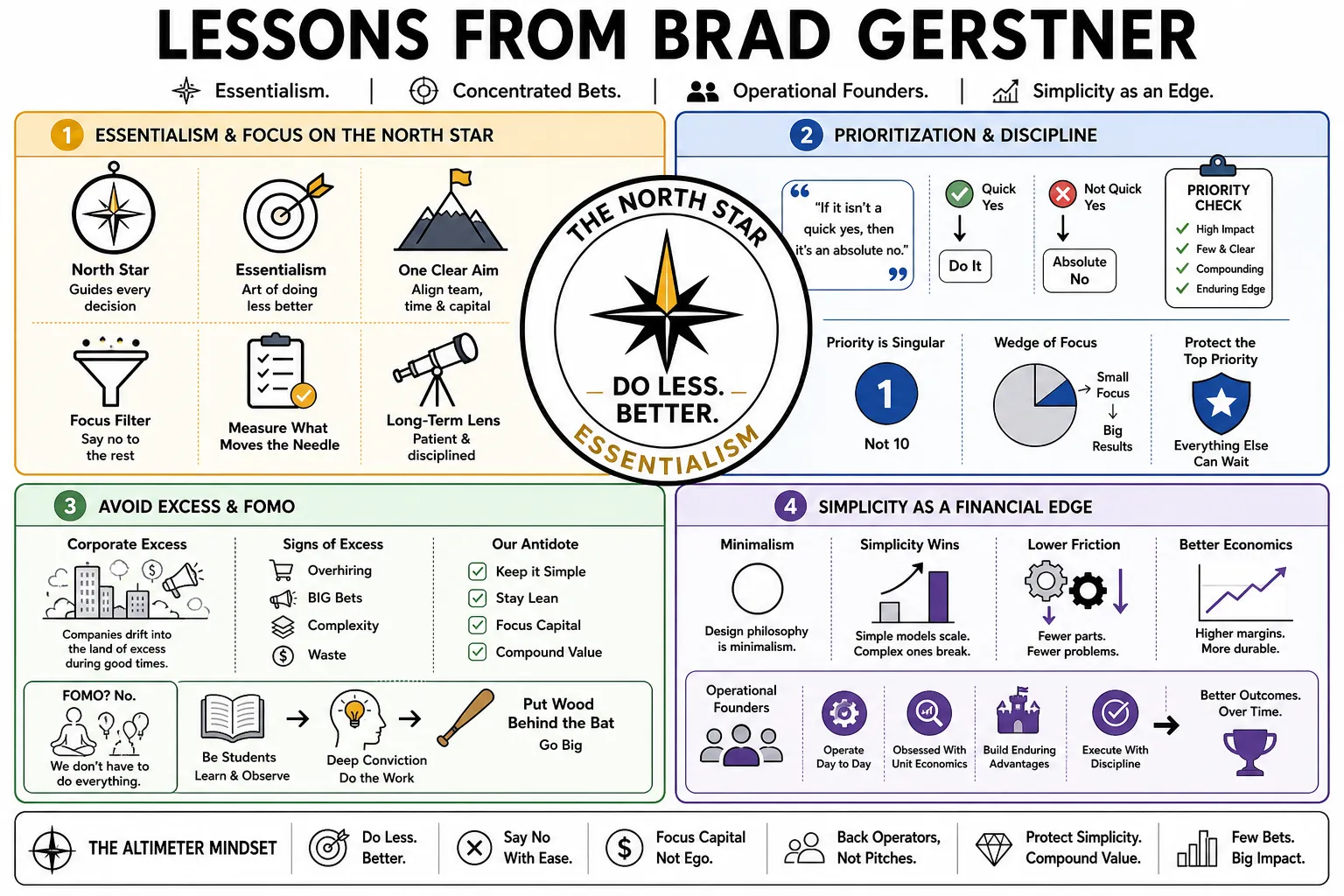
Lessons from Brad Gerstner
Brad Gerstner founded Altimeter Capital to invest across both early-stage venture and public equity markets. Best known for his 2022 open letter telling Mark Zuckerberg to cut headcount and rein in metaverse spending, he filters investments through a strict philosophy of "essentialism." This collection outlines his approach to making concentrated bets, backing operational founders, and treating corporate simplicity as a distinct financial edge.
Part 1: Essentialism and Focus
- On The North Star: "Essentialism, or the art of doing less better, is at the core of our investment culture at Altimeter." — Goldman Sachs: Insights]
- On Prioritization: "If it isn’t a quick yes, then it’s an absolute no." — Altimeter Capital: About]
- On Corporate Excess: "Both individuals and companies drift into the land of excess during good times." — The Big Picture: Masters in Business Podcasts]
- On Singular Priorities: "‘Priority’ is singular often, not plural. And it’s certainly not 10." — Goldman Sachs: Insights]
- On FOMO: "We don’t have to do everything. We don’t have a lot of FOMO. We’re happy being students, but when we develop deep conviction, we put a lot of wood behind the bat." — The Big Picture: Masters in Business Podcasts]
- On Minimalism: "For me, my design philosophy is minimalism and my life philosophy is essentialism. And that’s also really how we run the business." — Colossus: Brad Gerstner Episodes & Transcripts]
- On Operational Lethargy: "These incredible companies would run even better and more efficiently without the layers and lethargy that comes with this extreme rate of employee expansion." — Hoover Institution: About]
- On Avoiding Index Hugging: "If you have a diversified portfolio across hundreds of investments, you will have an index-like return." — Deciphr AI: Privacy Policy]
- On Being Clear-Eyed: "This lack of focus and fitness is obscured when growth is easy but deadly when growth slows and technology changes." — Scribd: About]
- On Capital Restraint: "Great companies take calculated risks, and when they work, they pour gasoline on them. And when they don’t, they extinguish them." — Business Insider: Tech]
Part 2: The Power Law and Supercycles
- On Value Concentration: "In the world of investing, it's where you place your big bet that will define you." — Colossus: Brad Gerstner Episodes & Transcripts]
- On Defining Supercycles: "We focus on super cycles and power law. It wasn't that we had a strong conviction on the data warehouse market. What we had conviction in was that all the world's storage and compute was going to move into the cloud." — Deciphr AI: Privacy Policy]
- On Pattern Recognition: "I look for pattern recognition around companies that become the market leaders in super cycles." — BG2 Pod with Brad Gerstner & Bill Gurley: Video Archive]
- On Asymmetric Outcomes: "There are not hundreds of big outcomes." — Deciphr AI: Privacy Policy]
- On Playing the Long Game: "Despite the market volatility, the secular arc of technology is very long." — Colossus: Brad Gerstner Episodes & Transcripts]
- On Valuing Compounders: He cares less about near-term price-to-earnings ratios if he believes a given company has the structural capacity to become ten times more valuable over a decade. — BG2 Pod with Brad Gerstner & Bill Gurley: Video Archive]
- On The Real Winners: "Sometimes it’s the pedestrian that’s the most impactful." — BG2 Pod with Brad Gerstner & Bill Gurley: Video Archive]
- On Concentrated Bets: "Diversification is often the opposite of risk mitigation if it leads to owning lower-quality businesses." — BG2 Pod with Brad Gerstner & Bill Gurley: Video Archive]
- On Sizing Up: When analyzing a company, success requires ignoring noise to find the one or two structural shifts that truly matter and sizing the investment accordingly. — Goldman Sachs: Insights]
- On Secular Shifts: The secular shift of all data workloads into the cloud drove his conviction in Snowflake, allowing him to ignore short-term multiples. — Benzinga: Markets]
Part 3: The "Time to Get Fit" Meta Letter
- On Meta's Drift: "Meta has drifted into the land of excess — too many people, too many ideas, too little urgency." — Business Insider: Tech]
- On Unchecked Growth: "An estimated $100B+ investment in an unknown future is super-sized and terrifying, even by Silicon Valley standards." — Adotat: Digital Marketing & Media Blog]
- On Rebuilding Trust: "Meta needs to get its mojo back." — Adotat: Digital Marketing & Media Blog]
- On Market Signals: "Notably, this decline in share price mirrors the lost confidence in the company, not just the bad mood of the market." — Payment Expert on X: Payments & Fintech News]
- On Core Competency: "It is time to get back to basics." — Business Insider: Tech]
- On Capping R&D: "We think Meta company should cap its metaverse investments to no more than $5B per year with more discrete targets and measures of success." — Payment Expert on X: Payments & Fintech News]
- On Headcount Discipline: He explicitly recommended that Meta reduce headcount expenses by at least twenty percent to double free cash flow. — Business Insider: Tech]
- On The Threat of Slowing Growth: The conventional wisdom heading into late 2022 was that Meta's core business had hit a wall, demanding extreme operational cuts. — Medium Help Center]
- On Market Confusion: "People are confused by what the metaverse even means." — Payment Expert on X: Payments & Fintech News]
Part 4: Founder Mode and Hardcore Operators
- On Building vs. Engineering: "Everything else is kind of bullshit and financial engineering... being in the room with the people who are actually doing the work and building the things that keep this engine of innovation going is what matters." — BG2 Pod with Brad Gerstner & Bill Gurley: Video Archive]
- On Wartime CEOs: "He’s always girding for battle. It’s always a war; you’re always on wartime footing." — BG2 Pod with Brad Gerstner & Bill Gurley: Video Archive]
- On Execution: "With Frank, it all starts and ends with hardcore and focused execution." — BG2 Pod with Brad Gerstner & Bill Gurley: Video Archive]
- On Jensen Huang: "Jensen is in full founder mode. They’re executing brilliantly. He is distrustful of conventional wisdom, has thin layers, and goes deep into the details." — BG2 Pod with Brad Gerstner & Bill Gurley: Video Archive]
- On Product-Led CEOs: "I think the CEO should be the CPO of a product or tech company. Leaders are best when they don't delegate away what they're best at." — BG2 Pod with Brad Gerstner & Bill Gurley: Video Archive]
- On "Founder Mode" Traps: He cautions against executives overplaying the founder-mode card to avoid board accountability or to justify erratic pivots without underlying logic. — BG2 Pod with Brad Gerstner & Bill Gurley: Video Archive]
- On Operational Excellence: "Unlike most CEO books today, this is a plain spoken, hard driving, attack oriented, precision obsessed offense." — BG2 Pod with Brad Gerstner & Bill Gurley: Video Archive]
- On Truth-Telling: A successful ecosystem requires operators and investors being willing to tell the unvarnished truth, just as they would want as a founder. — BG2 Pod with Brad Gerstner & Bill Gurley: Video Archive]
- On Founder Self-Awareness: Founder-led businesses tend to possess the operational self-awareness necessary to navigate sudden technological shifts. — TIKR Terminal: About]
- On Finding Starters: "It’s hard to think of someone who is a better starter and entrepreneur and risk taker." — BG2 Pod with Brad Gerstner & Bill Gurley: Video Archive]
Part 5: Crossover Investing and Capital Markets
- On The Crossover Model: "I wanted a firm that would benefit from understanding all the way from early-stage venture capital all the way through the public markets." — Colossus: Brad Gerstner Episodes & Transcripts]
- On Information Advantages: "The work on the public side would give me advantages on the venture side, and the work on the venture side would give me advantages on the public side." — Colossus: Brad Gerstner Episodes & Transcripts]
- On Stock-Based Compensation: SBC operates as a cash replacement that obscures true profitability, and serious investors must treat it as a hard expense when valuing technology companies. — BG2 Pod with Brad Gerstner & Bill Gurley: Video Archive]
- On Ignoring Forward Multiples: "Please don't look at a one-year forward sales number. It's highly misleading for a business that's growing at 70, 80, 90%, particularly when they are generating free cash." — Benzinga: Markets]
- On Over-Funding: "We’ve talked a lot about the adverse consequences to company behavior of taking too much money." — BG2 Pod with Brad Gerstner & Bill Gurley: Video Archive]
- On Recognizing Froth: He acknowledged that software multiples in late 2021 became too stretched, prompting his firm to distribute massive sums of stock directly to LPs to lock in value. — BG2 Pod with Brad Gerstner & Bill Gurley: Video Archive]
- On Time Arbitrage: Market dislocations provide a specific form of time arbitrage, allowing firms to buy great businesses when others are forced to sell due to short-term panic. — Podcast Notes: About]
- On Staying Sober: "We’re buying today because we believe in the long-term story... it keeps people sober about what public market investors are willing to pay." — BG2 Pod with Brad Gerstner & Bill Gurley: Video Archive]
- On Regulatory Capture: "One of the things Bill and I just resolutely agree on is the problem when the central government starts picking winners and losers; it generally always ends bad." — BG2 Pod with Brad Gerstner & Bill Gurley: Video Archive]
Part 6: Artificial Intelligence and Infrastructure
- On AI's Scale: "ChatGPT is having the iPhone moment right now." — Transform VC: About]
- On The Buildout: "This is the greatest capital expenditure cycle in human history, projecting a rise from $150 billion in 2023 to over $500 billion by 2026." — Longbridge: About]
- On Mispricing AI: The public market reliably overestimates the impact of artificial intelligence in the short run while massively underestimating its scale in the long run. — BG2 Pod with Brad Gerstner & Bill Gurley: Video Archive]
- On Macro Trends: "Innovation trumps macro trends." — Transform VC: About]
- On The Super Assistant Era: The industry is exiting the early generative phase and entering an era where integrated AI agents execute highly complex tasks autonomously. — Musixmatch: Community]
- On Picking Winners: "Now is the time to go sniffing in software. 90% of the consensus is correct... Find the 10% that got thrown out with the bathwater." — BG2 Pod with Brad Gerstner & Bill Gurley: Video Archive]
- On Hardware and Power: Structural winners of the intelligence boom are often the boring foundational layers, particularly semiconductor fabs and utility-scale power grids. — BG2 Pod with Brad Gerstner & Bill Gurley: Video Archive]
- On Recognizing Disruption: "Tesla stock is the replacement for Uber shares in my portfolio because Tesla has so much upside in the self-driving race." — BG2 Pod with Brad Gerstner & Bill Gurley: Video Archive]
- On Staying Patient: "Now is the time for VCs to meet everyone and learn to have a prepared mind, probably not the time to invest in everything." — Transform VC: About]
Part 7: Invest America and Financial Literacy
- On The Core Mission: "Invest America accounts are central to the Main Street Agenda — pulling every kid off the sidelines and putting them squarely in the game." — Wealthspire Advisors: Insights]
- On An Ownership Society: "When everyone realizes they can be an owner, it unites our country around free-market principles and unleashes the next generation of American success." — United States Senate: Committees & Hearings]
- On Bridging Inequality: "Fewer than 5% of kids currently have investment accounts. That's the gap Invest America set out to close." — Skift: Travel Industry News]
- On Power of Compounding: "With just $750 of additional savings per year from family, employers, church, or philanthropy, these accounts are worth $50k by age 18." — Fox Business: Markets]
- On Uplifting Families: He designed the program as a wealth-building tool for families structurally left out of the traditional stock market upside. — Fox Business: Markets]
- On Civic Return: "The return on this investment will be the greatest return this country has ever seen." — BG2 Pod with Brad Gerstner & Bill Gurley: Video Archive]
- On Origin Motivation: The national policy was sparked at a kitchen table when his young son asked why only certain kids received custodial stock accounts while others did not. — BG2 Pod with Brad Gerstner & Bill Gurley: Video Archive]
- On Financial Literacy: "The accounts get kids to believe, to ask questions that can help enhance their financial literacy." — Morningstar: Markets]
- On Corporate Responsibility: "The vision is simple — that corporations would include an Invest America match of $1,000 into the Invest America account of children of their employees." — Mezz CPA: Services]
Part 8: Early Lessons, Mistakes, and Integrity
- On Character: "Commitment to your word is your bond." — BG2 Pod with Brad Gerstner & Bill Gurley: Video Archive]
- On Effort and Scale: "It takes as much effort to start a restaurant as it does to start Google." — BG2 Pod with Brad Gerstner & Bill Gurley: Video Archive]
- On The Cost of Price Memory: "My biggest mistakes have not been not doing companies... it's been they came to me with the new price for the new round, and I went, 'Oh my God, no way.'" — Musixmatch: Community]
- On Omitting Winners: His most expensive professional errors involved holding onto early price anchoring and failing to buy more shares of clear winners. — BG2 Pod with Brad Gerstner & Bill Gurley: Video Archive]
- On Breaking Through: "How did Bill Gurley breakthrough in Silicon Valley? He started sending out a fax called Above the Crowd. That is the type of hack that shows people your passion." — BG2 Pod with Brad Gerstner & Bill Gurley: Video Archive]
- On Checking Biases: He warns operators against falling in love with a thesis by forcing internal analysts to actively hunt for contradictory facts. — Podcast Notes: About]
- On Empowering the Consumer: "We’re going to take the green screen, we’re going to turn it around and we’re going to give power to the people." — Colossus: Brad Gerstner Episodes & Transcripts]
- On Hustle: He screens heavily for grit, systematically asking recruits about the hardest thing they have ever endured to test their structural resilience. — BG2 Pod with Brad Gerstner & Bill Gurley: Video Archive]
- On Misspent Time: Looking back at his first decade investing, he recognizes he spent too much energy analyzing ideas that had zero mathematical chance of becoming massive outcomes. — 20VC with Harry Stebbings: Podcast Archive]