Bret Weinstein is an evolutionary biologist, author, and podcaster. He earned a PhD in Biology from the University of Michigan and taught at The Evergreen State College for 14 years. He hosts the DarkHorse Podcast and, with fellow evolutionary biologist Heather Heying, co-authored A Hunter-Gatherer's Guide to the 21st Century. Their work applies an evolutionary lens to hyper-novel modern environments and the mismatch between contemporary life and human bodies and minds shaped in earlier environments.
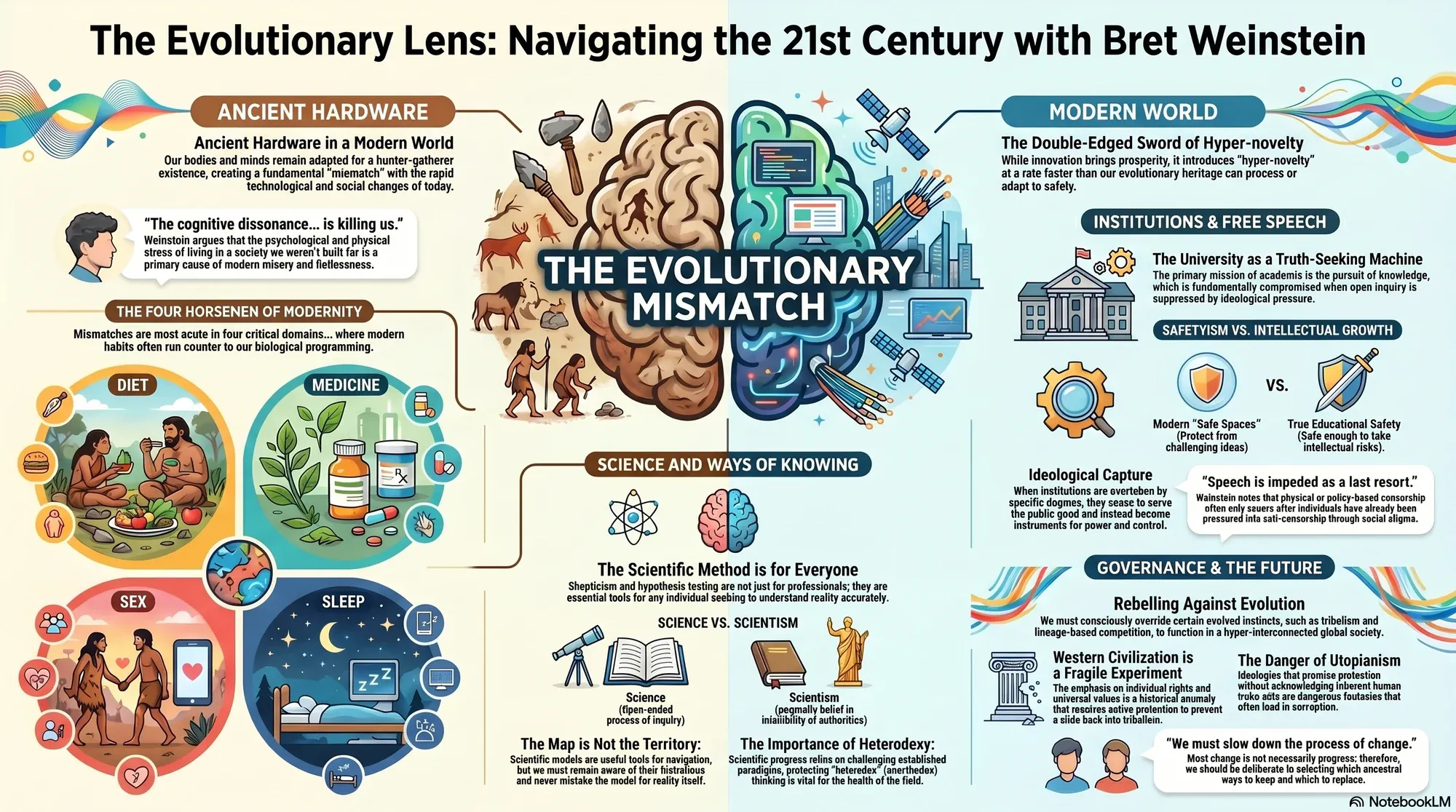
On Evolution and the Mismatch with Modernity
These lessons apply Heying and Weinstein's evolutionary-mismatch framework to modern environments and to deliberate responses when novelty outpaces adaptation.
Learnings:
- Our Ancient Hardware in a Modern World: Heying and Weinstein argue that the modern world is out of sync with our ancient brains and bodies; amid unprecedented wealth and comfort, they point to rising suicide, loneliness, chronic illness, division, misery, and political toxicity as signs of that mismatch. Source
- Evolutionary Mismatch Across Modern Life: Heying and Weinstein argue that modern life is out of sync with our ancient brains and bodies, and they apply that evolutionary-mismatch framework across sex and gender, diet, parenting, sleep, education, and more. Source
- The Importance of an Evolutionary Toolkit: Understanding our evolutionary past provides a powerful toolkit for navigating the complexities of the modern world. By applying an evolutionary lens, we can better understand and address a wide range of issues. Source
- Hyper-Novelty Can Outpace Adaptation: In an era of hyper-novelty, the rate of change can outstrip our evolutionary capacity to keep up, leaving ancient brains and bodies out of sync with the modern world. Source
- We Must Be Deliberate in Our Choices: Because novelty can outpace adaptation, we have to reason through which ancestral ways remain relevant and which should be replaced with something more deliberate, rather than expecting markets or problems to correct themselves without damage. Source
- Preserve an Unmediated Relationship: In a hyper-novel digital environment, maintain at least one relationship that does not depend on digital transmission: someone you understand deeply, can speak with directly, and can trust for an honest reality check. Source
On Free Speech, Academia, and Institutional Decay
These lessons focus on free expression as a condition of education and on institutional incentives and norms that can weaken academic inquiry.
Learnings:
- Free Expression Enables Education: On college campuses, free expression and the ability to exchange ideas are key to education and to the institutional contribution that makes civilization function. Source
- A Safe Space Should Be Safe Enough to Take Risks: Weinstein's educational ideal is a space safe enough for intellectual risk; a campus “safe space” defined as freedom from offense is mutually exclusive with a free-speech zone. Source
- Corrupt Incentives and Compliance Degrade Academia: Academic institutions can cease to function well when funding incentives distort the partnership between theory and experiment and the academic culture becomes timid and compliant in the face of power. Source
- Academia Needs Courageous, Deeper Thinkers: The academic culture is timid and compliant in the face of power; repairing it would require getting more courageous, deeper thinkers into faculty chairs and making them safe enough to stay. Source
- The First Amendment is Not Enough: While a crucial protection, the First Amendment alone is insufficient to guarantee a culture of free expression, especially in private institutions or in the face of social pressure and self-censorship. Source
On Science, Truth, and Ways of Knowing
These lessons distinguish open scientific inquiry from conclusions imposed before debate and emphasize methods, assumptions, heterodoxy, and falsification.
Learnings:
- The Methods of Science Belong to Everyone: Scientific method is not inherently elitist: its methods are every person's rightful inheritance, and everyone should deploy them as much as they can rather than treating science as something only other people do. Source
- Settled Science Must Follow Vigorous Debate: A scientific consensus can become settled when vigorous debate resolves in favor of one view; a conclusion delivered in advance to prevent disagreement has not been settled by that process. Source
- Scientific Truth Is Not Democratic: Majority opinion does not establish what is true; great ideas begin as a minority of one, so a heterodox new idea may be right even when nearly everyone has it wrong. Source
- Models Encode Their Assumptions: A model can return what was built into it, so models may help generate hypotheses but cannot validly test the same hypotheses they encode. Source
- Correlation Can Imply Causation (with a Causal Hypothesis): Contrary to the common refrain, a correlation between two phenomena can indeed suggest a causal relationship, especially when it is preceded by a plausible causal hypothesis. Source
- Look for Flaws in Evolutionary Models: Weinstein argues that an evolutionary biologist should look for flaws in evolutionary models; he expects those flaws to improve Darwinism, while treating evidence that Darwin was wrong as an acceptable outcome. Source
On Governance, Society, and the Future
These lessons address capture-resistant governance, unavoidable trade-offs, cooperation beyond kinship, subsidiarity, honest debate, and the risks of lineage-against-lineage competition.
Learnings:
- Good Governance Must Resist Capture: Good governance must be built so it cannot be turned against the people. Captured public research institutions illustrate one failure mode: private-profit interests can influence decisions while masquerading as the public good. Source
- The Dangers of Utopianism: Any ideology that promises a perfect society without acknowledging the inherent trade-offs of human existence is a dangerous fantasy. Source
- Western Civilization as a Fragile Experiment: Weinstein describes Western civilization as a successful but fragile experiment: it created a basis for cooperation outside genetic relatedness, enabling people with different strengths to work together, but that broader collaboration can break down when times get rough. Source
- Govern at the Lowest Appropriate Level: Subsidiarity means governing at the lowest appropriate level: some shared problems require global action, while local matters should remain local, with the lightest intervention needed to accomplish the goal. Source
- We Must Rebel Against Evolution (Wisely): Our predicament obligates us to rebel against evolution, but the difficult part is doing so without being out-competed by people who have not. That requires taking lineage-against-lineage competition out of the driver’s seat rather than staying on autopilot. Source
- Honest Debate Supports Good Governance: Good governance depends on honest public debate; an electorate deprived of candid argument is also deprived of the governance that follows from it. Source
Sources and Links
- Bret Weinstein — About
- A Hunter-Gatherer's Guide to the 21st Century
- DarkHorse Podcast
- Thought Economics interview
- Congressional testimony on free speech and safe spaces
- Interview on academia
- Looking Back and Looking Forward
- Why Darwin Was Right
- Mad Scientists
- Evolution, Innovation, and Western Civilization
- Evolutionary Biology, Markets, and Moral Progress
- Evolution and the Challenges of Modern Life