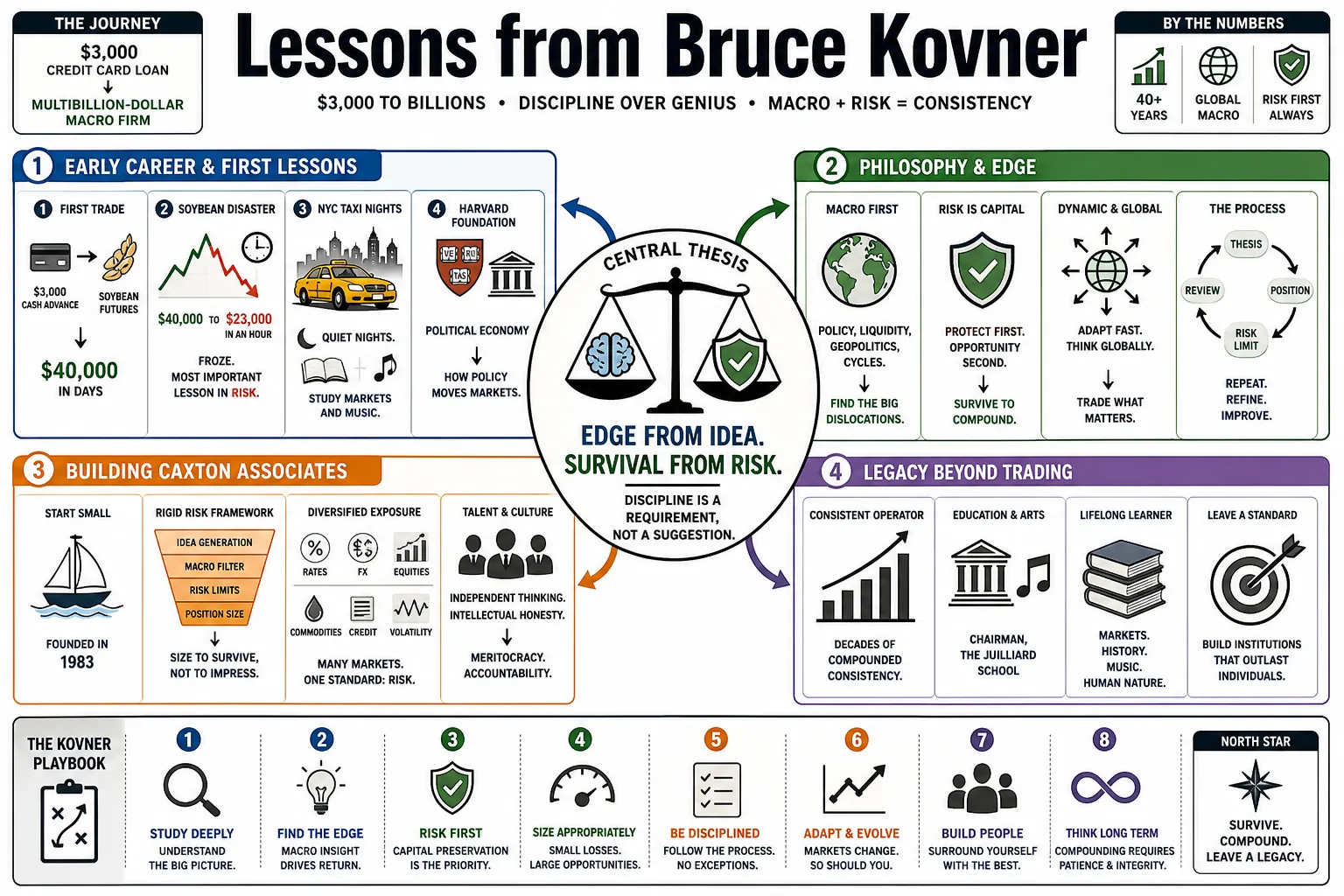
Lessons from Bruce Kovner
Bruce Kovner borrowed $3,000 on a MasterCard in early 1977 to begin trading, founded the global macro hedge fund Caxton Associates in 1983, and was chairman of the Juilliard School's board from 2001 to 2022. — The Kovner Foundation: The Kovners.
Part 1: Early Career and Foundations
- On Marcus Showing It Could Be Done: Kovner on Michael Marcus: "Michael taught me one thing that was incredibly important. He taught me that you could make a million dollars." — TurtleTrader: "Bruce Kovner" profile with Market Wizards interview excerpts.
- On Applying Yourself: Kovner: "He showed me that if you applied yourself, great things could happen. It is very easy to miss the point that you really can do it." — TurtleTrader: "Bruce Kovner" profile with Market Wizards interview excerpts.
- On Discipline: Kovner: "He showed me that if you take a position and use discipline, you can actually make it." — TurtleTrader: "Bruce Kovner" profile with Market Wizards interview excerpts.
- On Discarding a Hedge: On his early soybean trade, Kovner says: "In a moment of insanity, I discarded a hedge limiting losses if prices turned down, which they did." — TurtleTrader: "Bruce Kovner" profile with Market Wizards interview excerpts.
- On Losing Half the Profit: Kovner: "I had a huge gain but lost half before getting out. I lost half the profit in an hour." — TurtleTrader: "Bruce Kovner" profile with Market Wizards interview excerpts.
- On Being Sick for a Week: Kovner: "I closed out the trade and was physically sick for a week." He later reflects: "It helped me understand risk and create structures to control risk." — TurtleTrader: "Bruce Kovner" profile with Market Wizards interview excerpts.
- On Why Traders Make It: Kovner: "I'm not sure one can really define why some traders make it, while others do not." — TurtleTrader: "Bruce Kovner" profile with Market Wizards interview excerpts.
- On Using Your Own Intelligence: Kovner: "You have to use your own intelligence to draw conclusions about what the past activity of some traders may say about the future activity of other traders." — Business Insider: Trading Wisdom From Retiring Legend Bruce Kovner (2011, Market Wizards excerpts).
- On What Marcus Taught Him: Kovner on Michael Marcus: "He taught me that you could make a million dollars. He showed me that if you applied yourself, great things could happen." — Business Insider: Trading Wisdom From Retiring Legend Bruce Kovner (2011, Market Wizards excerpts).
Part 2: Risk Management and Position Sizing
- On the First Rule of Trading: Kovner: "The first rule of trading — there are probably many first rules — is don't get caught in a situation in which you can lose a great deal of money for reasons you don't understand." — TurtleTrader: "Bruce Kovner" profile with Market Wizards interview excerpts.
- On Trading Under Size: Kovner: "I would say that risk management is the most important thing to be well understood. Under trade, under trade, under trade is my second piece of advice. Whatever you think your position ought to be, cut it at least in half." — TurtleTrader: "Bruce Kovner" profile with Market Wizards interview excerpts.
- On Correlation: Kovner: "Through bitter experience, I have learned that a mistake in position correlation is the root of some of the most serious problems in trading. If you have eight highly correlated positions, then you are really trading one position that is eight times as large." — TurtleTrader: "Bruce Kovner" profile with Market Wizards interview excerpts.
- On Predetermined Stops: Kovner: "Whenever I enter a position, I have a predetermined stop. That is the only way I can sleep. I know where I'm getting out before I get in." — TurtleTrader: "Bruce Kovner" profile with Market Wizards interview excerpts.
- On Novice Traders: Kovner: "My experience with novice traders is that they trade three to five times too big. They are taking 5 to 10 percent risks on a trade when they should be taking 1 to 2 percent risks." — TurtleTrader: "Bruce Kovner" profile with Market Wizards interview excerpts.
- On Stop Vulnerability: Kovner: "I never think about stop vulnerability, because the point about a technical barrier — and I've studied the technical aspects of the market for a long time — is that the market shouldn't go there if you're right." — TurtleTrader: "Bruce Kovner" profile with Market Wizards interview excerpts.
- On Poor Money Management: Kovner: "The only thing that disturbs me is poor money management." — TurtleTrader: "Bruce Kovner" profile with Market Wizards interview excerpts.
- On Losing Sensibly: Kovner: "I never had a lot of difficulty with the process of losing money, as long as losses were the outcome of sound trading techniques." — TurtleTrader: "Bruce Kovner" profile with Market Wizards interview excerpts.
- On an Impersonal Market: Kovner: "A common mistake is to think of the market as a personal nemesis. The market, of course, is totally impersonal; it doesn't care whether you make money or not." — TurtleTrader: "Bruce Kovner" profile with Market Wizards interview excerpts.
- On the Emotional Burden of Trading: Kovner: "The emotional burden of trading is substantial; on any given day, I could lose millions of dollars. If you personalize these losses, you can’t trade." — Business Insider: Trading Wisdom From Retiring Legend Bruce Kovner (2011, Market Wizards excerpts).
Part 3: Global Macro and Market Dynamics
- On Imagining Different Worlds: Kovner: "First, I have the ability to imagine configurations of the world different from today and really believe it can happen." — TurtleTrader: "Bruce Kovner" profile with Market Wizards interview excerpts.
- On Staying Rational: Kovner: "Second, I stay rational and disciplined under pressure." — TurtleTrader: "Bruce Kovner" profile with Market Wizards interview excerpts.
- On a Consensus the Market Is Not Confirming: Kovner: "What I am really looking for is a consensus the market is not confirming. I like to know that there are a lot of people who are going to be wrong." — TurtleTrader: "Bruce Kovner" profile with Market Wizards interview excerpts.
- On Alternative Scenarios: Kovner: "One of the jobs of a good trader is to imagine alternative scenarios." — TurtleTrader: "Bruce Kovner" profile with Market Wizards interview excerpts.
- On Mental Pictures: Kovner: "I try to form many different mental pictures of what the world should be like and wait for one of them to be confirmed." — TurtleTrader: "Bruce Kovner" profile with Market Wizards interview excerpts.
- On Pictures That Click: Kovner: "Inevitably, most of these pictures will turn out to be wrong", but sometimes "in one picture, nine out of ten elements click." — TurtleTrader: "Bruce Kovner" profile with Market Wizards interview excerpts.
- On Technical Analysis and the Past: Kovner: "Technical analysis tracks the past; it does not predict the future." — Business Insider: Trading Wisdom From Retiring Legend Bruce Kovner (2011, Market Wizards excerpts).
- On Correlated Positions: Kovner: "If you have eight highly correlated positions, then you are really trading one position that is eight times as large." — Business Insider: Trading Wisdom From Retiring Legend Bruce Kovner (2011, Market Wizards excerpts).
- On Holding Only What He Understands: Kovner: "I can’t hold a position unless I understand why the market should move." — Business Insider: Trading Wisdom From Retiring Legend Bruce Kovner (2011, Market Wizards excerpts).
- On Others Knowing More: Bruce Kovner: "The market usually leads because there are people who know more than you do." — Trading Wisdom From Retiring Legend Bruce Kovner - Business Insider.
Part 4: Technical and Fundamental Integration
- On Charts as a Thermometer: Kovner: "For me, technical analysis is like a thermometer." — TurtleTrader: "Bruce Kovner" profile with Market Wizards interview excerpts.
- On Ignoring the Charts: Kovner: "Fundamentalists who say they are not going to pay any attention to the charts are like a doctor who says he's not going to take a patient's temperature." — TurtleTrader: "Bruce Kovner" profile with Market Wizards interview excerpts.
- On Technical Hype: Kovner: "Technical analysis, I think, has a great deal that is right and a great deal that is mumbo jumbo." — TurtleTrader: "Bruce Kovner" profile with Market Wizards interview excerpts.
- On the Past and the Future: Kovner: "Technical analysis tracks the past; it does not predict the future." — TurtleTrader: "Bruce Kovner" profile with Market Wizards interview excerpts.
- On the Voice of the Marketplace: Kovner: "Technical analysis reflects the voice of the entire marketplace and, therefore, does pick up unusual behavior." — TurtleTrader: "Bruce Kovner" profile with Market Wizards interview excerpts.
- On Bear Markets: Kovner: "The principle characteristic of a bear market is very sharp down movements followed by quick retracements." — TurtleTrader: "Bruce Kovner" profile with Market Wizards interview excerpts.
- On Studying Charts: Kovner: "Studying the charts is an absolutely critical stance and alerts me to existing disequilibria and potential changes." — TurtleTrader: "Bruce Kovner" profile with Market Wizards interview excerpts.
- On the Heisenberg Principle: Bruce Kovner: "The more a price pattern is observed by speculators, the more prone you are to have false signals. The more a market is the product of nonspeculative activity, the greater the significance of technical breakouts." — Trading Wisdom From Retiring Legend Bruce Kovner - Business Insider.
- On Market Views: Bruce Kovner: "I almost always trade on a market view; I don’t trade simply on technical information." — Trading Wisdom From Retiring Legend Bruce Kovner - Business Insider.
Part 5: Psychology and Discipline
- On Wishing and Hoping: Kovner: "Whenever a trader says ‘I wish,’ or ‘I hope,’ he is engaging in a destructive way of thinking because it takes attention away from the diagnostic process." — TurtleTrader: "Bruce Kovner" profile with Market Wizards interview excerpts.
- On an Impersonal Market: Kovner: "The market, of course, is totally impersonal; it doesn’t care whether you make money or not." — TurtleTrader: "Bruce Kovner" profile with Market Wizards interview excerpts.
- On Making Mistakes: Bruce Kovner: "You have to be willing to make mistakes regularly; there is nothing wrong with it." — Trading Wisdom From Retiring Legend Bruce Kovner - Business Insider.
- On Personalizing Losses: Bruce Kovner: "The emotional burden of trading is substantial; on any given day, I could lose millions of dollars. If you personalize these losses, you can’t trade." — Trading Wisdom From Retiring Legend Bruce Kovner - Business Insider.
- On a Greedy Trader: Kovner: "They are disciplined enough to take the right size positions. A greedy trader always blows out." — Business Insider: Trading Wisdom From Retiring Legend Bruce Kovner (2011, Market Wizards excerpts).
- On Emotional Equilibrium: Bruce Kovner: "To this day, when something happens to disturb my emotional equilibrium and my sense of what the world is like, I close out all positions related to that event." — Trading Wisdom From Retiring Legend Bruce Kovner - Business Insider.
- On Willingness to Make Mistakes: Kovner: "You have to be willing to make mistakes regularly; there is nothing wrong with it." — Business Insider: Trading Wisdom From Retiring Legend Bruce Kovner (2011, Market Wizards excerpts).
- On Greed: Bruce Kovner: "A greedy trader always blows out." — Trading Wisdom From Retiring Legend Bruce Kovner - Business Insider.
Part 6: Trading Mechanics and Execution
- On Sizing by the Stop: Kovner: "The position size on a trade is determined by the stop, and the stop is determined on a technical basis." — TurtleTrader: "Bruce Kovner" profile with Market Wizards interview excerpts.
- On Unexplained Breakouts: Bruce Kovner: "Tight congestions in which a breakout occurs for reasons that nobody understands are usually good risk/reward trades." — Trading Wisdom From Retiring Legend Bruce Kovner - Business Insider.
- On Technical Analysis as a Thermometer: Kovner: "For me, technical analysis is like a thermometer." — Business Insider: Trading Wisdom From Retiring Legend Bruce Kovner (2011, Market Wizards excerpts).
- On Sizing by the Stop: Kovner: "The position size on a trade is determined by the stop, and the stop is determined on a technical basis" — Business Insider: Trading Wisdom From Retiring Legend Bruce Kovner (2011, Market Wizards excerpts).
- On Trader Temperament: Bruce Kovner: "They are able to take positions others are unwilling to take. They are disciplined enough to take the right size positions." — Trading Wisdom From Retiring Legend Bruce Kovner - Business Insider.
- On the Predetermined Stop: Kovner: "Whenever I enter a position, I have a predetermined stop. That is the only way I can sleep. I know where I’m getting out before I get in." — Business Insider: Trading Wisdom From Retiring Legend Bruce Kovner (2011, Market Wizards excerpts).
- On Commodity Trends: Bruce Kovner: "The commodity markets are driven by supply and demand for physical goods; if there is a true shortage, prices will tend to keep trending higher." — Trading Wisdom From Retiring Legend Bruce Kovner - Business Insider.
- On Undertrading: Kovner: "Under trade, under trade, under trade is my second piece of advice. Whatever you think your position ought to be, cut it at least in half." — TurtleTrader: "Bruce Kovner" profile with Market Wizards interview excerpts.
- On Emotional Equilibrium: Kovner: "To this day, when something happens to disturb my emotional equilibrium and my sense of what the world is like, I close out all positions related to that event." — Business Insider: Trading Wisdom From Retiring Legend Bruce Kovner (2011, Market Wizards excerpts).
Part 7: Institutional Leadership and Philanthropy
- On Working With Students: Kovner on the Kovner Opportunity Scholars: "Our intention is to work with them through at least all of college." — Chronicle of Philanthropy: "You Never Get Anything Completely Right the First Time" (2016 interview).
- On Personal Involvement: Kovner: "we'll be very closely personally involved to make sure the holes in the system are covered with both mentoring and special financial aid." — Chronicle of Philanthropy: "You Never Get Anything Completely Right the First Time" (2016 interview).
- On Starting Slowly: Kovner: "From experience, I know that one has to start slowly and learn about what one is doing because you never get anything completely right the first time". — Chronicle of Philanthropy: "You Never Get Anything Completely Right the First Time" (2016 interview).
- On Listening: Kovner: "We very much want to listen and absorb and learn." — Chronicle of Philanthropy: "You Never Get Anything Completely Right the First Time" (2016 interview).
- On Not Drawing Attention: Kovner: "I want to make sure that when we do philanthropy it's principally about accomplishing something good for the cause and not drawing attention to us". — Chronicle of Philanthropy: "You Never Get Anything Completely Right the First Time" (2016 interview).
- On Deserving Attention: Kovner: "It doesn't mean in any sense that we deserve attention". — Chronicle of Philanthropy: "You Never Get Anything Completely Right the First Time" (2016 interview).
- On Where the Attention Belongs: Kovner: "The attention really should be on the programs and the purposes, the great kids or adults and artists who are doing great things." — Chronicle of Philanthropy: "You Never Get Anything Completely Right the First Time" (2016 interview).
- On Being Lucky: Kovner: "We're lucky to have been able to get financial resources to let us do this kind of thing." — Chronicle of Philanthropy: "You Never Get Anything Completely Right the First Time" (2016 interview).
- On the Moral Value of Giving: Kovner: "For me, gifts are given for the pleasure and the moral value of giving rather than public recognition. I prefer anonymity." — Philanthropy magazine: Interview with Bruce Kovner (Fall 2015).
Part 8: Life Philosophy and Intellectual Interests
- On Harvard: Kovner: "Harvard made a big difference in my life. I saw a lot of people there who came from relatively simple circumstances putting an enormous amount of effort behind teaching themselves and learning how to help others and think critically". — Chronicle of Philanthropy: "You Never Get Anything Completely Right the First Time" (2016 interview).
- On a Personal Philosophy: Kovner: "Those have always been important elements of my personal philosophy, and I've tried to express them in what we're doing." — Chronicle of Philanthropy: "You Never Get Anything Completely Right the First Time" (2016 interview).
- On Music: Kovner: "For me, great music is an enormously powerful source of spiritual connection". — Chronicle of Philanthropy: "You Never Get Anything Completely Right the First Time" (2016 interview).
- On Empathy in Music: Kovner: "It's a way of feeling what other people feel, a place where you can come into contact with the great minds and artists who have produced works of art that are really all about human empathy." — Chronicle of Philanthropy: "You Never Get Anything Completely Right the First Time" (2016 interview).
- On the Principles Behind AEI: Kovner: "I realized that AEI stood for two of the core principles in my life. First, defending the vision of America as a place committed to free enterprise and personal liberty." — Philanthropy magazine: Interview with Bruce Kovner (Fall 2015).
- On What Music Does: Kovner: "Music increases empathy. It helps us think about devotion, brotherhood, tragedy, and loss." — Philanthropy magazine: Interview with Bruce Kovner (Fall 2015).
- On the Obligations of Citizenship: Kovner: "I felt an obligation to be a good citizen in New York. One of the obligations of citizenship is to help the great institutions where you live." — Philanthropy magazine: Interview with Bruce Kovner (Fall 2015).
- On the American Dream at Home: Kovner: "I grew up in an environment in which there was a passionate belief that you could do anything here in America." — Philanthropy magazine: Interview with Bruce Kovner (Fall 2015).
- On a Mobile Free-Market Economy: Kovner: "I want America to be a place of ever-greater opportunity, via a highly mobile free-market economy that empowers people to achieve what they are capable of." — Philanthropy magazine: Interview with Bruce Kovner (Fall 2015).