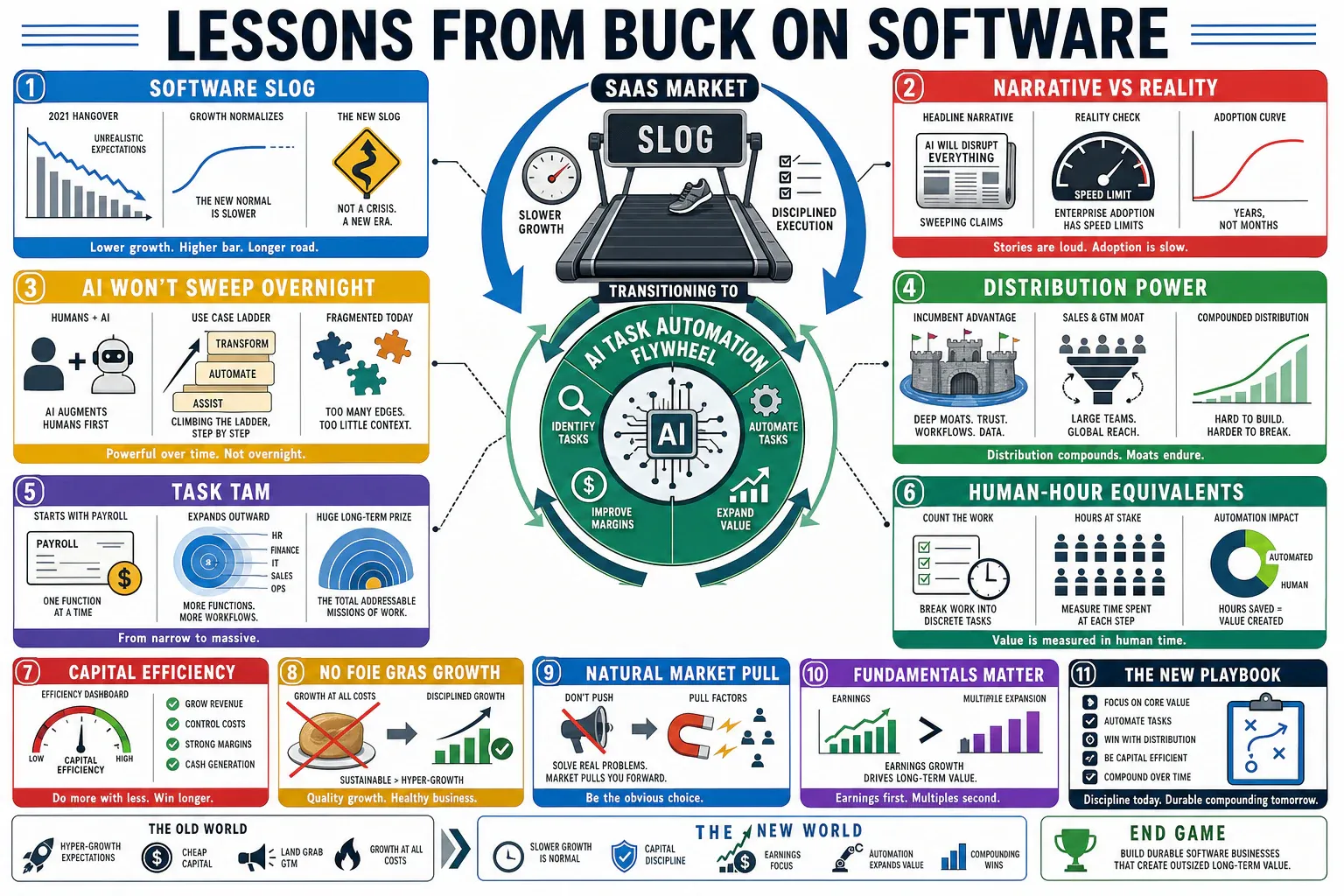
Buck on Software is a Substack newsletter in which the author, an investor in software companies, writes about SaaS market structure, valuation, growth and AI. — Buck on Software: The Software Slog.
## Part 1: The Software Slog & Market Realities
- On the Slog: Buck wrote: "I fear the software industry is settling into its own version of a slog: an extended period of low returns and slower growth where wealth creation feels hard." — Buck on Software: The Software Slog.
- On Making Money in a Slog: Buck wrote: "It is hard to make money in a slog." — Buck on Software: The Software Slog.
- On the 2019-2021 Surge: Buck wrote: "a 1999/Y2K-like surge in software spending from 2019-2021" — Buck on Software: The Software Slog.
- On Extended Hangovers: Buck wrote: "These surges can have extended hangovers" — Buck on Software: The Software Slog.
- On a Track Slog: Buck wrote: "A 40 laps around a high school track sort of slog." — Buck on Software: The Software Slog.
- On Different Starting Conditions: Buck wrote: "Coming out of the GFC the cloud was at the knee of the curve. SaaS penetration was near zero." — Buck on Software: The Software Slog.
- On Growth in a Slog: Buck wrote: "But growth doesn’t really accelerate in a slog. So, more layoffs are likely." — Buck on Software: The Software Slog.
- On Zombie SaaS: Buck wrote: "Zombie SaaS are kept alive by the oversized rounds of 2020/2021 and by the oversized venture capital funds raised in that period." — Buck on Software: The Software Slog.
- On Zombies and Returns: Buck wrote: "Zombie SaaS erodes the return potential of non-zombies." — Buck on Software: The Software Slog.
- On Zombie Headcount: Buck wrote: "Most of this headcount is zombie headcount - not productive and sustained by management teams not ready to write them off." — Buck on Software: The Software Slog.
## Part 2: Artificial Intelligence & The Winds of Change
- On the River of AI: Buck wrote: "The river of AI is likely to flow around the massive existing rock formation that is deterministic software. Gradually eroding it away versus sweeping it away." — Buck on Software: Winds of Change.
- On Sentiment and Reliability: Buck wrote: "the negative sentiment on software and AI is largely due to AI not being reliable enough for most business use cases." — Buck on Software: Winds of Change.
- On Hallucinations: Buck wrote: "even with improved models and tooling, LLMs are unlikely to become fully reliable. Hallucinations will still occur." — Buck on Software: Winds of Change.
- On Early AI Products: Buck wrote: "So early product offerings from software vendors have mostly sucked." — Buck on Software: Winds of Change.
- On Narrative Momentum: Buck wrote: "Growth has slowed and there is little estimate or narrative momentum." — Buck on Software: Winds of Change.
- On Software Bears: Buck wrote: "Software bears are leaping to a fully eroded end state (fully autonomous agents)." — Buck on Software: Winds of Change.
- On Incumbent Advantage: Buck wrote: "This gives incumbents an advantage, if they act aggressively to use it." — Buck on Software: Winds of Change.
- On Humans in the Loop: Buck wrote: "Humans will need to be in the loop, deterministic scaffolding (data, workflow/process, alerting) will still be very necessary, and specialization will be critical" — Buck on Software: Winds of Change.
- On Payroll: Buck wrote: "Payroll is a solved problem and there is a large amount of risk inherent in changing what is already working (for minimal upside)." — Buck on Software: Winds of Change.
- On Proven Velocity: Buck wrote: "Proven product velocity is required. Companies that can’t ship will see their advantage erode more quickly." — Buck on Software: Winds of Change.
## Part 3: Total Addressable Market (TAM) & Task Automation
- On Task TAM: Buck wrote: "the “task TAM” is likely an order of magnitude larger than the existing software TAM." — Buck on Software: Winds of Change.
- On Automating 15% of Tasks: Buck wrote: "It isn’t unreasonable to expect AI to automate 15% of tasks from this base of users ($300B) of which 10% ($30B) is captured by the vendor driving that increase." — Buck on Software: Winds of Change.
- On Unbounded Markets: Buck wrote: "In some end markets, the size of the task TAM is unbounded" — Buck on Software: Winds of Change.
- On Software Development: Buck wrote: "software development has an unbounded task TAM." — Buck on Software: Winds of Change.
- On Bounded Tasks: Buck wrote: "Increasing the number of tasks in the financial close process would likely not create much business value." — Buck on Software: Winds of Change.
- On Pricing In the Potential: Buck wrote: "there is zero optionality for that potential being priced into the sector today." — Buck on Software: Winds of Change.
- On Risk and Reward: Buck wrote: "An unbounded task TAM creates a better risk/reward" — Buck on Software: Winds of Change.
- On Returns to Scale: Buck wrote: "There will be returns to scale due to the cost of building out AI capabilities" — Buck on Software: Winds of Change.
- On Both Velocities: Buck wrote: "Exposure to both high velocity and low velocity end markets is desirable" — Buck on Software: Winds of Change.
- On R&D Intensity: Buck wrote: "Investors should expect R&D intensity to increase for both offensive and defensive reasons." — Buck on Software: Winds of Change.
## Part 4: Capital, Growth, & The "Foie Gras" Era
- On the Foie Gras Era: Buck wrote: "If 2016-2020 was the golden unicorn age of SaaS, 2021 nearly hurtled us into the foie gras* era." — Buck on Software: Don't be foie gras.
- On Abundant Capital: Buck wrote: "An overabundance of capital is bad for most businesses." — Buck on Software: Don't be foie gras.
- On Overfunding: Buck wrote: "Too much money means too many things get funded and the initiatives that are funded are overfunded." — Buck on Software: Don't be foie gras.
- On Killing Feature Ideas: Buck wrote: "Nearly all ideas for features/products from PMs should be killed rather than funded." — Buck on Software: Don't be foie gras.
- On CEO Focus: Buck wrote: "Most importantly, the focus of the CEO gets pulled in too many directions." — Buck on Software: Don't be foie gras.
- On Unnatural Pressure: Buck wrote: "Abundant capital increases category velocity, putting pressure on companies to do unnatural things to stay ahead of competition." — Buck on Software: Don't be foie gras.
- On the $0.34 Benchmark: Buck wrote: "The most successful software companies today went public while generating at least $0.34 of new revenue for every $1 of opex." — Buck on Software: Don't be foie gras.
- On Efficiency Path Dependence: Buck wrote: "If you create a culture of efficiency and excellence, you are more likely to stay efficient and excellent." — Buck on Software: Don't be foie gras.
- On Slamming on the Brakes: Buck wrote: "There are very few examples of successfully slamming on the brakes and pivoting to a culture of operational excellence from one of excess." — Buck on Software: Don't be foie gras.
## Part 5: SaaS Valuation & Financial Fundamentals
- On Pricing the Future Like the Past: Buck wrote: "The market is pricing the future like the past." — Buck on Software: The Wrong Bet.
- On Betting the World Stays the Same: Buck reframed a familiar line about investing as a question: "What happens when venture investors bet the world is going to stay the same?" — Buck on Software: The Wrong Bet.
- On Early Cloud Conditions: Buck wrote: "The market conditions were a dream for early movers and oligopolies formed in large core/sticky markets, leading to high retention and high incremental margins." — Buck on Software: The Wrong Bet.
- On Market Structure: Buck wrote: "This is a much less shareholder friendly market structure!" — Buck on Software: The Wrong Bet.
- On Incumbents Competing: Buck wrote: "Scaled, well-capitalized and well-run incumbents are increasingly competing against one another to sustain growth versus competing against on prem share donors." — Buck on Software: The Wrong Bet.
- On Penetration: Buck wrote: "growth is likely to start slowing as penetration exceeds 50%" — Buck on Software: The Wrong Bet.
- On Semiconductors: Buck wrote: "the current market dynamics in software remind me of semiconductors from 2000-2015." — Buck on Software: The Wrong Bet.
- On Extrapolating the Last Decade: Buck wrote: "Many investors seem to be taking the market growth of the last decade, extrapolating that forward, and using more mature market leaders like NOW, VEEV, and ADBE as comparables to derive terminal margins and terminal multiples." — Buck on Software: The Wrong Bet.
- On Betting on Change: Buck wrote: "rather than betting that things will change growth investors are betting that things will remain the same." — Buck on Software: The Wrong Bet.
## Part 6: Vertical Software & Aggregation
- On Core Workflows: Buck wrote: "SMB focused vertical SaaS companies usually start with a core workflow that has been tailored to the needs of their target industry." — Buck on Software: Vertical Aggregation.
- On Expanding Offerings: Buck wrote: "Toast, Mindbody, and ServiceTitan have brought to market dozens of SKUs despite fairly average R&D spend relative to revenue and market cap." — Buck on Software: Vertical Aggregation.
- On the Merchant Platform: Buck wrote: "The value for the merchant is pretty clear - a unified and straightforward platform to run the business." — Buck on Software: Vertical Aggregation.
- On Aligned Incentives: Buck wrote: "due to the payments element of the revenue model, incentives are tightly aligned between the merchant and vertical SaaS provider." — Buck on Software: Vertical Aggregation.
- On Disrupting Marketplaces: Buck wrote: "Vertical SaaS can be somewhat disruptive to marketplaces because they start with onboarded supply and margin built in from payments volume." — Buck on Software: Vertical Aggregation.
- On SaaS Becoming Banks: Buck wrote: "I don’t think it is yet consensus that some of these SaaS companies will become banks over the next decade." — Buck on Software: Vertical Aggregation.
- On Industry Growth: Buck wrote: "If your business is levered to an industry, you want that industry to grow." — Buck on Software: Vertical Aggregation.
- On the Price of Software: Buck wrote: "A longer-term risk to any payments-touched vertical is whether there is a price for software longer term greater than zero." — Buck on Software: Vertical Aggregation.
- On Bundling for Pricing Power: Buck wrote: "To maintain pricing power, vertical SaaS leaders are bundling (or will bundle) in adjacent vertical specific offerings that are harder to replicate for a payments-only new entrant." — Buck on Software: Vertical Aggregation.
## Part 7: Category Velocity & Human Decision Making
- On People Deciding: Buck wrote: "People make decisions, not businesses." — Buck on Software: Category velocity.
- On Two Dimensions: Buck wrote: "I like to think about business (particularly corporate) decision making along two dimensions." — Buck on Software: Category velocity.
- On the Me Axis: Buck wrote: "Fear is a common motivator on the me axis" — Buck on Software: Category velocity.
- On Tuning to Velocity: Buck wrote: "As a management team, you need to be realistic about the velocity of your category. And you need to tune your business to that velocity." — Buck on Software: Category velocity.
- On Low-Velocity Spending: Buck wrote: "if you hire a bunch of sales reps and spend a bunch of money on marketing, you will likely end up destroying shareholder value rather than creating it." — Buck on Software: Category velocity.
- On Tuning for Longevity: Buck wrote: "Rather than tune for growth, low velocity teams tune for longevity." — Buck on Software: Category velocity.
- On Consistency: Buck wrote: "Consistency of execution matters most in low velocity markets." — Buck on Software: Category velocity.
- On Too Much Capital: Buck wrote: "This is what happens when too much capital flows into a low-velocity category." — Buck on Software: Category velocity.
- On Slowing a New Category: Buck wrote: "Incumbents almost always want to slow the velocity of a new category at first." — Buck on Software: Category velocity.
## Part 8: Management, Hiring, & Company Building
- On Hiring for Growth That Never Came: Buck wrote: "so much of the hiring of the last two years was made in anticipation of net new ARR growth continuing in a linear or superlinear fashion." — Buck on Software: The Software Slog.
- On Superficial Layoffs: Buck wrote: "most of the layoffs have cut headcount back to Jan 2022 levels at best." — Buck on Software: The Software Slog.
- On Parties and Culture: Buck wrote: "Over the top offsites and parties get thrown all in the effort of “maintaining culture.”" — Buck on Software: Don't be foie gras.
- On Avoiding Exposure: Buck wrote: "My approach here is to avoid mid-market exposure (zombies), avoid workflow tools (zombies), and avoid overly optimistic consensus estimates." — Buck on Software: The Software Slog.
- On Getting Too Fat: Buck wrote: "just make sure you aren’t getting too fat instead." — Buck on Software: Don't be foie gras.
- On Systems of Record: Buck wrote: "Best positioned are systems of record that can generate FCF and consolidate features over the next three years." — Buck on Software: The Software Slog.
- On Forward Investment: Buck wrote: "Software is a business that requires forward investment. Product idea to first meaningful revenue is usually a 3-year process." — Buck on Software: Winds of Change.
- On Margin Expansion: Buck wrote: "Margin Expansion Has Probably Peaked" — Buck on Software: Winds of Change.
- On Software Spend: Buck wrote: "Software spend as a % of GDP is likely to increase every year for the next couple of decades." — Buck on Software: The Wrong Bet.