Krishna Rao is a strategic financial leader whose career spans from private equity at Blackstone to pivotal operational roles navigating hypergrowth at Airbnb, Cedar, Fanatics Commerce, and Anthropic. With an academic foundation from Harvard and Yale Law School, his approach uniquely blends rigorous capital allocation with a deep empathy for cross-functional execution. The following insights capture his philosophy on scaling businesses, fostering autonomous teams, and leveraging finance to build transformative technologies.
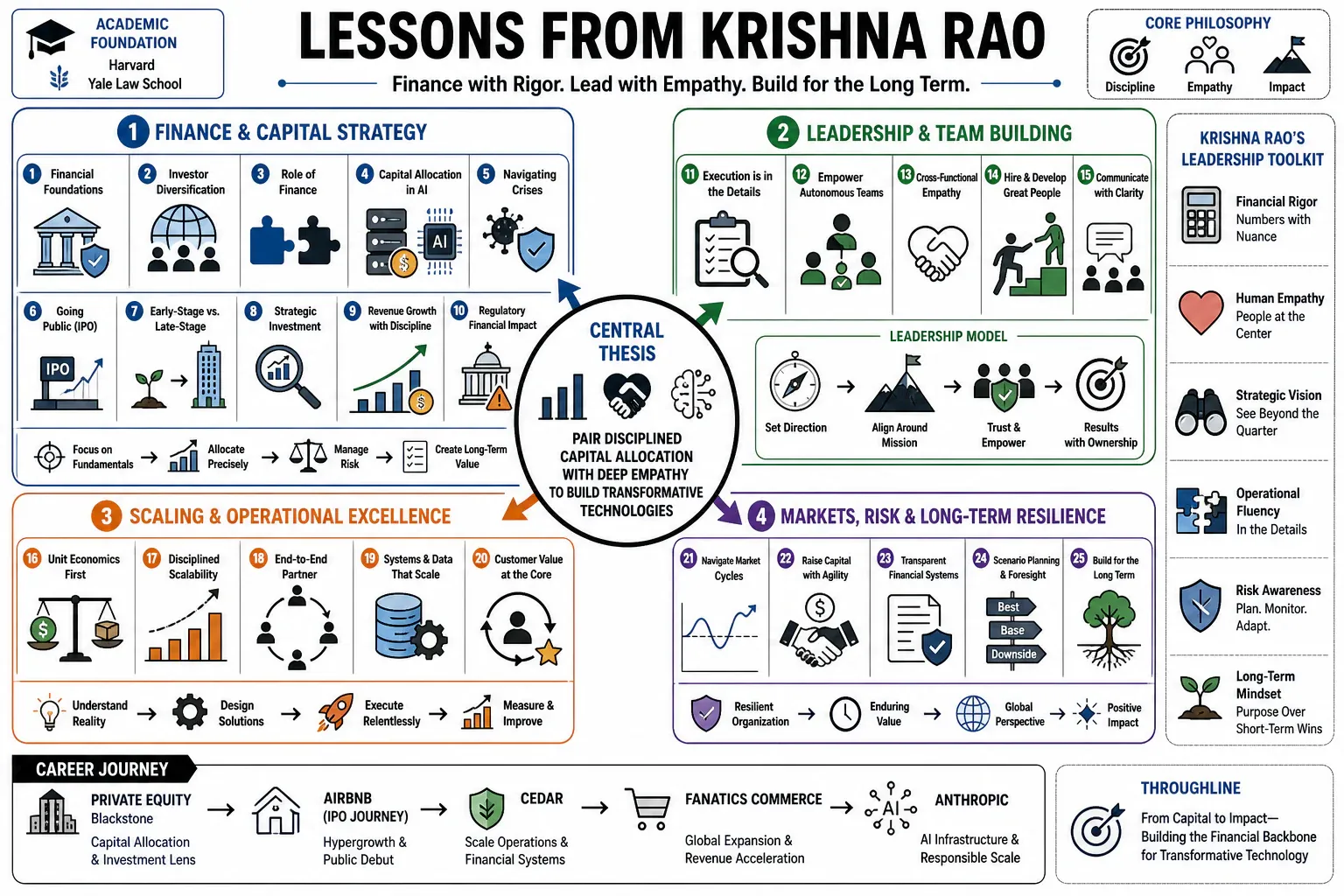
Part 1: Finance & Capital Strategy
- On Financial Foundations: "I look forward to working with the exceptional team at Anthropic to build a strong financial foundation that will support the responsible development and deployment of our technology." — Source: [Anthropic]
- On Investor Diversification: "So we’ve really diversified our investor base... very, very focused on global and international relationships, which we saw as extremely valuable." — Source: [The Economic Times]
- On the Role of Finance: Finance should not just be a back-office function but an end-to-end partner that acts as a strategic driver of overall business growth. — Source: [Cedar Blog]
- On Capital Allocation in AI: Disciplined infrastructure scaling and precise capital allocation are essential given the unprecedented, capital-intensive demand for AI services. — Source: [20VC Podcast]
- On Navigating Crises: Successfully raising over $10 billion during the COVID-19 pandemic required agility and an unwavering focus on core business fundamentals. — Source: [PYMNTS]
- On Going Public: Managing an IPO process, like the successful public debut at Airbnb, demands rigorous financial planning and a clear narrative for long-term value creation. — Source: [Yale Law School]
- On Early-Stage vs. Late-Stage Finance: The transition from scaling a private company to managing public markets requires building scalable, transparent, and resilient financial systems. — Source: [CFO Dive]
- On Strategic Investment: Moving from private equity at Blackstone to an operating role taught the critical importance of seeing beyond the numbers to understand the day-to-day operational reality. — Source: [American Kahani]
- On Revenue Growth: Rapid top-line revenue expansion must always be matched by a disciplined approach to unit economics and margin improvement. — Source: [20VC Podcast]
- On Regulatory Financial Impact: "Across Anthropic’s entire business... the government’s actions could reduce Anthropic’s revenue by multiple billions of dollars." — Source: [India Times]
Part 2: Leadership & Team Building
- On Execution: "Execution is in the details, and they matter — if you don't understand the fundamentals of your business or organization, there is no way you can effectively lead it." — Source: [Yale Law School]
- On Trust: "Talented people want autonomy and trust, and if you don't give that to them, they go elsewhere." — Source: [Yale Law School]
- On Empathy in Leadership: "Making a genuine effort to understand each role on a team and the challenges specific to that role is a good foundation for building strong working relationships." — Source: [Yale Law School]
- On Constructive Criticism: "I am direct and transparent with the people I interact with. I want to hear real-time feedback that is critical and constructive so we can get better continuously." — Source: [Yale Law School]
- On Self-Awareness: "I try to acknowledge my blind spots and hire strong team members that complement the gaps in my skills and experience." — Source: [Yale Law School]
- On Empowering Leaders: "I am always looking to work with talented leaders that push my thinking; I empower them to make their own decisions and make their own mistakes." — Source: [Yale Law School]
- On Cross-Functional Collaboration: "Working effectively within a company is challenging and requires a sustained focus on cross-functional collaboration." — Source: [American Kahani]
- On Mentorship: "I was fortunate to have understanding peers and generous mentors that taught me how to navigate a fast-growing company and get things done. Those lessons were invaluable." — Source: [American Kahani]
- On Operating Roles: The shift from investing to an operating role is particularly difficult because the jobs are fundamentally different and require building deep internal consensus. — Source: [American Kahani]
- On Career Risk: Throughout a career, it is natural to continuously evaluate how much risk to take on, when to shift roles, and where you will learn the most. — Source: [American Kahani]
Part 3: AI & The Future of Technology
- On Transformative Tech: "Anthropic’s mission to build transformative AI systems that benefit humanity deeply resonates with me." — Source: [Anthropic]
- On Pivotal Moments: Joining a company at the frontier of AI research is a rare opportunity to help shape a pivotal moment in global technological history. — Source: [Anthropic]
- On Responsible Deployment: A financial strategy in the AI sector must actively support and fund the responsible development and safe deployment of frontier models. — Source: [Anthropic]
- On Global AI Benefits: "The benefits of AI are not specific to one country or one region." — Source: [The Economic Times]
- On Compute Costs: The financial architecture of modern AI companies must account for massive, continuous, and strategic investments in hardware and compute infrastructure. — Source: [20VC Podcast]
- On AI Commercialization: Transitioning advanced AI from research labs to enterprise products requires a dedicated focus on building scalable, mutually beneficial commercial partnerships. — Source: [Inc. Magazine]
- On Ethical Stewardship: As a financial leader at an AI company, balancing the demands of hypergrowth with strict ethical safety constraints is a unique, mandatory challenge. — Source: [CFO Thought Leader Podcast]
- On Competition: Strategic, multi-billion dollar capital raises are essential for maintaining independence and a competitive advantage in the rapidly evolving LLM landscape. — Source: [The Logan Bartlett Show]
- On Safety First: Prioritizing safety research does not preclude commercial success; rather, it builds the long-term trust required for widespread enterprise adoption. — Source: [Anthropic]
- On Future Growth: The unprecedented trajectory of generative AI demands that financial leaders anticipate infrastructure and market needs years before they fully materialize. — Source: [TechBullion]
Part 4: Scaling & Hypergrowth
- On Hypergrowth Dynamics: Scaling a company from private growth stages through to an IPO requires a fundamental shift in how financial data is structured, audited, and communicated. — Source: [CFO Dive]
- On Pandemic Resilience: Navigating sudden macroeconomic shocks, such as the halt in global travel, tests a company's ability to ruthlessly prioritize capital preservation. — Source: [PYMNTS]
- On Strategic Partnerships: Building a robust business development function is critical for unlocking new, scalable revenue streams during periods of rapid expansion. — Source: [Sports Business Journal]
- On E-commerce Scaling: Managing finances at scale in digital commerce requires deep, real-time integration between the finance team and supply chain operators. — Source: [Fashion Network]
- On Organizational Design: As fast-growing companies scale, leaders must proactively redesign organizational structures to prevent operational bottlenecks and departmental silos. — Source: [Yale Law School]
- On Capital Markets: Successfully engaging with capital markets requires translating complex operational metrics into a clean, compelling thesis for public and institutional investors. — Source: [American Kahani]
- On Global Expansion Strategy: International growth must be supported by localized partnerships and a diversified investor base that deeply understands regional market nuances. — Source: [The Economic Times]
- On Mergers & Acquisitions: Effective corporate development relies on identifying acquisitions that not only add revenue but integrate seamlessly into the core company culture. — Source: [Cedar Press Release]
- On Adaptability: The ability to pivot operational strategy rapidly—whether due to a global pandemic or a sudden breakthrough in AI—is the defining characteristic of successful modern enterprises. — Source: [India Times]
- On Legal and Financial Synergy: A background in law provides a unique strategic advantage in navigating the complex, overlapping regulatory environments that accompany hypergrowth. — Source: [Yale Law School]
Part 5: Innovation & Consumer Experience
- On Tangible Problem Solving: "The problem Cedar is solving is so tangible. When you tell people about Cedar’s mission, everyone has a personal experience to share." — Source: [Cedar Blog]
- On Healthcare Complexity: "[Right now] I actually have a 6-page explanation of benefits from my insurance company sitting in front of me that I am trying to make sense of—a perfect example of what Cedar is addressing." — Source: [Cedar Blog]
- On the Patient Journey: "Almost everyone has had a healthcare billing issue either for themselves or in their family so it is extremely relevant, especially given how expensive medical care is in this country." — Source: [Cedar Blog]
- On Consumer-Centric Healthcare: "I believe Cedar’s relentless focus on improving the consumer experience in healthcare is the best way to address the problem." — Source: [Cedar Blog]
- On Personal Empathy in Business: Having a child during a global pandemic profoundly reinforced the urgent, personal need to simplify and humanize the healthcare system. — Source: [Cedar Blog]
- On Product Innovation: Financial leadership must actively champion and fund product innovations that directly remove friction from the end-user experience. — Source: [PYMNTS]
- On Fintech Intersection: The intersection of complex finance and intuitive technology is where the most impactful improvements to daily consumer life are currently being built. — Source: [Yale Law School]
- On Retail Technology: In modern digital commerce, the seamless backend integration of payments and digital storefronts is essential for capturing and retaining consumers. — Source: [Fashion Network]
- On Enterprise vs. Consumer: Building solutions for large enterprises ultimately succeeds only when the end-consumer's daily experience is prioritized above all else. — Source: [Cedar Press Release]
- On Meaningful Work: Choosing to work in challenging sectors like healthcare technology or AI safety reflects a deeper desire to solve problems that have a profound, lasting impact on society. — Source: [Anthropic]