Justin Dignelli is a technology executive and entrepreneur renowned for his expertise in bridging product-led growth (PLG) and enterprise sales motions. Drawing from his background as a professional athlete and his pivotal role in scaling MongoDB's cloud business, he has consistently championed data-driven go-to-market strategies. Through his leadership at Pace and Modal, Dignelli provides actionable blueprints for harmonizing self-service analytics with high-velocity revenue engines.
Part 1: Sales & Go-To-Market Strategy
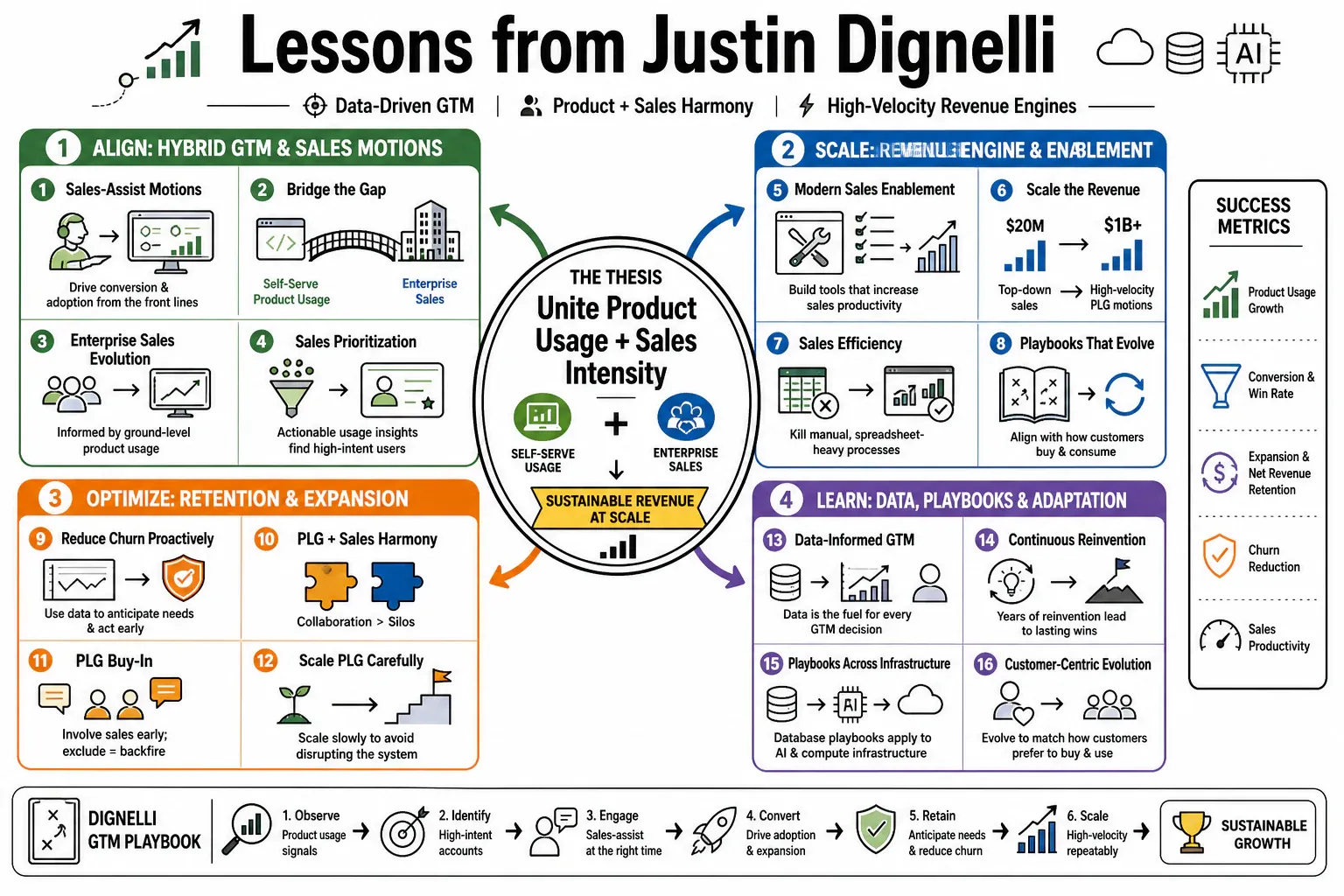
- On Sales-Assist Motions: "Sales assist isn't about traditional onboarding; it's about driving conversion and adoption metrics from the front lines." — Source: [ProductLed]
- On Hybrid GTM: "Bridging the gap between self-service product usage and enterprise sales is the defining challenge for modern software companies." — Source: [Pace]
- On Modern Sales Enablement: "You have to build internal tools that genuinely increase sales productivity, especially in a cloud-first offering." — Source: [The Org]
- On Scaling Revenue: "Scaling from $20 million to over $1 billion requires a fundamental shift from top-down sales to high-velocity, product-led motions." — Source: [Modal]
- On the GTM Machine: "The playbooks developed for database infrastructure can be directly applied to accelerate AI and compute infrastructure." — Source: [Modal]
- On Sales Prioritization: "Sales teams need actionable insights into product usage to effectively identify high-intent users and prioritize leads." — Source: [Pace]
- On Reducing Churn: "A proactive GTM strategy doesn't just win new logos; it uses data to anticipate needs and reduce churn before it happens." — Source: [Pace]
- On Enterprise Sales Evolution: "Enterprise sales isn't dead; it just needs to be informed by the self-serve product usage happening at the ground level." — Source: [Pace]
- On Sales Efficiency: "Manual, spreadsheet-heavy processes are the enemy of a high-volume, product-led sales environment." — Source: [Work-Bench]
- On Building Playbooks: "A successful GTM playbook must continuously evolve to align with how customers actually prefer to buy and consume software." — Source: [The Org]
Part 2: Product-Led Growth (PLG)
- On the Reality of PLG: "When you reach that prime of triumph, it's so easy to count the wins, but what we don't realize is that it takes years of reinvention to get there." — Source: [ProductLed]
- On PLG Buy-In: "Getting PLG buy-in is crucial, and excluding the sales team without any discussion can backfire." — Source: [ProductLed]
- On Scaling PLG: "Scaling slowly and carefully can mitigate the potential negative impacts of disrupting an existing sales-oriented system." — Source: [ProductLed]
- On PLG and Sales Harmony: "Harmonizing self-service and enterprise sales motions is essential for realizing the full value of a product-led strategy." — Source: [Growfusely]
- On PLG Case Studies: "Real-life SaaS growth isn't about theoretical frameworks; it's about experimenting directly with the user base to find what sticks." — Source: [Growfusely]
- On the PLG Mindset: "Product-led growth is as much an organizational shift as it is a go-to-market strategy." — Source: [Pace]
- On User Discovery: "PLG allows businesses to gain unprecedented insight into their user base simply by observing how the product is utilized." — Source: [ProductLed]
- On Self-Serve Metrics: "Focusing on the right self-serve metrics helps GTM teams understand where the friction lies and where intervention is needed." — Source: [Pace]
- On PLG Transformation: "The transition to PLG is not an overnight switch; it requires patient, methodical reinvention of legacy processes." — Source: [ProductLed]
Part 3: Data & Analytics in Sales
- On Actionable Data: "A game-changer in this process was to make real-time customer usage data accessible, understandable, and actionable for revenue-generating teams." — Source: [ProductLed]
- On Proactive Support: "When query latency was high, we used that data to proactively point customers to a feature that could address their specific issue." — Source: [ProductLed]
- On Bridging Data Silos: "Integrating data from CRMs and data warehouses is the only way to give hybrid GTM teams the holistic view they need." — Source: [Pace]
- On Usage-Based Insights: "Product usage data is the strongest indicator of a customer's intent and readiness for a larger enterprise conversation." — Source: [Pace]
- On Data Visibility: "Revenue teams can only act on what they can see; democratizing data access is step one for any modern sales organization." — Source: [ProductLed]
- On Analytics Platforms: "The goal of a revenue platform is to turn raw usage telemetry into prioritized, actionable workflows for sales reps." — Source: [Pace]
- On Customer Intelligence: "Understanding exactly how customers interact with your product provides an unfair advantage in sales conversations." — Source: [Pace]
- On Data-Driven Prioritization: "Sales reps shouldn't guess who to call; data should objectively highlight the accounts with the highest propensity to expand." — Source: [Pace]
- On the Value of Telemetry: "Telemetry isn't just for engineering; it's the lifeblood of a modern, efficient go-to-market engine." — Source: [The Org]
- On Real-Time Engagement: "Stale data leads to missed opportunities. GTM teams need real-time insights to engage customers exactly when they need help." — Source: [ProductLed]
Part 4: The MongoDB Journey
- On Customer Perception: "Initially, MongoDB treated its self-serve business and sales-led business as separate entities. Over time, we realized that, to the customer, it didn't matter." — Source: [ProductLed]
- On Unifying the Brand: "To the customer, they saw MongoDB as a single entity, whether they were PayGo or committed enterprise clients." — Source: [ProductLed]
- On Atlas Growth: "Defining the sales motions for MongoDB Atlas required building playbooks that bridged cloud consumption with traditional enterprise needs." — Source: [The Org]
- On Cloud GTM: "Transitioning to a cloud GTM model meant creating internal tools that empowered reps to sell a fully managed service effectively." — Source: [The Org]
- On Revenue Milestones: "Being part of the team that scaled MongoDB past the $1 billion mark taught me the mechanics of hyper-growth firsthand." — Source: [Modal]
- On Defining Sales Assist: "We built the 'sales assist' function at MongoDB specifically to increase the productivity and conversion rates of our cloud offerings." — Source: [The Org]
- On Organizational Silos: "Breaking down the walls between the self-serve and sales-led businesses was critical to our unified success at MongoDB." — Source: [ProductLed]
- On Scaling Systems: "The infrastructure we built to support Atlas's growth became the blueprint for how modern cloud companies should go to market." — Source: [The Org]
- On Continuous Reinvention: "The success of MongoDB Atlas wasn't accidental; it was the result of years of continuous reinvention and market adaptation." — Source: [ProductLed]
Part 5: Customer Centricity
- On the Customer's View: "Customers don't care about your internal organizational structure; they simply want a seamless experience as a paying user." — Source: [ProductLed]
- On Listening to Users: "Interview until you start hearing the same things over and over again… then start writing those down." — Source: [ProductLed]
- On Problem Solving: "When we noticed high latency, our priority wasn't to upsell, but to point the user to a feature that solved their immediate problem." — Source: [ProductLed]
- On Customer Success: "True customer success in a PLG model happens when sales reps act as guides rather than gatekeepers." — Source: [Pace]
- On User Empathy: "Understanding the user's journey through their own data is the ultimate form of empathy in software sales." — Source: [Pace]
- On Value Delivery: "The focus should always be on getting the customer to realize value quickly, rather than just closing the initial deal." — Source: [ProductLed]
- On Consistent Experience: "Whether a customer spends ten dollars or ten thousand, their interaction with the brand must feel cohesive." — Source: [ProductLed]
- On Feedback Loops: "The most valuable insights come from establishing tight feedback loops directly with the active user base." — Source: [Growfusely]
- On Anticipating Needs: "With the right data, you stop reacting to support tickets and start proactively anticipating customer needs." — Source: [Pace]
- On Building Trust: "Trust is built when a sales conversation focuses on optimizing a customer's existing usage rather than purely pushing for expansion." — Source: [ProductLed]
Part 6: Leadership & Team Alignment
- On Executive Buy-In: "Quick experiments can help you get wins and build buy-in from C-Suite around the product-led strategy." — Source: [ProductLed]
- On Change Management: "Disrupting an existing sales-oriented system requires careful pacing and deliberate communication across all levels." — Source: [ProductLed]
- On Cross-Functional Harmony: "Harmonizing the efforts of product, engineering, and sales is the only way to successfully execute a hybrid GTM motion." — Source: [Growfusely]
- On Empowering Reps: "Leadership's job is to equip front-line representatives with the data and tools they need to be effective advisors." — Source: [The Org]
- On Shared Goals: "When the self-serve and enterprise teams share the same customer-centric goals, organizational friction naturally decreases." — Source: [ProductLed]
- On Strategic Patience: "Transformation takes time. Leaders must be willing to endure the years of reinvention required to reach a 'prime of triumph'." — Source: [ProductLed]
- On Cultivating Buy-In: "You cannot force a PLG mindset onto a traditional sales team; you have to demonstrate its value through quick, tangible wins." — Source: [ProductLed]
- On Building the GTM Engine: "A world-class GTM engine is built by aligning incentive structures with the actual usage behaviors of your customers." — Source: [Modal]
- On Navigating Transitions: "Transitioning a company's sales motion requires leaders to act as bridge-builders between legacy practices and new methodologies." — Source: [ProductLed]
Part 7: Transitioning from Athletics to Business
- On Professional Discipline: "The discipline required to pitch professionally for the Dodgers translates directly to the rigorous demands of scaling a tech company." — Source: [YouTube]
- On Repetition and Practice: "Just as in sports, mastering sales and GTM motions requires endless repetition and a commitment to refining the fundamentals." — Source: [YouTube]
- On High-Pressure Performance: "Standing on the mound in professional baseball prepares you for the pressure of high-stakes enterprise negotiations." — Source: [YouTube]
- On Team Dynamics: "A successful startup operates much like a baseball team; every individual must execute their specific role for the collective win." — Source: [YouTube]
- On Resilience: "Athletics teaches you how to handle failure and rejection—skills that are indispensable in early-stage company building." — Source: [YouTube]
- On Continuous Improvement: "The drive to incrementally improve your performance as an athlete perfectly mirrors the iterative nature of product-led growth." — Source: [YouTube]
- On Strategic Execution: "A pitcher must execute a game plan against a batter; similarly, a sales leader must execute a precise strategy in the market." — Source: [YouTube]
- On the Value of Coaching: "Great athletes rely on coaches. In business, surrounding yourself with experienced advisors and mentors is just as critical." — Source: [Work-Bench]
- On Transitioning Careers: "Moving from professional sports to technology requires a willingness to start at the bottom and learn a completely new playbook." — Source: [YouTube]
Part 8: Entrepreneurship & Building Pace
- On Identifying the Problem: "Pace was born out of the shared frustration of using manual, spreadsheet-heavy processes to manage high-volume sales." — Source: [Work-Bench]
- On Solving Your Own Pain: "We built the platform we desperately wished we had when we were scaling the cloud business at MongoDB." — Source: [Pace]
- On Early Stage Focus: "In a startup, your initial focus must be on proving that your specific solution effectively bridges a massive gap in the market." — Source: [Pace]
- On Attracting Investors: "Securing backing from leaders at Stripe, Atlassian, and Heroku validated that the PLG-to-sales gap was a universally recognized pain point." — Source: [Work-Bench]
- On Adapting the Business: "Transitioning Pace into a GTM consulting practice demonstrated the necessary flexibility to find the best way to deliver value." — Source: [Pace]
- On Co-Founder Dynamics: "Partnering with someone who deeply understands the product side of the equation is essential when building a revenue platform." — Source: [Pace]
- On Enterprise Architecture: "Building a tool for enterprise sales means you have to seamlessly integrate with their existing CRMs and data warehouses from day one." — Source: [Pace]
- On the Founder Journey: "Founding a company requires stepping out of the comfort of a successful executive role to build something entirely from scratch." — Source: [Pace]
- On Advising Startups: "As an advisor to early-stage infrastructure companies, the goal is to impart the GTM playbooks that took years of trial and error to learn." — Source: [The Org]