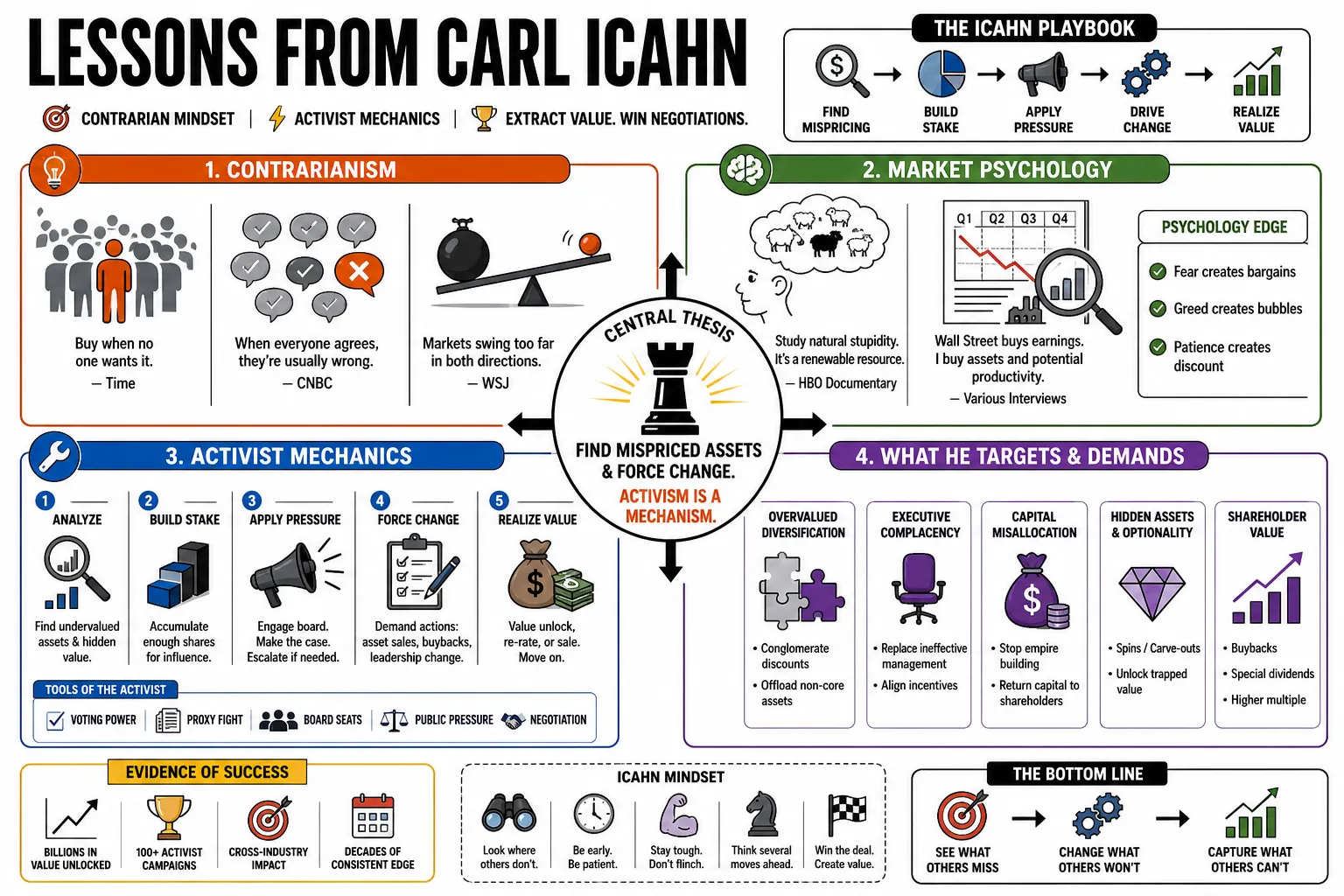
Lessons from Carl Icahn
Carl Icahn is an activist investor who formed Icahn & Co. in 1968 and began taking very large positions in individual companies in 1978. — About – Carl Icahn.
Part 1: Contrarianism and Market Psychology
- On Activism That Has Not Changed: carl-icahn: "I don’t believe activism has changed very much or, for that matter, that there were ever many true activists." — Carl Icahn: What It Takes To Be A Truly Successful Activist (Bloomberg Q&A excerpt).
- On Why Stocks Disconnect From Value: carl-icahn: "For the most part, the reason for this disconnect is management." — ‘If He Ruled the World’: Carl Icahn’s Take on Time Warner and Corporate America - Knowledge at Wharton.
- On Undervalued Companies and Hidden Assets: carl-icahn: "There are many companies that are undervalued because of poor management and/or there are certain hidden assets that the board or management have not taken advantage of." — Carl Icahn: What It Takes To Be A Truly Successful Activist (Bloomberg Q&A excerpt).
- On Throwing Out the Baby: carl-icahn: "There are many very good companies and many very good CEOs but then there are very many bad ones and I think it’s sort of crazy to throw the baby out with the bath water." — Carl Icahn: The Death of Activism (excerpt, The Acquirer’s Multiple).
- On No Accountability in Corporate America: carl-icahn: "The reason is simple – there is no accountability in Corporate America." — CARL C. ICAHN | Icahn Enterprises (letter to unitholders, Aug. 4, 2023).
Part 2: Corporate Governance and Board Incompetence
- On a True Corporate Democracy: carl-icahn: "I think there will be a true corporate democracy that will have to evolve so that we can become competitive with the rest of the world again." — ECON 252 (2008) - Lecture 15 - Guest Lecture by Carl Icahn | Open Yale Courses.
- On No Real Corporate Democracy: carl-icahn: "Shareholders find it hard to hold management teams and boards of directors accountable because there is no real corporate democracy." — CARL C. ICAHN | Icahn Enterprises (letter to unitholders, Aug. 4, 2023).
- On Accountability of Boards and Management: carl-icahn: "I have always believed that far too many boards and management teams in our country – with many exceptions – are not remotely accountable to shareholders and, in many cases, are inadequate to be the leaders at the companies they helm." — Statement to Shareholders of McDonald’s and Kroger – Carl Icahn.
- On Boards of Cronies: carl-icahn: "CEOs, generally with the help of a few friendly directors, are able to pack their respective board of directors with cronies who are unwilling to challenge a CEO or hold them accountable for their performance for fear of losing the prestige and stipends that come with being a public company director." — CARL C. ICAHN | Icahn Enterprises (letter to unitholders, Aug. 4, 2023).
- On Boards and Management Hard to Remove: carl-icahn: "There are many good boards and CEOs but sadly there are many that should not be there but are extremely hard to remove." — Carl Icahn: What It Takes To Be A Truly Successful Activist (Bloomberg Q&A excerpt).
- On the Business Roundtable: carl-icahn: "The Business Roundtable is a huge lobby, ironically paid for by the shareholders that are getting abused by them." — CNBC Exclusive: CNBC Transcript: Icahn Enterprises Chairman Carl Icahn Speaks with CNBC’s “Fast Money” Today.
- On Entrenched Boards: carl-icahn: "Even when a shareholder wages and wins an activist campaign, boards can be so entrenched that it can take years to implement the needed changes and unlock the value and/or hidden jewel." — CARL C. ICAHN | Icahn Enterprises (letter to unitholders, Aug. 4, 2023).
- On Abuses of Shareholders: carl-icahn: "We clean up these companies and it’s just amazing the abuses that corporate America places on the shareholders in many companies." — Carl Icahn: The Death of Activism (excerpt, The Acquirer’s Multiple).
Part 3: The CEO Sickness
- On Anti-Darwinian CEO Selection: carl-icahn: "It is anti-Darwinian the way we select CEOs in this country." — ‘If He Ruled the World’: Carl Icahn’s Take on Time Warner and Corporate America - Knowledge at Wharton.
- On Corporate Leadership Vacuum: carl-icahn: "One of our major problems I think in this economy right now is there is no leadership on the corporate level." — Carl Icahn: Leadership In U.S Corporations Is Worse Than Mediocre (excerpt, The Acquirer’s Multiple).
- On How CEOs Rise: carl-icahn: "Rather, too often CEOs have risen through the ranks because they were ho-hum, with the main skill of having not been seen as threatening to their superiors." — CARL C. ICAHN | Icahn Enterprises (letter to unitholders, Aug. 4, 2023).
- On Empire Building: carl-icahn: "With many exceptions, most CEOs are incapable of creating great businesses (or even improving them) and the desire to empire build is rampant." — CARL C. ICAHN | Icahn Enterprises (letter to unitholders, Aug. 4, 2023).
- On Removing a CEO: carl-icahn: "Once a CEO ascends to their seat, it is extremely difficult to remove them." — CARL C. ICAHN | Icahn Enterprises (letter to unitholders, Aug. 4, 2023).
- On Leadership Worse Than Mediocre: carl-icahn: "With many exceptions, many, many exceptions, leadership is worse than mediocre." — Carl Icahn: Leadership In U.S Corporations Is Worse Than Mediocre (excerpt, The Acquirer’s Multiple).
- On the Country Club: carl-icahn: "Those CEOs are generally too busy playing at the proverbial country club to realize what improvements can be made or what hidden jewels can be unlocked." — CARL C. ICAHN | Icahn Enterprises (letter to unitholders, Aug. 4, 2023).
- On How Poorly Companies Are Run: carl-icahn: "The thing about corporate America — few people that go to college, like where you are now, and most people in America don't realize how poorly most of our companies are run in this country, with many exceptions." — ECON 252 (2008) - Lecture 15 - Guest Lecture by Carl Icahn | Open Yale Courses.
- On Activism as the Best Paradigm: carl-icahn: "We have long believed that activism is the best investment paradigm." — CARL C. ICAHN | Icahn Enterprises (letter to unitholders, Aug. 4, 2023).
Part 4: Activist Strategy and Hostile Takeovers
- On Few True Activists: carl-icahn: "There are very few activist investors that have the capital base, the will, the knowledge and the patience to improve companies and increase shareholder value for all holders." — CARL C. ICAHN | Icahn Enterprises (letter to unitholders, Aug. 4, 2023).
- On a Stacked Deck: carl-icahn: "Put simply, the deck is stacked against the shareholder and the activist, and this explains why there is so little activism today relative to the number of companies that could benefit from it." — CARL C. ICAHN | Icahn Enterprises (letter to unitholders, Aug. 4, 2023).
- On Shaking Them Up: carl-icahn: "We need to shake these guys up." — ‘If He Ruled the World’: Carl Icahn’s Take on Time Warner and Corporate America - Knowledge at Wharton.
- On Mutual Funds Voting: carl-icahn: "Mutual funds before never liked to vote against the incumbent management." — ‘If He Ruled the World’: Carl Icahn’s Take on Time Warner and Corporate America - Knowledge at Wharton.
- On Hedge Funds Doing Homework: carl-icahn: "Hedge funds do take large positions and they, unlike mutual funds, are very, very oriented to how they are doing and to the performance of the company." — ‘If He Ruled the World’: Carl Icahn’s Take on Time Warner and Corporate America - Knowledge at Wharton.
Part 5: Value Extraction and Capital Allocation
- On Borrowing to Buy Stock: carl-icahn: "But instead of putting back into production they’ve taken that money, borrowed more and more, and bought stocks at very high valuations, and now it’s time to pay the price of that." — Carl Icahn: Corporate America Only Has Itself To Blame (excerpt, The Acquirer’s Multiple).
- On Liquidation: carl-icahn: "Liquidation doesn’t mean you are taking it apart." — ‘If He Ruled the World’: Carl Icahn’s Take on Time Warner and Corporate America - Knowledge at Wharton.
- On Assets in the Best Hands: carl-icahn: "What I care about is seeing these assets in the best hands." — ‘If He Ruled the World’: Carl Icahn’s Take on Time Warner and Corporate America - Knowledge at Wharton.
- On Making Assets More Productive: carl-icahn: "The person who buys the company should be able to make it more productive than the current managers." — ‘If He Ruled the World’: Carl Icahn’s Take on Time Warner and Corporate America - Knowledge at Wharton.
- On Conglomerates: carl-icahn: "This conglomerate concept really doesn’t work." — ‘If He Ruled the World’: Carl Icahn’s Take on Time Warner and Corporate America - Knowledge at Wharton.
Part 6: Negotiation and Leverage
- On What It Takes to Succeed as an Activist: carl-icahn: "It takes a great deal of patience, permanent capital and negotiating skill — as well as a very thick skin — to be truly a successful activist, and perhaps that’s why it is so lucrative and the best investing model that exists today." — Carl Icahn: What It Takes To Be A Truly Successful Activist (Bloomberg Q&A excerpt).
- On Choosing Management Teams: carl-icahn: "Perhaps above all, it takes the ability to choose good management teams, if needed, when you do gain control of a company." — Carl Icahn: What It Takes To Be A Truly Successful Activist (Bloomberg Q&A excerpt).
Part 7: Risk, Hubris, and Survival
- On the Market Not Being a Casino: carl-icahn: "The market is not a gambling casino and too many people in this type of market, too many people think it is, and especially now with low interest rates, so it’s really a dangerous place today." — Carl Icahn: Don’t Confuse A Bull Market With Brains! (excerpt, The Acquirer’s Multiple).
- On Being Too Hedged: carl-icahn: "Even though results for 2019 and 2020 were disappointing, our losses were partially because we were too hedged; not because of our activist activities during that period." — Carl Icahn: What It Takes To Be A Truly Successful Activist (Bloomberg Q&A excerpt).
- On Inflation Destroying Hegemonies: carl-icahn: "If you look in history, every hegemony has been destroyed by inflation, or almost every one." — Carl Icahn: Leadership In U.S Corporations Is Worse Than Mediocre (excerpt, The Acquirer’s Multiple).
- On Inflation as the Worst Thing: carl-icahn: "I can’t talk about next week or even next month, but inflation is the worst thing an economy can have." — Carl Icahn: Leadership In U.S Corporations Is Worse Than Mediocre (excerpt, The Acquirer’s Multiple).
- On the Activist Model's Record: carl-icahn: "I believe our long-term record clearly proves our point that activism is by far the best investment model that exists today." — Carl Icahn: What It Takes To Be A Truly Successful Activist (Bloomberg Q&A excerpt).
- On Sticking to the Knitting: carl-icahn: "Going forward, we intend to stick to our knitting and focus on our activist strategy while remaining appropriately hedged." — CARL C. ICAHN | Icahn Enterprises (letter to unitholders, Aug. 4, 2023).
- On Wasting Time on Ill-Fated Plans: carl-icahn: "The road to the graveyard on Wall Street is littered with the bones of companies, such as Eastman Kodak, which wasted a great deal of valuable time by coming up with one ill-fated plan after another and also failed to act decisively when transformative opportunities presented themselves." — Carl Icahn: The Life Of An Activist Investor (excerpt, The Acquirer’s Multiple).
- On Going Through the Pain: carl-icahn: "You have to go through the pain, you have to go through it." — Carl Icahn: Don’t Confuse A Bull Market With Brains! (excerpt, The Acquirer’s Multiple).
- On Straying From the Method: carl-icahn: "As compelling as the above numbers are, they would have been far more impressive had we not strayed over the past several years from our activist methodology and shorted (hedged) far more than was necessary." — CARL C. ICAHN | Icahn Enterprises (letter to unitholders, Aug. 4, 2023).
Part 8: Wealth, Drive, and The Game
- On Starting With Poker Winnings: carl-icahn: "I had made a few bucks playing poker and that's how I started with about eight, ten thousand dollars and I made all this money by borrowing at 90%." — ECON 252 (2008) - Lecture 15 - Guest Lecture by Carl Icahn | Open Yale Courses.
- On Respecting Buffett: carl-icahn: "I know, like and respect Warren Buffett." — Carl Icahn: Why Buffett Is Wrong on Coke - Barron's.
- On Not Being Geniuses: carl-icahn: "That’s why we are so successful, not because we’re geniuses." — Carl Icahn: Leadership In U.S Corporations Is Worse Than Mediocre (excerpt, The Acquirer’s Multiple).
- On Accountability and Assets: carl-icahn: "If there is a change in accountability, many of our assets are going to perform better." — ‘If He Ruled the World’: Carl Icahn’s Take on Time Warner and Corporate America - Knowledge at Wharton.
- On Good Governance: carl-icahn: "Good corporate governance is good business." — Front Page – Carl Icahn.
- On Fighting Tyranny: carl-icahn: "A lot of people died fighting tyranny. The least I can do is vote against it." — Front Page – Carl Icahn.