Chamath Palihapitiya helped lead Facebook's growth and founded Social Capital in 2011. The firm focuses on emerging technology, life sciences, and energy transition. — Social Capital — About.
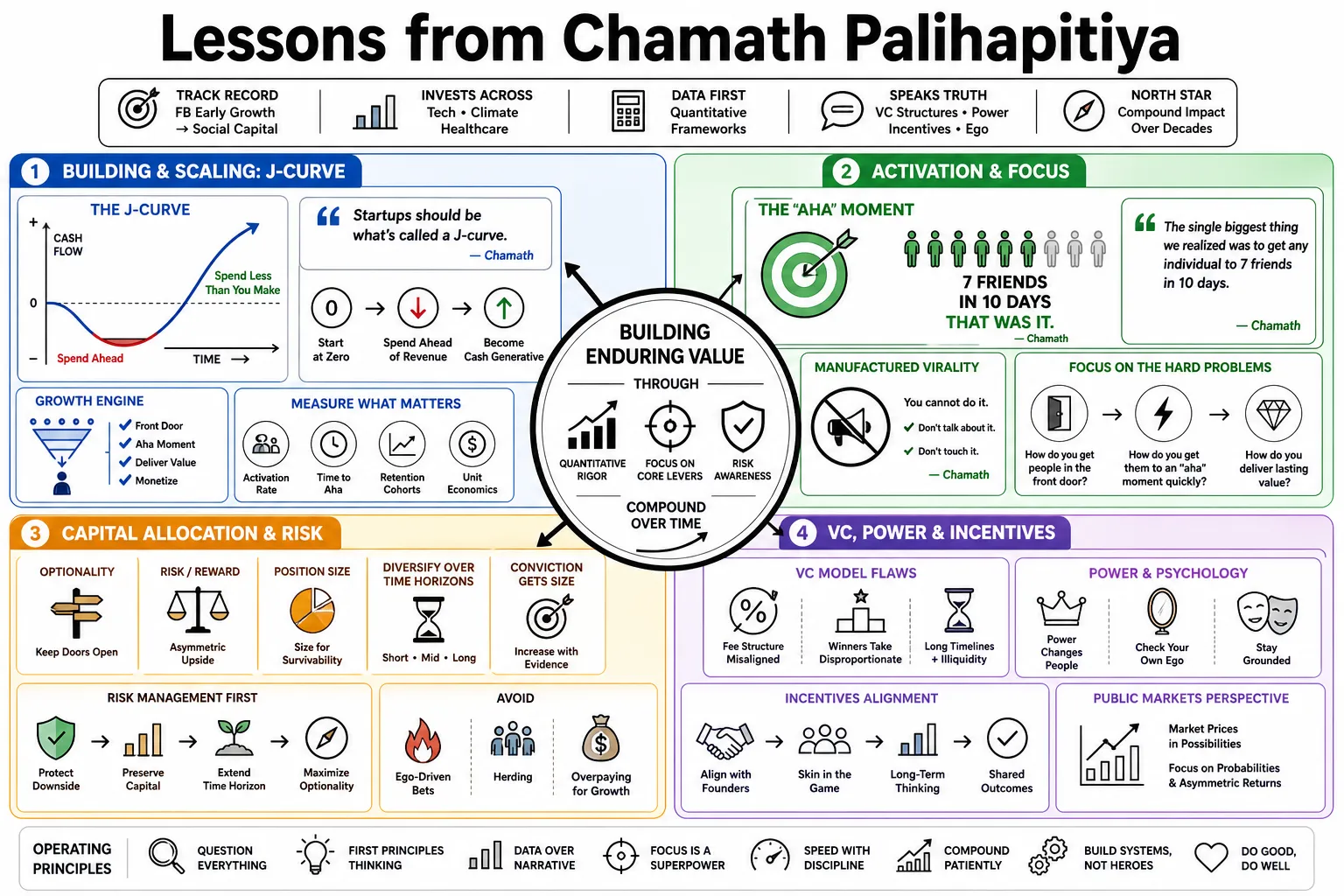
Part 1: Building and Scaling
- The Seven-Friends Activation Rule: Chamath said Facebook's growth team focused on helping a new user connect with seven friends in ten days, a simple activation target that organized the team's product work. — Growth Hackers Conference — Facebook's Path to One Billion Users.
- Focus on Core Value Before Virality: At Facebook, Chamath said he pushed the growth team to prioritize bringing people in, getting them to an aha moment, and repeatedly delivering core product value before designing for virality. — Growth Hackers Conference — Facebook's Path to One Billion Users.
- Test Intuition Against Data: Chamath says Facebook's growth team tested anecdotal beliefs about the product instead of relying on confident gut feelings that had not been validated. — Growth Hackers Conference — Facebook's Path to One Billion Users.
- Profitability Through Customer Value: Chamath warns that repeatedly subsidizing features with fundraising can hide weak unit economics; a startup needs customer value that remains defensible without endless outside capital. — Social Capital 2019 Annual Letter.
- Time Horizons: Chamath favors patient capital for entrepreneurs tackling hard problems and seeks returns that compound economically and socially over the long term. — Social Capital 2018 Annual Letter.
- Sustainable ROI: Chamath argues that pressure for immediate numerical returns and early exits can work against entrepreneurs building enduring businesses. — Social Capital 2018 Annual Letter.
- Crossing the Chasm: Chamath argues that a product reaches beyond its first enthusiastic adopters when its cost falls enough for mass-market use or its features become compelling enough to justify the price. — Lex Fridman Podcast #338.
- Do Not Outrun Product-Market Fit: Chamath warned that a growing software company can build an expensive sales and support apparatus before its core product is strong enough to sustain that growth. — Post Seed 2016 — Chamath Palihapitiya Interview.
- Copying: Chamath says that much of his own learning has come from observing and copying people he respects, and he encourages others to be good copiers. — Stanford GSB View From The Top.
Part 2: Capital Allocation and Investing
- Know Your Investing Edge: Chamath says investors should understand their strengths and biases, seek situations where they have an edge, and control the downside. — S&P Global Fixed Income in 15 Interview.
- Price Is Not Always Truth: Chamath argues that a stock's daily price can diverge from its underlying value, so he tries not to check prices every day. — Chamath Palihapitiya — Investing 101 Thread.
- Original Capital Structuring: Chamath predicted that ownership of many assets would be fractionalized and that communities could be built around that shift. — The Knowledge Project #94.
- The Fallacy of Venture Capital: Chamath criticizes venture investors who, in his view, become too concerned with protecting their status to take risks on ambitious ideas. — Stanford GSB View From The Top.
- The Fear of Losing Status: Chamath argues that winning a prestigious position can make an investor more risk-averse as protecting that position becomes a priority. — Stanford GSB View From The Top.
- Compounding Returns: Chamath favors slow, methodical company building and describes moderate growth that compounds over time as more valuable than chasing rapid short-term results. — Stanford GSB View From The Top.
- Structural Advantage: Chamath used SPACs to give selected companies access to large amounts of capital, but later stepped back as investor trust and deal quality weakened. — S&P Global — Investing, Mental Health, Poker & SPACs.
- Valuation Discipline: Chamath has warned that cheap money can reward distant growth projections, while inflation and higher-rate expectations can change the market's appetite for growth stocks. — Social Capital 2021 Annual Letter.
Part 3: The Psychology of Wealth and Power
- Money as an Instrument: Chamath urged students to acquire capital so they could advance their views and influence decisions, while keeping their moral compass. — Stanford GSB View From The Top.
- Capital and Influence: In Chamath's account, capital gives a person far more power to advance a worldview than ideas alone. — Stanford GSB View From The Top.
- Reallocating Capital: Chamath said his goal was to aggregate capital and direct it toward the priorities reflected in his worldview. — Stanford GSB View From The Top.
- Who Holds Power: Chamath argued that a small circle of wealthy people, rather than elected officials alone, has outsized influence over major assets and capital flows. — Stanford GSB View From The Top.
- Growing Up With Money Pressure: Chamath described growing up in a dysfunctional household on welfare and said money was a persistent source of pressure. — Stanford GSB View From The Top.
- Choosing Independence: Chamath said he left significant Facebook compensation behind because he valued independence, creativity, and the chance to win over the long term. — Chamath Palihapitiya — The Paradox of Ego and Humility.
- Money Does Not Solve Every Problem: Chamath says accumulating more possessions does not resolve a person's deeper problems and that wealth can reveal rather than erase aspects of one's personality. — Lex Fridman Podcast #338.
- A Seat at the Table: Chamath said he wanted to earn a seat among powerful capital allocators by proving he could operate as effectively as they could. — Stanford GSB View From The Top.
Part 4: Society, Social Media, and Incentives
- The Dopamine Loop: Chamath has argued that short-term social-media feedback loops erode civil discourse and cooperation. — Stanford GSB View From The Top.
- Ripping the Social Fabric: Reflecting on his time at Facebook, Chamath said he felt guilt about unintended consequences and worried that social platforms were harming the social fabric. — Stanford GSB View From The Top.
- Being Programmed: Chamath warns that social platforms can shape users' behavior without their noticing, and urges people to protect their intellectual independence. — Stanford GSB View From The Top.
- Opting Out of Social Media: Chamath said he largely stopped using social platforms because of his concerns about their effects, even though the choice created tension with friends. — Stanford GSB View From The Top.
- Manipulation Through Feedback Loops: Chamath warned that short-term social feedback loops and platform distribution could make it easier for bad actors to manipulate groups of people. — Stanford GSB View From The Top.
- Popularity Is Not Truth: Chamath warned that people can mistake likes and other short-term popularity signals for value or truth. — Stanford GSB View From The Top.
- The Fragility of Validation Metrics: Chamath described likes and similar feedback as brittle, short-term popularity signals that can encourage people to seek the next hit of approval. — Stanford GSB View From The Top.
- Infinite Feeds and Click Incentives: Chamath argued that infinite social feeds are built around a click-driven business model, unlike older media with fixed page or time limits. — Post Seed 2016 — Chamath Palihapitiya Interview.
Part 5: Leadership and Hard Truths
- Keep Experimenting: In his 2022 annual letter, Chamath invoked Theodore Roosevelt's 'man in the arena' passage and said Social Capital would keep experimenting and trying despite inevitable errors. — Social Capital 2022 Annual Letter.
- Corporate Cruelty: Criticizing a Cloudflare layoff memo, Chamath argued that calling departing workers 'measurers' reduced them to a label and could stigmatize their next job search. — All-In Podcast — Cloudflare Layoff Memo.
- Challenge Faulty Premises: Chamath says he challenges business decisions built on faulty premises and tries to surround himself with people willing to argue with him. — Chamath Palihapitiya — The Paradox of Ego and Humility.
- Barriers to Talent: Chamath argues that a person's location and social circumstances can keep capable people from being discovered and contributing fully, so opportunity is not distributed by talent alone. — Bloomberg Masters in Business — Chamath Palihapitiya.
- Confronting Reality: Chamath reviews his losing investments for blind spots and ego while distinguishing his own decisions from favorable market tailwinds behind wins. — S&P Global — Investing, Mental Health, Poker & SPACs.
- Benchmark the Business: Chamath described using portfolio reviews and benchmarks to find weak operating metrics and decide what a company should fix. — Post Seed 2016 — Chamath Palihapitiya Interview.
- What He Looks For in People: When backing leaders, Chamath says he looks for intellectual curiosity, resilience, and the unusual combination of ego with enough humility to change one's mind. — Chamath Palihapitiya — The Paradox of Ego and Humility.
Part 6: Risk, Failure, and Poker Dynamics
- Life as Poker: Chamath sees poker as a compact exercise in making uncertain decisions and staying emotionally balanced through wins and losses. — S&P Global — Investing, Mental Health, Poker & SPACs.
- Review Decisions, Not Just Outcomes: Chamath reviews his largest wins and losses to separate external tailwinds from his own decisions and to identify blind spots or ego-driven errors. — S&P Global Fixed Income in 15 Interview.
- Poker as a Compressed Investing Lesson: Chamath describes poker as a short-cycle setting for practicing limited-information decisions, bet sizing, and composure through wins and losses. — S&P Global Fixed Income in 15 Interview.
- Playing the Hand You're Dealt: Chamath compares life's uneven starting positions to poker hands: neither a strong nor a weak starting hand guarantees the result, so the task is to adjust as events unfold. — Waterloo Innovation Summit Interview.
- Poverty and Risk Tolerance: Chamath believes growing up poor shaped his relationship to money and risk; he has argued that some successful poker players share that background, though this is his observation rather than a proven rule. — Chamath Palihapitiya — The Paradox of Ego and Humility.
- Defying Game Theory: In poker, Chamath says human judgment can justify deviating from game-theory-optimal play in a specific situation. — Lex Fridman Podcast #338.
- Stripping Away Ego: Chamath says poker helps keep his ego in check by reminding him that even well-prepared players and entrepreneurs face setbacks. — Card Player Interview.
- Managing Tilt: Chamath warns that loss aversion and emotion after a setback can distort the next investment decision; poker lets him practice maintaining balance. — S&P Global — Investing, Mental Health, Poker & SPACs.
- Being Slightly Early: Chamath describes an investing edge from recognizing promising ideas months before the broader market while limiting the downside if he is wrong. — S&P Global Fixed Income in 15 Interview.
Part 7: The Future of Technology and Markets
- The Next Trillionaire: Chamath predicted that the world's first trillionaire would emerge from work on climate change. — The Knowledge Project #94.
- The End of Free Money: In his 2021 letter, Chamath argued that inflation and the expected end of quantitative easing were shifting markets away from the easy-money conditions that had favored growth stocks. — Social Capital 2021 Annual Letter.
- Watch SaaS Sales Efficiency: In a 2016 portfolio review, Chamath saw declining sales efficiency in some enterprise SaaS companies and warned that costly go-to-market infrastructure could mask weak core economics. — Post Seed 2016 — Chamath Palihapitiya Interview.
- AI and Productivity: Chamath predicts that AI tools could become a major source of productivity gains, disrupt existing economic value, and push an innovation-driven deflationary curve that benefits consumers. — Social Capital — Deep Dive: Artificial Intelligence.
- Energy Transitions: Chamath has called for investment in batteries, natural gas, nuclear power, and other energy capabilities to strengthen energy security and resilience. — Social Capital 2021 Annual Letter.
- Geopolitical Realignment: Chamath has argued for diversifying critical supply chains among several trading partners and investing in resilient battery, semiconductor, and manufacturing capacity. — Social Capital 2020 Annual Letter.
- Biotech and Healthcare: Social Capital has argued that combining data, diagnostics, and computing in bioinformatics could improve care while lowering healthcare costs. — Social Capital 2020 Annual Letter.
- Decentralizing Capital Access: Chamath argues that decentralized finance and composable projects could let more people participate in capital allocation without relying on a small set of established institutions. — Bloomberg Masters in Business — Chamath Palihapitiya.
- True Open-Source AI: Chamath distinguishes fully open-source AI from open-weight releases and argues that genuinely open models could reduce dependence on a small number of model makers. — Chamath Palihapitiya — Open-Source AI Post.
Part 8: Personal Growth and Mental Health
- The Ultimate Unlock: Chamath has said that personal happiness and mental health became easier to work on when he found someone he could talk to. — The Knowledge Project #94.
- Learning to Talk Openly: Chamath says talking about mental health felt awkward at first, but became easier and more useful to him with practice. — The Knowledge Project #94 — Understanding Yourself.
- Freedom and Happiness Are Different Paths: Chamath distinguishes financial freedom, whose methods he thinks can be taught, from happiness, which he says each person must work out through their own experience. — The Knowledge Project #94 — Understanding Yourself.
- Masculinity and Vulnerability: Chamath says he was taught that talking about emotions was weak, especially as an immigrant man, and that becoming more open has helped him. — The Knowledge Project #94.
- Normalizing Struggles: Chamath said that recognizing many of his own experiences as normal, and feeling part of a group, helped him personally. — The Knowledge Project #94.
- Fighting Yourself: Chamath described panic, overreaction, and fixation on the past or future as ways people can undermine their ability to observe the present. — The Knowledge Project #94.
- Choose Your Own Measures of Fulfillment: Chamath says he spent years responding to other people's perceptions and pressure before asking whether he was living a fulfilling life by his own definition. — The Knowledge Project #94 — Understanding Yourself.
- Belonging and Self-Worth: Chamath said that feeling part of a group helped him regulate his own sense of self-worth during difficult periods. — The Knowledge Project #94.
- First Principles in Life: Chamath says he returns to first principles by questioning business assumptions and asking which personal values, such as independence and creativity, matter most in a decision. — Chamath Palihapitiya — The Paradox of Ego and Humility.