Charlie Munger served as Berkshire Hathaway’s vice chairman and developed a practical approach to judgment built around a latticework of models from multiple disciplines. — Munger — Elementary Worldly Wisdom.
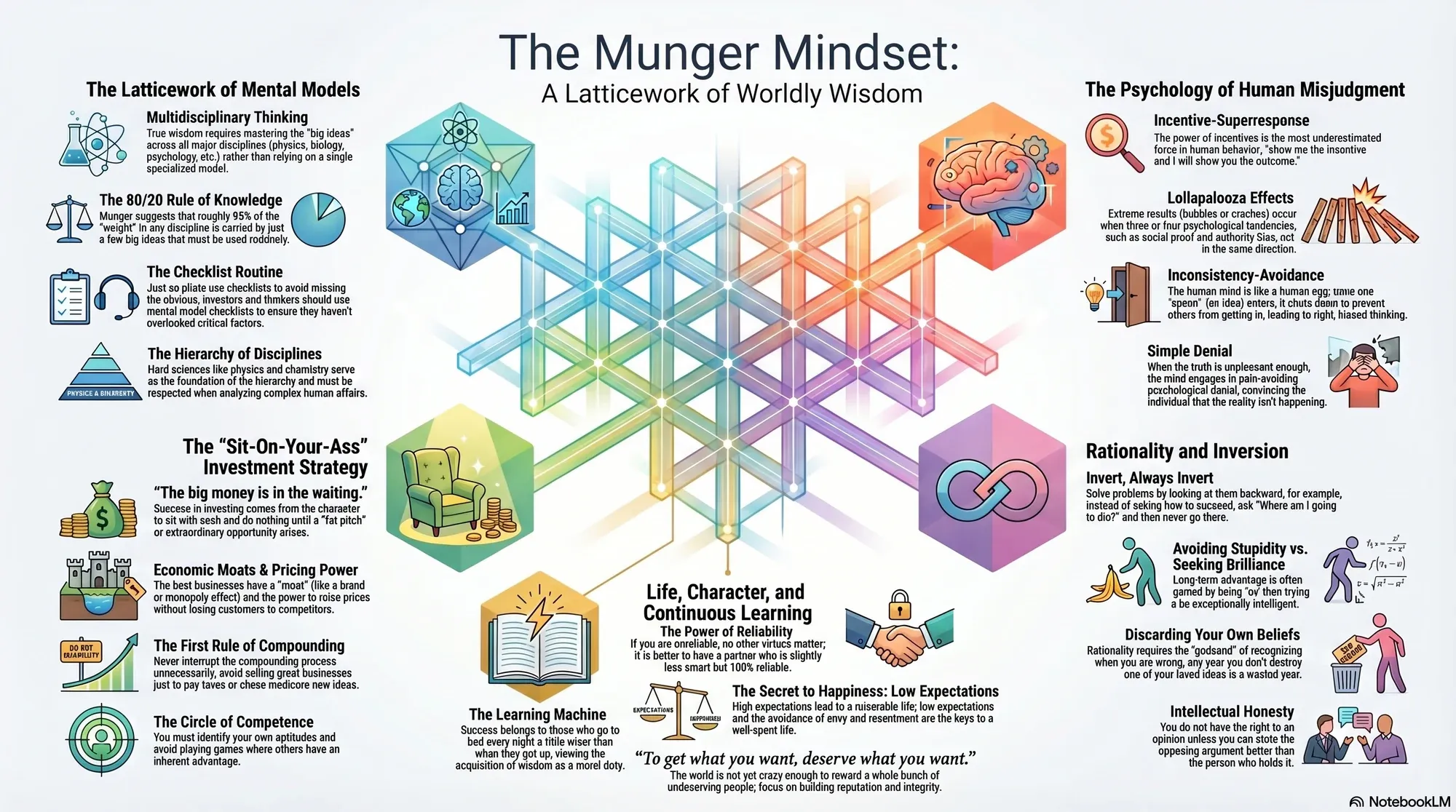
Part 1: The Latticework of Mental Models
- Multidisciplinary Thinking: Munger urged learning the major ideas across several disciplines and using them together, rather than forcing every problem through a single familiar model. — Munger — Worldly Wisdom, Revisited.
- Organizing Facts: Isolated facts become useful only when they fit into a framework of explanatory models that can be applied to new problems. — Munger — Elementary Worldly Wisdom.
- Physics Envy: Munger criticized economists who imitate the exactness of physics when human behavior and institutions do not permit comparable precision. — Munger — Academic Economics.
- The Important Models: Munger argued that a manageable set of major models does most of the work in practical judgment; he did not claim that every discipline has an identical 95-percent rule. — Munger — Elementary Worldly Wisdom.
- Psychology as a Foundation: He treated elementary psychology as essential to sound judgment because predictable errors in perception and motivation can distort decisions. — Munger — Elementary Worldly Wisdom.
- Hard Sciences: Munger gave special weight to models from physics, chemistry, biology, and engineering while warning against ignoring other disciplines. — Munger — Elementary Worldly Wisdom.
- Checklist Routines: He recommended simple checklist routines to catch predictable omissions and reduce mistakes in complex decisions. — Munger — USC Law Commencement.
- Math and Probability: Elementary probability belongs in a practical decision-maker’s toolkit; without it, Munger argued, one is poorly equipped for a lifetime of choices. — Munger — Elementary Worldly Wisdom.
- A Toolkit of Models: Relying on only one favored model makes unlike problems look deceptively similar; a wider toolkit allows a better fit between model and problem. — Munger — Elementary Worldly Wisdom.
Part 2: The Psychology of Human Misjudgment
- Incentive-Superresponse: Munger said that even after studying incentives closely, he repeatedly underestimated how strongly they shape behavior. — Munger — Psychology of Human Misjudgment (2005 revision).
- Social Proof: People tend to follow what others around them do, especially when circumstances are puzzling or stressful; this is a tendency to examine, not proof that it alone causes market bubbles. — Munger — Psychology of Human Misjudgment (2005 revision).
- Lollapalooza Effects: Several psychological tendencies acting together can produce an outcome much stronger than any one tendency would produce alone. — Munger — Psychology of Human Misjudgment (2005 revision).
- Pain-Avoiding Denial: When a fact is too painful, a person may distort or deny it rather than confront it directly. — Munger — Psychology of Human Misjudgment (2005 revision).
- Inconsistency Avoidance: Established beliefs and habits can be difficult to change, causing people to resist evidence that conflicts with prior commitments. — Munger — Psychology of Human Misjudgment (2005 revision).
- Doubt Avoidance: Under stress or uncertainty, people may settle on a conclusion prematurely just to end the discomfort of doubt. — Munger — Psychology of Human Misjudgment (2005 revision).
- Excessive Self-Regard: People often rate their abilities and judgments too highly, which can make correction and sound decisions harder. — Munger — Psychology of Human Misjudgment (2005 revision).
- Liking and Disliking: Affection can hide another person’s faults, while dislike can obscure that person’s merits; either reaction can distort evaluation. — Munger — Psychology of Human Misjudgment (2005 revision).
- Authority Misinfluence: Deference to an authority figure can induce inappropriate compliance even when the instruction deserves independent scrutiny. — Munger — Psychology of Human Misjudgment (2005 revision).
- Availability Misweighing: Easily recalled examples can receive too much weight in judgment; checklists and a search for contrary evidence can help counter that bias. — Munger — Psychology of Human Misjudgment (2005 revision).
Part 3: The Art of "Sit-On-Your-Ass" Investing
- Waiting for the Right Business: Munger emphasized that long-term ownership of a strong business can be more rewarding than frequent buying and selling, particularly after taxes. — Munger — Elementary Worldly Wisdom.
- Patience With Cash: Rather than accept a mediocre investment merely to deploy cash, Munger favored waiting for a rare opportunity with unusually favorable odds. — Munger — Elementary Worldly Wisdom.
- Opportunity Cost: He compared each proposed investment with strong alternatives already available, using opportunity cost as a filter for what deserves attention. — Berkshire Hathaway — 1997 Annual Meeting.
- Let Compounding Work: Munger argued that staying with a high-quality business can preserve compounding and avoid unnecessary taxes and transaction decisions. — Munger — Elementary Worldly Wisdom.
- Active Trading: Munger criticized brokers who encourage inexperienced investors to trade as if investing were gambling; such activity can benefit the broker more than the customer. — Daily Journal — 2021 Meeting Transcript.
- Shorting: Munger described short selling as a difficult, risky undertaking and said Berkshire generally preferred finding good businesses to own. — Berkshire Hathaway — 2007 Annual Meeting.
- Leverage: He warned that borrowing can magnify mistakes and ruin investors, although he acknowledged circumstances in which limited leverage may be rational. — Daily Journal — 2023 Meeting Transcript.
- Circle of Competence: An investor should know where personal aptitudes confer an edge and decline games in which others are better equipped. — Munger — Elementary Worldly Wisdom.
- Concentration: Munger favored committing substantially when a rare opportunity offered favorable odds, while refraining from bets that lacked that advantage. — Munger — Elementary Worldly Wisdom.
- When to Hold: If a good business keeps compounding, selling it merely to reinvest elsewhere can create taxes and the risk of choosing a worse alternative. — Munger — Elementary Worldly Wisdom.
Part 4: Economic Moats and Business Quality
- Business Quality: Munger preferred businesses whose underlying economics were resilient and understandable, rather than depending on heroic management to overcome a weak industry. — Munger — Elementary Worldly Wisdom.
- Moats Can Erode: He warned that traditional competitive advantages can weaken or disappear as technology and industry structures change. — Daily Journal — 2020 Meeting Transcript.
- Brand and Distribution Advantages: Munger illustrated how trusted brands and efficient distribution can protect a company’s economics; the pricing-power quotation in the old lesson belongs to Buffett. — Munger — Elementary Worldly Wisdom.
- Cash Conversion: Munger distinguished a business whose reported earnings become surplus cash from one whose reported profits are continually absorbed by the business. — Berkshire Hathaway — 2003 Annual Meeting.
- Monopoly Effects: He viewed some durable franchises as economically valuable but also recognized that market power and scale can foster complacency and bureaucracy. — Munger — Elementary Worldly Wisdom.
- Business Ethics: Munger urged making money by offering people something one would willingly buy in their place, rather than profiting from their harm. — Munger — USC Law Commencement.
- Brand Value: A familiar brand can lower customers’ uncertainty and create a durable informational advantage, as Munger illustrated with Wrigley. — Munger — Elementary Worldly Wisdom.
- Retail Realities: Munger noted that many once-powerful retailers disappeared; he treated Costco as an exceptional business rather than assuming retail success is durable. — Acquired — Charlie Munger Interview.
- Competitive Destruction: Technological or competitive change can erode a seemingly secure business, so an investor must examine whether an advantage will last. — Munger — Elementary Worldly Wisdom.
- Bureaucracy: Munger warned that growth in organizational scale can bring territoriality, bureaucratic delay, and incentives that work against the enterprise. — Munger — Elementary Worldly Wisdom.
Part 5: Rationality, Inversion, and Avoiding Stupidity
- Inversion: Looking backward from failure can reveal hazards that a forward-only plan misses; Munger used inversion as a practical problem-solving method. — Munger — USC Law Commencement.
- Avoiding Obvious Errors: He argued that systematically avoiding large, preventable mistakes can matter more than trying to appear exceptionally clever. — Munger — USC Law Commencement.
- Discarding Beliefs: Munger valued recognizing a mistake and dropping a belief or investment when the evidence no longer supports it. — Daily Journal — 2020 Meeting Transcript.
- Objectivity: Before settling on an opinion, Munger urged being able to explain the strongest case against it and actively seek disconfirming evidence. — Munger — USC Law Commencement.
- Intelligence Is Not Enough: Munger observed that capable people can still make poor decisions when they use narrow models or fall prey to psychological bias. — Munger — Elementary Worldly Wisdom.
- Pass on What You Do Not Understand: Munger considered it rational to pass on investments outside one’s circle of competence instead of forcing a judgment on a difficult business. — Munger — Elementary Worldly Wisdom.
- Limits of Calculation: Numbers are indispensable, but false precision can obscure the real economics of a business or the uncertainty in a decision. — Munger — Elementary Worldly Wisdom.
Part 6: The Moral Duty of Continuous Learning
- Learning Machines: Munger said Berkshire’s success depended on people who kept learning after formal education and became wiser through daily effort. — Munger — USC Law Commencement.
- A Reading Habit: Extensive reading was one of Munger’s central ways to keep learning from other people’s experience and ideas. — Munger — USC Law Commencement.
- Wisdom as a Duty: He described acquiring wisdom as a moral duty, not merely an instrument for career advancement. — Munger — USC Law Commencement.
- Learning from Others: Munger encouraged mastering the strongest ideas others had already discovered instead of relying only on one’s own unaided insight. — Munger — USC Law Commencement.
- Education Continues: He argued that progress in a career depends heavily on what one learns after leaving school. — Munger — USC Law Commencement.
- Intense Interest: Munger considered strong natural interest in one’s work an important ingredient of sustained excellence. — Munger — USC Law Commencement.
- Intellectual Humility: Munger urged people to recognize the boundaries of their understanding and to consider evidence that contradicts their preferred view. — Munger — Elementary Worldly Wisdom.
- Attention Span: In a Daily Journal discussion, Munger credited his long attention span, rather than exceptional raw intelligence alone, with part of his success. — Daily Journal — 2015 Meeting Notes.
Part 7: Personal Character and the Value of Integrity
- Earned Trust: Munger treated earned trust and reliability as long-term assets built through conduct, not mere declarations of integrity. — Munger — USC Law Commencement.
- Deserving What You Want: To gain trust and cooperation, Munger advised giving others the value and treatment one would want in their place. — Munger — USC Law Commencement.
- Reliability: He warned that unreliability can cancel out other strengths because people cannot safely depend on promises that are not kept. — Munger — USC Law Commencement.
- Work with People You Admire: Munger advised avoiding direct work under people one neither admires nor wishes to emulate, because close associates shape conduct. — Munger — USC Law Commencement.
- Habits Shape Character: Munger suggested that repeatedly acting in a role can gradually shape a person’s character, using the example of people who begin by pretending to be philanthropic. — Daily Journal — 2020 Meeting Transcript.
- Responsibility and Diligence: Munger placed high value on following through reliably and doing the work thoroughly once a responsibility had been accepted. — Munger — USC Law Commencement.
- Self-Serving Bias: He warned that self-serving explanations can distort one’s own judgment and relationships, and urged active resistance to that tendency. — Munger — USC Law Commencement.
Part 8: Economics, Incentives, and Corporate Governance
- EBITDA: Munger warned that EBITDA can make a company’s results look more substantial than its true economic earnings by excluding real costs. — Berkshire Hathaway — 2003 Annual Meeting.
- Derivatives and Accounting: In a Stanford interview, Munger criticized credit-default derivatives and mark-to-model accounting that could let both sides of a trade book apparent gains. — Stanford Lawyer — Munger Interview.
- Compensation Incentives: He warned that professional incentives can corrupt judgment when rewards favor pleasing promoters or clients over honest analysis. — Munger — Psychology of Human Misjudgment (2005 revision).
- Accounting and Reality: Munger viewed accounting as essential to practical business life but warned that reported figures can be crude approximations of economic reality. — Munger — Elementary Worldly Wisdom.
- Financial Engineering: He criticized financial practices that added complexity and apparent profits without improving underlying economic value, especially in derivatives markets. — Stanford Lawyer — Munger Interview.
- Stock-Picking Industry: In reported 2015 meeting remarks, Munger said only a small minority of stock pickers were disciplined and rational; he compared many others to faith healers. — Daily Journal — 2015 Meeting Notes.
- Passive Boards: Munger described how social proof and deference can make outside directors too passive to challenge a dominant chief executive. — Munger — Psychology of Human Misjudgment (2005 revision).
- Economics Needs Psychology: He argued that economics becomes less useful when it neglects the predictable psychological forces that shape real behavior. — Munger — Academic Economics.
Part 9: The Pursuit of Happiness and a Well-Spent Life
- Low Expectations: Munger named low expectations as one ingredient of a happy life, warning that unrealistic expectations invite needless disappointment. — Daily Journal — 2021 Meeting Transcript.
- Envy: He advised avoiding envy because comparing oneself with others creates dissatisfaction without improving one’s own life. — Munger — USC Law Commencement.
- Resentment: Munger discouraged resentment and revenge as destructive habits of thought; the poison metaphor in the old profile is not verified as his wording. — Munger — USC Law Commencement.
- Responding to Mischance: Drawing on Epictetus, Munger urged treating mischance as an opportunity to behave well and learn. — Munger — USC Law Commencement.
- Letting Go of Envy: In a later Daily Journal discussion, Munger said he had worked to conquer envy rather than measure his life against other people’s possessions. — Daily Journal — 2022 Meeting Transcript.
- Deferred Gratification: Munger associated deferred gratification and saving with resilience and greater freedom to handle future difficulties. — Daily Journal — 2017 Meeting Transcript.
- An Engaged Life: Munger cited Maimonides as an example of an engaged life and encouraged active participation in work and society. — Daily Journal — 2017 Meeting Transcript.
- Learn from Mozart: Munger used Mozart’s overspending and resentment as a cautionary example of how avoidable habits can make a gifted life unhappy. — Munger — USC Law Commencement.
Part 10: Worldly Wisdom on Contemporary Challenges
- Cryptocurrency: Munger repeatedly criticized cryptocurrencies as speculative and socially unproductive; the old lesson spliced phrases from different remarks into one quotation. — Daily Journal — 2023 Meeting Transcript.
- Robinhood: He objected to brokerage models that attract inexperienced customers into frequent, gambling-like trades while describing those trades as free. — Daily Journal — 2021 Meeting Transcript.
- Elon Musk and the Car Business: Munger recognized Elon Musk’s exceptional ability but still regarded automobiles as a difficult, highly competitive business. — Daily Journal — 2015 Meeting Q&A.
- Venture Capital Excess: Munger worried that abundant venture funding at high valuations could lead investors to accept weak economics and excessive risk. — Daily Journal — 2020 Meeting Transcript.
- Alibaba Mistake: Munger later called Alibaba one of his worst mistakes, saying he had been too impressed with its position and had underestimated its retail-business character. — Daily Journal — 2023 Meeting Transcript.
- Speculation in Markets: He criticized market activity that treats stocks as gambling chips instead of ownership interests in businesses. — Daily Journal — 2022 Meeting Transcript.
- Technology and Returns: Munger distinguished technological improvements that benefit customers from investments that necessarily earn attractive returns for the businesses supplying them. — Munger — Elementary Worldly Wisdom.
- Investing in China: He saw attractive Chinese businesses but acknowledged political and regulatory risks that investors need to weigh. — Daily Journal — 2023 Meeting Transcript.
- Assiduity: Munger praised the ability to keep working on a task until it is done, even when the work is demanding or unglamorous. — Munger — USC Law Commencement.
- A Borrowed Closing Line: Munger closed his commencement address by borrowing a line from The Pilgrim’s Progress about leaving one’s sword to someone able to carry it; the added “record of rational behavior” sentence in the old lesson is not part of that line. — Munger — USC Law Commencement.