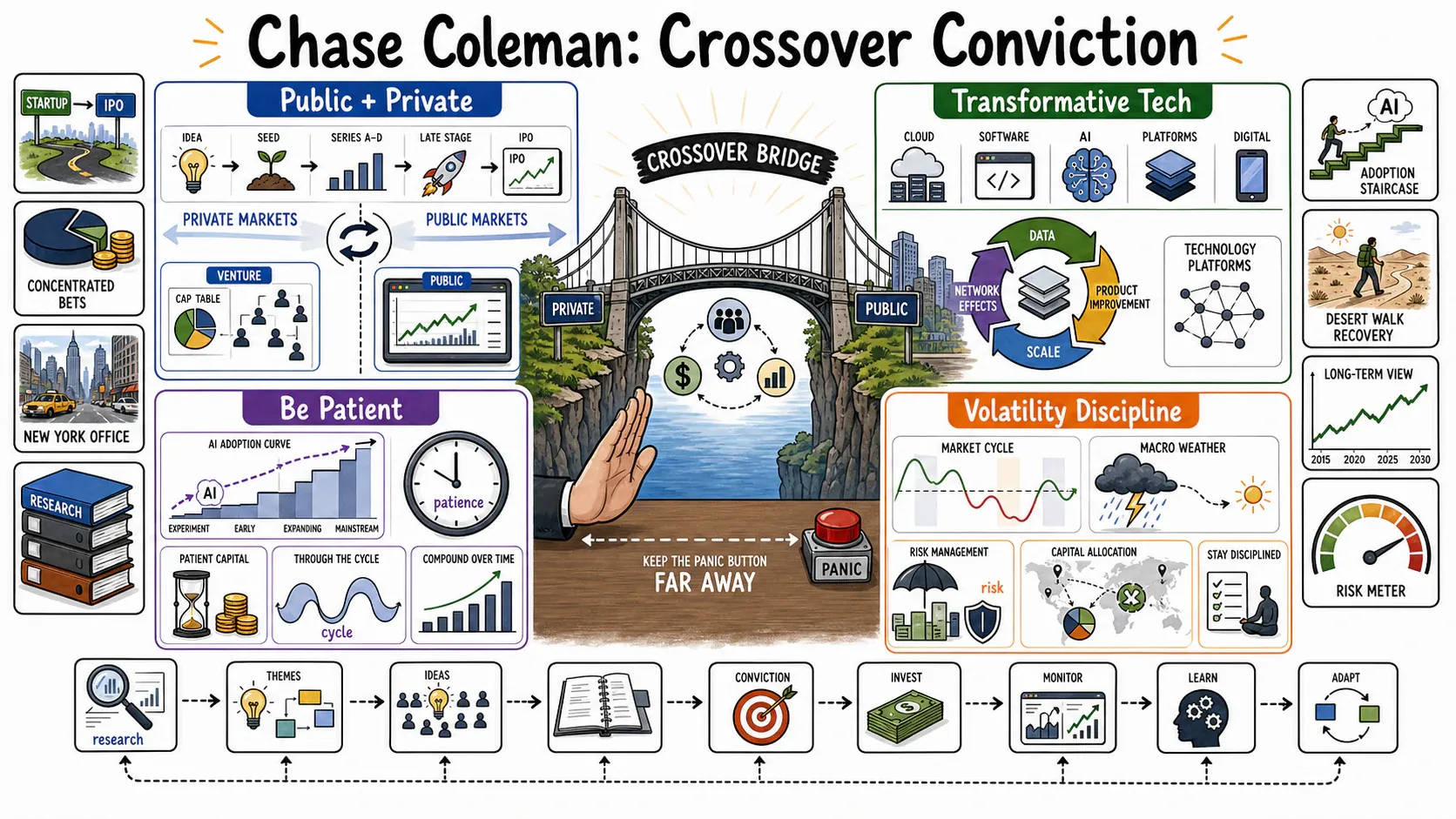
Chase Coleman founded Tiger Global in 2001 after working for Julian Robertson at Tiger Management. The firm invests across public and private markets and describes its approach as research-driven and long-term. — Tiger Global — Chase Coleman.
Reported Remarks and Firm Letters
- Avoid Excuses: In a 2022 letter to investors, Tiger Global acknowledged disappointing public-fund losses and said it would not blame the macroeconomic backdrop. The statement belongs to the firm letter, not to an authenticated Coleman speech. — Bloomberg via The Wealth Advisor — 2022 Letter Report.
- An IPO Drought: Coleman used a “walk through the desert” metaphor for the shortage of IPOs, not for the 2022 market correction as the inherited caption claims. — Institutional Investor — Coleman Investor Call.
- Look at AI Incumbents: Coleman argued that hyperscalers were positioned to compound existing advantages in AI because they already had talent, infrastructure and capital. — Institutional Investor — Coleman Investor Call.
- Use AI Internally: Coleman said Tiger Global was using in-house bots to summarize text for meeting preparation and assist with talent tracking; the inherited Amazon/ChatGPT shopping example is not supported. — Institutional Investor — Coleman Investor Call.
- AI as a Long-Term Theme: Coleman described AI as a potentially major deflationary theme and cited coding assistance as an emerging productivity use. — Institutional Investor — Coleman Investor Call.
Learnings from Chase Coleman III and Tiger Global's Strategy
The lessons below distinguish Tiger Global’s published investment approach from remarks reported from its private investor communications. Firm statements are attributed to the firm, not presented as direct Coleman quotations. — Tiger Global — Our Story.
On Investment Philosophy and Strategy
- Invest Across a Company’s Lifecycle: Tiger Global says it pioneered crossover investing, partnering with companies in both private and public markets as they develop. — Tiger Global — Our Edge.
- Follow Technology Shifts: Tiger Global describes investing through the internet, mobile, cloud and AI eras rather than confining its strategy to one technology cycle. — Tiger Global — Our Story.
- Seek Secular Growth: A Tiger Global team letter described seeking high-quality companies exposed to major secular growth trends. This is the firm’s stated approach, not a verified personal Coleman quote. — Institutional Investor — Tiger Global Anniversary Letter.
- Buy the Best, Short the Worst: The Tiger Global team letter traces a long/short principle to Julian Robertson: seek strong businesses on the long side and poorly positioned ones on the short side. — Institutional Investor — Tiger Global Anniversary Letter.
- Search Globally: Tiger Global says it has invested in more than 30 countries; its early move into private investing followed opportunities it found in emerging internet businesses. — Tiger Global — Our Story.
- Partner for the Long Term: Tiger Global presents the ability to back a company from early stage through public markets as an advantage of its crossover model. — Tiger Global — Our Edge.
- Combine Research and Data: Tiger Global says its team uses company and industry research alongside data and analytics. The inherited claims of streamlined diligence, speed and volume are not established by this source. — Tiger Global — Our Edge.
- Back Internet Leaders: Tiger Global lists Facebook, LinkedIn and Spotify among portfolio-company examples while describing its early internet-investment thesis; this does not establish that all were early or highly profitable investments. — Tiger Global — Our Story.
- Keep Fundamentals Central: Tiger Global describes its public business as fundamentally oriented, while its private-investment criteria include strong fundamentals, durable growth and competitive advantages. — Tiger Global — Our Strategy.
On Execution and Tactics
- Invest in Portfolio Talent: Coleman said Tiger Global led 15 Flipkart rounds and that Kalyan Krishnamurthy, a former Tiger Global employee, later became Flipkart’s CEO. The source does not say Tiger Global placed him there. — Institutional Investor — Coleman Investor Call.
- Research Businesses Deeply: Tiger Global says its process is fueled by company- and industry-specific research, data and analytics. The inherited modeling-hours and valuation-process details are not verified. — Tiger Global — Our Edge.
- Seek Durable Growth: Tiger Global says its founder-friendly approach focuses on companies with strong fundamentals, outstanding management, durable growth and competitive advantages; the inherited network-effect claim is not established. — Tiger Global — Our Story.
- Be Founder-Friendly: Tiger Global describes its approach as founder-friendly and focused on high-quality companies across stages. The source does not establish a general no-board-seat policy. — Tiger Global — Our Story.
- Use Multiple Public Strategies: Tiger Global says its public-equity business includes long/short, long-focused and crossover strategies; it is not solely a classic long/short fund. — Tiger Global — Our Strategy.
Learnings from Mistakes and Setbacks
- Name Mistakes Specifically: In a team-signed retrospective letter, Tiger Global identified concrete errors, including 2008 cyclicals, missed Alibaba and early exits from later winners. — Institutional Investor — Tiger Global Anniversary Letter.
- Beware Premature Exits: Tiger Global’s team letter said it sold Facebook, LinkedIn, Amazon, Netflix and other later winners too early, illustrating the cost of truncating a strong thesis. — Institutional Investor — Tiger Global Anniversary Letter.
- Examine the Cost of Passing: Tiger Global’s team letter cited passing on Alibaba for valuation or other reasons among its missed opportunities. The inherited broad FOMO framing overstates the evidence. — Institutional Investor — Tiger Global Anniversary Letter.
- Review Blind Spots: Tiger Global’s retrospective identified buying banks and other cyclical stocks during the 2008 financial crisis as a mistake. — Institutional Investor — Tiger Global Anniversary Letter.
- Reassess Investment Pace: Coleman said more than 20% of the 2021–22 vintages were performing poorly and wished the firm had invested less; this supports a bounded lesson about deployment pace, not a universal valuation diagnosis. — Institutional Investor — Coleman Investor Call.
On Leadership and Firm Culture
- Make Research a Team Capability: Tiger Global describes deep company and industry research, data and analytics as team-level sources of investment opportunities; the inherited personal mentor inference is not needed. — Tiger Global — Our Edge.
- Formalize Giving: Coleman’s official biography says he formalized Tiger Global Impact Ventures in 2021 to advance the firm’s philanthropic activities. — Tiger Global — Chase Coleman.
- Fresh Perspective Can Help: A team-signed Tiger Global letter suggested that inexperience may have helped it imagine the emerging internet-connected world; this is a firm reflection, not a verified Coleman-only quote. — Institutional Investor — Tiger Global Anniversary Letter.
- Act in an Unpromising Moment: The Tiger Global team said the post-dot-com launch looked poorly timed but was its opportunity, which it determined to make the most of. — Institutional Investor — Tiger Global Anniversary Letter.
- Build Complementary Teams: Tiger Global’s retrospective credited Scott Shleifer with identifying early Chinese internet investments; this is a historical contribution, not a claim about his current role. — Institutional Investor — Tiger Global Anniversary Letter.
Learn more:
- Tiger Global: Our Strategy
- Tiger Global: Our Story
- Tiger Global: Our Edge
- Tiger Global: Chase Coleman
- How Chase Coleman Became a Hedge Fund Legend — Institutional Investor
- Tiger Global’s Chase Coleman Says IPOs Are Still in the Desert — Institutional Investor
- Tiger Global’s Hedge Fund Posts 15% Monthly Drop, Pushing Year’s Loss to 44% — Bloomberg via The Wealth Advisor