Born in Ethiopia and raised in Sweden, Marcus Samuelsson is an American chef whose food reflects his mixed heritage. These lessons follow his path from early survival to opening restaurants like Red Rooster and actively carving out space for women and people of color in fine dining.
Part 1: Identity and Origins
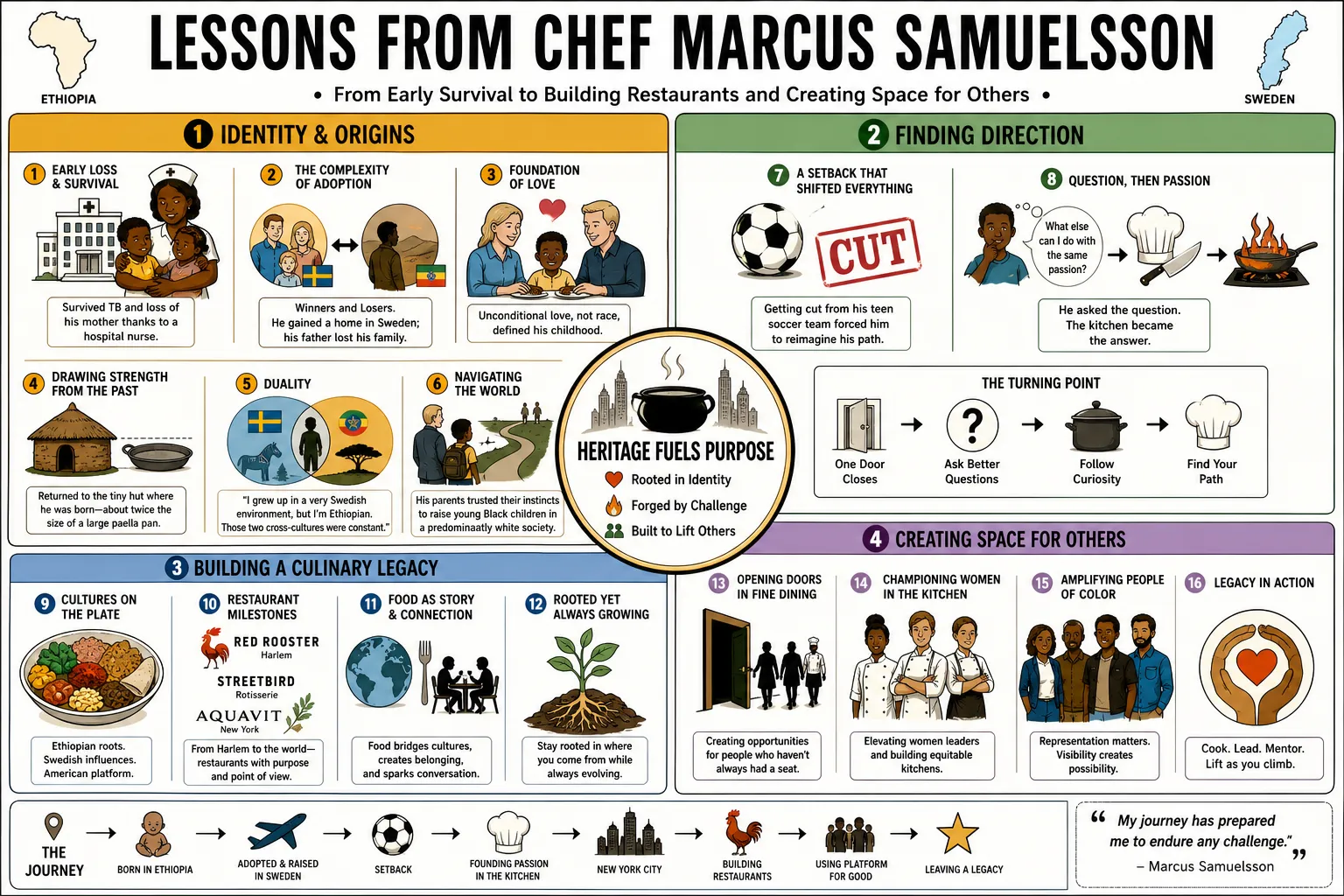
- On early loss and survival: He recognizes that he survived childhood tuberculosis and the loss of his mother only through the actions of a hospital nurse who took him and his sister in. — Reference: Eat My Globe
- On the complexity of adoption: He views adoption as having both winners and losers, noting that while he gained a loving home in Sweden, his biological father lost his family in Ethiopia. — Reference: Longer Tables with Chef José Andrés
- On the foundation of love: Despite growing up as a Black child in a white Swedish family, he credits the unconditional love he received, rather than race, as the defining element of his childhood. — Reference: Longer Tables with Chef José Andrés
- On drawing strength from the past: Returning to the tiny Ethiopian hut where he was born—a space roughly twice the size of a large paella pan—reminds him that his journey has prepared him to endure any challenge. — Reference: Longer Tables with Chef José Andrés
- On duality: "I grew up in a very Swedish environment, but I'm Ethiopian. Those two cross-cultures were constant" — Source: Newsweek
- On navigating the world: His adoptive parents equipped him with resilience by trusting their instincts to raise young Black children in a predominantly white society. — Reference: Newsweek
- On finding direction: Getting cut from his teenage soccer team forced him to question what else he could pursue with the same level of passion, eventually leading him to the kitchen. — Reference: Newsweek
Part 2: Culinary Philosophy and Technique
- On food's inherent goodness: He notes that while he has encountered bad people in his life, he has never met bad food, as it has always been good to him. — Reference: Newsweek
- On cooking with feeling: His grandmother Helga taught him that food is about more than taste; it encompasses texture, balance, and the emotions a meal evokes. — Reference: Newsweek
- On the universality of kitchen work: You do not need to share a spoken language to succeed in a kitchen, as the craft is built on the unspoken language of desire, listening, and executing. — Reference: EP 70: Marcus Samuelsson - Hospitality On The Rise
- On the value of humble beginnings: Starting his career tending to the garden in a Swiss restaurant gave him a foundational understanding of farm-to-table concepts before they became an industry trend. — Reference: EP 70: Marcus Samuelsson - Hospitality On The Rise
- On expanding the palate: Working on a cruise ship early in his career exposed him to Asian ports and Singaporean street food, giving him a culinary vocabulary vastly different from his European training. — Reference: EP 70: Marcus Samuelsson - Hospitality On The Rise
- On maximizing the grill: Stop treating the grill as a surface only for proteins; instead, dedicate half the space to seasonal vegetables. — Reference: Marcus Samuelsson On The Grilling Mistake You Need To Stop Making
- On grill temperature strategy: Use high heat for char and caramelization, but drop the temperature to slow-cook and smoke hardier vegetables during the fall and winter. — Reference: Marcus Samuelsson On The Grilling Mistake You Need To Stop Making
- On preparing vegetables for the fire: Do not peel vegetables before grilling, as the skins protect the interior while cooking and add valuable texture. — Reference: Marcus Samuelsson On The Grilling Mistake You Need To Stop Making
Part 3: Overcoming Barriers and Ambition
- On facing industry prejudice: When a mentor in France told him a Black chef could never own a fine dining restaurant, he recognized the man was speaking from the limited reality of the mid-1990s, but refused to let it dictate his future. — Reference: Eat My Globe
- On protecting your vision: "I can't lower my dream. I can't lower my ambition." — Source: PodLexicon
- On finding the right environment: His father encouraged him to move to New York City, reasoning that a city willing to elect a Black mayor might also be ready to support a Black chef. — Reference: Eat My Globe
- On early achievements: He became the youngest chef to ever earn a three-star review from The New York Times while leading the kitchen at Aquavit. — Reference: PBS Food
- On limitless dreams: By traveling internationally in his early twenties, he freed himself from geographical limitations and realized he could build his culinary career anywhere in the world. — Reference: EP 70: Marcus Samuelsson - Hospitality On The Rise
- On receiving help: He acknowledges that his career was significantly propelled by established chefs like Charlie Trotter, who saw his potential and opened doors to elevated culinary circles. — Reference: Newsweek
Part 4: Representation and Mentorship
- On learning what not to do: Training in elite European kitchens taught him exceptional skills, but the glaring absence of women and people of color showed him exactly what he needed to change when he ran his own restaurants. — Reference: EP 70: Marcus Samuelsson - Hospitality On The Rise
- On building inclusive teams: He actively constructs leadership teams that reflect diversity, such as his Metropolis restaurant, which is led entirely by women of color. — Reference: Newsweek
- On creating real paths: "If you're in a position of influence, liking something on Instagram isn't enough. You have to create real opportunities." — Source: Newsweek
- On the path for chefs of color: He acknowledges that the journey for chefs of color is always longer, but believes that extended effort makes the destination better. — Reference: Newsweek
- On honoring culture in hospitality: Leah Chase taught him that providing hospitality in Black spaces requires playing the right music, featuring Black artists, and fully celebrating the culture. — Reference: Newsweek
- On redefining luxury: Alberta Wright inspired him by proving that Black culinary excellence didn't have to mimic traditional soul food, demonstrating that soul and sophistication can easily coexist. — Reference: Newsweek
- On recognizing immigrants' impact: "It was never about brand exposure. It was about showing that immigrant culture is the reason America is so delicious." — Source: Newsweek
- On reframing culinary history: He actively works to broaden the definition of fine dining by highlighting the historic contributions that people of color have made to American food. — Reference: Newsweek
Part 5: Business, Media, and Legacy
- On owning the narrative: "I said, We got to be both a hospitality company and a media company." — Source: PodLexicon
- On building community spaces: Placemaking thrives when an institution actively reflects the community around it, a principle he applied when building Red Rooster in Harlem. — Reference: PodLexicon
- On the fragility of business: It took him two decades to build his restaurant group, but only ten days for the pandemic to break operations down. — Reference: PodLexicon
- On naming with intention: The name of his restaurant Hav & Mar translates to "ocean" in Swedish and "honey" in Amharic, deliberately marrying his dual heritage. — Reference: One54 Africa Podcast
- On designing physical spaces: Frustrated by the lack of furniture that fit his vision, he collaborated with West Elm to design pieces that blend Scandinavian minimalism with African maximalism. — Reference: Newsweek
- On his ultimate goal: When asked what he wants his legacy to be, he simply desires it to be "Delicious"—a word he uses to encompass both flavor and the elevation of historically excluded stories. — Reference: Newsweek
- On collaborative growth: During the pandemic, he found clarity in mentorship, partnering with a former employee to open a new restaurant in the chef's hometown, proving that excellence thrives with community context. — Reference: Newsweek
- On judging others' work: When evaluating dishes in cooking competitions, he focuses on the chef's effort to transform the ingredients, believing it is the judge's job to bring out the best rather than just criticize the food. — Reference: Newsweek
Part 6: Culture, Community, and Institution Building
- On stepping into responsibility before it feels comfortable: When Aquavit's executive chef died, Samuelsson accepted the head-chef role at 23 and treated the abrupt transition as a chance to lead rather than waiting for a safer moment. — Reference: Masters of Scale transcript
- On questioning inherited definitions of excellence: Culinary school taught him to regard French cuisine as the universal gold standard, but his later work rejected that hierarchy and built flavor from a much wider set of traditions. — Reference: The Sporkful
- On making cultural synthesis tangible: At Red Rooster, combinations such as cornbread with lingonberry butter and berbere vinaigrette turn his Swedish and Ethiopian influences into a menu guests can experience directly. — Reference: The Sporkful
- On designing with a neighborhood rather than merely locating there: He approached Red Rooster as a restaurant for Harlem and by Harlem, making community fit part of the concept instead of an afterthought. — Reference: TASTE
- On proximity as a form of research: Moving roughly 50 blocks from Midtown to Harlem felt to him like entering a different country, reinforcing that serious placemaking begins by living close enough to understand a community's food, art, music, and institutions. — Reference: Masters of Scale transcript
- On turning restaurants into emergency infrastructure: During the pandemic, he converted restaurants in Harlem, Newark, and Miami into community kitchens with World Central Kitchen; together they served more than 150,000 meals. — Reference: Hachette Book Group
- On using events to circulate value through a place: Harlem EatUp was built as more than a food festival; by drawing about 15,000 people, it connected dining with Harlem's wider culture and neighborhood economy. — Reference: Masters of Scale transcript
- On restoring authorship to culinary history: The Rise starts from the premise that Black cooks helped build American food while their authorship was routinely erased, so documentation and credit are part of the work—not editorial extras. — Reference: Hachette Book Group
- On refusing to flatten Black cooking into one category: He presents Black foodways as spanning Africa, the Caribbean, the American South, and many other places, resisting the idea that they can be reduced to a single definition of soul food. — Reference: Hachette Book Group
- On treating history as a living network: Rather than write a backward-looking encyclopedia, The Rise pairs 150 recipes with the work of contemporary chefs, writers, and activists so that remembrance also creates visibility for people shaping the field now. — Reference: Hachette Book Group
- On building mentorship into a pipeline: As co-chair of Careers Through Culinary Arts Program, he supports a path that helps underserved public-school students prepare for college and careers in restaurants and hospitality. — Reference: PBS Food
- On presenting immigration as part of the national story: In No Passport Required, he centers immigrant home cooks, artists, business owners, and community leaders to show how their traditions have shaped American food and culture. — Reference: PBS Food