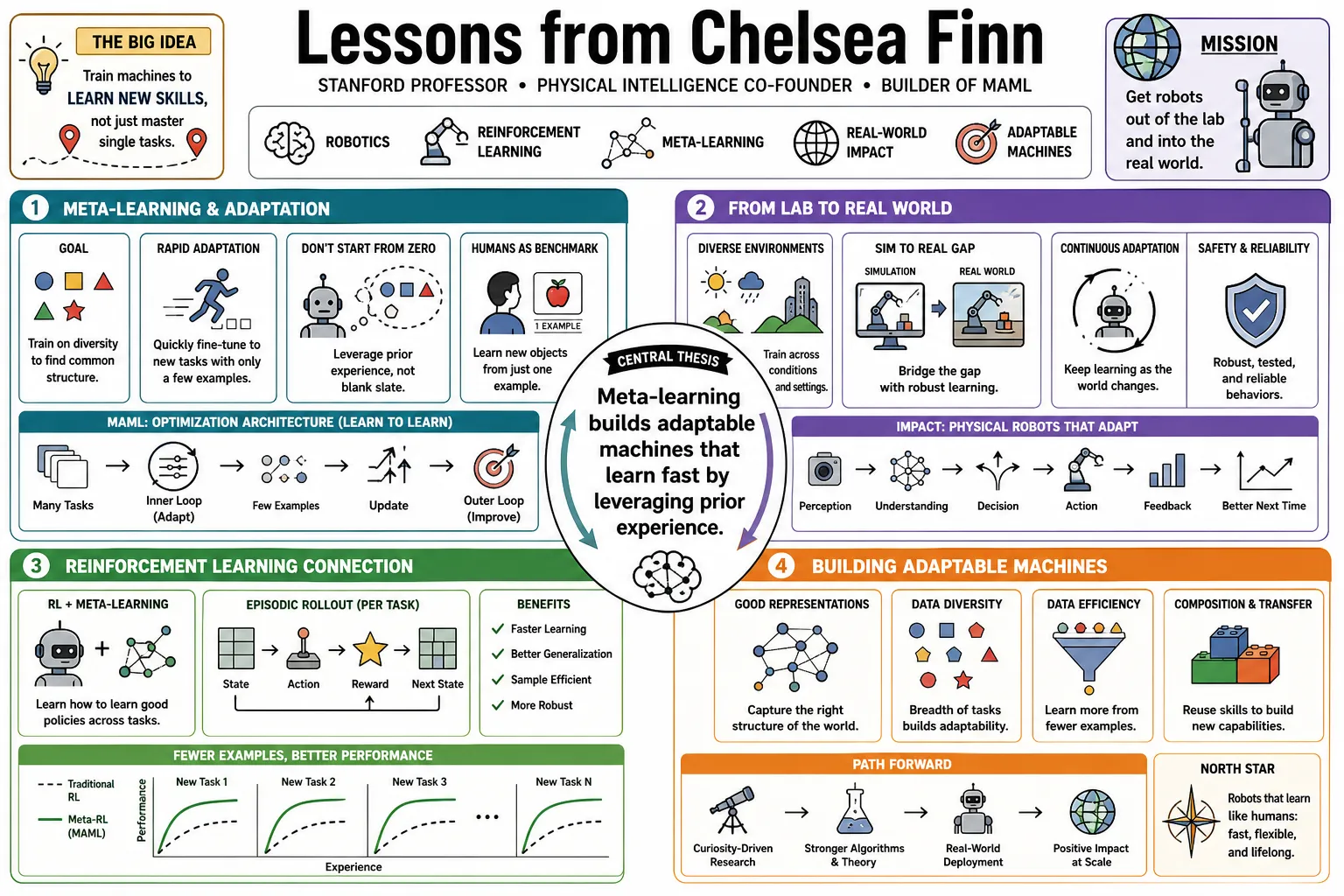
Lessons from Chelsea Finn
Chelsea Finn is a Stanford professor and Physical Intelligence co-founder. Her work spans meta-learning and adaptable robotics, with a focus on helping robots learn new physical tasks from prior experience and diverse data. — YC Root Access — Finn.
Part 1: Meta-Learning and Adaptation
- Learn Across Tasks: Meta-learning trains across related tasks so a system can use their common structure to adapt to a new one. — BAIR — Learning to Learn.
- Design for Fast Adaptation: MAML learns an initialization that can be adapted to a new task with a small number of gradient steps and examples. — MAML Paper.
- Reuse Prior Experience: A robot can use prior demonstrations across tasks to acquire a new manipulation skill from one demonstration rather than learning from scratch. — BAIR — One-Shot Imitation.
- Learn From Few Examples: Finn uses human few-shot recognition as motivation for systems that can adapt to new tasks from limited examples. — BAIR — Learning to Learn.
- Keep the Learning Rule General: MAML can be applied to models trained with gradient descent, including classification, regression and reinforcement learning. — MAML Paper.
- Infer Goals From Successes: Finn describes using a few positive examples to infer a human goal without requiring a fully specified reward function. — Stanford — Meta-Learning Robots.
- Continue Learning After Training: Finn frames meta-learning as a step toward versatile agents that keep learning varied tasks throughout their lifetimes. — BAIR — Learning to Learn.
- See the Bayesian Connection: Finn and coauthors show how gradient-based meta-learning can be interpreted as approximate inference in a hierarchical Bayesian model. — Hierarchical Bayes Paper.
- Apply Meta-Learning to Feedback: Finn and collaborators used meta-learning to adapt an automated coding-feedback system to new assignments with limited instructor work. — Stanford Report — Coding Feedback.
- Separate Method From Domain: MAML learns model parameters suited to rapid gradient-based adaptation rather than being limited to a particular vision or control task. — MAML Paper.
Part 2: The Complexity of Low-Level Control
- Take Motor Control Seriously: Finn says low-level motor control can be harder than high-level reasoning and has consumed much of her research effort. — Fast Company — Finn Interview.
- Bridge Intent and Motion: Turning a high-level subtask into reliable low-level motor commands remains a central robotics challenge. — Fast Company — Finn Interview.
- Do Not Mistake Familiar for Easy: Finn uses ordinary manipulation to show why actions effortless for people can be difficult for robots. — WIRED — Finn on Robotics.
- Model Continuous Physical Action: The π0 policy maps visual and language inputs to continuous motor commands, unlike a system that only chooses discrete text tokens. — π0 General Robot Control.
- Predict Before Acting: Finn and Levine combined video prediction with model-predictive control so a robot could plan pushes of novel objects from images. — Deep Visual Foresight.
- Expect a Reality Gap: Finn-coauthored work notes that policies successful in simulation can fail when real-world conditions change, motivating rapid adaptation. — Real-World Meta-RL Paper.
- Measure the Mundane Too: Finn shows that impressive AI performance does not imply reliable execution of ordinary physical tasks. — WIRED — Finn on Robotics.
- Learn From Raw Sensing: End-to-end robot learning can map camera observations directly to actions rather than relying on a hand-engineered perception and control pipeline. — Reward Engineering Paper.
- Adapt Beyond Simulation: A trained policy needs a way to adjust when physical conditions at deployment differ from those encountered in training. — Real-World Meta-RL Paper.
Part 3: Reinforcement Learning in the Real World
- Avoid Brittle Reward Engineering: Finn-coauthored work treats specifying successful outcomes as a bottleneck and learns from examples of success plus sparse user labels. — Reward Engineering Paper.
- Learn Within One Life: Single-life RL asks whether an agent can complete a novel task in one uninterrupted trial, using prior experience without resets. — Single-Life RL Paper.
- Respect Physical Sample Costs: Real-world robot trials are expensive, making rapid adaptation from limited physical experience valuable. — Real-World Meta-RL Paper.
- Learn From Existing Data: Offline RL trains robot policies from previously collected experience without requiring online exploration during training. — Offline Robotic RL Paper.
- Handle Sparse Feedback: In single-life tasks, rewards may arrive only after the full attempt, making recovery and exploration from prior data important. — Single-Life RL Paper.
- Constrain Unsafe Exploration: Finn-coauthored safety-critic research learns constraints that reduce falls and dropped objects while agents learn new tasks. — Safety Critic Paper.
- Plan for Recovery Without Resets: Standard episodic RL can reset after failure; a single-life agent must recover from an unfamiliar state on its own. — Single-Life RL Paper.
- Use Demonstrations Then Improve: Finn describes demonstrations as a starting point and reinforcement learning as a way for a generalist robot policy to improve through its own experience. — YC Root Access — Finn.
- Watch for Reward Overoptimization: Finn-coauthored research documents how optimizing a proxy reward can improve the metric while real quality plateaus or worsens. — Reward Overoptimization Paper.
- Sequence Skills Over Long Horizons: Finn-coauthored EMBER research combines learned low-level skills with planning because errors compound across multi-stage tasks. — EMBER Long-Horizon Tasks.
Part 4: Distribution Shift and Generalization
- Treat Distribution Shift as Central: Finn-coauthored work shows that models can lose accuracy when test data differ from their training domains. — Adaptive Risk Minimization.
- Test Beyond the Training Setup: Finn illustrates that a robot trained in one setup may stumble when objects or surroundings change. — WIRED — Finn on Robotics.
- Expect Uneven Capabilities: Finn cautions that AI can excel at an abstract task yet make surprising mistakes in routine physical interactions. — WIRED — Finn on Robotics.
- Collect Diverse Real-World Scenes: The Finn-coauthored DROID dataset deliberately spans hundreds of scenes to test and improve generalization beyond a single lab. — DROID Dataset.
- Build a Recovery Path: Recovery RL separates a task policy from a recovery policy that intervenes when the robot approaches a likely constraint violation. — Recovery RL Paper.
- Evaluate Transfer to New Conditions: Finn calls for testing robotic learning on new objects, scenes and tasks, not only familiar training cases. — CMU — Reduce, Reuse, Recycle.
- Learn to Adapt to Shift: Rather than rely only on one invariant model, adaptive risk minimization trains models to adjust using unlabeled test-domain data. — Adaptive Risk Minimization.
- Go Beyond One Robustness Trick: Domain randomization and invariant features can help with anticipated changes, but Finn-coauthored work also studies adaptation to new domains at test time. — Adaptive Risk Minimization.
- Adapt at Test Time: The adaptive-risk-minimization approach uses unlabeled observations from a new domain to update a model after deployment. — Adaptive Risk Minimization.
Part 5: Data Scaling and Representation
- Reduce, Reuse, Recycle: Finn argues that robots should reuse existing data and pretrained models rather than collect a fresh dataset for every new task. — CMU — Reduce, Reuse, Recycle.
- Scale Robot Data Differently: Robotics lacks the ready-made internet-scale interaction data available to language and vision systems, so data reuse matters. — CMU — Reduce, Reuse, Recycle.
- Coordinate Distributed Data Collection: DROID used a common portable setup across 13 institutions to collect robot demonstrations in varied real-world scenes. — DROID Dataset.
- Train Across Robot Bodies: The π0 team trained a generalist policy on data from multiple robot platforms so it could control more than one embodiment. — π0 General Robot Control.
- Mix More Than Perfect Demonstrations: Finn describes combining demonstrations, robot rollouts and human video to broaden the training signal for generalist policies. — YC Root Access — Finn.
- Let Interaction Supply Data: Finn and coauthors built a visual-control system from robot interaction data with little explicit task supervision. — BAIR — Visual Model-Based RL.
- Add Touch to Manipulation: Finn-coauthored tactile-control research shows a robot can learn from touch observations to reposition objects without relying only on vision. — Manipulation by Feel.
- Reduce Per-Task Engineering: The π0 work aims to replace hand-programming for each robot task with a generalist policy trained across many tasks and scenes. — π0 General Robot Control.
- Borrow Semantic Priors From the Web: π0 starts from a pretrained vision-language model to bring internet-scale semantic knowledge into robot control. — π0 General Robot Control.
Part 6: Embodied AI and Physical Intelligence
- Ground Intelligence in Action: The Physical Intelligence team treats physical interaction as a distinct challenge beyond language and image understanding. — π0 General Robot Control.
- Build a Generalist Robot Policy: Finn describes Physical Intelligence’s aim as a policy that can control different robots on varied physical tasks. — YC Root Access — Finn.
- Make the Policy More General: The π0 paper contrasts choreographed, narrow robot deployments with software that can adapt across robots and tasks. — π0 General Robot Control.
- Learn Across Hardware Forms: π0 combines data from single-arm, dual-arm and mobile manipulators rather than training on only one robot configuration. — π0 General Robot Control.
- Treat Software as a Deployment Bottleneck: The π0 team notes that even simple robot behaviors require extensive manual engineering; more capable generalist policies could reduce that burden. — π0 General Robot Control.
- Use Everyday Tasks as Tests: The π0 evaluation includes making coffee and other everyday manipulation tasks, grounding progress in physical execution. — π0 General Robot Control.
- Use Touch Where Vision Falls Short: Tactile predictive models can support contact-rich manipulation by giving the robot information about an object through touch. — Manipulation by Feel.
- Respect Control Frequency: Dexterous robot policies must output continuous motor commands fast enough for physical control; π0 explicitly designs for that requirement. — π0 General Robot Control.
Part 7: Trust, Alignment, and Human Interaction
- Make Reliability the Gate: Finn identifies reliability as the leading improvement needed before robots take on important workplace tasks. — Fast Company — Finn Interview.
- Learn From a Human Video: Domain-adaptive meta-learning enabled a robot to learn a new manipulation task from one video of a person demonstrating it. — BAIR — One-Shot Imitation.
- Let People Correct the Robot: Finn-coauthored work lets people guide a robot during long-horizon tasks with natural-language corrections rather than new teleoperation. — Yell At Your Robot.
- Split Guidance From Execution: A human can provide high-level verbal corrections while the robot’s learned low-level skills execute the physical movements. — Yell At Your Robot.
- Learn Individual Task Preferences: Finn-coauthored research learns robot policies from human preferences expressed in natural language, including result quality, speed and hygiene. — Freeform Preference Learning.
Part 8: The Future of Generalist Robots
- Aim for Human-Like Adaptability: Finn’s meta-learning work is motivated by the human ability to use previous experience to learn new tasks quickly. — BAIR — Learning to Learn.
- Build a Foundation for Control: π0 applies the foundation-model idea to robotics with a pretrained vision-language backbone and a policy for continuous physical action. — π0 General Robot Control.
- Teach by Demonstration: Finn and collaborators showed a robot learning novel object-manipulation tasks from a single human demonstration video. — BAIR — One-Shot Imitation.
- Test in Unseen Homes: π0.5 research evaluates generalist policies on multi-stage manipulation in homes not seen during training. — π0.5 Open-World Generalization.
- Move Toward One Generalist: Finn and coauthors aim for a single robot model that can handle varied tasks and objects instead of retraining for each one. — BAIR — Visual Model-Based RL.
- Combine Learning Approaches: Finn describes deep learning, reinforcement learning and meta-learning as complementary ways to build robots that can improve and adapt. — WIRED — Finn on Robotics.
- Measure Performance on Robots: The π0 team reports results and failures on physical robot tasks, not only static image or text benchmarks. — π0 General Robot Control.
- Keep Home Deployment in Perspective: Finn discusses household robots as a long-term ambition while emphasizing reliability and work remaining before broad deployment. — YC Root Access — Finn.
- Pursue Versatile Agents: Finn’s stated research goal is agents that adapt to unfamiliar situations and continue learning from experience. — BAIR — Learning to Learn.