# Lessons from Yejin Choi
Computer scientist and MacArthur Fellow Yejin Choi researches how to teach AI common sense and moral reasoning. She challenges the industry assumption that bigger language models will automatically fix their own reasoning flaws, focusing instead on algorithmic efficiency and pluralistic values. This profile gathers her perspectives on the unspoken rules of human intelligence and the limits of scale.
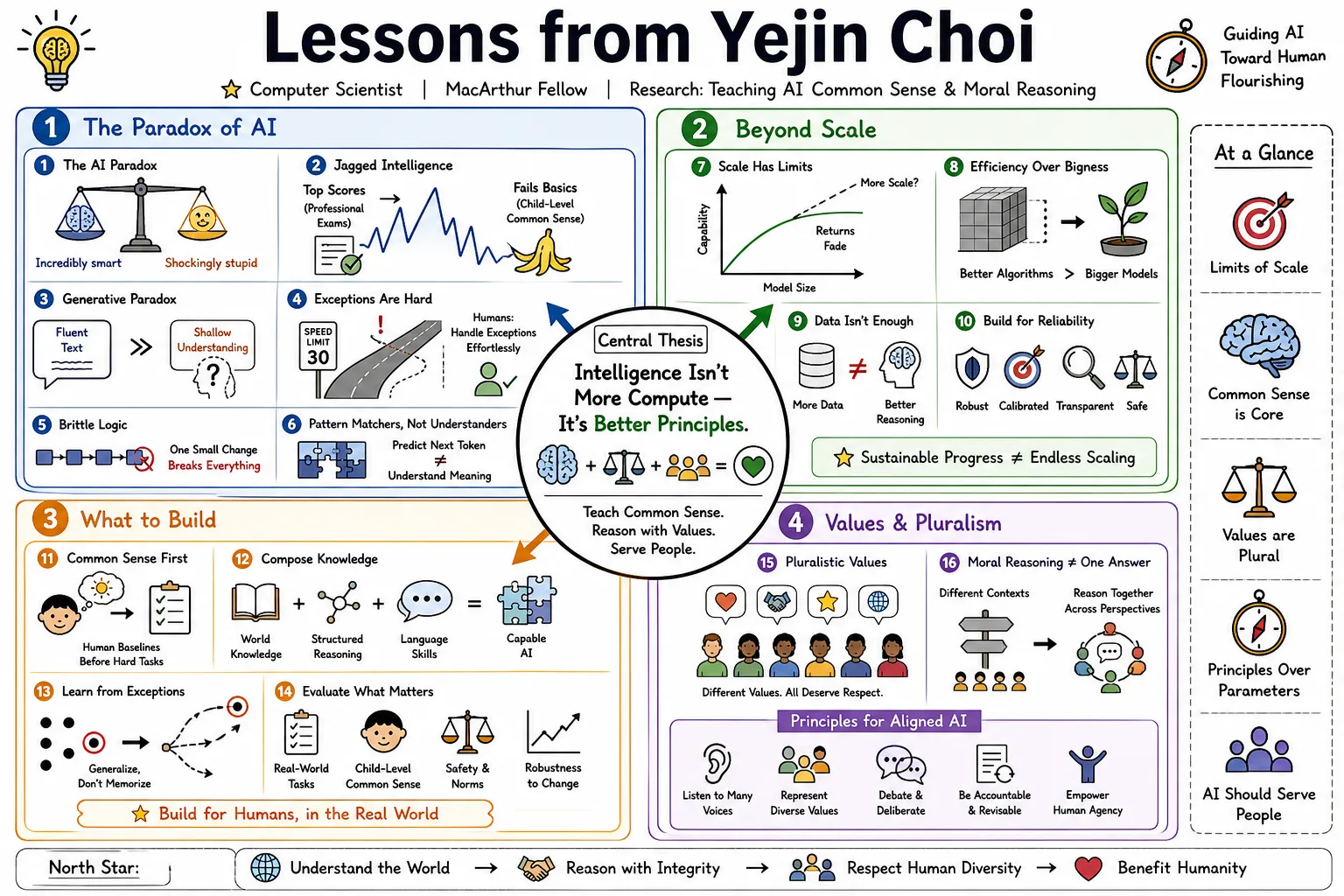
Part 1: The Paradox of AI
- On the AI paradox: "Current language models are incredibly smart and shockingly stupid at the same time." — Source: TED Talk
- On jagged intelligence: "AI systems perform exceptionally well on professional exams but fail at basic common sense tasks that a child finds trivial." — Source: Stanford HAI
- On generative capabilities: "There is a generative AI paradox: the ability to generate fluent text far exceeds the system's ability to actually understand what it is saying." — Source: GatesNotes
- On exceptions: "For AI, exceptions are incredibly difficult to handle, whereas humans navigate exceptions effortlessly even when nobody explicitly taught us about them." — Source: TED Talk
- On brittle logic: "When a model fails to understand that a heavier object falls at the same rate as a lighter one in a vacuum, it reveals that its knowledge is memorized rather than grounded in physical reality." — Source: Mindscape Podcast
- On surface fluency: "We confuse a model's linguistic competence with true reasoning capability, mistaking good grammar for logical thought." — Source: Time Magazine
- On missing foundations: "If you train a model exclusively on the internet, it learns everything about human opinions but very little about the physics of everyday life." — Source: Stanford HAI
- On the illusion of understanding: "Just because an AI can write a beautiful poem about a sunset does not mean it possesses a functional concept of the sun, light, or time." — Source: MacArthur Foundation
- On unexpected failures: "You can give a model a complex coding problem and it succeeds, but ask it to figure out how to stack three irregularly shaped blocks, and it fails completely." — Source: TED Talk
- On solving the paradox: "To fix the gap between smart and stupid, we cannot just feed models more text; we have to fundamentally rethink how they represent reality." — Source: GatesNotes
Part 2: The Dark Matter of Intelligence
- On defining common sense: "Common sense is the dark matter of intelligence—it is the vast, unspoken, implicit knowledge that you and I have that holds everything together." — Source: TED Talk
- On unspoken rules: "We do not talk about the obvious. Because it is so obvious, nobody writes it down, which means language models do not learn it from reading the web." — Source: MacArthur Foundation
- On physical constraints: "Humans intuitively know that a glass will break if pushed off a table; AI has to predict the next word in a sentence about a glass falling without actually understanding gravity." — Source: Mindscape Podcast
- On social dynamics: "A significant part of our intelligence involves understanding social norms and reading the room, which requires inferring intent rather than just translating words." — Source: Stanford HAI
- On the limits of text: "If we want to teach AI the dark matter of intelligence, text alone is insufficient. We need multimodal grounding that mimics how humans interact with the physical world." — Source: Time Magazine
- On building knowledge graphs: "Projects like ATOMIC and COMET were designed to map out this unspoken, inferential knowledge so that algorithms could reference it directly." — Source: MacArthur Foundation
- On the invisibility of context: "Context is invisible to a machine until it is explicitly modeled, whereas humans filter every interaction through a massive contextual net." — Source: TWIML AI Podcast
- On basic causality: "Current systems struggle with basic cause-and-effect because they map statistical correlations, which are an incomplete shadow of the true causal dark matter." — Source: Mindscape Podcast
- On the interstitial glue: "Intelligence is not just facts and figures; it is the interstitial glue that connects disparate pieces of information into a coherent worldview." — Source: GatesNotes
- On measuring the unknown: "The exact fraction of knowledge that humans have but never write down is unknown, but my speculation is that it is overwhelmingly large." — Source: TED Talk
Part 3: The Fallacy of Scale
- On the narrative of size: "The current industry narrative is that larger is always better, but scaling up an inherently flawed architecture will not fix its foundational blind spots." — Source: Time Magazine
- On environmental impact: "Relying purely on massive scale is economically and environmentally unsustainable, creating an arms race that ignores efficiency." — Source: UN Security Council Briefing
- On human efficiency: "Our own minds are living proof that a path away from pouring billions into ever-larger models is possible, as the human brain operates on the energy of a lightbulb." — Source: Time Magazine
- On diminishing returns: "While scaling laws guarantee predictable gains in language perplexity, they do not guarantee the emergence of reliable, compositional reasoning." — Source: Stanford HAI
- On David vs. Goliath: "We do not always need a Goliath model. Sometimes a smaller, highly focused model can outperform a massive one if it is trained with better algorithms and data." — Source: MacArthur Foundation
- On brute force vs. elegance: "Instead of relying on the brute force of scaling, the AI community needs to prioritize algorithmic elegance and structural innovation." — Source: TWIML AI Podcast
- On the illusion of progress: "Just making a model ten times larger gives the illusion of progress, but it often just masks the same underlying fragility." — Source: Mindscape Podcast
- On hardware reliance: "If the only way to solve AI is to build larger data centers, we have failed to understand the nature of intelligence itself." — Source: GatesNotes
- On alternative architectures: "We must actively explore neuro-symbolic approaches and models that integrate structured knowledge, rather than assuming deep learning alone at scale will solve everything." — Source: Stanford HAI
- On scientific fragility: "The pure scaling approach is scientifically fragile because we cannot fully explain why it works, making it impossible to guarantee it will behave safely." — Source: Time Magazine
Part 4: Pluralistic Alignment and Moral Reasoning
- On diverse perspectives: "We should not align AI to a single, averaged human preference; pluralistic alignment ensures models can respect diverse values across different communities." — Source: Stanford HAI
- On defeasible morality: "Moral reasoning is defeasible, meaning our judgments often change when new context is introduced. AI must learn to adapt to nuanced ethical dilemmas." — Source: MacArthur Foundation
- On procedural reasoning: "We must move beyond evaluating the outcomes of moral decisions and instead evaluate the procedural reasoning the AI uses to arrive at its conclusion." — Source: TWIML AI Podcast
- On the Overton window: "An Overton pluralistic model is designed to present a spectrum of reasonable, diverse responses rather than insisting on one universal truth." — Source: Stanford HAI
- On teaching ethics: "Teaching an AI ethics is similar to teaching it common sense; both require understanding the unspoken social contracts that govern human behavior." — Source: Mindscape Podcast
- On human oversight: "Because moral values vary heavily by culture, we need steerable models that allow human users to define the value distribution." — Source: Time Magazine
- On the MoReBench project: "Creating benchmarks for moral reasoning helps us test how models navigate complex dilemmas where there is no strictly correct answer." — Source: MacArthur Foundation
- On avoiding homogenization: "If we rely on a few massive models controlled by central entities, we risk homogenizing global culture and erasing minority viewpoints." — Source: UN Security Council Briefing
- On collaboration: "Solving AI alignment requires deep collaboration with moral philosophers and psychologists, not just computer scientists." — Source: GatesNotes
Part 5: Benchmarks and Evaluation
- On static benchmarks: "When a model beats a static benchmark, it often means the benchmark is saturated, not that the model has achieved human-level intelligence." — Source: TWIML AI Podcast
- On the Turing Test: "The classical Turing Test is no longer sufficient; we need evaluation environments that can distinguish between mere fluency and genuine comprehension." — Source: Stanford HAI
- On adversarial testing: "To truly evaluate a model, we must use adversarial benchmarks like WinoGrande that actively search for the system's blind spots." — Source: MacArthur Foundation
- On metric limitations: "Traditional metrics reward surface-level pattern matching, which gives us a false sense of security regarding a model's capabilities." — Source: Mindscape Podcast
- On evaluating toxicity: "We must build robust frameworks to evaluate toxic degeneration in language models to prevent them from amplifying the worst parts of the internet." — Source: Time Magazine
- On physical interaction: "Benchmarks like PIQA test physical interaction question answering, revealing how poorly models grasp the spatial realities of objects." — Source: Stanford HAI
- On social IQ: "Evaluating a model's social intelligence requires testing its ability to infer intent and predict human reactions in everyday scenarios." — Source: MacArthur Foundation
- On reference-free metrics: "Developing reference-free metrics like CLIPScore allows us to evaluate model outputs dynamically without relying on static, human-written answers." — Source: TWIML AI Podcast
- On jagged capability: "Because AI capabilities are highly jagged, a model can score 90% on an evaluation yet fail disastrously on a minor variant of the same task." — Source: TED Talk
Part 6: The Nature of the Human Mind
- On biological inspiration: "Our brains process information highly efficiently; mimicking the principles of biological intelligence should guide how we build synthetic models." — Source: GatesNotes
- On developmental learning: "A human child learns physics by knocking over blocks and dropping toys, a multi-sensory process that text-only models completely miss." — Source: Mindscape Podcast
- On human creativity: "Human intelligence is marked by the struggle to generate creative output, even when our underlying understanding of a concept is profound." — Source: Time Magazine
- On folk psychology: "A core component of human cognition is folk psychology—our intuitive ability to attribute beliefs, desires, and intents to others." — Source: Stanford HAI
- On implicit biases: "The human mind naturally relies on heuristics and implicit assumptions, which allow us to process complex environments rapidly." — Source: MacArthur Foundation
- On reasoning vs. recall: "Humans use active reasoning to solve novel problems, whereas models heavily rely on recalling patterns from their training data." — Source: TWIML AI Podcast
- On the nature of thought: "True thought requires an internal model of the world that allows for simulation and forecasting, not just backward-looking prediction." — Source: GatesNotes
- On human values: "Our values are not static code; they are dynamic, shifting based on context, empathy, and lived experience." — Source: Stanford HAI
- On biological constraints: "The biological constraints of the human brain forced evolution to prioritize extreme efficiency, a design principle we have abandoned in AI." — Source: Mindscape Podcast
Part 7: Democratizing AI with Smaller Models
- On open-source research: "Democratizing AI means ensuring that powerful tools are accessible to researchers globally, not just locked behind corporate walls." — Source: UN Security Council Briefing
- On breaking monopolies: "Focusing on smaller, high-quality models allows universities and smaller organizations to compete with massive tech monopolies." — Source: Time Magazine
- On knowledge distillation: "We can unlock immense potential by distilling the reasoning capabilities of massive models into smaller, more agile architectures." — Source: TWIML AI Podcast
- On synthetic data: "Using high-quality synthetic data to train smaller models helps bridge the performance gap without requiring astronomical computing resources." — Source: Stanford HAI
- On global equity: "AI should be a tool that serves the global majority, which requires building infrastructure that can be run without massive energy expenditure." — Source: UN Security Council Briefing
- On model orchestration: "Smaller models can act as efficient orchestrators, delegating tasks to specific tools rather than trying to contain all knowledge internally." — Source: MacArthur Foundation
- On lowering barriers: "By making models smaller, we lower the barrier to entry, allowing diverse voices to participate in steering AI development." — Source: Time Magazine
- On targeted utility: "A small model trained explicitly for a specific domain can often outperform a massive, generalized model while using a fraction of the compute." — Source: GatesNotes
- On sustainable progress: "Sustainable progress in AI requires a commitment to algorithmic innovation that prioritizes efficiency as a primary metric of success." — Source: TWIML AI Podcast
Part 8: The Adventure of Research
- On the unknown: "Working in AI right now has the feeling of a grand adventure; you are constantly exploring unknown territory and encountering unexpected phenomena." — Source: New York Times
- On asking new questions: "The role of academic research is not just to build better products, but to ask fundamental questions about the nature of intelligence." — Source: GatesNotes
- On curiosity: "When you see an unexpected failure in a model, it fuels the curiosity to dive deeper and find out what else is missing from our understanding." — Source: TED Talk
- On interdisciplinary horizons: "The future of AI research must be interdisciplinary, pulling insights from cognitive neuroscience, linguistics, and philosophy." — Source: Stanford HAI
- On challenging assumptions: "Good research requires the willingness to challenge the prevailing assumptions of the industry, even when everyone else is moving in one direction." — Source: Time Magazine
- On the role of universities: "Universities play a critical role in AI because they can prioritize long-term, foundational inquiries over short-term commercial gains." — Source: GatesNotes
- On scientific rigor: "We have to redefine scientific rigor in AI, moving beyond raw leaderboard scores to deeply analyze how and why models fail." — Source: TWIML AI Podcast
- On future generations: "Part of the adventure is mentoring the next generation of researchers to think critically about the societal impacts of the technology they build." — Source: MacArthur Foundation
- On embracing uncertainty: "The rapid evolution of AI means we must become comfortable with uncertainty, using it as a catalyst for deeper exploration and discovery." — Source: Mindscape Podcast