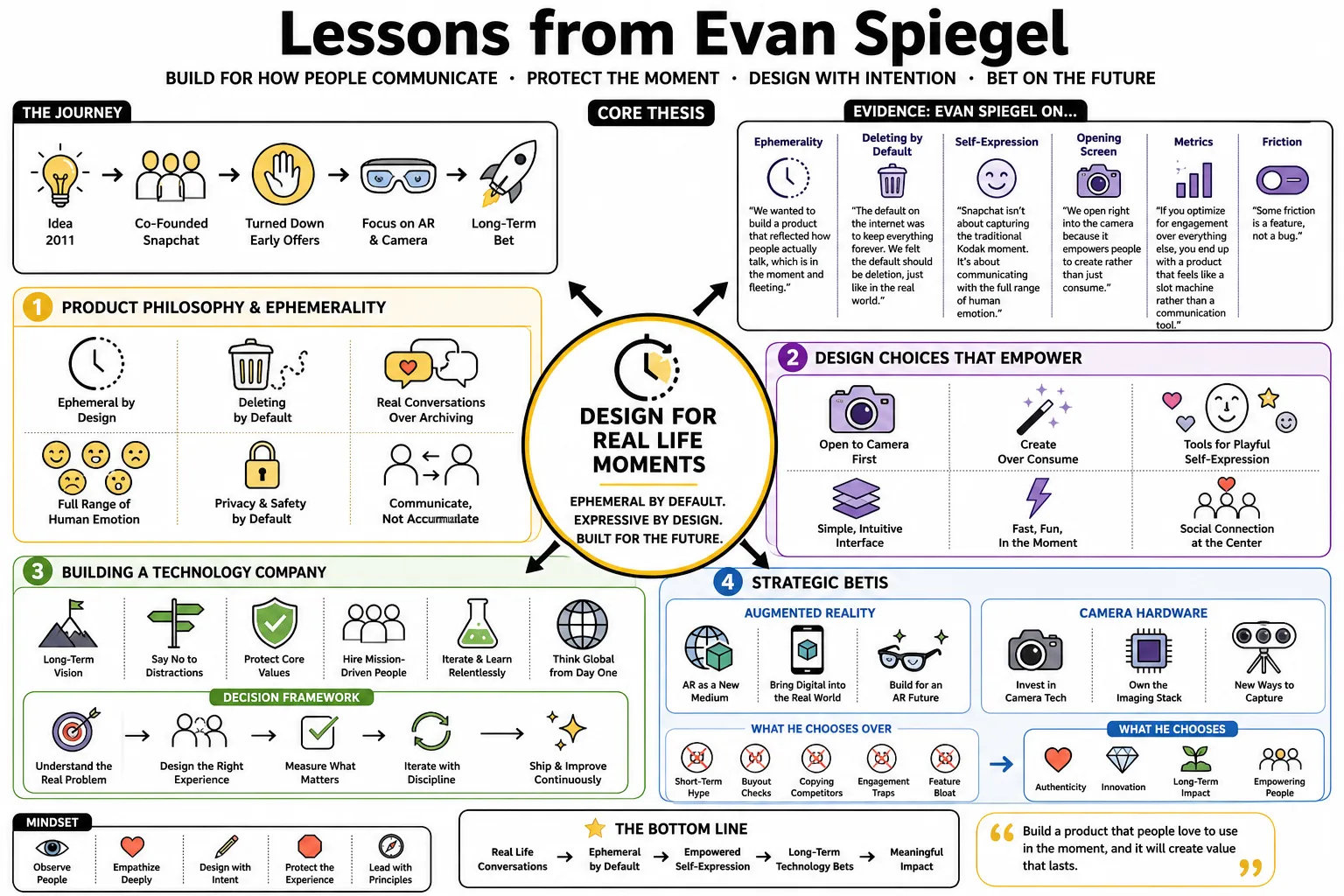
Lessons from Evan Spiegel
Evan Spiegel co-founded Snapchat and popularized the idea that digital messages should delete by default to mimic spoken conversation. He turned down early buyout offers to focus Snap on augmented reality and camera hardware. This collection covers his approach to product design and software limits, alongside his strategies for building a technology company.
Part 1: Product Philosophy & Ephemerality
- On Ephemerality: "We wanted to build a product that reflected how people actually talk, which is in the moment and fleeting." — Source: [How I Built This with Guy Raz]
- On Deleting by Default: "The default on the internet was to keep everything forever. We felt the default should be deletion, just like in the real world." — Source: [Snapchat Blog]
- On Self-Expression: "Snapchat isn't about capturing the traditional Kodak moment. It's about communicating with the full range of human emotion." — Source: [Snap Inc. S-1 Registration Statement]
- On The Opening Screen: "We open right into the camera because it empowers people to create rather than just consume." — Source: [Vanity Fair New Establishment Summit]
- On Metrics: "If you optimize for engagement over everything else, you end up with a product that feels like a slot machine rather than a communication tool." — Source: [Lenny's Podcast]
- On Friction: "Sometimes adding friction to a product makes it more meaningful. Not everything should be frictionless if it removes the humanity." — Source: [The Diary Of A CEO]
- On Iteration: "We probably release one percent of the products that we are working on. We throw away a lot." — Source: [WSJ. Magazine]
- On Joy: "We are in the business of making people happy. If a feature doesn't bring joy to the user, we shouldn't build it." — Source: [Code Conference]
- On Design: "Good design is about making things understandable, not just making them look pretty." — Source: [Fast Company]
- On Communication: "People want to communicate with their friends, not broadcast to an audience of strangers." — Source: [TechCrunch Disrupt]
Part 2: Competition & Copying
- On Being Copied: "If you build great stuff, people are going to copy your product. That is just a fact of life in technology." — Source: [Time Magazine]
- On Innovation vs. Imitation: "You have to be comfortable being misunderstood for a long period of time while you build the future." — Source: [Snap Partner Summit]
- On Competitor Strategy: "We don't focus on what our competitors are doing. We focus on what our users are trying to do." — Source: [CNBC Interview]
- On Software Moats: "Software isn't a moat. Your moat is the trust of your community and your pace of innovation." — Source: [Lenny's Podcast]
- On The Copycat Threat: "Just because Yahoo has a search box doesn't mean they're Google." — Source: [Bloomberg]
- On Staying Ahead: "The only way to survive when everyone is copying you is to build the next thing before they finish copying the last thing." — Source: [Wired]
- On Originality: "We don't build things because other people are building them. We build things because we think they should exist." — Source: [Forbes]
- On Market Share: "We'd rather have a smaller, highly engaged community than a massive, passive audience." — Source: [Snap Inc. Earnings Call]
- On Focus: "The distraction of looking at what others are doing is more dangerous than the competition itself." — Source: [Recode Decode]
Part 3: Leadership & Building Teams
- On Management Styles: "I had to learn how to transition from a founder who builds things to a CEO who builds teams that build things." — Source: [The Diary Of A CEO]
- On The T-Shaped Leader: "You need to be deeply knowledgeable in one area, but capable of understanding and connecting with experts across many disciplines." — Source: [The Diary Of A CEO]
- On Hiring: "We look for people who care deeply about the work they do, not just the title they hold." — Source: [Business Insider]
- On Delegation: "The hardest part of scaling a company is learning to let go of the things you love doing so others can do them." — Source: [Harvard Business Review]
- On Internal Communication: "We value private, small-group communication internally, just like our product does externally. It fosters honesty." — Source: [The Verge]
- On Failure: "We celebrate the effort of trying something new, even if the result isn't what we hoped for." — Source: [Code Conference]
- On Company Culture: "Culture isn't a ping pong table. It's how people treat each other when things go wrong." — Source: [Fortune]
- On Decisiveness: "Sometimes you have to make a decision with imperfect information. Waiting for perfect information means you're already too late." — Source: [Founders Podcast]
- On Apologizing: "When you make a mistake as a leader, you have to own it quickly and publicly. The cover-up is always worse." — Source: [New York Times]
- On Vision: "A leader's job is to continually point to the horizon and remind the team why the journey is worth it." — Source: [Time Magazine]
Part 4: The Camera & Augmented Reality
- On The Camera's Evolution: "The camera has evolved from a tool for keeping memories to a tool for talking." — Source: [Snap Inc. S-1 Registration Statement]
- On Augmented Reality: "AR isn't just about putting a digital object in a physical space; it's about computing overlaid on the real world." — Source: [Snap Partner Summit]
- On Hardware: "We believe the camera is the fundamental hardware constraint of our time. Improving it unlocks entirely new software experiences." — Source: [TechCrunch]
- On Spectacles: "We built Spectacles to free the camera from the phone. You shouldn't have to look down at a screen to experience life." — Source: [The Verge]
- On The Metaverse: "We prefer the real world. We don't want to build a virtual reality where you escape; we want to enhance the world you're already in." — Source: [The Guardian]
- On Lenses: "Lenses were initially seen as toys, but they are actually profound ways for people to express how they feel without typing." — Source: [Fast Company]
- On Visual Communication: "Images are faster and more expressive than text. They are the new baseline for conversation." — Source: [Bloomberg Technology]
- On Wearables: "The transition to wearable computing will take time, but it is inevitable because it is more natural." — Source: [CNBC Interview]
- On Spatial Computing: "The future of computing is spatial, not constrained to a glowing rectangle in your pocket." — Source: [In Good Company Podcast]
Part 5: Entrepreneurship & Refusing to Sell
- On Selling the Company: "There are very few people in the world who get to build a business like this. I think trading that for some short-term gain isn't very interesting." — Source: [Yahoo Finance]
- On Belief: "If you sell, it wasn't the right dream. But if you don't, you are likely onto something meaningful." — Source: [USC Marshall Commencement Speech]
- On Taking Risks: "You have to be willing to burn the boats. If you have a fallback plan, you won't push as hard." — Source: [How I Built This with Guy Raz]
- On Youth: "Being young in business is an advantage because you don't know what isn't supposed to work." — Source: [Forbes]
- On Wealth: "Money is a byproduct of creating value, not the goal itself." — Source: [The Wall Street Journal]
- On Conviction: "We're just going to keep executing on what we believe, regardless of what the market says today." — Source: [Entrepreneur]
- On Founding a Company: "Starting a company is like jumping off a cliff and assembling an airplane on the way down." — Source: [Stanford University Talk]
- On Board Advice: "Listen to your board, but remember that you are the one running the company. They are advisors, not the operators." — Source: [Recode Decode]
- On The IPO: "Going public is just another milestone, not the finish line. The work doesn't stop." — Source: [CNBC Squawk Box]
- On Value Creation: "If you build something that people use every day to talk to the people they love most, the business model will follow." — Source: [Code Conference]
Part 6: Privacy & The Social Media Landscape
- On Social Media Feeds: "The social media feed is designed to rank content by popularity, which naturally incentivizes controversy." — Source: [Axios]
- On Privacy: "Privacy is not about secrecy; it is about context. People want to share different things with different groups." — Source: [Senate Judiciary Committee Testimony]
- On Data Collection: "We don't need to know everything about you to run a good business. We just need to help you communicate." — Source: [The New York Times]
- On Algorithmic Amplification: "We manually curate our discovery platform because we don't believe algorithms should decide what news is important." — Source: [Snap Partner Summit]
- On The Follower Model: "Counting followers turns friendship into a popularity contest. We wanted to eliminate that pressure." — Source: [Vanity Fair]
- On Safety for Minors: "Protecting young people online is a shared responsibility, but platforms must build safety into the architecture of the product." — Source: [Senate Judiciary Committee Testimony]
- On Authenticity: "True authenticity online only exists when people aren't worried about performing for an audience." — Source: [GQ Magazine]
- On Ads: "Advertising should be engaging and native to the format, not a disruptive interruption." — Source: [Advertising Week]
- On Toxicity: "By separating social from media, we prevent the echo chambers that breed toxicity on other platforms." — Source: [The Verge]
Part 7: Dealing with Criticism & Mistakes
- On Skepticism: "Someone will always have an opinion about you. Whatever you do won't ever be enough." — Source: [USC Marshall Commencement Speech]
- On Redesigns: "When you change a product that people use every day, they will be upset. You have to endure the anger if you know the change is necessary." — Source: [Code Conference]
- On Being Misunderstood: "It is a feature, not a bug, to be misunderstood by older generations. It means you are building for the youth." — Source: [TechCrunch]
- On Learning from Errors: "The biggest mistake is not making a mistake; it's failing to learn from it and moving too slowly to fix it." — Source: [The Diary Of A CEO]
- On Public Scrutiny: "You cannot let the press cycle dictate your product roadmap." — Source: [WSJ. Magazine]
- On Resilience: "In times of despair, you may believe the cynic who tells you that one person cannot make a difference. Do not listen." — Source: [USC Marshall Commencement Speech]
- On Growth Pain: "Growing pains are real. Every time the company doubles in size, everything breaks, and you have to rebuild the processes." — Source: [Fast Company]
- On Ego: "You have to detach your ego from the product. If a feature fails, it doesn't mean you are a failure." — Source: [Lenny's Podcast]
- On Staying Grounded: "When things are going well, you aren't as good as they say. When things go poorly, you aren't as bad as they say." — Source: [Bloomberg]
Part 8: Life, Art, & Perspectives
- On Conformity: "People do silly things to avoid appearing different. We have a biological desire to conform, but we must resist it to innovate." — Source: [USC Marshall Commencement Speech]
- On Art and Technology: "The intersection of art and technology is where the most meaningful products are born. It's not just about code; it's about feeling." — Source: [Founders Podcast]
- On Dissent: "Listen to the whispers of your soul and do not fear being a dissenting voice." — Source: [USC Marshall Commencement Speech]
- On Creativity: "I think everyone is born creative, but it can be suppressed by fear." — Source: [Entrepreneur]
- On Working Smart: "It's not about working harder, it's about working the system." — Source: [YourStory]
- On Passion: "Find something important to you. Find something that you love." — Source: [USC Marshall Commencement Speech]
- On The Unknown: "It is not possible at this time or any time to know the end results of our efforts." — Source: [USC Marshall Commencement Speech]
- On Empowerment: "I'd like to create a space for people who have a lot of talent but not a lot of reach." — Source: [Time Magazine]
- On Impact: "The goal is not to leave a legacy; the goal is to leave the world a little more connected than you found it." — Source: [In Good Company Podcast]