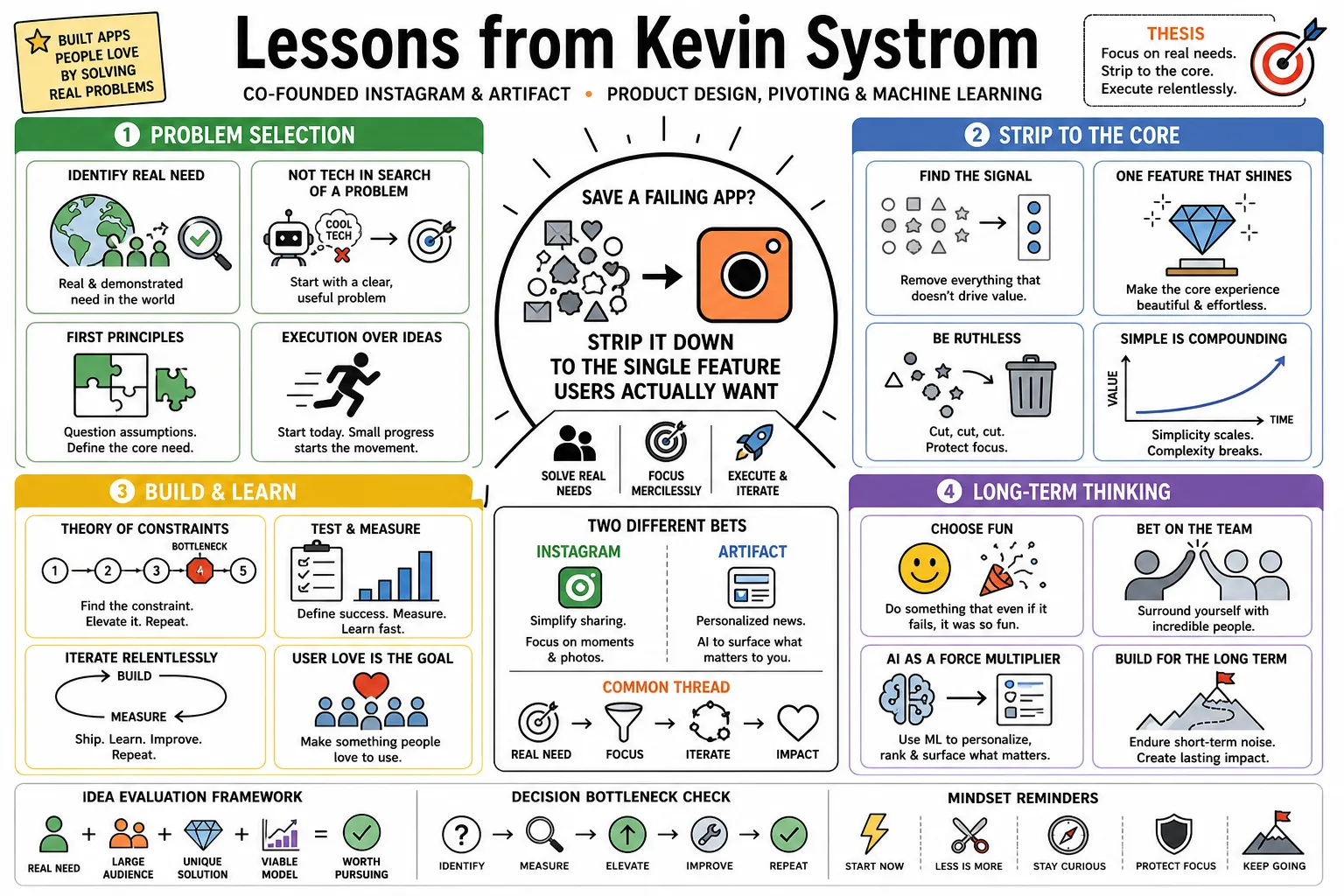
Lessons from Kevin Systrom
Kevin Systrom co-founded Instagram and the AI news aggregator Artifact. He proved you can save a failing app by stripping it down to the single feature users actually want. This collection gathers his advice on product design, pivoting, and machine learning.
Part 1: Problem Selection and First Principles
- On identifying the problem: "Every startup should address a real and demonstrated need in the world. If you build a solution to a problem lots of people have, it's so easy to sell your product to the world." — Source: [Quote Fancy]
- On technology in search of a problem: "Many entrepreneurs fall into the trap of building technology because it seems cool, rather than starting with a clear, useful problem that needs solving." — Source: [Sequoia Capital]
- On execution over ideas: "If you've got an idea, start today. There's no better time than now to get going. There's always small progress that can be made to start the movement." — Source: [AZ Quotes]
- On finding bottlenecks: "Applying the Theory of Constraints helps teams identify and resolve bottlenecks in their decision-making process." — Source: [The Tim Ferriss Show]
- On evaluating ideas: "You have to choose to do something that even if it fails it was so fun. We never started Instagram knowing it was going to be big. We started Instagram because we loved photography." — Source: [Lex Fridman Podcast]
- On validating needs: "Don't build something you think people want. Build something you know you want, and see if others share the same pain point." — Source: [Inc. Magazine]
- On the value of hard work: "I promise you, a lot of it is luck. But you make your own luck by working really hard and trying lots and lots of things." — Source: [Quote Fancy]
- On getting to the core: "Your job as a founder is to be a problem solver. Once you identify a genuine need, focus all your efforts on solving it for as many customers as possible." — Source: [Forbes]
- On systemic thinking: "Understanding systems and how components interact is often more valuable than understanding any single piece of the technology." — Source: [Stratechery]
- On foundational constraints: "Limits force creativity. If you have infinite resources, you often end up building something bloated." — Source: [Lex Fridman Podcast]
Part 2: The Art of the Pivot
- On failing fast: "You need to fail in order to find the right solution. Failing quickly allows you to diagnose why a product isn't working and pivot." — Source: [The Tim Ferriss Show]
- On avoiding the private beta trap: "Staying in private beta for too long out of fear of judgment is a mistake. You want to get the product out so you can gather feedback." — Source: [Startup Archive]
- On user signals: "Follow the user signal. We realized that while people weren't using Burbn's check-in features, they were constantly sharing photos." — Source: [How I Built This]
- On stripping away features: "It takes courage to throw away months of work. We stripped away everything from Burbn that was extraneous to focus entirely on photos." — Source: [The Guardian]
- On user behavior vs intent: "Focus on what users are actually doing rather than what you intended for them to do." — Source: [Product Monk]
- On the transition from Burbn: "Burbn was too complex and cluttered. We had to pivot because the initial concept simply was not meeting market needs." — Source: [Medium]
- On iteration over time: "Instagram took only eight weeks to build and ship, but it was the product of over a year of previous work, experimentation, and trial and error." — Source: [Inc. Magazine]
- On identifying the real product: "Sometimes the real product is just one single feature buried inside a much larger, failing application." — Source: [Sequoia Capital]
- On the willingness to change: "Many successful companies are the result of pivots. You have to be willing to kill your original idea if the data tells you to." — Source: [The Tim Ferriss Show]
Part 3: Product Simplicity and Design
- On feature limitations: "The best feature is less features." — Source: [AZ Quotes]
- On focus: "Focusing on one thing and doing it really, really well can get you very far." — Source: [Quote Fancy]
- On the origin of filters: "When my wife said her photos didn't look as good as professional ones, I realized that adding high-quality filters could solve a core user barrier." — Source: [Equalman]
- On visual communication: "Photography is an incredibly efficient way of communicating. A single image can replace paragraphs of text." — Source: [Lex Fridman Podcast]
- On Apple's influence: "Do less, but do that smaller bit better than anyone else in the world. This is a lesson drawn directly from Steve Jobs." — Source: [Forbes]
- On app speed: "One of our core tenets for Instagram was ensuring the upload process was exceptionally fast. Speed is a feature." — Source: [Startup Archive]
- On removing friction: "Every extra tap or screen reduces the number of people who will successfully complete an action. Strip away the friction." — Source: [Stratechery]
- On continuous refinement: "A product is never truly finished. It requires continuous refinement to remain simple as new capabilities are added." — Source: [How I Built This]
- On aesthetic value: "Making things beautiful is about making users feel good about what they are creating, beyond pure aesthetics." — Source: [Medium]
Part 4: Decision Making and Risk
- On batting averages: "Everyone thinks they have to bat a 1,000. That's crazy. The best Quant hedge funds in the world bat 50.001%. They just take a lot of bets." — Source: [Lex Fridman Podcast]
- On testing assumptions: "A big part of knowing that you're right is working as hard as you can to prove that you're wrong. And if you can't, well, there's only one option left." — Source: [The Tim Ferriss Show]
- On the Theory of Constraints: "By focusing on the single biggest bottleneck in a process, you can dramatically increase the throughput of your entire organization." — Source: [Stanford ETL Speaker Series]
- On taking calculated risks: "You have to place multiple bets. Not all of them will pay off, but the ones that do cover the losses of the others." — Source: [Lex Fridman Podcast]
- On the paralysis of choice: "Sometimes any decision is better than no decision. You can usually correct a bad decision, but you can't recover lost time." — Source: [The Jordan Harbinger Show]
- On trusting data: "You have to look objectively at the data. If the numbers contradict your intuition, you must be willing to change your mind." — Source: [Stratechery]
- On finding truth: "Surround yourself with people who will challenge your ideas and tell you when your thinking is flawed." — Source: [The Tim Ferriss Show]
- On learning from failure: "Failures are just data points. They tell you what not to do next time." — Source: [Startup Archive]
- On maintaining perspective: "When faced with a tough choice, zoom out. Ask yourself if this decision will matter in five years." — Source: [Inc. Magazine]
Part 5: Machine Learning and the Future of Feed
- On the unconnected graph: "Artifact uses an unconnected social graph, where the feed is based on what a user actually reads rather than who they follow." — Source: [India Times]
- On AI improving products: "Throughout the years, what I saw was that every time we use machine learning to improve the consumer experience, things got really good really quickly." — Source: [India Times]
- On avoiding echo chambers: "Our algorithm is fuzzy enough that you will likely see, a big portion of the time, exploration content." — Source: [Gizmodo]
- On exploration content: "Items the AI isn't fully certain the user will like are essential to prevent user boredom and frustration." — Source: [Gizmodo]
- On quality standards in AI feeds: "The only content that's allowed to be distributed is subject to a high quality bar. Our goal is to have publishers across the ideological spectrum subject to quality and integrity." — Source: [Gizmodo]
- On generative AI utility: "We can use GPT-4 to rewrite clickbait headlines into descriptive titles, saving users time and frustration." — Source: [Substack]
- On personalized summaries: "AI allows us to summarize articles into bullet points or even explain them like the user is five years old." — Source: [Medium]
- On the limits of AI: "Machine learning is a powerful tool, but it still requires human oversight to ensure it aligns with product values and user safety." — Source: [Stratechery]
- On adapting to algorithms: "Initially, we opposed algorithmic ranking at Instagram. We shifted our stance when we observed that algorithmic feeds actually improved user engagement." — Source: [Stratechery]
- On the current AI era: "We live in an exciting time where artificial intelligence is changing just about everything we touch, and the opportunities for new ideas seem limitless." — Source: [Mashable]
Part 6: Leadership, Accountability, and Hiring
- On admitting mistakes: "One thing I tried to do at Instagram was say when I screwed up. Point out how I was wrong about things and point out where my judgement was off." — Source: [Lex Fridman Podcast]
- On hiring criteria: "Hire people who are much better than you. Ask yourself if you could see yourself working for them in the future." — Source: [The Jordan Harbinger Show]
- On scaling your time: "As a founder, you must hire smart people who will contribute their own ideas, allowing you to carve out time for strategic thinking." — Source: [Sequoia Capital]
- On the 360-degree interview: "Implementing 360-degree interviews helps uncover how a candidate interacts with people at all levels of an organization." — Source: [The Tim Ferriss Show]
- On receiving feedback: "You have to actively solicit honest feedback from your team. If they are afraid to tell you the truth, you have a culture problem." — Source: [The Tim Ferriss Show]
- On leadership transparency: "Transparency builds trust. When you explain the reasoning behind a decision, your team is much more likely to support it." — Source: [The Jordan Harbinger Show]
- On delegating: "You cannot make every decision yourself as the company grows. You have to build systems and empower others to make calls." — Source: [Forbes]
- On cultural fit: "Skill is important, but if someone does not align with your core values, they will ultimately damage the team dynamic." — Source: [Inc. Magazine]
- On leading by example: "Your team will mirror your behavior. If you work hard and remain humble, they are likely to do the same." — Source: [Startup Archive]
- On early team dynamics: "In the early days, you are practically living with your co-founders. Mutual respect and clear communication are non-negotiable." — Source: [How I Built This]
Part 7: Assessing Startup Advice and Mentorship
- On advice going stale: "Startup advice often goes stale or is heavily colored by the advisor's specific experiences. Be cautious." — Source: [Sequoia Capital]
- On pattern matching: "Look for advice that holds true across many different situations rather than rigid, dogmatic rules." — Source: [Sequoia Capital]
- On evaluating mentors: "Find mentors who have the self-awareness to understand the edge cases where their own experience might not apply." — Source: [The Tim Ferriss Show]
- On survivorship bias: "Be aware of survivorship bias. Many successful founders attribute their success to specific actions, ignoring the role of luck." — Source: [Lex Fridman Podcast]
- On universal truths: "The best advice focuses on human psychology and fundamental business mechanics, rather than transient technological trends." — Source: [Stratechery]
- On trusting your gut: "While advice is helpful, you are the one closest to your product and users. Ultimately, you must trust your own judgment." — Source: [Inc. Magazine]
- On asking the right questions: "When speaking with a mentor, don't ask them what you should do. Ask them how they would think about the problem." — Source: [The Jordan Harbinger Show]
- On the limitation of playbooks: "There is no single playbook for building a successful company. You have to write your own as you go." — Source: [Forbes]
- On unsolicited advice: "Listen politely to unsolicited advice, but carefully filter what you actually apply to your business." — Source: [Startup Archive]
Part 8: Lifelong Learning and Reading
- On "The Goal": "Eliyahu Goldratt's 'The Goal' fundamentally changed how we thought about bottlenecks and process optimization at Instagram." — Source: [The Tim Ferriss Show]
- On reading comprehension: "Mortimer Adler's 'How to Read a Book' taught me how to engage more deeply with text and improve my retention of knowledge." — Source: [What's That Book]
- On "Principles": "Ray Dalio's approach to creating an idea meritocracy completely blew me away and offered a practical framework for transparency." — Source: [Read This Twice]
- On studying history: "Books like 'The Lessons of History' provide essential context for understanding human behavior and cyclical societal trends." — Source: [Tanner Haas]
- On asking better questions: "The real value of reading is learning how to formulate better questions about the world, rather than simply accumulating facts." — Source: [The Jordan Harbinger Show]
- On the Lean Startup method: "Eric Ries's work perfectly captures the necessity of continuous innovation and building agile, responsive businesses." — Source: [Read This Twice]
- On cross-disciplinary learning: "Ideas from completely different fields like politics, mathematics, or history can often solve difficult problems in software." — Source: [Stratechery]
- On continuous education: "The moment you stop learning is the moment your company starts dying. You have to remain a student of your industry." — Source: [Lex Fridman Podcast]
- On the core message: "If I could put one message on a billboard to reach millions of people, it would simply be: Follow your passion." — Source: [Medium]