Lessons from Tobias Carlisle
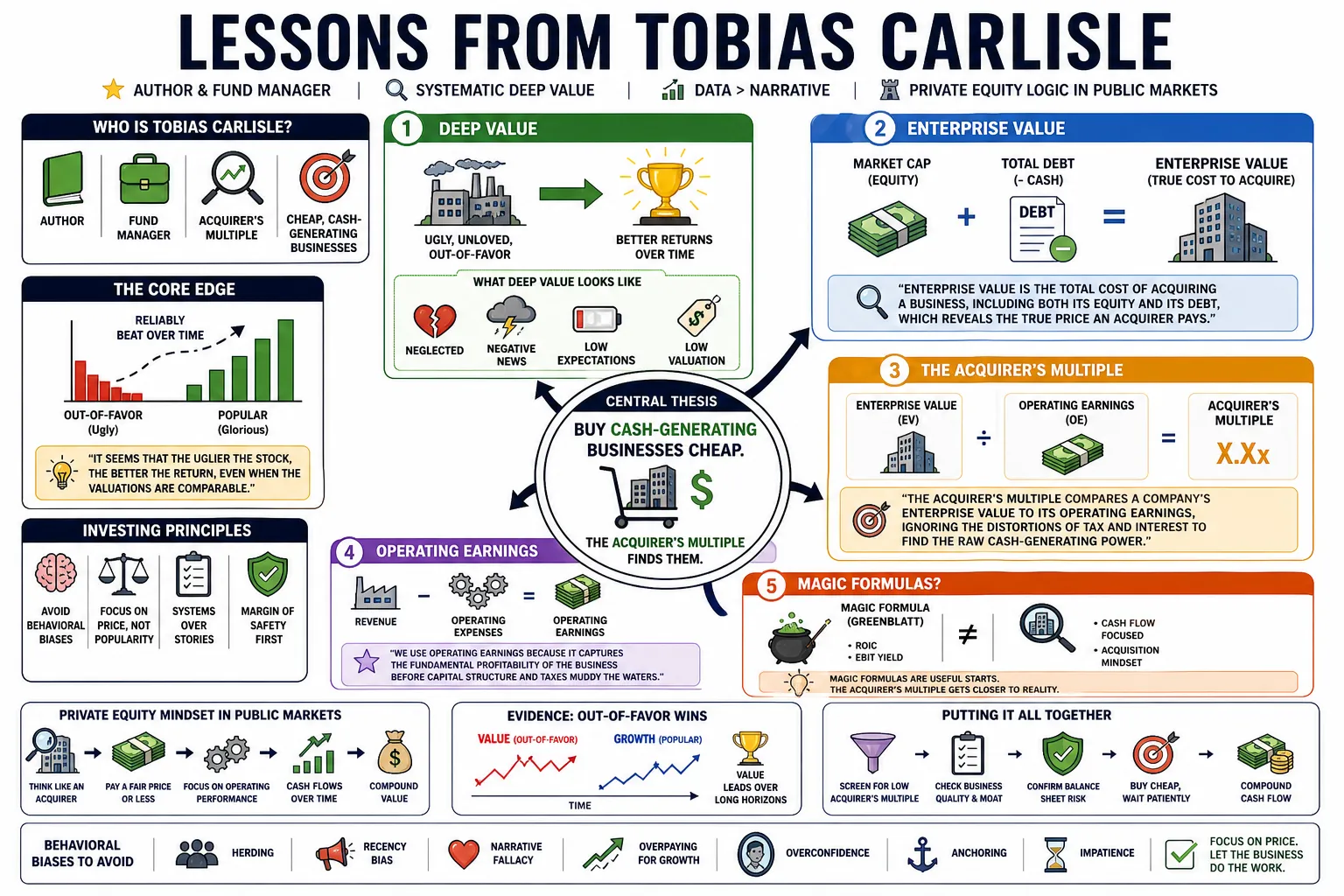
Tobias Carlisle is an author and fund manager who developed the Acquirer's Multiple to identify cheap, cash-generating businesses. His strategy relies on data showing that out-of-favor stocks reliably beat popular ones. This compilation details his approach to systematic investing, from avoiding behavioral biases to applying private equity logic to public markets.
Part 1: Deep Value and The Acquirer's Multiple
- On Deep Value: "It seems that the uglier the stock, the better the return, even when the valuations are comparable." — Source: [Goodreads]
- On Enterprise Value: "Enterprise value is the total cost of acquiring a business, including both its equity and its debt, which reveals the true price an acquirer pays." — Source: [The Acquirer's Multiple]
- On The Acquirer's Multiple: "The Acquirer’s Multiple compares a company’s enterprise value to its operating earnings, ignoring the distortions of tax and interest to find the raw cash-generating power." — Source: [The Investor's Podcast]
- On Operating Earnings: "We use operating earnings because it captures the fundamental profitability of the business before capital structure and taxes muddy the waters." — Source: [Acquirers Funds]
- On Magic Formulas: "While Greenblatt’s Magic Formula seeks good companies at bargain prices, simply buying the cheapest companies regardless of quality often generates higher returns." — Source: [Quantitative Value]
- On Margin of Safety: "A deep discount to intrinsic value provides both a margin of safety against errors and a source of outsized returns." — Source: [Novel Investor]
- On the Glamour Penalty: "Investors chronically overpay for growth and glamour, creating a structural advantage for those willing to buy the market's discarded assets." — Source: [Deep Value]
- On Finding Bargains: "The best bargains are often found in companies facing temporary crises, where market pessimism has driven the price far below fundamental value." — Source: [ValueWalk]
- On Cash Rich Companies: "Companies trading below their net current asset value often represent absolute bargains, provided they aren't burning cash too quickly." — Source: [Greenbackd]
- On Private Equity Logic: "Deep value investing applies the logic of private equity to public markets by looking for cash flow relative to the entire capital structure." — Source: [The Acquirer's Multiple Book]
Part 2: Mean Reversion and Market Dynamics
- On Mean Reversion: "Mean reversion is the iron rule of the financial markets. High margins attract competition, and low margins force consolidation." — Source: [Goodreads]
- On Corporate Lifecycles: "Businesses are rarely as permanently impaired as the market prices them during a downturn, nor as invincible as they appear during a boom." — Source: [Acquirers Funds]
- On the Value Premium: "The value premium exists largely because investors fail to anticipate how powerfully mean reversion forces fundamental metrics back toward average." — Source: [Novel Investor]
- On Profit Margins: "Abnormally high profit margins are the most mean-reverting metric in finance; they are an invitation for competitors to enter the industry." — Source: [Deep Value]
- On Growth Traps: "Extrapolating recent growth into the distant future is the most common and expensive mistake made by equity investors." — Source: [Quantitative Value]
- On Value Traps: "A true value trap is a company whose fundamentals deteriorate faster than its valuation can revert to the mean." — Source: [ValueWalk]
- On Reversion Speed: "The speed of mean reversion is unpredictable, which is why value investors must construct portfolios capable of enduring long periods of underperformance." — Source: [The Investor's Podcast]
- On the Catalyst for Reversion: "Sometimes the only catalyst required for a cheap stock to appreciate is simply the absence of further bad news." — Source: [Greenbackd]
- On Cyclical Industries: "Buying peak earnings at low multiples in cyclical industries is a classic value trap; the true bargain is often trough earnings at a high multiple." — Source: [Acquirers Funds]
- On Earnings Estimates: "Analysts chronically underestimate the tendency of depressed earnings to recover and over-project the sustainability of peak earnings." — Source: [Novel Investor]
Part 3: Systematic Investing and Rules-Based Models
- On Simple Models: "Simple models do tend to outperform human experts in almost every scenario, especially in environments with high noise." — Source: [PenderFund Capital]
- On Process Over Prediction: "Success in markets requires relying on a systematic process rather than attempting to make accurate macroeconomic predictions." — Source: [Advisor Analyst]
- On Beating the Market: "One simple rule for beating the market is to buy a portfolio of undervalued stocks and hold them with discipline." — Source: [Goodreads]
- On Algorithmic Discipline: "An algorithm doesn't get scared when the market drops, and it doesn't fall in love with a charismatic CEO." — Source: [Quantitative Value]
- On Backtesting: "The purpose of a backtest is not to predict exact future returns, but to understand the reliability of a strategy across different market cycles." — Source: [Acquirers Funds]
- On Overfitting: "The more parameters you add to a quantitative model, the more likely you are to fit the noise rather than the signal." — Source: [The Investor's Podcast]
- On Removing Emotion: "Systematic value investing removes the need for human judgment at the point of maximum stress, which is exactly when human judgment is most flawed." — Source: [Deep Value]
- On Consistency: "A mediocre model applied consistently will usually beat a brilliant model applied sporadically." — Source: [ValueWalk]
- On Rule Discretion: "Every time you override your quantitative system because you think this time is different, you degrade the long-term performance of the model." — Source: [Greenbackd]
- On Complexity: "Complexity in investment strategy often serves as a marketing tool rather than a driver of excess returns." — Source: [Novel Investor]
Part 4: The Broken Leg Fallacy and Behavioral Biases
- On the Broken Leg Fallacy: "The broken leg fallacy occurs when experts believe they have special knowledge that invalidates a statistical model, but their interventions almost always hurt returns." — Source: [Reddit AMAs]
- On Expert Failure: "Humans are excellent at identifying edge cases but terrible at weighing probabilities, which is why models beat experts." — Source: [Quantitative Value]
- On Narrative Bias: "Investors are wired to love a good story. Glamour stocks offer a compelling narrative, while deep value stocks usually offer a terrifying one." — Source: [The Acquirer's Multiple Book]
- On Overconfidence: "The belief that you can reliably forecast the future earnings of a complex business is the ultimate investor overconfidence." — Source: [Acquirers Funds]
- On Loss Aversion: "Value investing is psychologically painful because it requires buying the exact assets that are causing other investors the most immediate pain." — Source: [Deep Value]
- On Social Proof: "It is much easier to lose money holding the same stocks as everyone else than to risk underperforming while holding a portfolio of ugly companies." — Source: [ValueWalk]
- On the Illusion of Control: "Detailed financial models provide the illusion of precision and control, masking the inherent uncertainty of the future." — Source: [The Investor's Podcast]
- On Confirmation Bias: "Once an investor buys a stock, they selectively filter information to support their thesis, ignoring red flags that a model would dispassionately process." — Source: [Goodreads]
- On Market Noise: "The daily fluctuations of the stock market are primarily noise driven by behavioral reactions, not changes in fundamental business value." — Source: [Novel Investor]
- On Patience: "In a systematic strategy, doing nothing is often the hardest and most necessary action to take." — Source: [Greenbackd]
Part 5: Contrarianism and Market Sentiment
- On Independent Thinking: "You have to be an independent thinker in markets to be successful because the consensus is built into the price." — Source: [Goodreads]
- On Uncovering Mispricings: "Investors aren't rewarded for picking winners; they're rewarded for uncovering mispricings between the price of a security and its intrinsic value." — Source: [Novel Investor]
- On Zagging: "To achieve market-beating returns, you must zig when the crowd zags, which fundamentally means looking foolish for extended periods." — Source: [E-Investing for Beginners]
- On Fear and Greed: "The market mechanisms of fear and greed guarantee that assets will periodically be mispriced in predictable directions." — Source: [Deep Value]
- On Consensus Trades: "By definition, the most popular trade in the market has the least margin of safety because perfection is already priced in." — Source: [Acquirers Funds]
- On Being Uncomfortable: "If a value investment doesn't make you feel physically uncomfortable when you execute the trade, it's probably not cheap enough." — Source: [The Investor's Podcast]
- On Market Bottoms: "The best time to deploy capital is when the news cycle is universally negative and the idea of buying equities seems irresponsible." — Source: [ValueWalk]
- On Career Risk: "Institutional managers avoid deep value because the career risk of holding ugly, underperforming stocks is higher than the reward for being right." — Source: [Greenbackd]
- On Contrarian Traps: "Being a contrarian just for the sake of being different is a fast way to lose money; you must be a contrarian who is also right about the math." — Source: [The Acquirer's Multiple]
Part 6: Activism and Corporate Control
- On the Role of Activists: "Activist investors act as the market's immune system, targeting bloated, underperforming companies and forcing them to return value to shareholders." — Source: [Deep Value]
- On Capital Allocation: "The primary failure of bad management is poor capital allocation, like hoarding cash or wasting it on ego-driven acquisitions instead of buying back undervalued stock." — Source: [Acquirers Funds]
- On Cash Hoards: "A massive cash balance on a balance sheet is often a liability because it invites management to destroy value through terrible acquisitions." — Source: [Greenbackd]
- On Share Repurchases: "When a stock is deeply undervalued, the most accretive action management can take is aggressive share repurchases, retiring equity at a discount." — Source: [The Acquirer's Multiple]
- On Carl Icahn's Strategy: "Icahn's genius wasn't in predicting business outcomes, but in identifying structurally cheap assets and using brute force to extract the cash." — Source: [Deep Value]
- On Proxy Fights: "The mere threat of a proxy fight is often enough to compel an entrenched board to initiate a dividend or sell non-core divisions." — Source: [ValueWalk]
- On the Agency Problem: "Corporate executives often prioritize building a larger empire over maximizing per-share value, creating the exact inefficiencies that activists exploit." — Source: [Novel Investor]
- On Catalysts: "While cheap stocks can languish for years, an activist filing a 13D acts as a sudden, powerful catalyst for value realization." — Source: [The Investor's Podcast]
- On Unlocking Value: "Value is unlocked not by improving the underlying business operations, but by simply changing the capital structure and returning cash to owners." — Source: [Reddit AMAs]
Part 7: Concentrated Investing and Portfolio Construction
- On Concentration: "Concentrated portfolios generate higher long-term returns for skilled investors, but they require the stomach to endure brutal drawdowns." — Source: [Concentrated Investing]
- On Diversification: "Over-diversification is a defense against ignorance; if you have a purely mechanical edge, you only need enough positions to let the probabilities play out." — Source: [Acquirers Funds]
- On Sizing Positions: "Kelly criterion principles suggest betting heavily when the odds are overwhelmingly in your favor, rather than equal-weighting mediocre ideas." — Source: [The Investor's Podcast]
- On Holding Periods: "To capture the value premium, an investor must be willing to hold out-of-favor assets for three to five years, allowing mean reversion to take effect." — Source: [Deep Value]
- On Portfolio Turnover: "Systematic rebalancing forces you to sell what has gone up and buy what has gone down, mechanically executing the buy low, sell high mantra." — Source: [Quantitative Value]
- On Tracking Error: "To beat the index, your portfolio must look fundamentally different from the index, which guarantees periods of significant tracking error and underperformance." — Source: [ValueWalk]
- On the Optimal Number of Stocks: "A portfolio of 20 to 30 carefully selected deep value stocks provides adequate protection against idiosyncratic disaster while preserving the alpha of the strategy." — Source: [Concentrated Investing]
- On Risk Management: "Risk is not volatility; risk is the permanent impairment of capital caused by paying too much for an asset." — Source: [Goodreads]
- On Letting Winners Ride: "In a systematic approach, rebalancing rules naturally prune winners and fund losers, keeping the portfolio strictly aligned with the underlying value metrics." — Source: [Novel Investor]
Part 8: Philosophy, Moats, and Avoiding Ruin
- On Economic Moats: "Wide moats are incredibly rare and very difficult to identify in advance; betting on mean reversion is statistically more reliable than betting on permanent dominance." — Source: [Quantitative Value]
- On the Risk of Ruin: "The first rule of compounding is avoiding zeros. By focusing on balance sheets and free cash flow, you protect the downside and eliminate the risk of ruin." — Source: [Acquirers Funds]
- On Sun Tzu and Investing: "Like ancient military strategy, successful investing is about securing an impregnable position and waiting for the enemy to make a mistake." — Source: [Soldier of Fortune: Warren Buffett's Sun Tzu]
- On Quality vs. Price: "A bad business at a great price is often a superior investment to a great business at a bad price, provided the balance sheet is solvent." — Source: [The Acquirer's Multiple]
- On Market Efficiency: "The market is mostly efficient, but it is reliably inefficient at the extremes where human emotion overwhelms rational calculation." — Source: [Deep Value]
- On Financial Fraud: "Screening for earnings manipulation and accounting irregularities is the most important first step in building a quantitative value portfolio." — Source: [Quantitative Value]
- On Forecasting: "The future is fundamentally unknowable. Valuation is the only anchor investors have in a sea of uncertainty." — Source: [The Investor's Podcast]
- On the Ultimate Edge: "The ultimate edge in investing isn't analytical superiority; it is behavioral discipline, the ability to stick to a proven strategy when it feels terrible to do so." — Source: [Greenbackd]