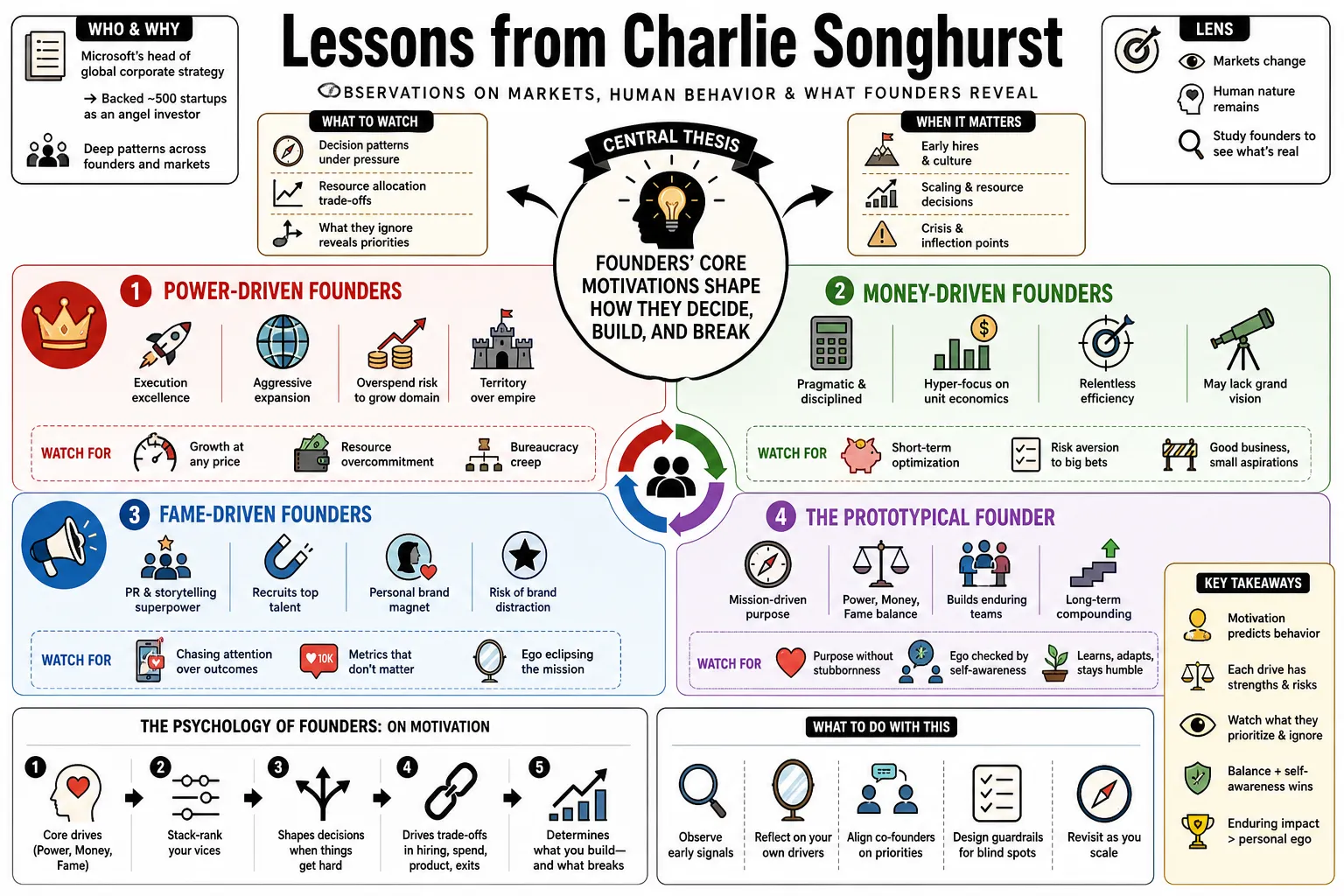
Lessons from Charlie Songhurst
Charlie Songhurst, a former Microsoft strategy executive, said in 2020 that he had made 483 angel investments. These lessons draw on his direct interviews about founders, hiring, startup failure and investing. — Invest Like the Best — Songhurst Interview.
Part 1: The Psychology of Founders
- Founder Motivation: Songhurst asks founders to rank power, money and fame alongside the kind of work and impact they value, using the answers to test fit rather than declare one universally best motive. — Invest Like the Best — Songhurst Interview.
- Power and Execution: He said founders who put power first often excel at execution but may need help keeping startup capital under control. — Invest Like the Best — Songhurst Interview.
- Money and Capital Efficiency: He associated money-first founders with attention to capital efficiency; he did not say they necessarily lack vision. — Invest Like the Best — Songhurst Interview.
- Fame Depends on Context: Songhurst generally avoids fame-first founders, while acknowledging that fame may matter in a show-business venture. — Invest Like the Best — Songhurst Interview.
- Founder–Market Fit: Songhurst rejects a single ideal founder profile: beyond energy and cognitive ability, he looks for a founder whose traits fit the particular business. — Invest Like the Best — Songhurst Interview.
- Idiosyncratic Outliers: He warned that exceptional companies such as Google and Facebook are too idiosyncratic to yield a reliable cookie-cutter investment rule. — Invest Like the Best — Songhurst Interview.
Part 2: The Dynamics of Scaling
- Politics at Scale: Songhurst observed that larger organizations introduce more capable executives but also more internal politics and boundary disputes. — Invest Like the Best — Songhurst Interview.
- Politics as a Management Signal: He relayed a rough saying that executives in better-run companies spend less time on politics than those in weaker companies; the 25% and 50% figures were not presented as measured data. — Invest Like the Best — Songhurst Interview.
- Productivity Through Growth: He described falling output per person as a major scaling risk when a startup replaces informal coordination with formal management. — Invest Like the Best — Songhurst Interview.
- When Speed Matters: Songhurst distinguished the few startups with strong network effects, where speed can matter greatly, from the many others where carefully chosen hires matter more than speed. — Invest Like the Best — Songhurst Interview.
- Leadership Learns by Surviving: Songhurst said founders can transform substantially during their first 36 months of leadership; surviving early mistakes gives them time to develop managerial skill. — Invest Like the Best — Songhurst Interview.
- Boring and Complex Markets: His preferred investment quadrant combines low glamour with high complexity, which he argues attracts fewer competing entrepreneurs. — Invest Like the Best — Songhurst Interview.
- Information-Flow Advantage: Rather than assume an investor can simply outthink everyone else, Songhurst looks for insights available through a different information flow. — Invest Like the Best — Songhurst Interview.
Part 3: The Art of Early-Stage Investing
- Recognizable Failure Modes: He argued that common startup failures are easier to study and avoid than the unusual circumstances behind exceptional success. — Invest Like the Best — Songhurst Interview.
- Unglamorous Opportunity: Songhurst pointed to accounting and audit software as useful but unglamorous work that can be less crowded than celebrated technology categories. — Invest Like the Best — Songhurst Interview.
- Investor Aesthetics: He noted that investors develop preferences for gritty, tangible businesses or abstract software businesses, and those tastes can create blind spots. — Invest Like the Best — Songhurst Interview.
- Fashionable Consumer Investing: Songhurst suggested that earlier success in consumer network-effect businesses drew too much subsequent capital to areas such as ridesharing and scooters. — Invest Like the Best — Songhurst Interview.
- Seek a Different Lens: Songhurst argued that geographically disparate networks can reveal opportunities missed within one tightly connected investor community. — Invest Like the Best — Songhurst Interview.
- Do Not Confuse Luck with Skill: He questioned how much of a startup’s apparent success reflects timing and enabling infrastructure, rather than solely the brilliance of its founders. — Invest Like the Best — Songhurst Interview.
- More Than One Investor Style: Songhurst described effective investors with different styles rather than one universal formula, while noting that popular styles attract imitators and lose advantage. — Invest Like the Best — Songhurst Interview.
Part 4: Identifying Talent and Recruitment
- Look Beyond Crowded Talent Markets: He suggested recruiting from less competitive places where capable people may have fewer competing offers. — Invest Like the Best — Songhurst Interview.
- Surround Yourself with Stronger People: Songhurst said that spending time with people who are smarter, harder-working and morally better can improve your judgment and expose you to more useful ideas. — Invest Like the Best — Songhurst Interview.
- Invest Time in Key Hires: Songhurst argued that spending even 100 hours on an early, high-impact hire can be rational because that person shapes both output and later hiring. — Invest Like the Best — Songhurst Interview.
- Where Talent Flows: He proposed watching where ambitious young people choose to work: a shift toward entrepreneurship may strengthen startups while weakening older professions. — Invest Like the Best — Songhurst Interview.
- Recruiting Is Core Work: Songhurst said founders underestimate recruiting because the first hires influence the quality and biases of many subsequent hires. — Invest Like the Best — Songhurst Interview.
- Survival Builds Skill: Using an old military saying he did not claim to originate, Songhurst argued that surviving early hazards lets founders gain the experience needed to improve. — Invest Like the Best — Songhurst Interview.
- Sell the Mission to Recruits: He said a strong recruiting pitch combines the role’s rewards, genuine fit with the founder, and excitement about building something meaningful together. — Invest Like the Best — Songhurst Interview.
- High-Trust Ecosystems: Songhurst argued that Silicon Valley’s high-trust investing culture supports founder autonomy and ambitious company building. — Invest Like the Best — Songhurst Interview.
Part 5: Assessing Markets and Opportunities
- Timing and Enabling Technology: He suggested that some startup opportunities emerge when enabling technologies, such as GPS, mobile internet or cloud infrastructure, become practical. — Invest Like the Best — Songhurst Interview.
- Competition for Exciting Work: Songhurst contrasted crowded, exciting fields such as space technology with less glamorous complex software niches that attract fewer entrepreneurs. — Invest Like the Best — Songhurst Interview.
- Useful Boring Software: He used accounting and audit software to illustrate how important infrastructure-like products can be overlooked because they lack glamour. — Invest Like the Best — Songhurst Interview.
- Local Limits on Global Finance: Songhurst saw large potential in cross-border finance but said national regulatory systems and historical banking structures continued to fragment it. — Invest Like the Best — Songhurst Interview.
- The Importance of Timing: Songhurst repeated someone else’s heretic-versus-prophet aphorism to illustrate his question of whether some startups become viable only when the surrounding technology is ready. — Invest Like the Best — Songhurst Interview.
Part 6: Failure Modes and Survival
- Early Financing Mistakes: He named poor early financing and cap-table choices among the avoidable errors that can burden a young company long after the initial deal. — Invest Like the Best — Songhurst Interview.
- Avoid Catastrophic Errors: Songhurst advised studying failure and avoiding unrecoverable early mistakes so the company survives long enough for its founders to get better. — Invest Like the Best — Songhurst Interview.
- Stage-Specific Failure: In his framework, startups must first make the founding team productive, then find product–market fit, then learn formal management and institution building. — Invest Like the Best — Songhurst Interview.
- Slow Organizational Decline: Songhurst observed that some companies appear to die slowly and asked why people inside them do not change course earlier; the stronger chronic-pain explanation was Andreessen’s. — Cheeky Pint — Songhurst and Andreessen.
Part 7: Historical Context and Geopolitics
- Geopolitical Risk: Songhurst argued that conflict can destroy investors’ wealth, citing the European world wars as examples and presenting lower perceived conflict risk as a possible European advantage. — Invest Like the Best — Songhurst Interview.
- Forestry as a Store of Value: He described forestry as an historically overlooked store of value because it is hard to seize and requires very patient capital; this was an investment view, not a guarantee of safety. — Invest Like the Best — Songhurst Interview.
- Trust and Long Horizons: Songhurst suggested that high trust lets investors give founders more autonomy, which may help companies pursue unusually ambitious long-term outcomes. — Invest Like the Best — Songhurst Interview.
- An Unusual West Coast Ecosystem: Songhurst suggested that the West Coast’s weaker old status hierarchies made entrepreneurship more attractive; he did not claim one irreproducible defense-and-counterculture formula. — Invest Like the Best — Songhurst Interview.
Part 8: East Coast vs. West Coast Thinking
- Quantitative East Coast Lens: He said investors trained on spreadsheets may develop a stronger instinct for margins and unit economics, though this is a tendency, not a rule for everyone on the East Coast. — Invest Like the Best — Songhurst Interview.
- West Coast Product Lens: Songhurst contrasted that with investors who recognize a product lead through direct use before the advantage appears in financial statements. — Invest Like the Best — Songhurst Interview.
- What Spreadsheets Can Miss: He argued that an early product advantage may be difficult to capture in current numbers; he used the iPhone as an example of a qualitative lead. — Invest Like the Best — Songhurst Interview.
- When Growth Masks Bad Economics: Songhurst credited quantitative investors with spotting companies whose rapid growth or apparent product–market fit depended on uneconomic subsidies. — Invest Like the Best — Songhurst Interview.
- Beware Imagined Network Effects: He cautioned that product-led investors can mistake an ordinary competitive market for one with powerful network effects. — Invest Like the Best — Songhurst Interview.
- Use Both Lenses: His East–West comparison identified a strength and weakness in each lens: test unit economics while remaining open to product advantages that do not yet appear in the numbers. — Invest Like the Best — Songhurst Interview.
- Imaginative Product Judgment: Songhurst said some investments require an imaginative leap from a compelling early product experience to its possible future commercial scale. — Invest Like the Best — Songhurst Interview.
- Trust and Investing Culture: In Songhurst’s account, East Coast finance often grew from zero-sum trading habits while West Coast technology investing developed a more trusting approach to founders. — Invest Like the Best — Songhurst Interview.