Barry Diller began in the William Morris mailroom, went on to lead Paramount and help launch Fox, and later built internet businesses through IAC. The lessons below trace his approach to learning, hiring, creative decisions, and public projects. His forecasts and business judgments are presented as his views, not established outcomes. — Masters of Scale — The Infinite Learner.
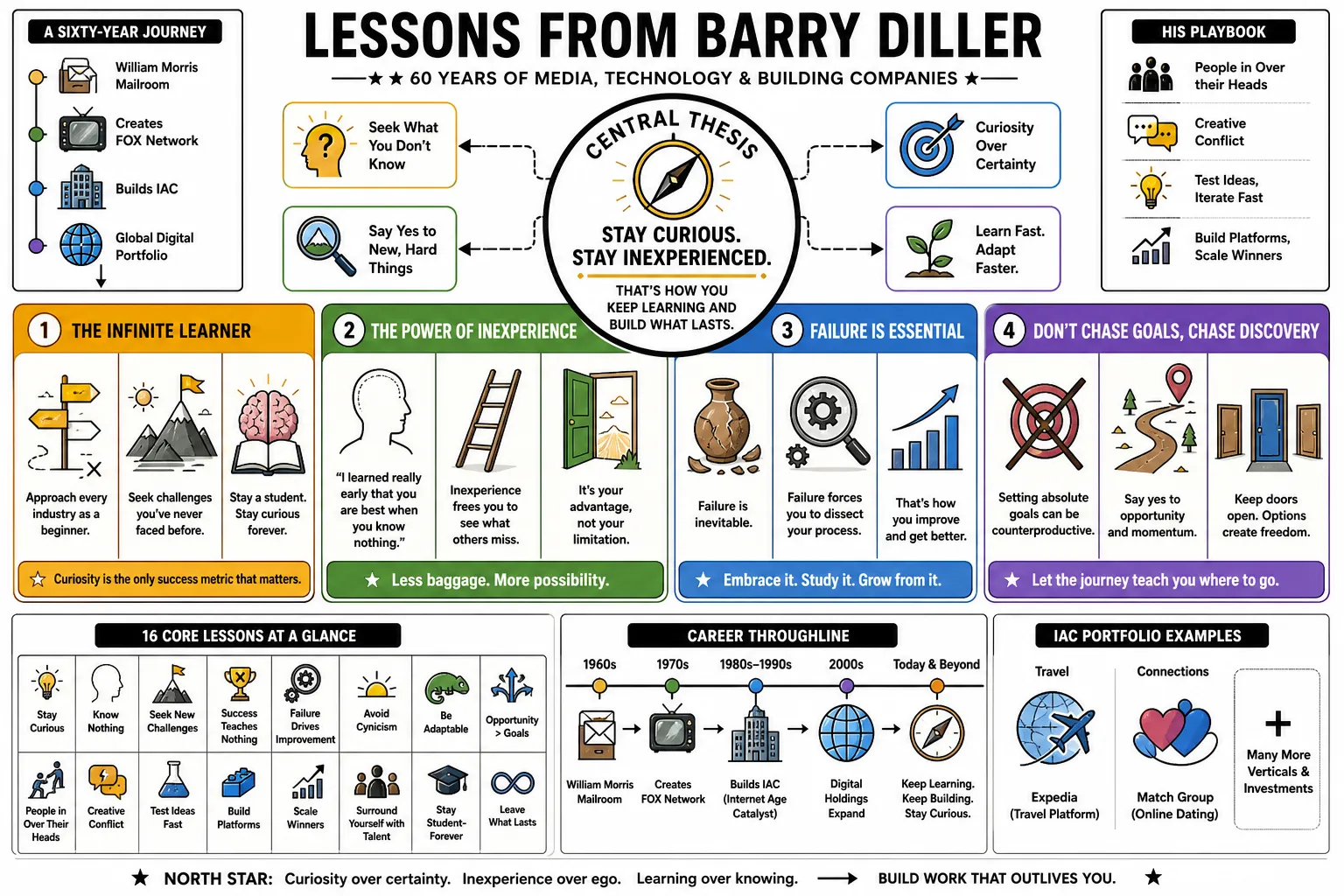
Part 1: The Infinite Learner & Inexperience
- On the infinite learner: Diller seeks work he has not yet figured out. He says learning makes a new challenge engaging, while maintaining an already-established operation can leave him less interested. — Masters of Scale — The Infinite Learner.
- On the value of inexperience: Entering an unfamiliar field can give Diller a clean slate. He still brings his life experience; the advantage is having fewer predetermined assumptions about how the new task must work. — Masters of Scale — The Infinite Learner.
- On learning from failure: Diller treats failures as occasions to inspect how a project went wrong and adjust his approach. That does not mean failure is the only way to learn. — The Knowledge Project — Barry Diller Interview.
- On career goals: For a broad creative career, Diller prefers following curiosity and opportunities to fixing a single destination in advance. He distinguishes that from professions with a defined training path. — The Knowledge Project — Barry Diller Interview.
- On curiosity: Diller’s own measure of success is remaining curious and interested in what he is doing. — The Knowledge Project — Barry Diller Interview.
- On avoiding cynicism: Diller tries to keep cynicism from determining creative decisions, because dismissing possibilities too early can block the work. — The Knowledge Project — Barry Diller Interview.
- On optimism in business: Diller describes himself as pragmatically optimistic: he recognizes threats but prefers to approach possibilities with hope rather than defeatism. — Alain Elkann — Barry Diller Interview.
- On recognizing market gaps: Diller’s television innovations began by questioning formats others treated as fixed. At ABC, he wanted stories with a beginning, middle, and end rather than only continuing series. — Masters of Scale — The Infinite Learner.
Part 2: Hiring & Talent Development
- On hiring philosophies: Diller prefers hiring people early in their development and giving them responsibilities beyond what they have already proved. He recognizes that some will not succeed. — Graham Bensinger — Hiring and Control.
- On taking responsibility: At the loosely organized ABC of his early career, Diller found room to take on responsibility without waiting for a perfectly defined role. — Masters of Scale — The Infinite Learner.
- On promoting internally: Diller regards developing internal successors as an important management responsibility. When he has had to recruit leaders from outside, he has sometimes treated it as a failure of that development effort. — Graham Bensinger — Hiring and Control.
- On the nature of work: Diller advises doing the work in front of you well, including tasks others do not want, rather than treating ordinary responsibilities as beneath you. — The Knowledge Project — Barry Diller Interview.
- On avoiding ingrained habits: His preference for early-career hires partly reflects wanting people whose approach has not already been fully shaped by another employer. — Graham Bensinger — Hiring and Control.
- On operational speed: Diller generally starts from trust rather than suspicion. He acknowledges being disappointed at times but prefers that risk to organizing his life around mistrust. — The Knowledge Project — Barry Diller Interview.
- On the startup mindset: Diller believes employees can bring an owner-like commitment to a company, while recognizing that working for someone else is not the same as owning it. — The Knowledge Project — Barry Diller Interview.
Part 3: Management & Creative Conflict
- On creative conflict: Diller favors passionate disagreement among people who care about a creative decision. The purpose is to test ideas by listening and arguing, not simply to win the argument. — Remarkable People — Barry Diller Interview.
- On the output of conflict: In Diller’s creative process, prolonged discussion can wear down rehearsed positions and expose a more useful idea. He describes this as a personal method, not the only route to clarity. — Masters of Scale — The Infinite Learner.
- On self-awareness as a leader: Diller distinguishes being an interesting boss from being an easy one. He acknowledges inconsistency and leaves others to judge how well they work with him. — Graham Bensinger — Hiring and Control.
- On torturing the process: Diller pushes a creative project beyond merely acceptable work, repeatedly testing and refining it rather than settling too quickly. — David Begnaud — Barry Diller Interview.
- On accountability: For Diller, knowing about a serious problem starts the responsibility to address it. Awareness is not an excuse to wait for someone else to act. — The Knowledge Project — Barry Diller Interview.
Part 4: Strategy & Decision-Making
- On momentum: Diller favors taking the next practical step and correcting the course as he learns, rather than expecting a complete route to be visible at the start. — The Knowledge Project — Barry Diller Interview.
- On trusting ideas: When Diller believes in an idea, he wants to move it into action rather than let endless deliberation prevent a test. — Remarkable People — Barry Diller Interview.
- On over-analysis: Diller is skeptical of elaborate forecasts presented as certainty when evaluating a new creative project. He prefers testing the underlying idea to being persuaded by polished projections. — Remarkable People — Barry Diller Interview.
- On data vs. intuition: In creative decisions, Diller sees historical data as insufficient to predict which new story or project will succeed. He relies heavily on editorial judgment. — The Knowledge Project — Barry Diller Interview.
- On executing ideas: Diller favors staying with an idea when it has a plausible business model, while avoiding a commitment that puts everything at risk. An appealing product does not guarantee survival. — AllThingsD — Diller at D6.
- On primary motivations: Diller describes curiosity and independence as stronger drivers of his career than financial necessity. That is an account of his own circumstances, not a claim that money inevitably follows good work. — Alain Elkann — Barry Diller Interview.
- On ambition: Diller wanted Little Island to be a distinctive public place rather than a routine replacement pier. The ambition was to create something visitors would recognize and enjoy. — CBS Sunday Morning — Little Island.
- On resourcefulness: Little Island’s unusual design depended on resources that let Diller and his collaborators attempt something unexpected. Their circumstances do not prove that every impractical idea can be realized. — CBS Sunday Morning — Little Island.
- On building systematically: Diller describes his career as shaped by serendipity and opportunities he could not have laid out decades in advance. — Alain Elkann — Barry Diller Interview.
- On meaningless corporate jargon: Diller rejected vague synergy language, while making a concrete case for interactivity in his proposed QVC–Paramount combination. — Los Angeles Times — Diller on Diller.
Part 5: Hollywood & The Entertainment Industry
- On modern Hollywood: Diller criticizes the impersonality of actors auditioning alone into phones, contrasting it with the more direct human encounters he remembers from earlier Hollywood. — Graham Bensinger — Old Hollywood.
- On the insular nature of entertainment: Diller criticizes Hollywood’s insularity and its difficulty responding to changes in how audiences receive entertainment. — AllThingsD — Diller at D6.
- On early television snobbery: Diller recalls film executives looking down on his television background when he arrived at Paramount. He says it took time to learn how to run the studio on his own terms. — Vanity Fair — Barry Diller’s Career.
- On losing the 1994 Paramount bid: After QVC lost its Paramount bid in 1994, Diller’s brief statement acknowledged defeat and moved on. He also told the original reporter that an auction is not a test of ego or talent: a bidder does not always win. — Los Angeles Times — The Paramount Bid.
- On the 2024 Paramount bid: In September 2024, Diller described his renewed interest in Paramount as a sense of duty tied to his history with the studio and his belief that he knew what to do with its assets. — Screen Daily — Diller’s 2024 Paramount Pursuit.
- On the Fox broadcasting gamble: Diller approached Fox as an alternative to the three established networks, using different programming rather than trying to imitate their schedules. — Masters of Scale — The Infinite Learner.
- On Rupert Murdoch: Diller recalls Murdoch backing the fourth-network proposal when others considered it unrealistic. The support turned an uncertain idea into a venture they could actually attempt. — Alain Elkann — Barry Diller Interview.
- On creating Fox: Diller did not expect Fox to recreate CBS’s complete old-style network. He described building a more limited programming network instead. — Los Angeles Times — Diller’s Fox Network.
Part 6: Tech, Streaming & The Media Business
- On the QVC epiphany: At QVC, Diller saw television, telephones, and computers converging into an interactive screen. That showed him a use for screens beyond telling stories. — Masters of Scale — Learn to Unlearn.
- On tech giants ruling Hollywood: In 2024, Diller argued that Netflix, Amazon, and Apple had displaced the legacy studios’ global dominance. He explicitly distinguished losing dominance from going out of business. — Screen Daily — Diller’s 2024 Paramount Pursuit.
- On Netflix’s lead: In a 2023 interview, Diller described Netflix as having won the subscriber competition. This was his assessment at the time, not a guarantee that its lead could never change. — Firing Line — Barry Diller.
- On the 2023 Hollywood strikes: During the 2023 strikes, Diller warned that a prolonged shutdown could create a damaging cycle: fewer new programs, cancelled subscriptions, and less revenue to restart production. — Face the Nation — July 2023 Interview.
- On the legacy studios: At CES in 2017, Diller saw Disney as an exception to the difficult economics he described for the movie business. This was his contemporary view, not a prediction that other studios could never adapt. — Campaign — Diller’s CES 2017 Remarks.
- On the impact of streaming on culture: Diller thinks abundant on-demand entertainment makes it harder for individual works to hold cultural attention for long. This is his assessment of streaming, not proof that memorable work has disappeared. — Graham Bensinger — Old Hollywood.
- On the shift away from linear TV: In 2017, Diller expected attractive commercial-free programming to draw viewers away from traditional ad-supported television. That was a forecast, not a declaration that linear television had already died. — Campaign — Diller’s CES 2017 Remarks.
Part 7: Artificial Intelligence & Copyright
- On AI's threat to copyright: Diller argues that publishers should challenge unauthorized use of their work by AI companies, including through litigation. This is his advocacy, not a settled legal conclusion. — Remarkable People — Barry Diller Interview.
- On the fair use defense for AI: Diller disputes the argument that fair use permits AI companies to ingest publishers’ work without an adequate business model for producing it. This is his legal and commercial position, not a settled ruling. — Face the Nation — July 2023 Interview.
- On the limits of AI: Diller believes AI can help people without replacing every human activity. He distinguishes computational tools from what he calls the human equation; this is his view, not a proven technical limit. — PhocusWire — Diller at Explore 2026.
- On regulating AI: Diller argues that protecting professional publishing in the AI era will require legislation or litigation. His concern here is publishers’ rights and business models, not a verified deadline for regulating every use of AI. — Face the Nation — July 2023 Interview.
- On AI as the next revolution: Diller describes AI as a technological revolution whose consequences are not yet clear. He sees potential benefits alongside uncertainty about how society and businesses will change. — PhocusWire — Diller at Explore 2026.
- On truth in the AI era: After seeing a convincing AI-generated version of Reid Hoffman, Diller questioned how people would identify truth when synthetic representations could be difficult to distinguish from real ones. — PhocusWire — Diller at Explore 2024.
- On massive AI startup valuations: Asked about highly priced AI teams in 2025, Diller said he would be inclined to sell if he owned one. It was a hypothetical expression of skepticism, not investment advice or a valuation forecast. — Remarkable People — Barry Diller Interview.
- On protecting the publishing industry: Diller worries that uncompensated AI use of publishers’ work could undermine the economics of producing that work. He argues for payment and control rather than assuming the outcome is inevitable. — Remarkable People — Barry Diller Interview.
Part 8: Philanthropy, Legacy & Building
- On building public spaces: Diller values public spaces for the pleasure and civic life they can offer. Little Island was intended to give visitors an unexpected, welcoming experience. — CBS Sunday Morning — Little Island.
- On the experience of Little Island: Diller wanted Little Island to feel like a departure from the ordinary city, describing the experience with an Oz comparison. — CBS Sunday Morning — Little Island.
- On the ultimate reward of philanthropy: Diller says seeing people enjoy Little Island gives him a distinctive satisfaction that he has not found in the same way in his other work. — CNN — Diller on Little Island.
- On the scale of his legacy: Diller recalls spending three years reading William Morris’s files. He treated that neglected archive as an education in the entertainment business. — Masters of Scale — The Infinite Learner.
- On corporate evolution: Diller uses IAC to develop businesses but favors independence once an operation has reached a stage where it needs to pursue its own priorities. Growth does not, for him, require keeping every company inside a conglomerate. — Masters of Scale — Learn to Unlearn.
- On the origins of his ambition: Diller thinks his need for control may relate to having felt out of control when he was young. He presents this as his own explanation, not a proven psychological cause. — Graham Bensinger — Hiring and Control.
- On fixing corporate cultures: In 2020, Diller argued that Expedia had lost clarity and discipline and needed a reset. He explicitly said his criticism was not an accusation against the employees themselves. — CNBC — Expedia’s 2020 Culture Reset.
- On the essence of his career: Diller enjoys the difficult work of building and reshaping an operation more than maintaining it once it is established. That preference helps explain the changes in his career. — Masters of Scale — The Infinite Learner.