Daryl Morey is a basketball executive best known for applying advanced statistical analysis to NBA roster building and in-game strategy. During his tenure as general manager of the Houston Rockets and president of basketball operations for the Philadelphia 76ers, he pushed the league to prioritize three-point shooting and efficiency over traditional basketball intuition. This profile outlines his approach to evaluating talent, managing cognitive biases, and calculating risk in high-stakes environments.
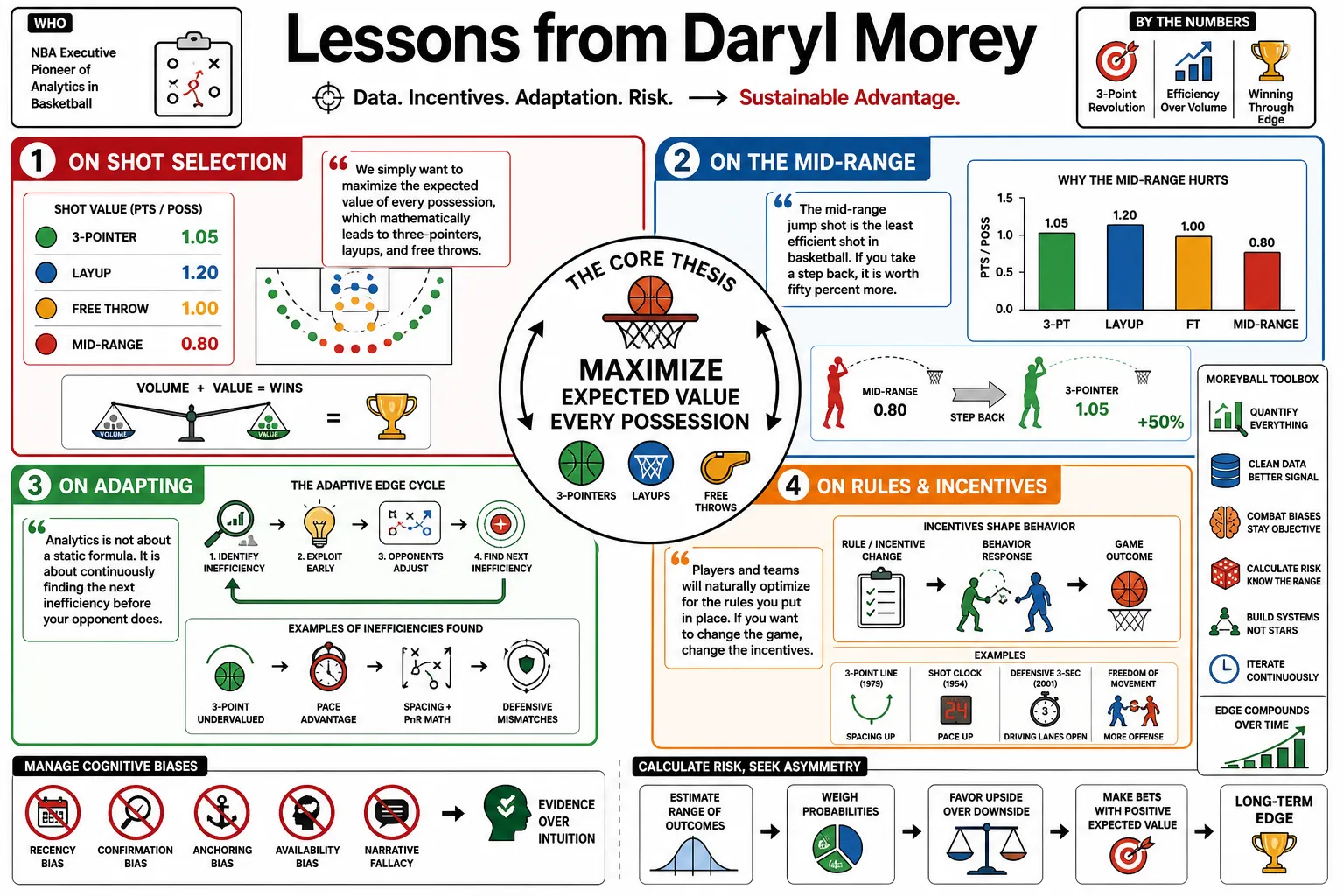
Part 1: The Core Philosophy of Moreyball
- Prioritize efficient shots: Houston sought more high-value shots at the rim and from three-point range, with free throws also part of its efficiency focus. — The Ringer — Daryl Morey Changed the Game.
- Question the mid-range default: The Rockets reduced routine mid-range attempts because many three-pointers or shots near the rim offered better expected returns; exceptional mid-range shooters could still merit an exception. — The Ringer — Daryl Morey Changed the Game.
- Keep updating the model: Morey treats a model as revisable: as advantages erode and new evidence appears, the team must keep testing its assumptions and looking for better methods. — Mindscape — Daryl Morey on Analytics, Psychology, and Basketball.
- Rules shape incentives: Shot selection reflects the rules of the game; changing the balance of three-point attempts requires changing those rules, not merely asking teams to ignore efficient choices. — The Ringer — Daryl Morey Changed the Game.
- Be wary of certainty: Morey is skeptical of confident judgments in uncertain decisions and uses models to challenge first impressions rather than treating any one opinion as final. — Michael Lewis — Basketball’s Nerd King.
- Combine scouting and data: A model can expose where scouts and consensus disagree, while experienced scouts may notice context or player development that the available data misses. — Mindscape — Daryl Morey on Analytics, Psychology, and Basketball.
- Compound small decision edges: Morey’s front-office aim was a modest, repeatable improvement in draft, trade, and free-agency decisions rather than a perfect forecast. — Mindscape — Daryl Morey on Analytics, Psychology, and Basketball.
- Optimize for winning: Morey frames analytics as a decision tool for helping a team win, especially by improving choices in the draft, trades, and free agency. — Mindscape — Daryl Morey on Analytics, Psychology, and Basketball.
- Learn from misses: When an analytical prediction fails, Morey looks for the model’s blind spots and changes what it measures or weights. — Michael Lewis — Basketball’s Nerd King.
- Test ideas against outcomes: The Rockets tested assumptions against player outcomes and changed their model when predictions such as Joey Dorsey’s and DeAndre Jordan’s proved wrong. — Michael Lewis — Basketball’s Nerd King.
Part 2: Managing Risk and Probability
- The five-percent title window: Morey argued that even a roughly five-percent chance of winning the championship is enough to focus a contender on the title rather than wait for a seemingly easier season. — Grantland — The 5 Percent Theory.
- Take a real title window seriously: When a team ranks among the leading contenders, Morey favors pursuing the available championship opportunity because injuries and other changes can close the window quickly. — The Ringer — Daryl Morey Changed the Game.
- Expect some unpopular decisions: Morey observed that efficient basketball choices could be culturally uncomfortable even when the numbers supported them. — Mindscape — Daryl Morey on Analytics, Psychology, and Basketball.
- Convert future assets when a title path appears: Morey distinguished rebuilding for future assets from the different priorities of a team already in a championship window. — Mindscape — Daryl Morey on Analytics, Psychology, and Basketball.
- Distinguish contention from rebuilding: Morey supported the Sixers’ earlier rebuild as a way to create future contention, while describing a different calculus once a team has a real chance to win the title. — Mindscape — Daryl Morey on Analytics, Psychology, and Basketball.
- Judge the decision, not hindsight: Morey and his staff explicitly watched for hindsight bias so that an outcome would not be mistaken for proof that the earlier decision was obvious. — Michael Lewis — Basketball’s Nerd King.
- Use a multiyear title horizon: Morey described optimizing championship probability across roughly a three-year window, rather than maximizing only the next season’s wins. — Mindscape — Daryl Morey on Analytics, Psychology, and Basketball.
- Recognize option value: Morey described draft rights as options whose value depends on the uncertainty and potential of the underlying player. — Mindscape — Daryl Morey on Analytics, Psychology, and Basketball.
- Account for career incentives: Morey acknowledged that early in his career he sometimes focused on surviving to the next season, even as his organizations set championship goals. — Mindscape — Daryl Morey on Analytics, Psychology, and Basketball.
- Take a risk when the window is real: Morey favored pursuing an available championship window rather than avoiding every uncertain move, because opportunities can vanish quickly. — The Ringer — Daryl Morey Changed the Game.
Part 3: Behavioral Economics and Bias
- Invert the trade: To counter the endowment effect, Morey’s team imagines holding the other side of a proposed trade and asks whether it would still choose the deal. — Mindscape — Daryl Morey on Analytics, Psychology, and Basketball.
- Watch for confirmation bias: Morey named confirmation bias among the major distortions his front office needed to counter when evaluating players and trades. — Mindscape — Daryl Morey on Analytics, Psychology, and Basketball.
- Limit the weight of draft interviews: Morey said his Houston team found that interviews added almost no predictive value to its draft evaluations and could reward a prospect’s interview skill rather than basketball ability. — Mindscape — Daryl Morey on Analytics, Psychology, and Basketball.
- The Marc Gasol photograph: Morey’s model liked Marc Gasol, but a photograph and mocking nickname helped sway the Rockets away from drafting him; Morey later banned nicknames in the evaluation process. — Michael Lewis — Basketball’s Nerd King.
- Separate stories from prediction: Morey treated memorable interviews and player stories as possible sources of bias, testing them against longer-term evidence instead of letting a compelling narrative settle a draft decision. — Michael Lewis — Basketball’s Nerd King.
- Distrust certainty in the draft room: Morey approached player forecasts with uncertainty and used models to probe confident scout judgments that diverged from the data. — Michael Lewis — Basketball’s Nerd King.
- Notice anchoring bias: Morey identified anchoring as a major bias that can distort trade valuations, alongside endowment and confirmation bias. — Mindscape — Daryl Morey on Analytics, Psychology, and Basketball.
- Correct for mental shortcuts: Morey paired model outputs with human scouting partly because both sides have blind spots: people can overread visible cues, while models can miss context. — Michael Lewis — Basketball’s Nerd King.
- Build checks against known biases: Morey’s front office explicitly identified biases before decisions and used techniques such as inverting trades to make its judgments less vulnerable to them. — Mindscape — Daryl Morey on Analytics, Psychology, and Basketball.
Part 4: The Art of the Trade
- Keep a path to elite talent: In Philadelphia, Morey sought a path to another elite player after trading James Harden, using expiring contracts and cap room when a star-for-star swap was unavailable. — The Ringer — Sixers’ Go-for-Broke Summer.
- Wait for a consequential opportunity: Morey protected Philadelphia’s cap flexibility when no high-impact opportunity appeared at the February deadline, while saying he would have reconsidered for a genuinely good offer. — The Ringer — Sixers’ Go-for-Broke Summer.
- Reject merely okay use of scarce space: Morey said he would not use major cap room on a merely okay player if stronger options failed, because that would reduce future room to improve. — CBS Philadelphia — Morey’s Offseason Press Conference.
- Stars move title odds: Morey emphasized that elite players have unusual leverage over NBA outcomes, which is why major roster plans sought another top-tier talent alongside existing stars. — Mindscape — Daryl Morey on Analytics, Psychology, and Basketball.
- Evaluate a patient star pursuit: Morey explained that Philadelphia waited with cap flexibility for a major opportunity and was ready to change course if a better offer appeared earlier. — The Ringer — Sixers’ Go-for-Broke Summer.
- Keep trade conversations open: Morey described regular conversations with other front offices and said he preferred openness to a style built around withholding information in search of a rare lopsided deal. — Mindscape — Daryl Morey on Analytics, Psychology, and Basketball.
Part 5: Drafting and Talent Evaluation
- The Jeremy Lin miss: Morey later said he underweighted Jeremy Lin’s strong Harvard performance because the Ivy League was poorly represented among drafted-player comparisons, then let Lin go despite a good training camp. — Freakonomics Radio — Elite Athletes.
- Draft for talent while considering fit: Morey described seeking the best available player but also valuing multi-position skills and a fit with Houston’s up-tempo system. — Houston Rockets — Morey Discusses Draft Night.
- Study misses to improve the model: After the Rockets’ model misjudged Joey Dorsey and DeAndre Jordan, Morey revisited its treatment of age, opponent quality and physical tools. — Michael Lewis — Basketball’s Nerd King.
- Adjust for age: Morey found that Joey Dorsey’s strong college record looked different once the model properly accounted for his age relative to opponents. — Michael Lewis — Basketball’s Nerd King.
- Beware tiny evaluation samples: Morey warned that a brief workout can mislead evaluators who give it more weight than a longer college record or a player’s broader development context. — Michael Lewis — Basketball’s Nerd King.
- Defense needs contextual measurement: Morey noted that individual defensive numbers can miss interactions among defenders, making the effect of a player’s teammates important to interpretation. — Medill — Daryl Morey on Stats and Defense.
- Treat late picks probabilistically: Morey’s model assigned low odds of finding a strong player with late first- or early second-round picks, so draft decisions had to be made under substantial uncertainty. — Michael Lewis — Basketball’s Nerd King.
- Look beyond points per game: Morey found that college counting statistics could mislead; pace, minutes, opportunities and opponent strength mattered to assessing a prospect’s likely NBA contribution. — Michael Lewis — Basketball’s Nerd King.
Part 6: Systems Thinking and Organization
- Hire people who can disagree: Morey said he wanted capable staff who were comfortable disagreeing with him and whose track records and use of data he could weigh. — Mindscape — Daryl Morey on Analytics, Psychology, and Basketball.
- Protect team chemistry: For a contender with strong chemistry, Morey said a poor-fit addition could do disproportionate harm and should have an exit plan. — Mindscape — Daryl Morey on Analytics, Psychology, and Basketball.
- Separate hindsight from the decision: Morey’s front office named hindsight bias explicitly so a later outcome would not be confused with what was knowable at the time. — Michael Lewis — Basketball’s Nerd King.
- Respect cap constraints: With a salary cap and limited ways to acquire talent, Morey treated draft, trade and free-agency decisions as connected uses of scarce resources. — Mindscape — Daryl Morey on Analytics, Psychology, and Basketball.
- Keep searching as edges erode: Morey said early analytics advantages had eroded as other teams adopted similar tools, making fresh insights harder to find. — Mindscape — Daryl Morey on Analytics, Psychology, and Basketball.
- Delegate to specialists: Morey described scouts, analysts and programmers informing acquisition decisions, while coaches and assistants optimized players on the court. — Mindscape — Daryl Morey on Analytics, Psychology, and Basketball.
- Define the championship objective: Morey described the front office’s goal as improving its chance to win a title over a multiyear horizon. — Mindscape — Daryl Morey on Analytics, Psychology, and Basketball.
Part 7: The NBA Landscape and Evolution
- The slow adoption of threes: Morey said teams took decades to fully exploit the three-point shot’s value, even though it awards 50 percent more points than a two-pointer. — Mindscape — Daryl Morey on Analytics, Psychology, and Basketball.
- Morey’s Harden scoring comparison: Morey argued that James Harden generated more points per possession than Michael Jordan under the measure he favored, while acknowledging that cross-era counterarguments were reasonable. — CBS Sports — Morey on Harden and Jordan.
- Clarifying the bubble championship: After his 2020-bubble comments drew criticism, Morey said he respected the Lakers’ title and would have celebrated a Rockets title in the same setting as legitimate. — ClutchPoints — Morey Clarifies Bubble Comments.
- Competitive ideas spread quickly: Morey said other NBA teams can see a new on-court tactic and follow it, which limits how long a purely tactical advantage lasts. — Mindscape — Daryl Morey on Analytics, Psychology, and Basketball.
- Change incentives through the rules: Morey argued that if the league disliked the volume of three-point attempts, it could change the rules that make those attempts valuable. — Mindscape — Daryl Morey on Analytics, Psychology, and Basketball.
- Space the floor for creators: Morey’s teams valued players who stretched defenses so elite creators could attack the basket and generate efficient shots. — The Ringer — Daryl Morey Changed the Game.
- Pair complementary leaders: Morey described the value of a coach whose strengths complemented his own and who could get players working toward the same goal. — Mindscape — Daryl Morey on Analytics, Psychology, and Basketball.
- Use AI as one input: Morey said AI models added useful signal to scouting and could be weighted more heavily if their predictive record improved; he did not claim they would replace general managers. — Pablo Torre Finds Out — AI in Sports.
Part 8: Leadership and Dealing with Criticism
- Morey’s response to Harden: When James Harden called him a liar, Morey publicly said his record of following through with agents and league colleagues spoke for itself. — FOX Sports — Morey and Harden.
- Admit evaluation misses: Morey described learning from mistaken player evaluations and changing the model rather than defending its original forecasts. — Michael Lewis — Basketball’s Nerd King.
- Challenge consensus with evidence: Morey used analytical models to question confident conventional judgments, while still allowing scout insight to correct model blind spots. — Michael Lewis — Basketball’s Nerd King.
- Balance urgency against the offer: Morey described preserving cap flexibility when a strong deal was not available, despite the pressure to improve a contender quickly. — The Ringer — Sixers’ Go-for-Broke Summer.