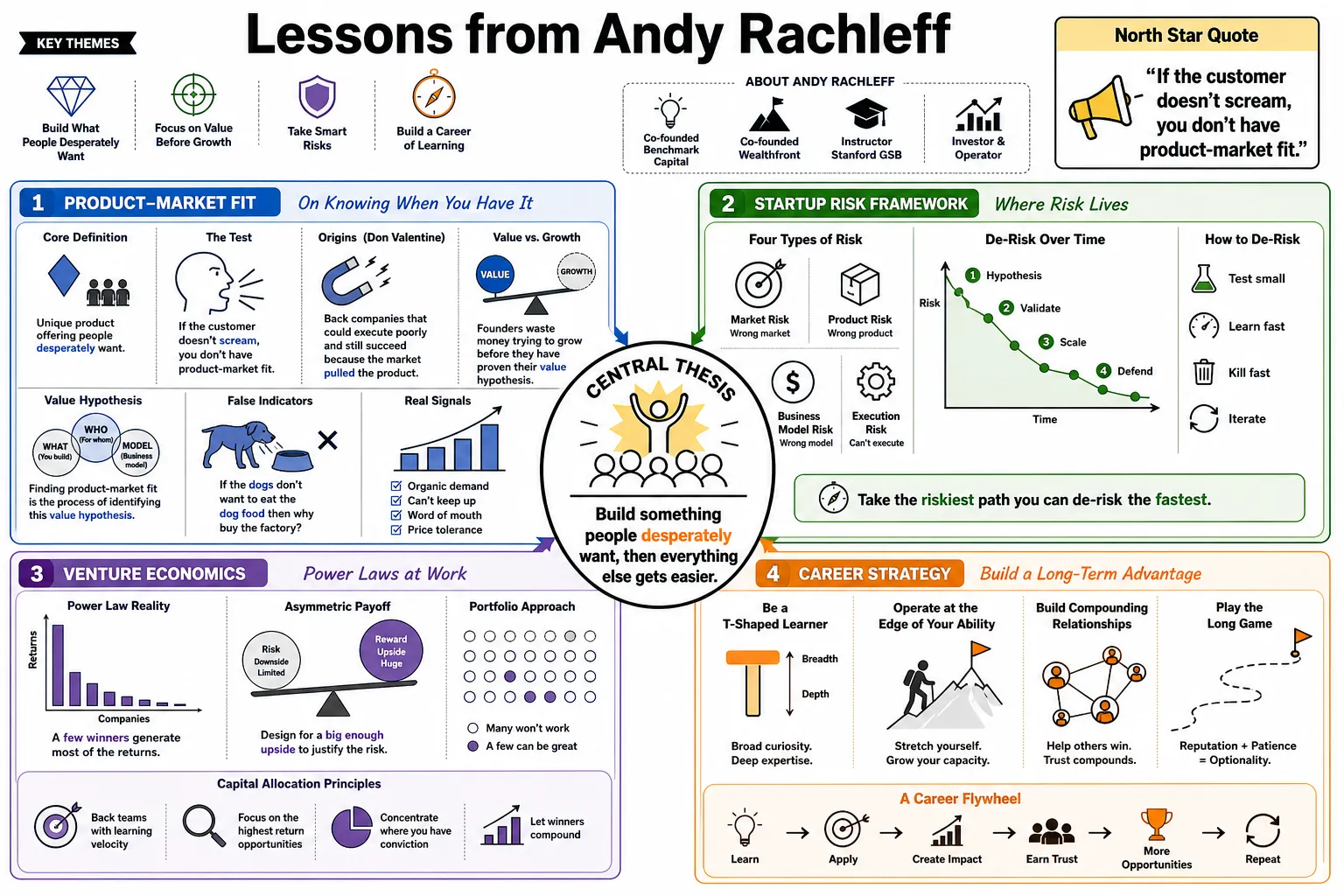
Lessons from Andy Rachleff
Andy Rachleff co-founded Benchmark Capital and Wealthfront and popularized the concept of product-market fit to evaluate early-stage startups. This profile collects his applied frameworks on startup risk, venture economics, and career strategy, drawing from his time in the industry and as an instructor at Stanford GSB. — The Tim Ferriss Show #397 transcript, Mike Maples and Andy Rachleff, "Two Questions Every Entrepreneur Should Answer" (2019).
Part 1: Product-Market Fit
- On knowing when you have it: In enterprise, pull a 30-day trial no matter what. Quoting a lesson from Doug Leone: "If the customer doesn't scream, you don't have product-market fit," because a customer who won't buy isn't desperate. — Reference: The Tim Ferriss Show #397 transcript, Mike Maples and Andy Rachleff, "Two Questions Every Entrepreneur Should Answer" (2019).
- On origins: He credits the concept to Don Valentine of Sequoia, who (paraphrased) wanted "companies that can screw everything up and still succeed because the customer pulls the product out of their hands." — Reference: The Tim Ferriss Show #397 transcript, Mike Maples and Andy Rachleff, "Two Questions Every Entrepreneur Should Answer" (2019).
- On value vs. growth: "First you need to define and test your value hypothesis. And then only once proven do you move on to your growth hypothesis." — Reference: Tren Griffin, "12 Things About Product-Market Fit," a16z (2017), quoting Andy Rachleff.
- On the value hypothesis: Product-market fit "is when you have proven the value hypothesis": "the what, the who, and the how. What are you going to build? For whom is it relevant? The how's the business model." — Reference: The Tim Ferriss Show #397 transcript, Mike Maples and Andy Rachleff, "Two Questions Every Entrepreneur Should Answer" (2019).
- On false indicators: "If you address a market that really wants your product — if the dogs are eating the dog food — then you can screw up almost everything in the company and you will succeed." — Reference: Tren Griffin, "12 Things About Product-Market Fit," a16z (2017), quoting Andy Rachleff.
- On true indicators: For consumer products, the best test is exponential organic growth. "The only way to know that you have product market fit is if you get word of mouth," a lesson he learned from Scott Cook. — Reference: The Tim Ferriss Show #397 transcript, Mike Maples and Andy Rachleff, "Two Questions Every Entrepreneur Should Answer" (2019).
- On market power: Marc Andreessen named it Rachleff's Law: "When a great team meets a lousy market, market wins. When a lousy team meets a great market, market wins. When a great team meets a great market, something special happens." — Reference: Marc Andreessen, "The Pmarca Guide to Startups, part 4: The only thing that matters" (2007).
- On pivoting: If the value hypothesis fails, iterate the market and business model, not the product: "If you fix the market and pivot the product, then you have no advantage because your original insight is gone." — Reference: The Tim Ferriss Show #397 transcript, Mike Maples and Andy Rachleff, "Two Questions Every Entrepreneur Should Answer" (2019).
- On customer desperation: Don't try to win over skeptics by reshaping the product: "you want to go find people who actually love what you're doing, not try to convince the nos and turn them into yeses." — Reference: The Tim Ferriss Show #397 transcript, Mike Maples and Andy Rachleff, "Two Questions Every Entrepreneur Should Answer" (2019).
- On the one question: His whole product-market-fit class reduces to one question: "what do you uniquely offer that people desperately want because if they're not desperate, there's a good enough alternative… if there's a good enough alternative, you're doomed." — Reference: Mixergy, "Andy Rachleff on founding Benchmark & Wealthfront" (2017)
- On pivoting the market, not the product: "If you fix the market and pivot the product, then you have no advantage because your original insight is gone." Keep the product and find a different market or business model. — Reference: The Tim Ferriss Show #397 transcript (Mike Maples and Andy Rachleff, 2019)
- On the enterprise test: In enterprise, product-market fit shows up in sales yield—a sales team's contribution margin divided by its cost: "when a company gets to a sales yield greater than one, that's how you know you've hit product market fit." — Reference: The Tim Ferriss Show #397 transcript (Mike Maples and Andy Rachleff, 2019)
- On listening to consistent feedback: Wealthfront pivoted after consistent feedback: "We'd rather that you manage our entire portfolio adequately and inexpensively than a portion of it superbly." It tested demand with a concierge service before building. — Reference: Mixergy, "Andy Rachleff on founding Benchmark & Wealthfront" (2017)
Part 2: The Contrarian Consensus Matrix
- On quadrants of success: From Howard Marks's 2x2: if you're wrong you don't make money, and if you're right and consensus "the returns get arbitraged away." "The only way to make outsized returns as an investor or an entrepreneur is to be right and non-consensus." — Reference: The Tim Ferriss Show #397 transcript, Mike Maples and Andy Rachleff, "Two Questions Every Entrepreneur Should Answer" (2019).
- On market validation: "You only know that you're non-consensus when you start, not whether or not you're right. You hope that you're right." — Reference: The Tim Ferriss Show #397 transcript, Mike Maples and Andy Rachleff, "Two Questions Every Entrepreneur Should Answer" (2019).
- On Howard Marks: He learned the right/consensus framework from his "investment idol," Howard Marks of Oaktree Capital. — Reference: The Tim Ferriss Show #397 transcript, Mike Maples and Andy Rachleff, "Two Questions Every Entrepreneur Should Answer" (2019).
- On startup ideas: If you ask five people about a killer idea, "at least four out of the five of them should say they don't like it because they haven't been conditioned to like it." — Reference: The Tim Ferriss Show #397 transcript, Mike Maples and Andy Rachleff, "Two Questions Every Entrepreneur Should Answer" (2019).
- On where ideas come from: "Great ideas find you, you don't find them. If you sit in a room trying to figure out, 'What company should I start?' then by definition you're starting with the market… and that leads to mundane ideas." — Reference: Mixergy, "Andy Rachleff on founding Benchmark & Wealthfront" (2017)
Part 3: Venture Capital Economics
- On the power law: Citing Harvard's William Sahlman, "80% of a typical venture capital fund's returns are generated by 20% of its investments." — Reference: Andy Rachleff, "Demystifying Venture Capital Economics, Part 1," Wealthfront (2014).
- On target returns: The industry rule of thumb is "to look for deals that have the chance to return 10x your money in five years." — Reference: Andy Rachleff, "Demystifying Venture Capital Economics, Part 1," Wealthfront (2014).
- On industry concentration: "The top 20 firms (out of approximately 1,000 total VC firms) generate approximately 95% of the industry's returns." — Reference: Andy Rachleff, "Demystifying Venture Capital Economics, Part 1," Wealthfront (2014).
- On backing only the leader: Most VCs thought backing eBay and Google was crazy—but "the leader in a technology market is usually worth more than all the other players in its space combined, so it is not worth backing anyone other than the leader." — Reference: Andy Rachleff, "Demystifying Venture Capital Economics, Part 1" (Wealthfront, 2014)
Part 5: Wealthfront and Democratizing Finance
- On the first niche: Wealthfront's critical insight came from Doug Mackenzie, who told him to "focus on young people and tech because they'll care a lot more about the quality of the user experience than they will the assets under management." — Reference: The Tim Ferriss Show #397 transcript, Mike Maples and Andy Rachleff, "Two Questions Every Entrepreneur Should Answer" (2019).
Part 6: Identifying Technology Inflection Points
- On starting points: "Truly great technology companies are the result of an inflection point in technology that allows the founder to conceive a new kind of product. The question then is: who wants to buy my product?" — Reference: Tren Griffin, "12 Things About Product-Market Fit," a16z (2017), quoting Andy Rachleff.
Part 7: Career Strategy and the Halo Effect
- On borrowing credit: "You get more credit than you deserve for being part of a successful company, and less credit than you deserve for being part of an unsuccessful company." — Reference: Andy Rachleff, "How Do I Choose Where To Work?," Wealthfront (2012).
- On choosing momentum: He prefers graduates "take their first jobs after graduation at midsized companies with momentum, not startups, because they are the companies most likely to be big successes." — Reference: Andy Rachleff, "48 Hot Tech Companies To Build A Career," Wealthfront (2012).
- On recruiter biases: "Everyone wants to recruit or back people from successful companies because they know people carry the lessons of success with them." — Reference: Andy Rachleff, "How Do I Choose Where To Work?," Wealthfront (2012).
- On avoiding early startups: To students set on joining startups right away, he says: "You're not ready." The odds are that an early startup will fail. — Reference: Andy Rachleff, "48 Hot Tech Companies To Build A Career," Wealthfront (2012).
Part 8: Startup Execution and Growth
- On founder stubbornness: Founders make a mistake when they iterate on "the what." Instead "you should iterate on the who and the how, the business model." — Reference: The Tim Ferriss Show #397 transcript, Mike Maples and Andy Rachleff, "Two Questions Every Entrepreneur Should Answer" (2019).