Lessons from Jason Calacanis
Jason Calacanis is an entrepreneur and angel investor best known for early bets on Uber and Robinhood. Through his book Angel and the All-In podcast, he details a high-volume, aggressive approach to venture capital. This profile breaks down his rules for evaluating founders, running syndicates, and handling the psychological grind of startups.
Part 1: The Angel Investing Playbook
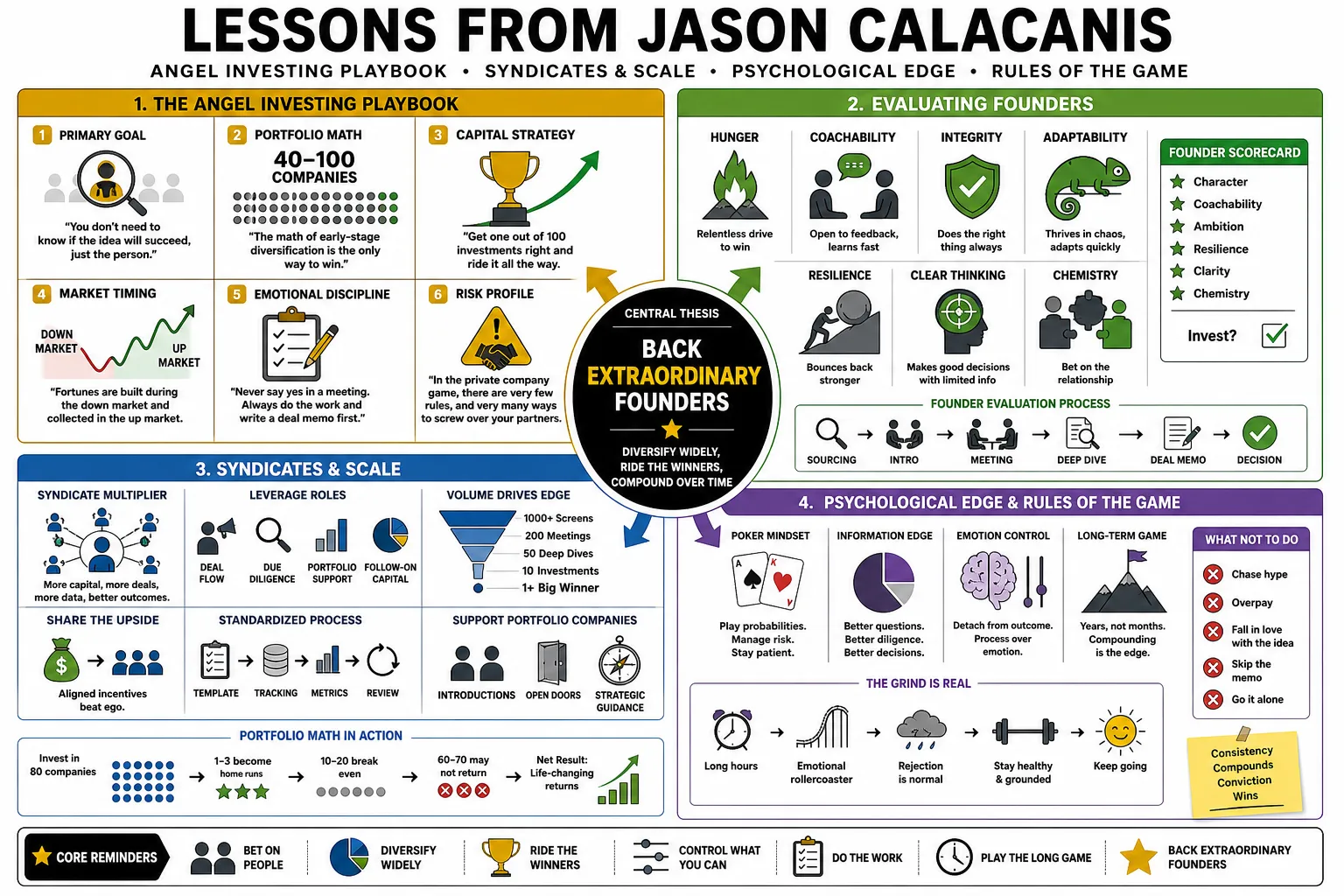
- On the primary goal: "You don't need to know if the idea will succeed, just the person." — Source: [Medium]
- On portfolio math: "You have to build a portfolio of 40 to 100 companies because the math of early-stage diversification is the only way to win." — Source: [Max Mednik]
- On capital strategy: "Get one out of 100 investments right and ride it all the way." — Source: [Hustle Fund]
- On market timing: "Fortunes are built during the down market and collected in the up market." — Source: [AZ Quotes]
- On emotional investing: "Never say yes in a meeting. Always do the work and write a deal memo first." — Source: [Crowdwise]
- On risk profile: "In the private company game, there are very few rules, and very many ways to screw over your partners." — Source: [Revhacks]
- On the nature of the game: "Angel investing is very similar to poker, where you're playing against other people, you can increase your chances by doing the work." — Source: [25iq]
- On writing checks: "Start with small checks like $1,000 to learn the ropes, like playing at a low-stakes poker table." — Source: [The Meb Faber Show]
- On status and motivation: "Angels want to be affiliated with winning teams. They want to be part of your effort to change an industry." — Source: [Dreamit]
Part 2: Evaluating Founders
- On founder failure: "The number one reason a startup fails is that the founder gives up." — Source: [Goodreads]
- On the ideal archetype: "Angel investors are looking for wild cards because the best founders are typically inflexible and unmanageable, pursuing their visions at the expense of other people's feelings." — Source: [QuoteFancy]
- On founder mindset: "You have to be delusional to see a vision others cannot, but you must have the skill to actually build it." — Source: [The Jordan Harbinger Show]
- On assessing character: "People's reputations are made in the bad times more than the good times." — Source: [AZ Quotes]
- On evaluating product focus: "Founders need to focus on the one magical thing their startup does for consumers instead of boiling the ocean." — Source: [Real Founder Lessons]
- On co-founder dynamics: "Always look for multiple founders. You need redundancy in a startup because the journey is brutal." — Source: [BeFreed]
- On executive function: "Being an entrepreneur is like being in a constant state of warfare; it requires incredibly high executive function." — Source: [Substack]
- On tracking progress: "If a founder isn't sending a regular monthly update, they are usually hiding bad news or disorganized." — Source: [This Week in Startups]
- On true market fit: "If you can't sell your product, it's not a product, it's a hobby." — Source: [EarlyNode]
Part 3: The Reality of Startups and Execution
- On the value of ideas: "It’s not about ideas, it’s about making ideas happen." — Source: [EarlyNode]
- On the difficulty curve: "Starting is easy. Finishing is hard." — Source: [PictureQuotes]
- On incremental progress: "Success is less about grand innovation and more about a lot of little innovations executed relentlessly." — Source: [AZ Quotes]
- On taking the leap: "The only way to fail is not to try." — Source: [EarlyNode]
- On historical revisionism: "No one remembers how you got there, only that you got there." — Source: [EarlyNode]
- On distribution: "Startups often die not because the product is imperfect, but because nobody knows you exist." — Source: [Reddit]
- On setting milestones: "Use the rule of 72 to set realistic, trackable milestones for growth and customer acquisition." — Source: [Founder Institute]
- On initial traction: "You need at least six months of user or revenue growth to prove you are actually onto something." — Source: [Manas Saloi]
- On survival: "Having eighteen months of cash runway is the baseline for surviving the inevitable pivots." — Source: [BeFreed]
- On failure as a prerequisite: "You're not an entrepreneur until you've failed a lot." — Source: [EarlyNode]
Part 4: Work Ethic and the Zero-Sum Game
- On luck vs. effort: "There is no luck, you work hard and study things intently. If you do that for long and hard enough you're successful." — Source: [QuoteFancy]
- On the realities of capitalism: "Success is a zero-sum game. The limited opportunities go to those who work the hardest and who have the most skill." — Source: [Medium]
- On work-life balance: "If you want balance in your life, a startup environment might not be the right place for you." — Source: [Signal v. Noise]
- On getting noticed: "If you want to be noticed by the CEO, outwork all of your contemporaries." — Source: [Quartz]
- On the democratization of learning: "With free online education everywhere, there is absolutely no excuse for not acquiring high-value skills." — Source: [Ketone]
- On entitlement: "People want the private jet lifestyle without being willing to put in the necessary grueling work." — Source: [2CentDad]
- On baseline excellence: "Excellence is everything today, and most people aren't excellent. If you're not truly excellent at what you do, you're toast." — Source: [AZ Quotes]
- On skill acquisition: "Be great at an important skill like sales, coding, or product design, and refine it faster than anyone else." — Source: [Medium]
- On showing up: "You can beat a lot of people just by showing up for work every single day and being a learning machine." — Source: [Substack]
- On the daily grind: "The difference between winning and losing is often just having the persistence to keep hustling and trying new things." — Source: [Business Insider]
Part 5: Deal Flow and Syndicates
- On manufacturing luck: "You can make your own luck in life by putting yourself next to the people who are already winning." — Source: [Revhacks]
- On the power of syndicates: "Syndicates allow angels to write the kind of checks traditionally reserved for venture capitalists." — Source: [Inc]
- On democratizing wealth: "Angel investing is a dark art of becoming truly wealthy, and syndicates open that door to more people." — Source: [The Meb Faber Show]
- On disrupting venture capital: "The bottom half of VCs will now be wholesale replaced by folks running top-tier syndicates." — Source: [Medium]
- On scaling deal flow: "As an investor gains experience and shares deals, their deal flow compounds exponentially." — Source: [The Meb Faber Show]
- On working in public: "Being transparent about your investment process and mistakes is the best strategy to attract high-quality inbound deal flow." — Source: [Hustle Fund]
- On syndicate members: "Treat your syndicate members as scouts; they are an extension of your team and will bring you deals you'd never see." — Source: [Angel Invest Boston]
- On adding value: "By involving syndicate members with diverse professional backgrounds, you turn passive investors into an active, supportive network for founders." — Source: [Angel Invest Boston]
- On the lazy money: "A huge percentage of VCs are lazy. If you actually do the work, you can beat them to the best deals." — Source: [Substack]
Part 6: Pitching and Communication
- On the fifteen-second rule: "Get to the product within fifteen seconds. Investors have seen thousands of pitches and want to see the solution quickly." — Source: [Founder Institute]
- On showing vs. telling: "Use one slide to show your product, your customers, and your progress instead of talking in generalities." — Source: [Founder Institute]
- On slide synchronization: "Ensure your presentation slides match exactly what you are saying to avoid confusing the investor." — Source: [Founder Institute]
- On grandiosity: "You have to have a big vision and take very small steps to get there. Be humble as you execute but gigantic in your aspiration." — Source: [AZ Quotes]
- On brevity: "Avoid long backstories. The investor is looking for escape velocity, not a novel." — Source: [Founder Institute]
- On defending the idea: "If a founder gets defensive when you push back on their pitch, they will break when the market pushes back on their product." — Source: [This Week in Startups]
- On market sizing: "Don't just say it's a billion-dollar market. Show me how you capture the first million in revenue." — Source: [This Week in Startups]
- On traction claims: "If you claim to have customers, show real examples and engagement metrics rather than vanity numbers." — Source: [Founder Institute]
- On clarity of thought: "The pitch deck is just a proxy for how clearly the founder thinks about their business." — Source: [This Week in Startups]
Part 7: Media, Podcasting, and Network Building
- On hosting style: "Being in the moment during an interview is vastly superior to strictly following a pre-written script." — Source: [The Split]
- On audience community: "Calling the audience 'Besties' frames the podcast as a community, rather than a mere broadcast." — Source: [Apple Podcasts]
- On generating attention: "Aggressive networking and list-making is the best way to generate attention and capture network value." — Source: [Angel]
- On self-promotion: "Never apologize for plugging your own projects; if you don't advocate for your business, no one else will." — Source: [Podscripts]
- On media influence: "Podcasting allows you to bypass traditional gatekeepers and speak directly to the founders you want to invest in." — Source: [This Week in Startups]
- On observing peers: "When people see true friendship on a podcast, it's an intoxicating thing that draws the listener in." — Source: [The Tim Ferriss Show]
- On consistency: "Releasing thousands of episodes acts as a massive, compounding surface area for luck, rather than standard content creation." — Source: [This Week in Startups]
- On leaning into jokes: "Embrace the memes, because self-deprecating humor builds rapport and keeps the audience engaged." — Source: [YouTube]
- On information advantage: "In Silicon Valley, whoever has the most information and the widest network wins the best deals." — Source: [Acquired]
Part 8: Lessons from Failure and Resilience
- On moderate success: "Moderate success is worse than failure because it keeps you tethered to a zombie business instead of moving on." — Source: [Wikipedia]
- On founder identity: "Founders mistakenly equate their personal worth with their company's performance. You have to learn to say: I tried, it didn't work out, it's okay." — Source: [Medium]
- On the dot-com crash: "Having to lay off eighty people was a defining experience that forced me to adopt a more conservative approach to capital." — Source: [Business Insider]
- On pivoting: "Vision is not a bullet point in a spreadsheet. You cannot be married to a specific product if it is not achieving its intended impact." — Source: [Wikipedia]
- On moving forward: "The difference between successful and unsuccessful people is a never-say-die mentality." — Source: [Medium]
- On systemic failure: "Startups have a high, inherent failure rate. You must build a high-volume portfolio strategy to survive it." — Source: [Max Mednik]
- On learning from losses: "You learn more from the spectacular failures than you do from the easy wins." — Source: [This Week in Startups]
- On financial discipline: "Never put yourself in a position where running out of money makes the decision for you." — Source: [Amazon]
- On managing psychology: "Entrepreneurship is a grueling psychological test masked as a business endeavor." — Source: [This Week in Startups]
- On the ultimate goal: "I will be the greatest investor in Silicon Valley." — Source: [Reddit]