Lessons from Will Thorndike
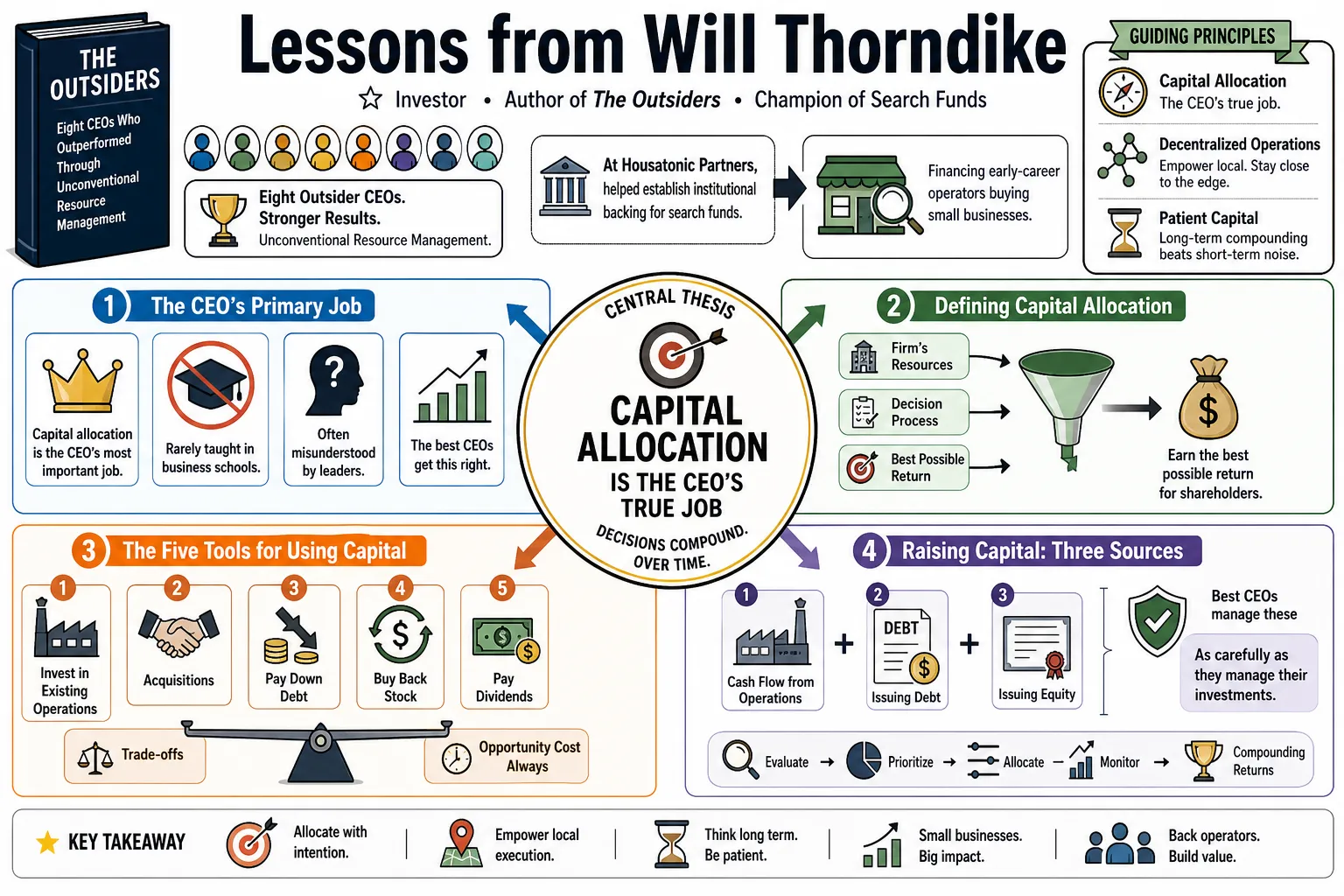
Investor Will Thorndike wrote The Outsiders, a study of eight CEOs who outperformed their peers through unconventional resource management. At his firm Housatonic Partners, he helped establish institutional backing for search funds to finance early-career operators buying small businesses. This profile explores his findings on capital allocation, decentralized operations, and patient capital.
Part 1: Capital Allocation & The CEO's True Job
- On the primary job of a CEO: "Capital allocation is a CEO's most important job, yet it is rarely taught in business schools and is often misunderstood by corporate leaders." — Source: [The Outsiders]
- On defining capital allocation: "It is the process of deciding how to deploy the firm's resources to earn the best possible return for shareholders." — Source: [Invest Like the Best, Ep 36]
- On the five tools: "CEOs have five basic options for using capital: investment in existing operations, acquisitions, paying down debt, buying back stock, and paying dividends." — Source: [The Outsiders]
- On raising capital: "There are three ways to generate capital: cash flow from operations, issuing debt, and issuing equity. The best CEOs manage these as carefully as they manage their investments." — Source: [Talk at Google]
- On the experience gap: "Most CEOs reach the top by excelling in marketing, operations, or sales, only to find that their primary responsibility is now something they have no experience in: investing the company's cash." — Source: [The Outsiders]
- On executive temperament: "The most successful leaders are often introverted, analytical, and remarkably dispassionate when evaluating how to spend money." — Source: [Invest Like the Best, Ep 36]
- On retained earnings: "A dollar retained by the business must generate at least a dollar of market value over time, otherwise it should be returned to the shareholders." — Source: [The Outsiders]
- On acting like investors: "The best CEOs view themselves as investors first and managers second, constantly weighing the opportunity cost of every dollar." — Source: [Colossus]
- On ignoring consensus: "Standard corporate finance often pushes leaders toward predictable, steady growth, but optimal allocation requires lumpy, opportunistic decisions." — Source: [Housatonic Partners Overview]
- On long-term outperformance: "The group of eight CEOs studied in my research outperformed the S&P 500 by a factor of twenty over their tenures simply through superior capital allocation." — Source: [The Outsiders]
Part 2: Cash Flow Over Earnings
- On the flaw of reported earnings: "Reported earnings are an accounting fiction; cash flow is the true reality of a business." — Source: [The Outsiders]
- On maximizing cash: "The goal of a business is not to maximize accounting profit, but to maximize long-term free cash flow." — Source: [Talk at Google]
- On minimizing taxes: "Cash flow must be considered on an after-tax basis, leading great CEOs to obsess over strategies that minimize the tax burden." — Source: [The Outsiders]
- On EBITDA versus reality: "While many focus on EBITDA, the true measure of a company's engine is the cash left over after capital expenditures and taxes." — Source: [Invest Like the Best, Ep 288]
- On capital intensity: "Businesses that require constant, massive capital reinvestment just to stand still are inherently inferior to those that generate excess cash with minimal required investment." — Source: [Housatonic Partners Investment Criteria]
- On John Malone's insight: "John Malone realized early on that maximizing earnings meant paying higher taxes, so he intentionally sheltered cash flow through depreciation and interest expense." — Source: [The Outsiders]
- On Wall Street guidance: "By focusing on cash flow rather than EPS, you naturally stop caring about quarterly earnings guidance, which frees you to manage for the long term." — Source: [Invest Like the Best, Ep 36]
- On reinvestment rates: "The ideal business generates high cash flow and has the internal capacity to reinvest that cash at similarly high rates of return." — Source: [50X Podcast]
- On predictable revenue: "Recurring revenue models are highly prized because they translate into predictable cash flow streams, which can then be levered or allocated with certainty." — Source: [Housatonic Partners Strategy]
Part 3: Decentralization & Organizational Design
- On corporate headquarters: "A large corporate headquarters is usually a sign of bureaucratic waste. The best organizations keep headquarters extremely small." — Source: [The Outsiders]
- On operating autonomy: "Hire the best people you can, and leave them alone to run their businesses." — Source: [The Outsiders]
- On the role of the center: "In a highly decentralized model, the operating managers handle the day-to-day, while the CEO at the center focuses purely on capital allocation." — Source: [Talk at Google]
- On fostering entrepreneurship: "Decentralization pushes decision-making down to the people closest to the customer, fostering an entrepreneurial culture that a centralized bureaucracy crushes." — Source: [Invest Like the Best, Ep 36]
- On avoiding consultants: "Exceptional CEOs rarely hire management consultants, preferring to rely on the judgment of their own operating managers and their own analytical frameworks." — Source: [The Outsiders]
- On corporate overhead: "Every dollar spent on corporate overhead is a dollar subtracted from the cash flow available for reinvestment." — Source: [The Outsiders]
- On Tom Murphy's structure: "Tom Murphy ran a multi-billion dollar media empire with a headquarters staff that could fit comfortably into a single conference room." — Source: [The Outsiders]
- On managing complexity: "By keeping operations separate and accountable, a company can scale significantly without succumbing to internal friction." — Source: [50X Podcast]
- On trust and accountability: "Radical decentralization requires an immense amount of trust in operating managers, backed by strict accountability based on financial returns." — Source: [Invest Like the Best, Ep 288]
Part 4: Acquisitions & Capital Deployment
- On the nature of M&A: "Most corporate acquisitions destroy value because the acquiring CEO overpays in pursuit of growth rather than return on investment." — Source: [The Outsiders]
- On pricing discipline: "Great capital allocators have absolute pricing discipline; they determine what an asset is worth to them and refuse to pay a penny more." — Source: [Invest Like the Best, Ep 36]
- On opportunistic buying: "The best acquisitions are often made during industry downturns or broader economic panics when prices are distressed." — Source: [The Outsiders]
- On synergies: "Outsider CEOs are deeply skeptical of projected 'synergies,' preferring to justify acquisitions based on current cash flows and identifiable hard cost cuts." — Source: [Talk at Google]
- On integrating acquisitions: "Acquired companies should be integrated quickly, with overhead stripped away to maximize cash flow." — Source: [The Outsiders]
- On making large bets: "When the odds are overwhelmingly in your favor, you must be willing to bet heavily, sometimes committing a significant portion of the company's capital to a single acquisition." — Source: [Invest Like the Best, Ep 288]
- On avoiding auctions: "Auctions usually result in the winner overpaying. The best deals are sourced proprietarily or negotiated directly." — Source: [Housatonic Partners Strategy]
- On selling assets: "Capital allocation is a two-way street; it involves buying, but also ruthlessly selling off divisions that no longer meet return thresholds." — Source: [The Outsiders]
- On using debt in acquisitions: "Debt is a tool that should be used aggressively when interest rates are low and target cash flows are highly predictable, but it must be managed with care." — Source: [The Outsiders]
Part 5: Share Repurchases & Per-Share Value
- On the metric that matters: "Value is not determined by the overall size of the enterprise, but by the value of a single share." — Source: [The Outsiders]
- On the math of buybacks: "A share repurchase is simply a dividend that is tax-advantaged and increases the remaining shareholders' percentage of the business." — Source: [Talk at Google]
- On when to buy back stock: "Repurchases only create value when the stock is trading meaningfully below its intrinsic value. Buying back overvalued stock destroys wealth." — Source: [Invest Like the Best, Ep 36]
- On Henry Singleton's approach: "Singleton pioneered the large-scale share repurchase, retiring an astonishing 90 percent of Teledyne's outstanding shares over his tenure when the market undervalued them." — Source: [The Outsiders]
- On the stigma of shrinking: "Many CEOs resist shrinking their companies because their compensation and prestige are tied to overall size, even if shrinking increases per-share value." — Source: [The Outsiders]
- On tender offers: "Tender offers are a highly efficient mechanism for repurchasing large blocks of stock quickly when a massive discount presents itself." — Source: [The Outsiders]
- On evaluating internal investment vs. buybacks: "Every internal project and potential acquisition must be weighed against the return of simply buying back the company's own stock." — Source: [Invest Like the Best, Ep 288]
- On avoiding stock splits: "Avoiding stock splits helps attract a base of long-term shareholders who are focused on business fundamentals rather than short-term price fluctuations." — Source: [The Outsiders]
- On using stock as currency: "Issuing stock to fund acquisitions should only be done when your own stock is highly valued relative to the asset you are buying." — Source: [Talk at Google]
- On the dividend decision: "Dividends are an inefficient way to return capital due to taxes; buybacks are usually mathematically superior if the stock is cheap." — Source: [The Outsiders]
Part 6: Independence & Ignoring the Crowd
- On being a positive deviant: "To achieve extraordinary returns, you must act differently than the crowd. You cannot outperform the market by conforming to its standard practices." — Source: [The Outsiders]
- On ignoring Wall Street: "The best CEOs spend almost no time catering to Wall Street analysts or attempting to manage quarterly earnings expectations." — Source: [Invest Like the Best, Ep 36]
- On the pressure to act: "Most corporate mistakes come from a bias toward action. True masters are perfectly comfortable doing nothing for years until the right opportunity appears." — Source: [The Outsiders]
- On contrarian timing: "Great operators sell assets when the market is euphoric and buy heavily when capital is scarce and panic is widespread." — Source: [Talk at Google]
- On investor relations: "Having a small, quiet investor relations function is often a hallmark of a CEO who is focused on running the business rather than promoting the stock." — Source: [The Outsiders]
- On trusting personal logic: "When the math dictates a course of action that contradicts industry norms, you must have the fortitude to follow the math." — Source: [Invest Like the Best, Ep 288]
- On peer group comparisons: "Evaluating your company strictly against peers can lead to mediocre decisions; you must evaluate opportunities against the broader universe of capital deployment." — Source: [Housatonic Partners Overview]
- On dealing with criticism: "When you buy back stock instead of building new factories, the press will call you uncreative. You have to ignore the noise and focus on intrinsic value." — Source: [The Outsiders]
- On rationality: "Rationality is a trait that allows a leader to separate emotion from financial decisions, which is exceedingly rare in corporate boardrooms." — Source: [50X Podcast]
Part 7: Patient Capital & Long-Term Holding
- On the power of compounding: "The most powerful force in investing is uninterrupted compounding over very long periods of time." — Source: [Invest Like the Best, Ep 288]
- On multi-decade time horizons: "Holding exceptional businesses for decades, rather than flipping them after three to five years, is where the vast majority of real wealth is created." — Source: [Invest Like the Best, Ep 288]
- On private equity timelines: "The traditional private equity model forces selling good businesses too early. Extending the holding period indefinitely aligns better with compounding." — Source: [Housatonic Partners Strategy]
- On tax advantages of holding: "Selling a business triggers immediate tax liabilities that interrupt compounding. Holding defers taxes and allows capital to grow uninterrupted." — Source: [50X Podcast]
- On finding the right businesses: "To hold a business for thirty years, it must have a durable competitive advantage and operate in an industry not prone to rapid technological obsolescence." — Source: [Invest Like the Best, Ep 288]
- On management continuity: "Long holding periods require stable, long-term management teams that are incentivized to build enduring value rather than short-term spikes." — Source: [Housatonic Partners Strategy]
- On weathering cycles: "When you commit to a multi-decade horizon, you must accept that the business will go through severe economic downturns, and you must design its balance sheet to survive them." — Source: [The Outsiders]
- On continuous reinvestment: "The magic of a long-term hold occurs when a business can reinvest its own cash flows at high rates of return for years on end." — Source: [Invest Like the Best, Ep 36]
- On the rarity of patience: "Patience is an active choice. Doing nothing is often the hardest action for an investor or a CEO to justify to impatient shareholders." — Source: [Talk at Google]
- On redefining the exit: "The best exit strategy for an exceptional business is often no exit at all." — Source: [Invest Like the Best, Ep 288]
Part 8: The Search Fund Model & Evaluating Talent
- On the search fund thesis: "The search fund model pairs highly capable, hungry young talent with established, slowly growing businesses that need a succession plan." — Source: [Housatonic Partners Search Fund Overview]
- On identifying operators: "When evaluating young talent to run a business, you look for grit, humility, and an innate sense of financial pragmatism rather than solely industry experience." — Source: [Stanford GSB Search Fund Study]
- On the advantage of youth: "Young operators lack bad habits and are often more willing to dig into the granular details of a small business than seasoned executives." — Source: [50X Podcast]
- On small business dynamics: "The best search fund targets are boring, highly recurring, unglamorous businesses operating in niches where they are a primary player." — Source: [Housatonic Partners Investment Criteria]
- On board mentorship: "In the search fund model, the board of directors acts as the seasoned capital allocators, mentoring the young CEO on strategic deployment while leaving operations to them." — Source: [Stanford GSB Search Fund Study]
- On transition risks: "The riskiest period in a search fund acquisition is the first year of transition from the founder to the new operator. Stabilizing the culture is paramount." — Source: [Housatonic Partners Overview]
- On equity alignment: "Operators must have substantial equity upside tied directly to the value they create, aligning their interests perfectly with their investors." — Source: [The Outsiders]
- On avoiding turnarounds: "It is much easier to buy a good business with a predictable margin than to buy a struggling business and attempt to fix it." — Source: [Housatonic Partners Search Fund Overview]
- On the compounding of talent: "Just as capital compounds, relationships with talented operators compound over time, leading to multiple successful partnerships across a career." — Source: [50X Podcast]