Dalton Caldwell is a co-founder and general partner of Standard Capital. He previously served as a managing partner at Y Combinator, where he worked with more than a thousand startups. — Standard Capital — Dalton Caldwell.
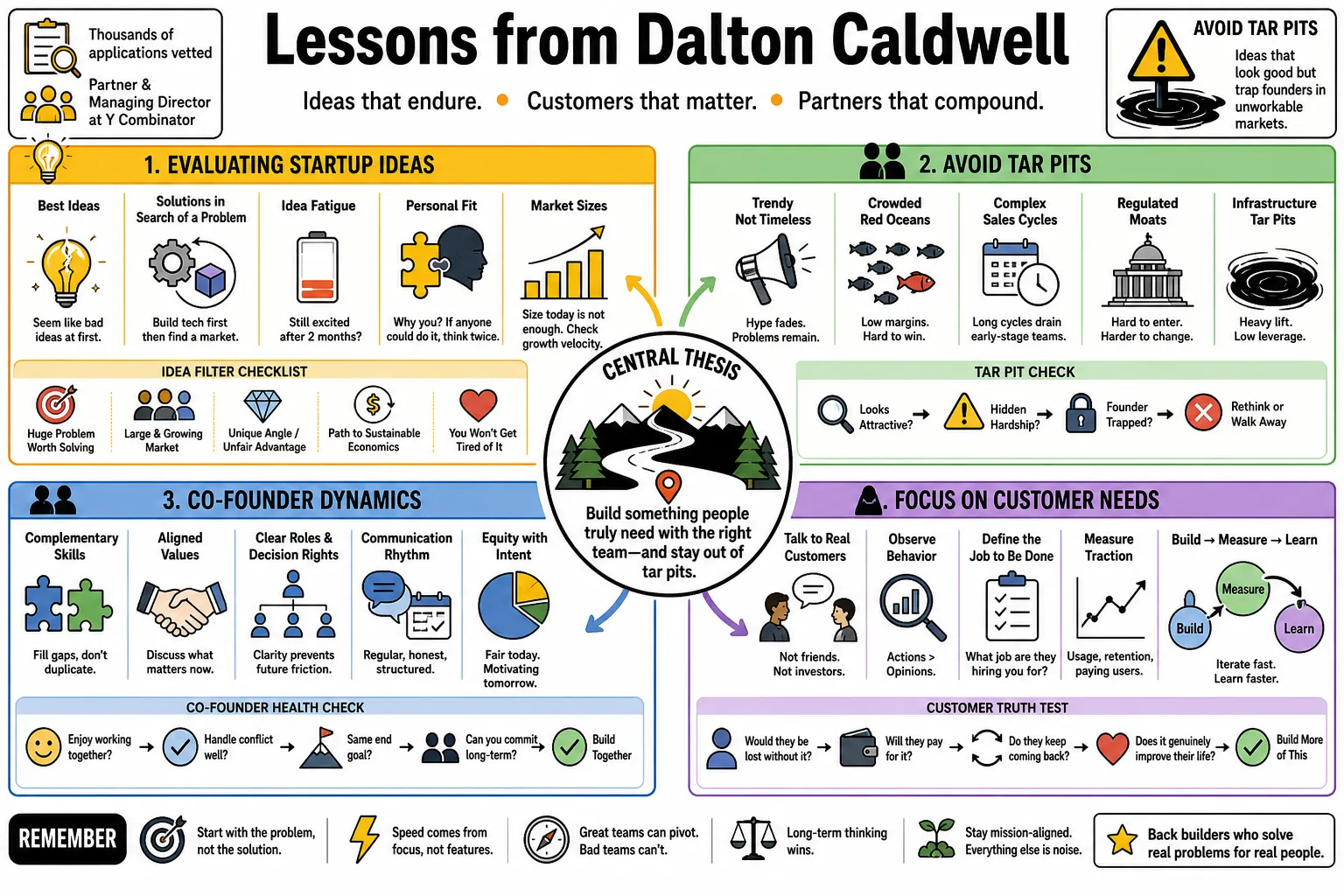
Part 1: Evaluating Startup Ideas
- On unconventional ideas: Do not dismiss a startup idea merely because its category sounds ambitious or unusual; examine whether customers want it and whether the team can execute. — How to Choose an Idea for Your Startup.
- On solutions in search of a problem: Caldwell warns against building technology before identifying who needs it and why; begin with a specific customer problem. — How to Choose an Idea for Your Startup.
- On durable interest: When evaluating an idea, ask whether the founders are genuinely excited enough about it to persist through rejection and setbacks. — How to Choose an Idea for Your Startup.
- On founder–idea fit: A founding team should have a specific insight into the problem or relevant experience with the customer; starting a company for its own sake is a weak substitute. — How to Choose an Idea for Your Startup.
- On emerging markets: A small market today can still be promising if a founder has a credible case that it will grow substantially; Caldwell cautions against treating a precise pre-seed TAM spreadsheet as decisive. — Lessons from 1,000+ YC Startups.
- On validating interest: Polite encouragement is not the same as traction: watch whether prospective customers actually engage and use the product. — All About Pivoting.
- On explaining the idea: Explain in plain language what the product does and who wants it; jargon can conceal an unresolved customer or product question. — How to Choose an Idea for Your Startup.
- On less crowded ideas: Caldwell encourages founders to look beyond the ideas circulating in their peer group and explore neglected categories informed by their own experience. — Lessons from 1,000+ YC Startups.
- On traction: Judge an early product by actual customer behavior and continued use, not encouraging words or sign-up intent alone. — All About Pivoting.
Part 2: "Tar Pit" Ideas & Deceptive Traps
- On tarpit ideas: A tarpit idea attracts repeated founder interest and often positive early reactions, yet can leave teams stuck on a hard-to-solve problem. — Tarpit Ideas: The Sequel.
- On deceptive feedback: An attractive-sounding idea may receive praise from people who have not tested whether they would use or buy the resulting product. — Tarpit Ideas: The Sequel.
- On slow failure: A little apparent traction can keep founders attached to an idea that is not working and delay a useful change of direction. — All About Pivoting.
- On consumer-social critical mass: A social product needs enough relevant participation to be useful, but raw user growth alone can dilute the community that made it valuable. — Critical Mass vs. Network Effects.
- On structural barriers: Before pursuing a seemingly obvious opportunity, investigate why earlier attempts failed and what incentives or constraints remain. — How to Change the World? Get the Small Things Right.
- On leaving a weak idea: Founders can resist a needed pivot because changing course feels like admitting defeat; examine weak traction honestly before investing further. — All About Pivoting.
- On idea history: Study previous attempts at the same customer problem and explain what is materially different in your approach or timing. — How to Change the World? Get the Small Things Right.
Part 3: Co-Founders & Team Dynamics
- On choosing a co-founder: Choose a person whose judgment and conduct you know under stress, not merely a résumé that fills a skill gap. — Co-Founder Mistakes That Kill Companies.
- On founder equity: Put equity and vesting terms in writing early. Caldwell and Seibel favor splits close to equal while noting that a literal 50/50 deadlock may call for a tie-breaker. — Co-Founder Mistakes That Kill Companies.
- On resolving conflicts: Address co-founder disagreements directly and learn how each person responds under pressure; avoided conflict can compound. — Co-Founder Mistakes That Kill Companies.
- On solo founding: A strong co-founder can provide substantial support during the difficult pre-product-market-fit period, though Caldwell and Seibel do not say every solo founder must add one. — Co-Founder Mistakes That Kill Companies.
- On complementary skills: Shared trust and the ability to learn together can matter more than finding a co-founder who merely matches a missing skill on paper. — Co-Founder Mistakes That Kill Companies.
- On shared ownership: Forming the team before fixing every detail of the idea can help co-founders develop a stronger sense of shared ownership. — Co-Founder Mistakes That Kill Companies.
- On difficult conversations: A founder relationship needs room for honest disagreement; postponing hard conversations can turn manageable tensions into a larger problem. — The Hard Conversations Founders Don’t Want to Have.
- On separating when needed: If a co-founder relationship has become irreparable, a deliberate separation may be less damaging than extending the conflict. — Co-Founder Mistakes That Kill Companies.
Part 4: The "Default Alive" Mindset & Resilience
- On survival: Caldwell urges struggling founders to keep a viable startup going when they still have a path to learn and improve, rather than mistaking a low point for the end. — Lessons from 1,000+ YC Startups.
- On default alive: Using Paul Graham’s “default alive” framework, Caldwell and Seibel ask whether current revenue growth would bring the startup to profitability before cash runs out without another fundraise. — Save Your Startup During an Economic Downturn.
- On runway math: Calculate runway under a scenario with no new investment, and confront the result while there is still time to change spending. — Save Your Startup During an Economic Downturn.
- On conviction and evidence: The balance between trusting a founder’s expertise and gathering more validation depends on what they know and how much customer evidence they have. — When Should a Founder Trust Gut Instincts?.
- On pivoting: At the earliest stage, changing an idea should be lightweight. Revisit assumptions when real customer behavior fails to match polite encouragement or weak early traction. — All About Pivoting.
- On hiring and burn: Stay lean before product-market fit; avoiding premature hiring is easier than making painful cuts after runway has shortened. — Save Your Startup During an Economic Downturn.
- On early iteration: Use early customer learning to change ideas and assumptions quickly, particularly before committing to a large team or fixed product. — All About Pivoting.
Part 5: Dealing with Investors & Fundraising
- On customers before VCs: Choose a real customer problem before trying to predict what investors will fund; code and customer conversations provide better early evidence than imagined exit strategies. — Build for Customers, Not VCs.
- On fundraising priorities: Do not treat a fundraising process as a substitute for customer and product progress; spend the bulk of early-stage effort making something people use. — YC Founders Made These Fundraising Mistakes.
- On investor decisions: Investors can decline an otherwise promising startup because they make only a small number of bets and have their own risk preferences. — Lessons from 1,000+ YC Startups.
- On traction and leverage: A product with customers and a growing metric generally gives founders more fundraising leverage than pitching before any customer evidence exists. — YC Founders Made These Fundraising Mistakes.
- On a clear pitch: Describe what the product does and who wants it in plain language; jargon can make a real opportunity harder to evaluate. — How to Choose an Idea for Your Startup.
- On valuation as a signal: Do not confuse a high headline valuation with business progress; Caldwell and Seibel advise studying enduring companies rather than merely comparing financing announcements. — YC Founders Made These Fundraising Mistakes.
- On investor incentives: Investor preferences and a founder’s product priorities can diverge; weigh advice about spending or rapid growth against direct customer evidence and runway. — Save Your Startup During an Economic Downturn.
- On capital and demand: More funding does not replace evidence that customers want the product; stay lean while learning what works, then spend where real demand justifies it. — YC Founders Made These Fundraising Mistakes.
Part 6: Listening to Customers & Finding Product-Market Fit
- On product–market fit: A strong signal is that customers are using and asking for the product, giving the company demand to grow with rather than relying on financing alone. — YC Founders Made These Fundraising Mistakes.
- On talking to users: Founders should spend direct time with early customers; those conversations can uncover problems and use cases that dashboards or delegated reports miss. — Secrets You Can Learn From Your Customers.
- On unscalable work: Use small, manual or improvised solutions to get a product in customers’ hands and learn what matters before building elaborate systems. — Things That Don’t Scale, The Software Edition.
- On customer empathy: Taking customers’ circumstances seriously helps founders notice needs and edge cases they might otherwise overlook. — Secrets You Can Learn From Your Customers.
- On interpreting requests: Ask customers what they need and test the request against how they use the product; even a seemingly simple request may expose an important unmet need. — Secrets You Can Learn From Your Customers.
- On pricing as a signal: If a startup wins only because it is far cheaper than alternatives, its customer data may not show whether the product solves a valuable problem; willingness to pay for superior value is stronger evidence. — Most Startups Are Undercharging.
- On early social adopters: A social service can begin with a small, dedicated group for whom the product is already useful, rather than require a huge undifferentiated audience on day one. — Critical Mass vs. Network Effects.
- On engaged users: A large follower count can be a vanity measure if people are not meaningfully participating; protect the quality and usefulness of the core community. — Critical Mass vs. Network Effects.
- On releasing to learn: Put an early workable version in front of users so actual use reveals what needs fixing; waiting to anticipate every defect can delay learning. — Things That Don’t Scale, The Software Edition.
Part 7: Ignoring Bad Advice & "Startup Theater"
- On startup theater: A pre-product-market-fit company should not imitate the org chart and rituals of a large, mature company; its immediate job is to learn what customers want. — Startup Childhood.
- On founder focus: If visibility work is crowding out customer conversations and product improvement, redirect time toward the people who use the product. — Lessons from 1,000+ YC Startups.
- On fundraising headlines: Reading who raised what can push founders toward choosing ideas for imagined investor appeal instead of building for customers. — Build for Customers, Not VCs.
- On conventional practices: Challenge assumptions about the customer problem, but do not assume every ordinary operational best practice must be reinvented. — Stop Innovating on the Wrong Things.
Part 8: The Admissions & YC Interview Process
- On application clarity: Describe what the company does and why customers want it in plain terms; an application is read by people looking for a coherent business, not corporate polish. — How to Apply and Succeed at Y Combinator.
- On interview answers: Treat the YC interview as a real conversation about the company, rather than reciting memorized answers or jargon. — How to Apply and Succeed at Y Combinator.
- On ability to build: If the founding team lacks an established technical track record, show a prototype or other concrete evidence that it can bring the product to market and be clear about who built it. — How to Apply and Succeed at Y Combinator.
- On showing the team: Where possible, include all founders in the application’s founder video so reviewers can understand who is building the company together. — How to Apply and Succeed at Y Combinator.
- On evidence of progress: Show what the team has actually built or learned. For repeat applicants, progress since the prior application can be a positive signal. — How to Apply and Succeed at Y Combinator.
- On initiative: Caldwell encourages applicants to create opportunities for progress through concrete work rather than rely on networking or pedigree alone. — How to Apply and Succeed at Y Combinator.