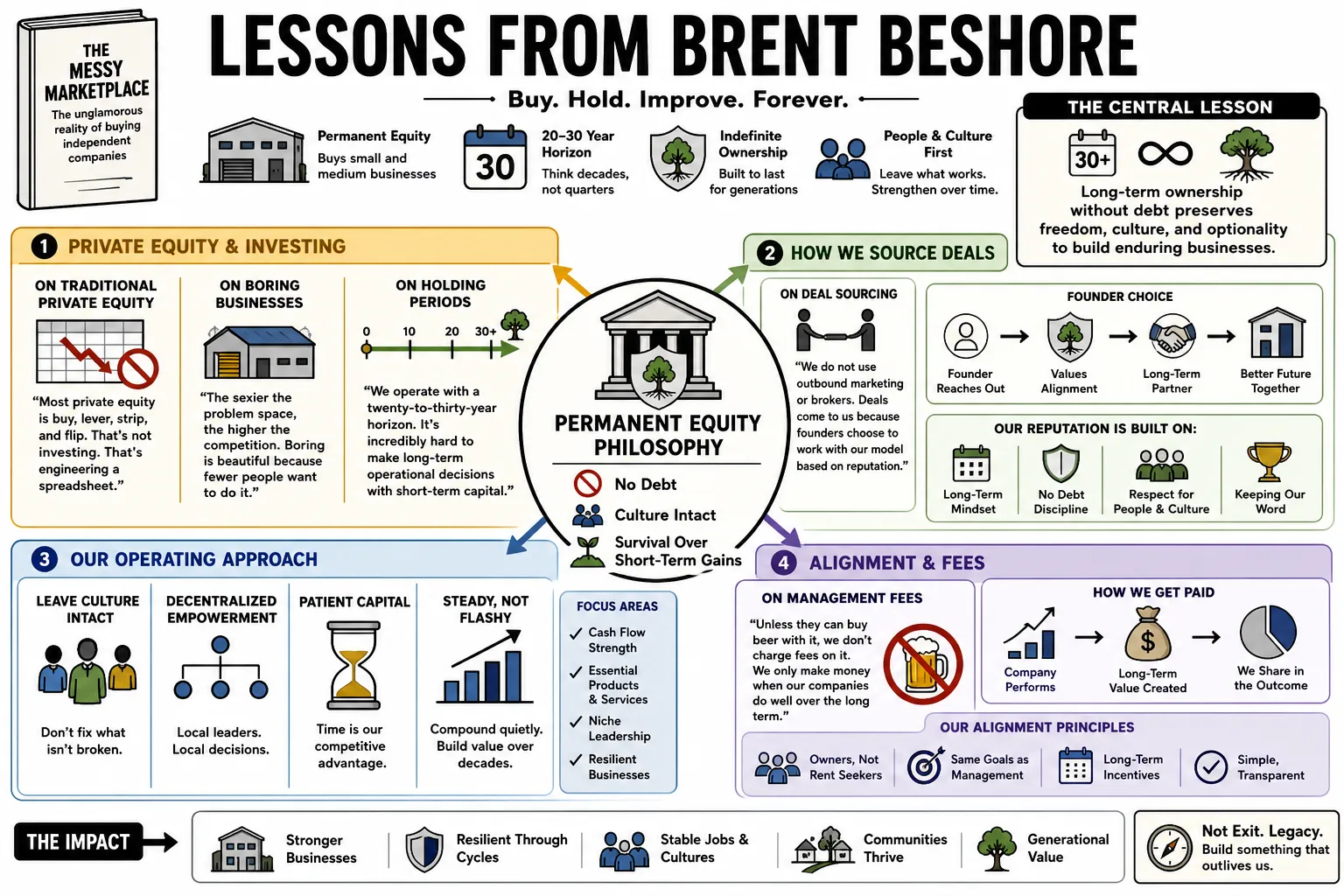
Lessons from Brent Beshore
Brent Beshore is founder and CEO of Permanent Equity, a private investment firm that buys founder-owned businesses and typically intends to hold them indefinitely, often without leverage. Its funds have roughly 30-year lives. He is also the author of The Messy Marketplace. — In The Trenches: "Brent Beshore: The Forrest Gump of Private Equity" (2022, show notes).
Part 1: Private Equity and Investing
- On Being the Opposite of Private Equity: Beshore: "we're sort of the opposite of private equity," where a traditional firm will "know who they want to sell to before they buy." — Investing Billions, EP269: "The $350M 30-Year Fund Model" (2025, transcript).
- On Compounding: Beshore starts from first principles: "every big business started as a small business," and "Businesses take time to compound." — Investing Billions, EP269: "The $350M 30-Year Fund Model" (2025, transcript).
- On Thirty Years of Capital: Beshore: "They give us their capital for 30 years. And so that allows us to buy with no intention of selling the business." — Investing Billions, EP269: "The $350M 30-Year Fund Model" (2025, transcript).
- On No Fees: On why Permanent Equity charges no management fee, Beshore says "we joke that unless you can buy beer with it, we don't charge fees on it," because "we don't eat unless they eat." — Investing Billions, EP269: "The $350M 30-Year Fund Model" (2025, transcript).
- On Being Morally Opposed: Beshore says he is "morally opposed to making money if our investors don't make more." — Investing Billions, EP269: "The $350M 30-Year Fund Model" (2025, transcript).
- On Using Debt: Beshore: "I probably sound more hard-lined about debt than I am." His concern is the target company: "There's usually a pretty decent amount of key man risk in the business." — Investing Billions, EP269: "The $350M 30-Year Fund Model" (2025, transcript).
- On the Aerospace Downturn: When airline demand fell, Beshore says competitors spent their time negotiating with banks while his team, with no debt, was "able to again, like make 10 years of progress in 18 months." — Investing Billions, EP269: "The $350M 30-Year Fund Model" (2025, transcript).
- On Business Hygiene: Beshore calls it "the table stakes of business hygiene, kind of all the standard things that every small company should be doing well," and adds "Small businesses don't stay small on purpose." — Investing Billions, EP269: "The $350M 30-Year Fund Model" (2025, transcript).
- On Generational Opportunities: Beshore says "really kind of generational opportunities" come "about once every seven to 10 years." — Investing Billions, EP269: "The $350M 30-Year Fund Model" (2025, transcript).
- On the Price of Continuity: On the gap to the highest bidder, Beshore says it might be "a five, 10, 12 percent difference in what we're paying depending on the situation. If you care deeply about the business and the legacy and what happens next, that seems like a reasonable trade." — Investing Billions, EP269: "The $350M 30-Year Fund Model" (2025, transcript).
Part 2: The Messy Marketplace
- On the Forrest Gump of Private Equity: Beshore: "I often joke that I'm the Forrest Gump of private equity," and he says he started down the path when "I had too much to drink one night to be honest and agreed to help start a business." — Smart Business Revolution: "Investing in Small Family-Owned Businesses for the Long Term" (2021, transcript).
- On Owner Mode: Beshore: "Most businesses that size are, are really non transferable. We call it Owner mode. And all the value of the business is tied up in the relationships, the skill set of the owner." — Smart Business Revolution: "Investing in Small Family-Owned Businesses for the Long Term" (2021, transcript).
- On Learning by Googling: Early on, in diligence calls with lawyers and accountants, Beshore says "I would just be furiously googling what the term was to try to figure out if I could, if I could hang." — Smart Business Revolution: "Investing in Small Family-Owned Businesses for the Long Term" (2021, transcript).
- On Defensible Niches: Beshore likes businesses where "they have a little niche that they can defend in the marketplace, for whatever reason." — Smart Business Revolution: "Investing in Small Family-Owned Businesses for the Long Term" (2021, transcript).
- On Releasing Lids: Of the small companies he buys, Beshore says "as we're able to release those lids, the growth rate then starts to accelerate." — Investing Billions, EP269: "The $350M 30-Year Fund Model" (2025, transcript).
- On Sellers Who Want the Highest Price: Beshore says most sellers just want value for themselves and their family: "most people, frankly, don't care. Most people, what they care about is to realize the value that is maximum to them and their family. I don't blame them. I don't judge them." — Investing Billions, EP269: "The $350M 30-Year Fund Model" (2025, transcript).
- On What Selling to Private Equity Means: Beshore: "when they sell the traditional private equity, the world will never be the same for them." — Investing Billions, EP269: "The $350M 30-Year Fund Model" (2025, transcript).
- On Owning Like a Family: Beshore says Permanent Equity took the opposite approach to private equity: "we want to own businesses like a family would." — My First Million: "Private Equity Business" (2020, transcript).
- On Content With a Purpose: On why Permanent Equity publishes so much, Beshore says "Our goal in every piece of content is to educate and then repel the wrong people and attract the right people." — Think Like An Owner: "Building and Growing a Competitive Advantage at Permanent Equity" (2021, transcript).
Part 3: Leadership and Management
- On Being Functionally Irrelevant: Beshore: "in terms of my judgment, I'm close to functionally irrelevant these days at Permanent Equity." — Think Like An Owner: "Building and Growing a Competitive Advantage at Permanent Equity" (2021, transcript).
- On Hiring Operators: Beshore: "we have a rule around here that we don't hire people who haven't been operators, because we think that operating skill set is far more important than investing skill set, especially for what we do." — Think Like An Owner: "Building and Growing a Competitive Advantage at Permanent Equity" (2021, transcript).
- On Extreme Reliability: Asked about competitive advantage, Beshore says "we do what we say we're going to do when we say we're going to do it. We just try to practice extreme reliability." — Think Like An Owner: "Building and Growing a Competitive Advantage at Permanent Equity" (2021, transcript).
- On What a Brand Is: Beshore: "if you think about what is a brand, that's basically what can people expect." — Think Like An Owner: "Building and Growing a Competitive Advantage at Permanent Equity" (2021, transcript).
- On Having Only Your Word: Beshore says reliability means "knowing that at the end of the day all we have is our word." — Think Like An Owner: "Building and Growing a Competitive Advantage at Permanent Equity" (2021, transcript).
- On the Chicken Layer: Beshore: "There's what we call the everything-tastes-like-chicken layer to business," where "if you don't have good feedback loops and information, you can't make decisions." — Think Like An Owner: "Building and Growing a Competitive Advantage at Permanent Equity" (2021, transcript).
- On Speed Versus Quality: Beshore: "if you can get pretty quickly to X and it takes another 10X to get to Y, is that 10X effort worth it? And oftentimes the answer is no." — Think Like An Owner: "Building and Growing a Competitive Advantage at Permanent Equity" (2021, transcript).
- On the Margin of Safety: Beshore says "the margin of safety is down to the trust and reliability of the people that are involved in it." — Think Like An Owner: "Building and Growing a Competitive Advantage at Permanent Equity" (2021, transcript).
- On Helping Without Expecting Return: On publishing how Permanent Equity works, Beshore says "Our philosophy has always been that it's far, far better to just help people and expect nothing in return." — Think Like An Owner: "Building and Growing a Competitive Advantage at Permanent Equity" (2021, transcript).
Part 4: Risk and Leverage
- On Short-Term Capital: Beshore: "I don't think you can make good long term decisions with that type of short term capital." — Investing Billions, EP269: "The $350M 30-Year Fund Model" (2025, transcript).
- On Cyclicality: Beshore: "there's almost no industries that don't experience some cyclicality." — Investing Billions, EP269: "The $350M 30-Year Fund Model" (2025, transcript).
- On the Cost of Debt in a Cycle: Beshore: "if you're going to experience that cyclicality, you have to really think about what are the consequences of using debt where you can't take advantage of the cyclicality." — Investing Billions, EP269: "The $350M 30-Year Fund Model" (2025, transcript).
- On Cash on Hand: Beshore says a firm like his can move quickly on generational opportunities because "we keep a lot of cash on hand, we're ready to move quickly." — Investing Billions, EP269: "The $350M 30-Year Fund Model" (2025, transcript).
- On Blood in the Streets: Beshore wonders "will the government ever allow there to truly be blood in the streets" after the COVID-era programs ended his firm's wave of inbound conversations. — Investing Billions, EP269: "The $350M 30-Year Fund Model" (2025, transcript).
- On Not Needing Capital: Beshore says the "dynamics between capital seekers and capital providers drives me crazy" and that he told early prospects "I don't need your money. Like, we're doing great on our own." — Investing Billions, EP269: "The $350M 30-Year Fund Model" (2025, transcript).
- On Outside Capital: Beshore says everyone told him not to raise outside capital, yet "I've been shocked at how good the partnership's gone." — Investing Billions, EP269: "The $350M 30-Year Fund Model" (2025, transcript).
- On Bad News First: On investor letters, Beshore says "that's the ideal for us is to lay all the bad news up front, to be honest about all the struggles and stresses and strains, to explain our logic." — Investing Billions, EP269: "The $350M 30-Year Fund Model" (2025, transcript).
- On a Stressful Life: Of levered, short-horizon ownership, Beshore says "I think it's an incredibly stressful life. I don't think it sets up well for good relationships." — Investing Billions, EP269: "The $350M 30-Year Fund Model" (2025, transcript).
Part 5: Company Culture and Hiring
- On the Cell Phone Test: Beshore: "We always use the cell phone test as if the CEO or the seller calls us, are we cringing before we pick up the phone or are we excited to pick up the phone?" — Investing Billions, EP269: "The $350M 30-Year Fund Model" (2025, transcript).
- On Life Being Too Short: Beshore: "life's too short to work with people that you don't want to work with." — Investing Billions, EP269: "The $350M 30-Year Fund Model" (2025, transcript).
- On Not Taking Yourself Seriously: Beshore: "There's a way of taking things seriously without taking yourself seriously." — Investing Billions, EP269: "The $350M 30-Year Fund Model" (2025, transcript).
- On Why People Act: Beshore: "people's behavior always makes sense to them," because "no one's doing the thing that they think is stupid in the moment." — Investing Billions, EP269: "The $350M 30-Year Fund Model" (2025, transcript).
- On Loving Well in Difficulty: On the hardest situations in the portfolio, Beshore says "we try to love them well in their difficulty." — Investing Billions, EP269: "The $350M 30-Year Fund Model" (2025, transcript).
- On Eggshells: Beshore: "You don't want people that you're walking on eggshells, that you have to be a different version of yourself." — Investing Billions, EP269: "The $350M 30-Year Fund Model" (2025, transcript).
- On Shame and Care: Beshore relays a psychologist's view that "shame and fear will drive you to about 95% of human performance. And the only thing that will drive you to nearly 100% of human performance is to genuinely care and love for people." — Investing Billions, EP269: "The $350M 30-Year Fund Model" (2025, transcript).
- On Punching Up: On hiring, Beshore says "there are certain people who punch up but most people punch down. And we don't like people who punch down." — Think Like An Owner: "Building and Growing a Competitive Advantage at Permanent Equity" (2021, transcript).
- On There Being No Secret: Beshore: "the secret, again, is there is no secret. Just treat people well and truly care about them and try to do good by them." — Think Like An Owner: "Building and Growing a Competitive Advantage at Permanent Equity" (2021, transcript).
Part 6: Personal Philosophy and Success
- On the Seven-Month Silence: On his first acquisition, Beshore says the owner said no, "for seven months, I didn't hear from him," and then called to say "I'll give it to you for the price you asked for." — Smart Business Revolution: "Investing in Small Family-Owned Businesses for the Long Term" (2021, transcript).
- On Cheap Versus Good: Beshore says he "did a lot of things early in my career that were cheap and not good long term, sustainable," because "things are usually cheap for a reason." — Investing Billions, EP269: "The $350M 30-Year Fund Model" (2025, transcript).
- On Bristling at Feedback: Beshore: "I get feedback sometimes. It makes me bristle." — Investing Billions, EP269: "The $350M 30-Year Fund Model" (2025, transcript).
- On Getting What God Wants: On worrying about competitors he has helped, Beshore says "I think we're going to have what God wants us to have." — Think Like An Owner: "Building and Growing a Competitive Advantage at Permanent Equity" (2021, transcript).
- On Not Being Right for Most: Beshore says of Permanent Equity, "We're not right for everyone. In fact, we're not right for most people." — Think Like An Owner: "Building and Growing a Competitive Advantage at Permanent Equity" (2021, transcript).
- On Being Comfortable in Your Skin: Beshore: "we've gotten comfortable in our own skin that we are who we are," and "We're just trying to be us." — Think Like An Owner: "Building and Growing a Competitive Advantage at Permanent Equity" (2021, transcript).
- On Recovering Difficult People: On the firm's no-jerks writing, Beshore says "everyone's either an a-hole or a-hole in recovery. So, we just try to be more in recovery than not." — Think Like An Owner: "Building and Growing a Competitive Advantage at Permanent Equity" (2021, transcript).
Part 7: Deal Structuring and Incentives
- On Paying Staff From Cash Flow: Beshore: "everyone is incentivized in the exact same way, including my staff," and "For us, we're paying out to our staff quarterly." — Investing Billions, EP269: "The $350M 30-Year Fund Model" (2025, transcript).
- On Selling What You Would Buy: Beshore: "I want to be on the other side of it and be able to say, hey, I would buy that if I wasn't doing what I do now." — Investing Billions, EP269: "The $350M 30-Year Fund Model" (2025, transcript).
- On Cash as Lifeblood: Beshore: "if you think about our organization, cash is the lifeblood of our organization." — Investing Billions, EP269: "The $350M 30-Year Fund Model" (2025, transcript).
- On Reinvesting First: Beshore says the first use of cash is "high probability, high quality reinvestments back into the portfolio." — Investing Billions, EP269: "The $350M 30-Year Fund Model" (2025, transcript).
- On Regular Distributions: On thirty-year funds, Beshore says "we're making regular distributions every six months." — Investing Billions, EP269: "The $350M 30-Year Fund Model" (2025, transcript).
- On Not Being the Highest Bidder: Beshore: "it's not like we're paying dramatically less than other people. We're just not probably going to be the very highest bidder." — Investing Billions, EP269: "The $350M 30-Year Fund Model" (2025, transcript).
- On Majority Stakes: Beshore: "we're always buying a majority stake in these companies. And so we have to be prepared to change out leadership." — Investing Billions, EP269: "The $350M 30-Year Fund Model" (2025, transcript).
- On Deal Rescue: Beshore says one of his specialties is what the firm calls deal rescue, because "every deal has to be rescued at least three times." — Think Like An Owner: "Building and Growing a Competitive Advantage at Permanent Equity" (2021, transcript).
- On Undifferentiated Bidders: In a competitive process Beshore says "everyone else is kind of battling against each other. And really, there's very little differentiation between those groups." — Investing Billions, EP269: "The $350M 30-Year Fund Model" (2025, transcript).
Part 8: Diligence and Board Dynamics
- On What to Look At: Beshore says in evaluating a business "we're looking at typically, what's their margin, how quickly do they get paid and can we work with the people?" — Investing Billions, EP269: "The $350M 30-Year Fund Model" (2025, transcript).
- On What Makes a Business Durable: When looking at deals, Beshore says "what's the thing that makes them special that makes them durable," and it "certainly can't all be tied up in the goodwill of the owner." — Smart Business Revolution: "Investing in Small Family-Owned Businesses for the Long Term" (2021, transcript).
- On Lightly Professionalized Companies: Of the $5 to $15 million free-cash-flow companies he targets, Beshore says "These businesses are lightly professionalized or to some degree not professionalized organizations." — Investing Billions, EP269: "The $350M 30-Year Fund Model" (2025, transcript).
- On Checklists and Judgment: On institutionalizing judgment, Beshore says "you can create checklists of processes to make sure that the person's judgment doesn't run astray." — Think Like An Owner: "Building and Growing a Competitive Advantage at Permanent Equity" (2021, transcript).
- On Asking Whether Anyone Has Seen It: Beshore says colleagues facing a hard issue ask "has anybody seen anything like this before?" and often hear "we've seen that movie before." — Think Like An Owner: "Building and Growing a Competitive Advantage at Permanent Equity" (2021, transcript).
- On the Weekly Executive Meeting: Beshore: "once a week, the executive team is getting together and really talking through what are challenges we're all facing, and how can we help one another in those challenges." — Think Like An Owner: "Building and Growing a Competitive Advantage at Permanent Equity" (2021, transcript).
- On Walking Down the Hall: Beshore says the culture is one where "everyone on the team feels comfortable walking down to anybody else's office" to raise a concern. — Think Like An Owner: "Building and Growing a Competitive Advantage at Permanent Equity" (2021, transcript).
- On Collections of People: On why investors accept messy outcomes, Beshore says "businesses are nothing more than collections of people." — Investing Billions, EP269: "The $350M 30-Year Fund Model" (2025, transcript).
- On the Assembly Line: Beshore: "We really try to take an assembly line approach, which is very different" from a partner model where you expand by hiring more partners. — Think Like An Owner: "Building and Growing a Competitive Advantage at Permanent Equity" (2021, transcript).