Chris Bloomstran is president and chief investment officer of Semper Augustus Investments Group. His published client letters analyze business value, market conditions and Berkshire Hathaway in detail. — Semper Augustus team.
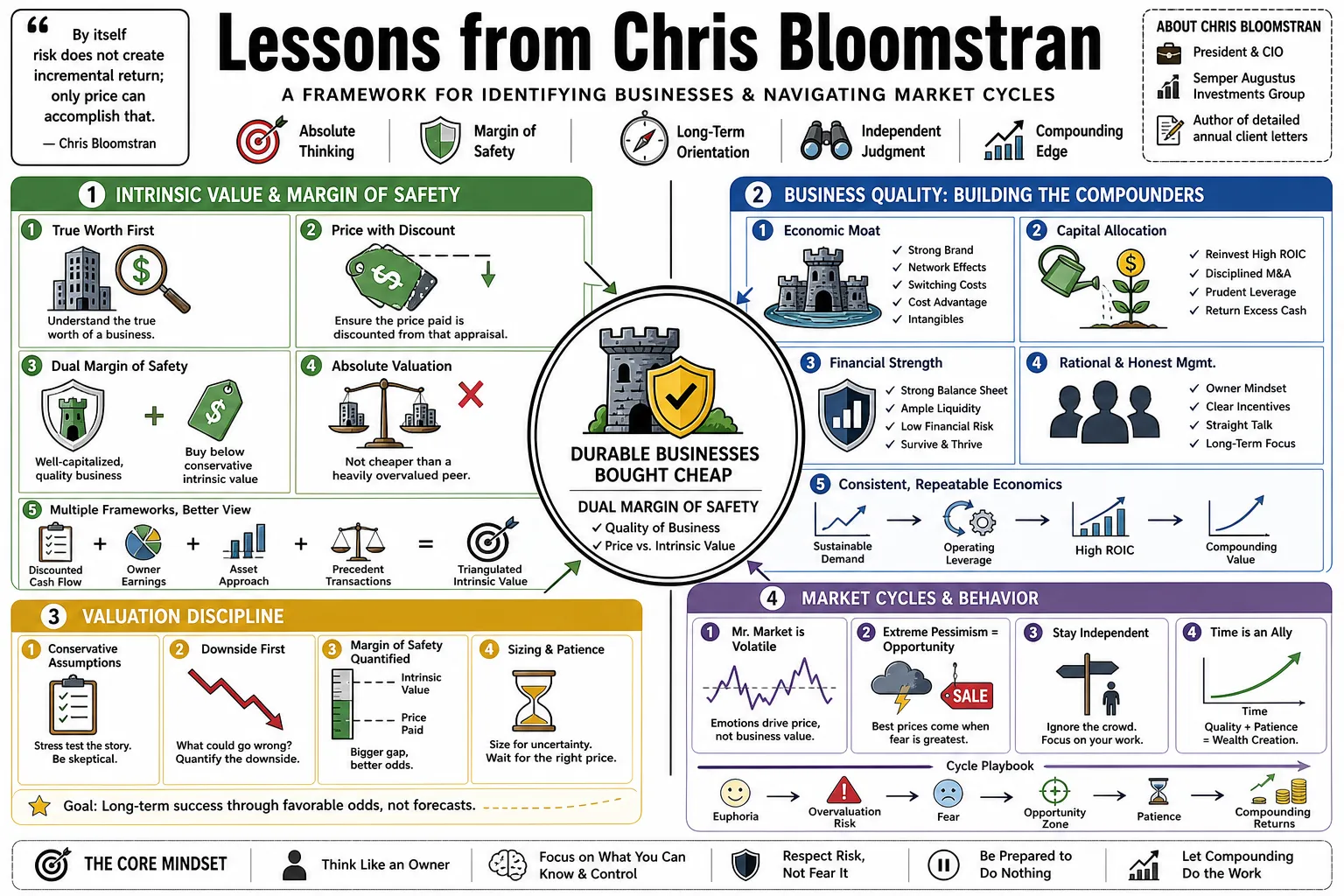
Part 1: Intrinsic Value & Margin of Safety
- Define Risk as Permanent Loss: Bloomstran's firm defines investment risk as permanent loss of capital, not ordinary price volatility; buying below a conservative appraisal is part of how it manages that risk. — Semper Augustus investment philosophy.
- Pay Less Than Appraised Value: A margin of safety begins with a conservative appraisal of a business and a purchase price below that appraisal. — Semper Augustus investment philosophy.
- Use Two Margins of Safety: Semper Augustus describes a dual margin of safety: own a high-quality, well-capitalized business and pay a meaningful discount to its appraised value. — Semper Augustus investment philosophy.
- Price Matters in Absolute Terms: Bloomstran's 2000 client letter argues that even a desirable security can become a poor investment if the purchase price is unreasonable. — Price Matters letter.
- Cross-Check Intrinsic Value: In valuing Berkshire, Bloomstran compares sum-of-the-parts and adjusted-earnings methods, then uses book value and return on equity as reconciliation checks. — 2017 Semper Augustus letter.
- Do Not Replace Valuation With a Macro Call: Bloomstran discusses monetary and market conditions, but his Berkshire appraisal still centers on business quality, earning power and the price paid. — 2017 Semper Augustus letter.
- Look Through Reported Earnings: Bloomstran adjusts Berkshire's reported earnings to estimate its underlying economic earning power instead of relying on a single reported multiple. — 2017 Semper Augustus letter.
- Learn From Robert Brookings Smith: Bloomstran credits his first client, Robert Brookings Smith, as a formative investing influence and recounts Smith's willingness to leave an overheated market before 1929 and buy amid the 1932 collapse. — The Vigilant Investor interview.
- Favor Intrinsic Growth Over Short-Term Prices: Bloomstran's client letter puts long-term growth in a company's intrinsic value ahead of near-term changes in its stock price. — Price Matters letter.
- Start With Economic Returns: Semper Augustus looks for businesses whose free cash returns exceed a realistic cost of capital, then asks whether their shares trade below conservatively appraised value. — Semper Augustus investment philosophy.
Part 2: Analyzing Berkshire Hathaway
- Measure Compounding Over Decades: Bloomstran's 2015 letter reports that Berkshire's book value per share compounded at about 19.4% annually over the first 50 years under Buffett, while cautioning that the much lower later-period rates are more relevant to future expectations. — Semper Augustus 2015 client letter.
- Remember How Entry Price Changes Yield: Bloomstran records Buffett's pre-1965 Berkshire purchases below $11 per share and explains that an investor's return on today's equity depends on the price originally paid; a lower cost basis magnifies the earnings yield on that investment. — Semper Augustus 2015 client letter.
- Value Berkshire's Moving Parts: Bloomstran values Berkshire through its operating businesses and investment holdings, cross-checking a sum-of-the-parts appraisal against adjusted earning power and other measures. — Semper Augustus 2017 client letter.
- Understand Insurance Float: Berkshire's insurance businesses have often underwritten profitably, giving it durable policyholder funds to invest at a negative effective cost. — Semper Augustus 2015 client letter.
- Reinvest Retained Earnings Well: Bloomstran argues that Berkshire's future growth depends heavily on reinvesting retained earnings profitably, as it had done over the period he examined. — Semper Augustus 2015 client letter.
- Preserve Berkshire's Crisis Optionality: Berkshire's surplus cash gives it capacity to deploy large sums in a crisis, an advantage Bloomstran specifically recognizes in his stress test. — Semper Augustus 2015 client letter.
- Protect Subsidiary Autonomy: Bloomstran sees Berkshire's relationships with subsidiary managers and the operating latitude some businesses enjoy under its umbrella as advantages, though he warns those relationships must be preserved. — Semper Augustus 2015 client letter.
- Redirect Capital When Economics Change: Bloomstran credits Berkshire with recognizing textiles' weak economics, diverting capital to insurance and later adapting its investment mix as opportunities changed. — Semper Augustus 2015 client letter.
- Count Investee Earnings Beyond Dividends: To assess Berkshire's stock holdings, Bloomstran considers not only dividends received but also profits retained by the underlying businesses. — Semper Augustus 2015 client letter.
- Respect Succession Uncertainty: Bloomstran expresses confidence in Berkshire's succession plan and durable franchise but says future leaders' ability to manage risk cannot be known in advance. — Semper Augustus 2015 client letter.
Part 3: The Mechanics of Market Bubbles
- Watch Capital Concentrate in Winners: Bloomstran likens market-cap-weighted flows to feeding the largest index constituents while smaller ones lose weight; the pattern can reinforce concentration. — Semper Augustus 2017 client letter.
- Understand Cap-Weighted Buying: A capitalization-weighted fund buys index constituents in proportion to their market value rather than a fresh appraisal of each business; Bloomstran warns that heavy flows can push price away from fundamentals. — Semper Augustus 2017 client letter.
- Test Growth Stories Against Economics: Bloomstran asks whether AI-related revenue and future profits can justify the capital being committed to data centers, even if the technology produces real benefits. — Latticework 2025 interview.
- Compare AI Capex With Fiber's Buildout: Bloomstran compares the scale of AI infrastructure spending with the late-1990s fiber buildout, warning that revenue and depreciation may not justify the investment even though the timing and winners are uncertain. — Latticework 2025 interview.
- Avoid Paying Bubble Prices for Blue Chips: In the late-1990s boom, Bloomstran cut expensive blue-chip holdings and found better-priced small- and mid-cap businesses; a familiar name did not justify a 40–60-times-earnings price. — Acquirers Podcast interview.
- Assess Index Concentration: Bloomstran warns that when returns and flows cluster in a few large index constituents, a cap-weighted investor can take on concentrated valuation risk. — Semper Augustus 2017 client letter.
- Remember How Manias Unwind: Semper Augustus took its name from the tulip mania as a reminder that speculative price rises can reverse sharply and leave late buyers with large losses. — Semper Augustus tulipomania history.
- Separate Innovation From Investor Returns: Bloomstran allows that AI could produce productivity gains while questioning whether the businesses funding today’s infrastructure can earn returns sufficient to justify their spending and valuations. — Latticework 2025 interview.
- Separate Business Return From Multiple Change: When appraising prospective returns, Bloomstran separates what a business may earn on equity from the extra gain or loss caused by a changing valuation multiple. — Semper Augustus 2017 client letter.
Part 4: Inflation & Macroeconomics
- Measure Purchasing Power: Bloomstran treats inflation as a risk to the real value of cash and bonds and asks whether owned businesses can protect purchasing power in more extreme scenarios. — Semper Augustus 2015 client letter.
- Check Pricing Power Business by Business: Bloomstran notes that some Berkshire subsidiaries can raise prices faster than inflation while others cannot, so inflation resilience depends on each business’s economics. — Semper Augustus 2015 client letter.
- Model Multiple Monetary Outcomes: Bloomstran sees prolonged deflation as a plausible consequence of heavy debt, but also stress-tests persistent inflation and its effects; he does not claim one monetary outcome is inevitable. — Meb Faber Show interview.
- Stress-Test the Discount Rate: Bloomstran cautions against valuing stocks solely at current low interest rates; he tests how future rates and lower valuation multiples could change expected returns. — Semper Augustus 2015 client letter.
- Model Inflation in Financing Costs: Bloomstran warns that inflation can lift nominal sales while higher rates reset borrowing costs, particularly for short-funded businesses; analyze both sides before assuming inflation helps owners. — Meb Faber Show interview.
- Judge Capital Allocation Economically: Bloomstran cautions that borrowing cheaply to repurchase richly valued shares can look attractive against the interest rate while still lowering economic returns on capital. — Semper Augustus 2017 client letter.
- Treat Heavy Debt as a Constraint: Bloomstran argues that a heavily indebted economy can struggle to grow in real terms and, if inflation persists, can face a higher interest burden as short-term borrowing resets. — Meb Faber Show interview.
- Use History Without Claiming Certainty: Bloomstran compares today's valuations with earlier cycles but cautions that historical peaks and troughs are imperfect yardsticks, especially for inflationary scenarios without close domestic analogues. — Semper Augustus 2017 client letter.
- Judge Cash in Real Terms: Bloomstran warns that hyperinflation can destroy the purchasing power of cash and bonds even though their nominal amounts remain stated in currency units. — Semper Augustus 2015 client letter.
Part 5: Financial History & Market Cycles
- Use History as a Warning: Bloomstran drew on the tulip mania and the 1920s when recognizing late-1990s excess, using earlier episodes to frame—not precisely predict—a new bubble. — Acquirers Podcast interview.
- Learn From Smith's 1928 Exit: Bloomstran recounts how Robert Brookings Smith moved out of stocks before the 1929 crash and bought again in 1932; the episode illustrates patience across a full market cycle. — Vigilant Investor interview.
- Let Value Catch Up With Hype: Bloomstran notes that several prominent 1999 companies became attractive to his firm only after the bubble burst and prices fell enough for underlying value to catch up. — Semper Augustus 2017 client letter.
- Stress-Test Peak Profit Margins: Bloomstran compares market eras with unusually high profit margins and valuation multiples; his own analysis tests whether elevated margins could compress rather than persist. — Latticework 2025 interview.
- Read the Statements Before Investing: After losing his entire $7,000 stake in a Norwegian tanker company, Bloomstran obtained its financial statements and saw the leverage and weak assets he had missed. — Vigilant Investor interview.
- Adjust Mean Reversion for Structural Change: Bloomstran notes that capital-light businesses, lower rates and tax changes pushed market margins above older ranges; he still considers compression possible rather than assuming a fixed historical ceiling. — Latticework 2025 interview.
- Study the 1970s Valuation Squeeze: Bloomstran recalls that a richly valued late-1960s market was followed by a long, rangebound bear market and much lower valuation multiples by 1982; high starting prices mattered. — Meb Faber Show interview.
Part 6: Portfolio Management & Patience
- Treat Cash as a Temporary Byproduct: Semper Augustus says cash can accumulate briefly when attractive investments are scarce, but Bloomstran warns that holding it for years can drag returns; cash is not a standing market-timing strategy. — Semper Augustus 2017 client letter.
- Concentrate Only With Downside Knowledge: Bloomstran describes concentrated portfolios of well-understood businesses, while warning that conviction without a deep understanding of downside risk can be disastrous. — Semper Augustus 2017 client letter.
- Let Compounding Work: Bloomstran argues that patient ownership and low turnover let investors observe a business compound; frequent trading can interrupt that learning and the compounding itself. — Semper Augustus 2017 client letter.
- Study Mistakes Openly: Bloomstran describes strong investors as humble, willing to admit mistakes and curious enough to learn from them rather than conceal them. — Semper Augustus 2017 client letter.
- Avoid Panic Selling: Bloomstran warns that investors can damage a long-term plan by selling during a crisis and buying back only after prices have recovered. — Semper Augustus 2017 client letter.
- Expect Periods of Underperformance: Bloomstran says even strong long-term investors can underperform for years; changing a sound process merely to chase recent relative returns can undermine it. — Semper Augustus 2017 client letter.
- Protect Time for Reading and Thinking: Bloomstran points to company filings, annual reports and dedicated thinking time as recurring habits of investors he admires, without prescribing a fixed daily reading quota. — Semper Augustus 2017 client letter.
- Keep Independent Judgment: Bloomstran praises independent thought and autonomy of process, while allowing that capable investors can work effectively with like-minded peers. — Semper Augustus 2017 client letter.
- Analyze Downside Before Upside: Bloomstran says the best investors he knows spend more time on what can go wrong than on optimistic forecasts, because permanent capital loss—not price volatility—is the central risk. — Semper Augustus 2017 client letter.
Part 7: Assessing Business Quality
- Evaluate Capital Allocation: Bloomstran treats management's decisions about reinvestment, dividends, debt, acquisitions and repurchases as central to business value; the decisions depend on understanding returns on capital and intrinsic value. — Semper Augustus 2017 client letter.
- Look for Returns Above the Cost of Capital: Semper Augustus seeks businesses earning free-cash returns above a realistic cost of capital, while maintaining strong balance sheets and buying below a conservative appraisal of value. — Semper Augustus investment philosophy.
- Test Pricing Power, Not Just Its Label: Bloomstran notes that some Berkshire subsidiaries can raise prices faster than inflation while others cannot; pricing power is business-specific, not a blanket attribute of a famous company. — Semper Augustus 2015 client letter.
- Judge Buybacks by Price: Bloomstran argues that repurchases can benefit owners when shares are cheap relative to value, but buying them at excessive prices destroys capital. — Semper Augustus 2015 client letter.
- Retain Earnings Only With Reinvestment Prospects: Bloomstran says Berkshire's future growth depends heavily on reinvesting retained earnings profitably; if acceptable opportunities disappear, distributing profits becomes preferable. — Semper Augustus 2015 client letter.
- Treat Growth as Part of Value: Semper Augustus treats growth as one component of valuation: growth that fails to produce commensurate free-cash profits can destroy value rather than create it. — Semper Augustus investment philosophy.
- Compare Margins With Capital Employed: Bloomstran warns that a low-margin business can still earn good returns on capital; comparing margin percentages across unlike business models without balance-sheet context can mislead. — Semper Augustus 2017 client letter.
- Keep Leverage From Weakening the Franchise: Bloomstran argues that adding substantial debt could lift Berkshire's return on equity while materially weakening its fortress balance sheet and increasing fragility. — Semper Augustus 2015 client letter.
- Look for a Structural Cost Advantage: Bloomstran identifies GEICO's lower administrative and selling overhead as a reason it could underwrite more profitably than many competing auto insurers, even with a higher claims ratio. — Semper Augustus 2015 client letter.
Part 8: Accounting Truths & Financial Realities
- Read the Footnotes for Economic Cash Flow: Bloomstran's Berkshire analysis uses tax footnotes to show that actual cash taxes differed sharply from income-statement expense; the footnotes can change an investor's view of free cash generation. — Semper Augustus 2015 client letter.
- Challenge Non-GAAP Add-Backs: Bloomstran questions management presentations that add back option-grant costs simply because they are not paid in cash; an adjusted earnings figure needs an economic justification for each exclusion. — Semper Augustus 2017 client letter.
- Account for Share Grants: Bloomstran treats option and restricted-stock grants as part of executive compensation and praises Berkshire for avoiding large issuance that dilutes owners. — Semper Augustus 2015 client letter.
- Compare Depreciation With Real Capital Spending: Bloomstran compares Berkshire's reported depreciation with actual capital expenditures, separating accounting expense, tax deductions and cash invested in rail and energy assets. — Semper Augustus 2015 client letter.
- Inspect Working Capital Alongside Profit: In assessing Berkshire's manufacturing, service and retail group, Bloomstran looks beyond net income to its working capital, debt and cash balances before judging the quality of its returns. — Semper Augustus 2015 client letter.
- Interpret Goodwill Economically: Bloomstran says goodwill and acquired intangibles require economic judgment: some past amortization understated Berkshire's book value, while write-offs or overpaid acquisitions can distort other companies' equity. — Semper Augustus 2015 client letter.
- Normalize Free Cash During Growth Investment: Bloomstran warns that a simple operating-cash-minus-capex screen can understate a company's economic cash generation during a temporary, sensible capacity buildout; his Hexcel example shows why maintenance and growth spending must be distinguished. — Acquirers Podcast interview.
- Test Accounting Choices Over Time: Bloomstran recommends examining a company's history of write-offs, write-downs and acquisition accounting, because reported returns can shift with the judgments behind the statements. — Buffett and Berkshire interview.
- Use Book Value as a Qualified Cross-Check: Bloomstran regards book value as an imperfect but useful Berkshire valuation proxy; it can understate earning power and can be badly distorted at other companies, so it is not a universal standalone measure. — Semper Augustus 2015 client letter.