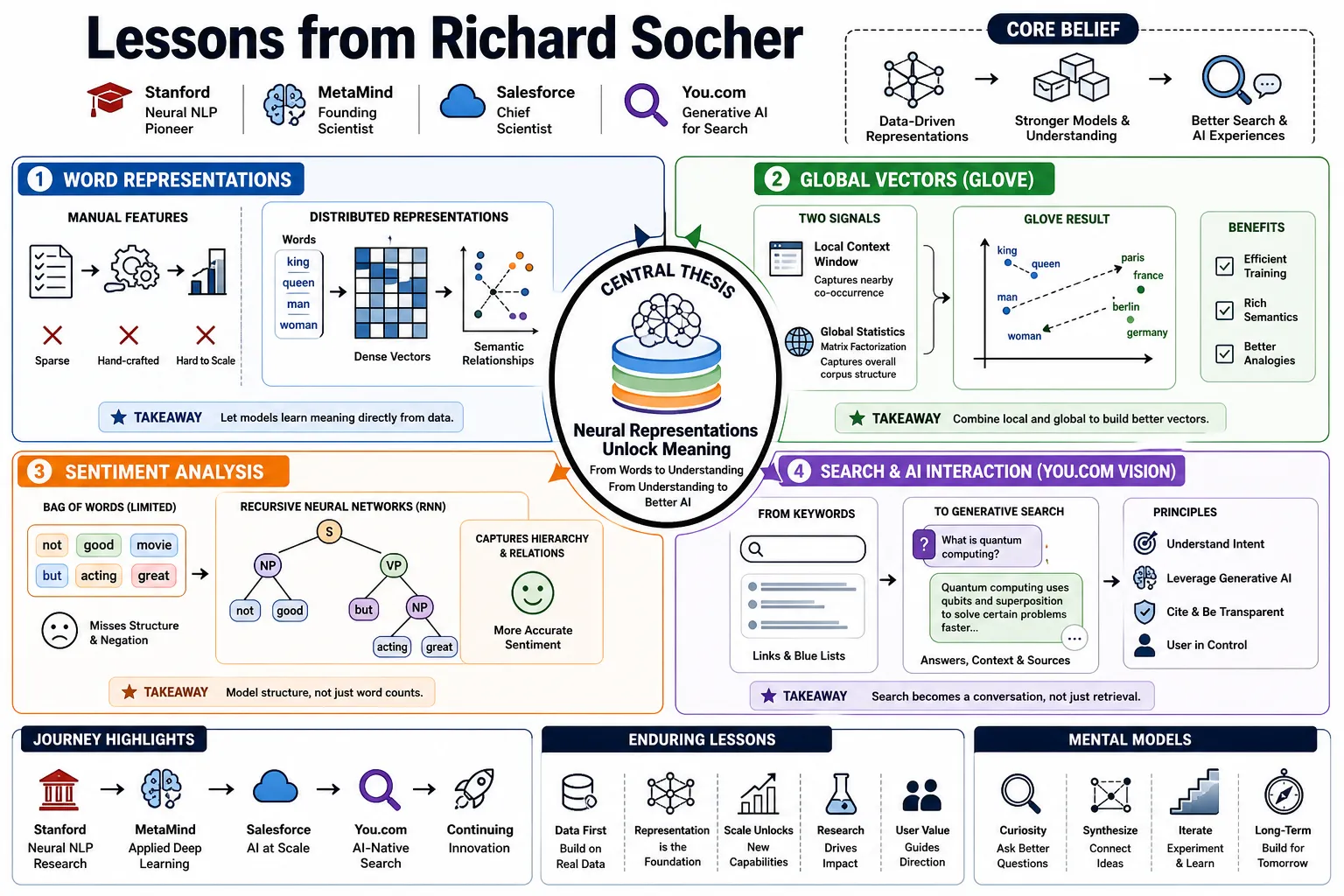
Lessons from Richard Socher
Richard Socher helped bring neural networks to mainstream natural language processing during his time at Stanford. After founding MetaMind and serving as Chief Scientist at Salesforce, he launched You.com to apply generative AI to search. The insights below cover his technical work in deep learning, his approach to building startups, and his views on search and interacting with AI.
Part 1: Deep Learning in NLP
- On Word Representations: "Moving away from manual feature engineering toward distributed representations allows models to capture semantic relationships directly from the data." — Source: [Google Scholar]
- On the Limits of Traditional NLP: "Before deep learning, the field was largely dominated by conditional random fields and latent Dirichlet allocation, which often struggled to scale with complex contextual nuances." — Source: [Cognitive Revolution]
- On Global Vectors (GloVe): "By using both local context window methods and global matrix factorization, we can construct more efficient word vectors that map semantic meaning into vector space." — Source: [Google Scholar]
- On Sentiment Analysis: "Treating text as a 'bag of words' ignores the hierarchy of relations; using Recursive Neural Networks allows us to parse how individual words combine to form the overall sentiment of a sentence." — Source: [Stanford NLP Group]
- On Feature Engineering: "The future of NLP relies on systems that learn the features themselves, rather than relying on human engineers to hand-craft linguistic rules." — Source: [Forbes]
- On Contextual Understanding: "The true meaning of a word is defined by its context; models must analyze the surrounding sentence structure to disambiguate intent." — Source: [Socher.org]
- On the Transition to Neural Networks: "The shift toward deep learning in NLP was met with initial skepticism, but the empirical results on language modeling benchmarks ultimately proved the viability of neural architectures." — Source: [The Gradient]
- On Language as Intelligence: "Natural language capability is one of the most exciting and differentiating manifestations of human intelligence." — Source: [Re-Work]
- On the Evolution of NLP: "The field has evolved from counting word frequencies to training massive models capable of understanding logical structures and complex dependencies within language." — Source: [Stanford University]
Part 2: The Philosophy of Search
- On the Broken State of Search: "Traditional search is fundamentally broken due to its heavy reliance on advertising incentives and SEO-driven content." — Source: [Time Magazine]
- On AI-Powered Search: "Search should evolve from providing a list of blue links to delivering direct, synthesized, and accurate answers." — Source: [You.com]
- On the Advertising Model: "When search engines prioritize ad revenue, the quality of the organic results inevitably degrades, creating a misalignment between the user and the platform." — Source: [You.com]
- On Privacy in Search: "Users deserve a private search experience where their personal data is not commodified to serve targeted advertisements." — Source: [You.com Privacy]
- On Citing Sources: "To combat hallucinations, AI search engines must maintain a digital paper trail, citing real, verifiable sources for every factual claim." — Source: [Time Magazine]
- On Reducing Information Overload: "The goal of modern search is to read the entirety of the internet and summarize it for you, saving you the time of clicking through endless tabs." — Source: [Weights & Biases]
- On Language as an Interface: "Natural language is the fundamental interface for human-computer interaction, and search should feel like a conversation rather than a keyword query." — Source: [Re-Work]
- On User Agency: "Providing users with control over the sources they trust helps build a more customizable and reliable discovery engine." — Source: [You.com]
- On the Future of Knowledge Retrieval: "As models improve, search engines will transition from information retrieval tools into autonomous agents that can execute complex research tasks on your behalf." — Source: [The MAD Podcast]
- On Trust: "Trust is the ultimate currency of any search engine; if users cannot trust the answers provided by an AI, the technology fails its primary purpose." — Source: [Time Magazine]
Part 3: The Future of Work
- On Becoming Managers: "The future of work is all of us becoming managers of AI. You move from being an individual contributor to delegating clearly and specifying requirements." — Source: [Rajiv.com]
- On the Lump of Labor Fallacy: "Work is not a zero-sum game; as AI automates certain tasks, the overall pie grows, leading to a transformation of the workforce rather than its erasure." — Source: [Rajiv.com]
- On Productivity Amplification: "AI allows individuals to operate with the output capacity of an entire team, fundamentally shifting what a single person can accomplish in a day." — Source: [Future.com]
- On Enterprise Applications: "Applying deep learning to real-world business problems like customer service automation and structured data analysis unlocks massive operational efficiency." — Source: [Salesforce Engineering]
- On Skill Shifts: "The most valuable skill will no longer be knowing the answer, but knowing how to ask the right questions and evaluate the AI's output." — Source: [Cognitive Revolution]
- On Democratizing Expertise: "AI democratizes access to high-level reasoning, allowing non-experts to tackle problems that previously required highly specialized training." — Source: [Siemens AI Podcast]
- On Economic Expansion: "By drastically lowering the cost of intelligence, we open up entirely new industries and services that were previously economically unfeasible." — Source: [Thought Economics]
- On Human Creativity: "When mundane, repetitive tasks are automated, human workers are freed to focus on creative and strategic thinking." — Source: [Red Bull]
- On Trusting AI Teammates: "Just like managing human employees, working with AI requires building trust over time by validating its capabilities and understanding its failure modes." — Source: [Rajiv.com]
Part 4: Constructive Optimism
- On Constructive Optimism: "Constructive Optimism means being optimistic about our ability to build incredible technology and systems, while pursuing progress through tangible, pragmatic milestones." — Source: [Socher.org]
- On the Age of AI: "We are entering the Age of AI... This era combines aspects of the renaissance, enlightenment and the industrial revolution." — Source: [Socher.org]
- On Supercharging Science: "AI has the potential to supercharge science and research, accelerating discoveries in medicine, materials, and physics." — Source: [Socher.org]
- On Human Nature: "Artificial intelligence shows us who we really are. By trying to build intelligent machines, we are forced to ask fundamental questions about what it truly means to be human." — Source: [Red Bull]
- On the Trajectory of Progress: "Focusing solely on apocalyptic scenarios ignores the massive, compounding benefits that AI deployment brings to global living standards." — Source: [Thought Economics]
- On Pragmatic Implementation: "True progress in AI isn't simply about theorizing AGI; it's about shipping products that solve real problems for real people today." — Source: [Unicorn Bakery]
- On Managing Disruption: "While technological transitions are always disruptive, society has repeatedly shown the capacity to adapt and ultimately thrive alongside new tools." — Source: [Siemens AI Podcast]
- On Ethical AI Building: "Building ethical AI requires intentionality; it means designing systems that prioritize trust and accuracy from the ground up." — Source: [You.com]
- On Technology as a Tool: "AI is not an autonomous entity with its own desires; it is a tool built by humans, and its impact will be determined by human choices." — Source: [Red Bull]
Part 5: Superintelligence and Safety
- On the Safety Paradox: "Because the marginal cost of intelligence goes way down, AI can actually help defenders in cybersecurity and biological defense by allowing for more extensive red-teaming and system hardening." — Source: [Socher.org]
- On the p(doom) Narrative: "The pessimistic 'p(doom)' scenarios often rely on unrealistic assumptions about how intelligence scales and how society responds to threats." — Source: [Thought Economics]
- On Multiple Superintelligences: "Having multiple, competing superintelligences could potentially drive the net risk of catastrophe toward zero, as they check and balance one another." — Source: [Socher.org]
- On Defensive Scaling: "Defensive technologies generally scale faster and cheaper than offensive ones when both sides have access to the same fundamental AI capabilities." — Source: [Thought Economics]
- On Regulation vs. Innovation: "Prematurely locking down AI research out of fear risks consolidating power in the hands of a few tech giants and stifling the open-source ecosystem." — Source: [Peter Diamandis Podcast]
- On Grounded Risk Assessment: "We should focus on mitigating near-term harms like bias and misinformation, rather than letting hypothetical long-term existential risks paralyze development." — Source: [The Gradient]
- On Open Source: "A thriving open-source AI community is essential for transparency and security, allowing thousands of researchers to audit and improve foundational models." — Source: [The MAD Podcast]
- On Alignment: "Aligning models with human values is an iterative process that relies heavily on human feedback and continuous evaluation in real-world environments." — Source: [Weights & Biases]
- On Defensive AI: "We will use AI to build better firewalls and virus scanners, creating an immune system for the digital world." — Source: [Socher.org]
- On Anthropomorphizing AI: "A common mistake in safety discussions is projecting human motivations, like the desire for power or survival, onto mathematical optimization functions." — Source: [Thought Economics]
Part 6: Prompt Engineering and Interacting with AI
- On Prompting as Programming: "Prompt engineering is essentially programming in natural language; it is the process of structuring language to guide AI models toward generating highly specific outputs." — Source: [You.com]
- On Iterative Refinement: "The best results from LLMs come from a conversational workflow where the user iteratively refines their constraints based on the model's initial drafts." — Source: [Cognitive Revolution]
- On Context Windows: "Providing an LLM with relevant context through retrieval-augmented generation drastically reduces hallucinations and grounds the response in factual reality." — Source: [Time Magazine]
- On Specificity: "When managing AI, vague prompts lead to generic answers; specifying the format and constraints is required for high-quality output." — Source: [Rajiv.com]
- On Hallucination Prevention: "Implementing 'reward engineers' and retrieval mechanisms is required to bridge the gap between a creative language model and a factual search engine." — Source: [Scaled ML 2026]
- On System Instructions: "Setting clear boundaries and rules via system prompts ensures the model behaves predictably and adheres to the required safety guidelines." — Source: [The Gradient]
- On the Role of the User: "The user is no longer querying a database; they are collaborating with an intelligent agent to co-create a solution." — Source: [You.com]
- On Few-Shot Learning: "Demonstrating the desired outcome with a few examples within the prompt is often more effective than explaining the rule in abstract terms." — Source: [Weights & Biases]
- On Interface Design: "The chat interface is powerful, but the future of interacting with AI will involve multi-modal inputs and specialized UI elements tailored to specific workflows." — Source: [Future Proof Podcast]
Part 7: Entrepreneurship and Building
- On Transitioning from Academia: "Moving from academia to industry requires a shift in mindset: a beautiful algorithm only matters if it can be deployed efficiently and solve a real customer pain point." — Source: [The Gradient]
- On Competing with Giants: "To compete against major AI players, startups must focus on agility and highly specific use cases." — Source: [Future Proof Podcast]
- On Product Focus: "The greatest technology in the world will fail if it isn't wrapped in a product that genuinely delights the user and reduces friction." — Source: [Unicorn Bakery]
- On MetaMind's Mission: "MetaMind was founded on the idea that deep learning shouldn't be restricted to a few researchers; it should be accessible to developers building practical applications." — Source: [Salesforce Engineering]
- On Research within Startups: "A successful AI startup balances the need for fundamental research with the rigorous demands of engineering and product shipping." — Source: [The Gradient]
- On Assembling Teams: "Building a high-performing AI team means finding people who are mathematically rigorous but also deeply pragmatic and product-oriented." — Source: [Unicorn Bakery]
- On the Salesforce Acquisition: "Integrating MetaMind into Salesforce allowed us to scale deep learning across the world's leading CRM platform, reaching millions of users instantly." — Source: [Medium]
- On You.com's Origin: "You.com was born from the realization that the primary gateway to the internet had stopped innovating and was failing its users." — Source: [You.com]
- On Founder Resilience: "Being a founder requires an irrational belief in your vision, coupled with the flexibility to constantly adapt your strategy based on market feedback." — Source: [Unicorn Bakery]
- On Value Creation: "The ultimate metric for an AI company isn't parameter count or benchmark scores; it's the amount of time and effort saved for the end user." — Source: [Future Proof Podcast]
Part 8: The Broader AI Era
- On Multimodal Models: "The next frontier is extending deep learning beyond text to seamlessly integrate vision and structured data into a unified understanding of the world." — Source: [Salesforce Engineering]
- On AI Agents: "We are moving from an era of models that only generate text to agents that can reason, plan, and execute multi-step workflows across the internet." — Source: [The MAD Podcast]
- On Moore's Law for AI: "The scaling laws of compute and data suggest that we have not yet hit the ceiling of what neural networks can achieve; the trajectory remains incredibly steep." — Source: [The MAD Podcast]
- On Protein Folding and Science: "Applying language modeling techniques to protein generation demonstrates that the underlying architecture of deep learning is universally applicable to decoding nature's sequences." — Source: [TWIML AI Podcast]
- On Knowledge Work: "AI will do to knowledge work what the tractor did to farming; it won't eliminate the need for humans, but it will fundamentally change the nature of the labor." — Source: [Rajiv.com]
- On Consumer AI: "For AI to reach its full potential, it must break out of enterprise silos and become an intuitive, daily companion for the average consumer." — Source: [You.com]
- On AI Democratization: "Lowering the barrier to entry for AI development ensures that the benefits of this technology are distributed globally, rather than hoarded by a few institutions." — Source: [Siemens AI Podcast]
- On Continuous Learning: "The pace of AI research requires constant adaptation; what was considered state-of-the-art six months ago is often rendered obsolete by the next paradigm shift." — Source: [Cognitive Revolution]
- On the Ultimate Goal: "The purpose of building artificial intelligence is ultimately to empower human intelligence, giving us the tools to solve our most intractable problems." — Source: [Socher.org]