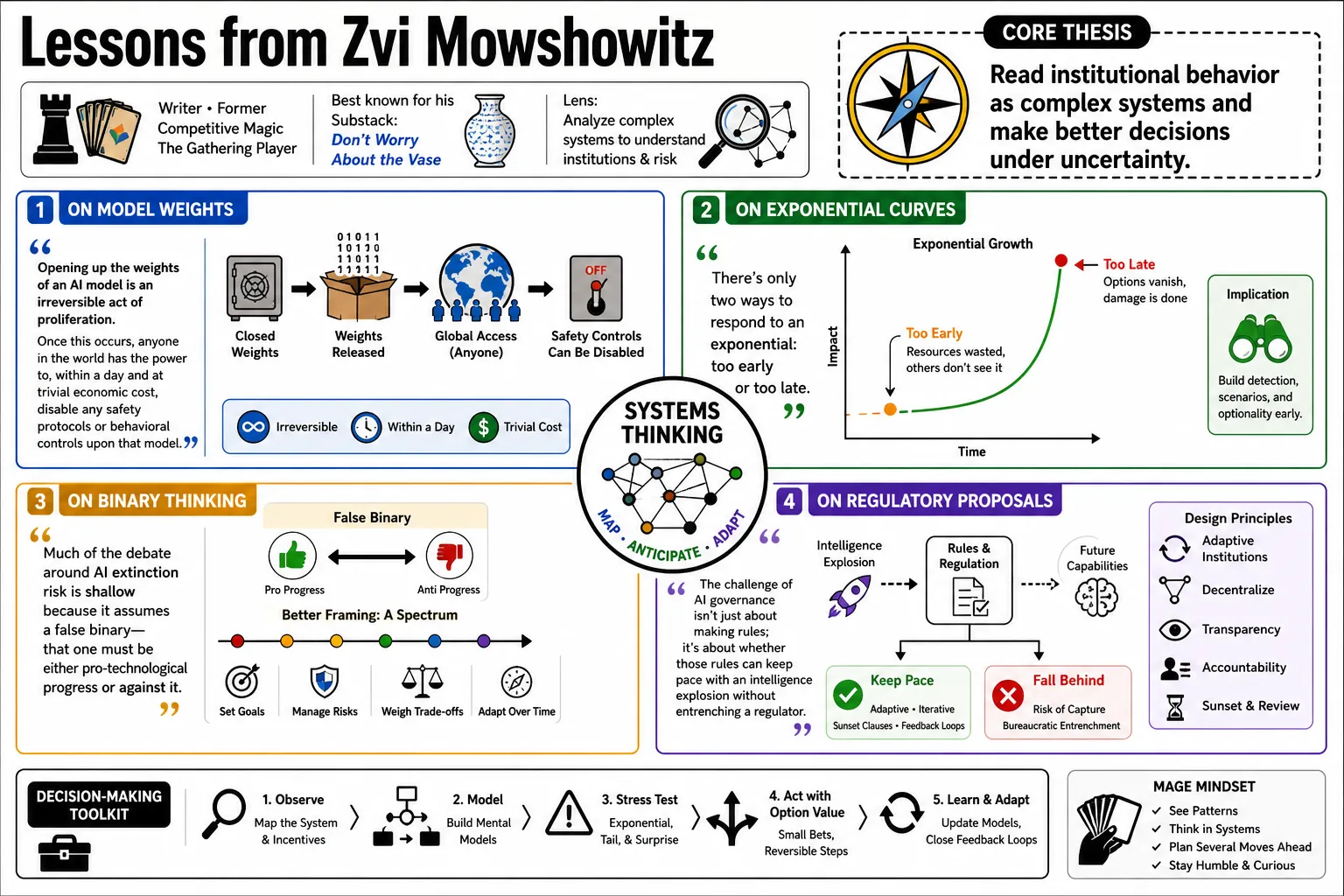
Lessons from Zvi Mowshowitz
Zvi Mowshowitz is a writer and former competitive Magic: The Gathering player best known for his Substack, Don't Worry About the Vase. He unpacks topics from AI safety to corporate bureaucracy by analyzing them as complex systems. This collection gathers his observations on how to read institutional behavior and make decisions under uncertainty.
Part 1: Artificial Intelligence and Existential Risk
- On model weights: "Opening up the weights of an AI model is an irreversible act of proliferation. Once this occurs, anyone in the world has the power to, within a day and at trivial economic cost, disable any safety protocols or behavioral controls upon that model." — Source: [Regulations.gov]
- On exponential curves: "There’s only two ways to respond to an exponential: too early or too late." — Source: [80,000 Hours]
- On binary thinking: "Much of the debate around AI extinction risk is shallow because it assumes a false binary—that one must be either pro-technological progress or against it." — Source: [EconTalk]
- On regulatory proposals: "The challenge of AI governance isn't just about making rules; it's about whether those rules can keep pace with an intelligence explosion without entrenching a regulatory monopoly." — Source: [Don't Worry About the Vase]
- On the AI race: "The activities of companies like OpenAI, Anthropic, and Google represent a live player dynamic, where scaling policies and development pace are driven by race dynamics rather than deliberate safety margins." — Source: [The Cognitive Revolution]
- On AGI exceptionalism: "AGI is fundamentally different from conventional technologies; treating it as just another software tool fails to account for its potential to permanently disempower humanity." — Source: [Don't Worry About the Vase]
- On assessing probability: "Estimating the subjective probability of catastrophic outcomes from AI isn't about precise forecasting, but about bounding the risks and deciding what actions are justified today." — Source: [80,000 Hours]
- On open source AI: "The argument for open-source AI often conflates the benefits of open software with the irreversible dangers of releasing highly capable agentic models." — Source: [Don't Worry About the Vase]
- On alignment: "The technical difficulty of aligning advanced systems is compounded by the fact that we do not fully understand what we are aligning them to, or how to measure success." — Source: [Don't Worry About the Vase]
- On taking progress seriously: "If you truly believe the scaling laws are holding, you must update your entire worldview to account for a radically different future within our lifetimes." — Source: [The Cognitive Revolution]
Part 2: Simulacra Levels and Communication
- On the nature of Simulacra Levels: "Simulacra levels are one of the key concepts I use to think about things, helping to decode how communication operates at different layers of reality." — Source: [Don't Worry About the Vase]
- On Level 1 communication: "Speaking on Level 1 means trying to communicate true and helpful things about physical reality, ignoring higher-level social considerations." — Source: [LessWrong]
- On the tension of honesty: "I do my best to keep acting purely on level 1 as close to true as often as possible, but it's definitely not entirely true. I absolutely think about the higher-level consequences of what I'm writing." — Source: [LessWrong]
- On multidimensional awareness: "I would extend this principle to needing to be aware of all four simulacra levels at once at all times. Say true and helpful things, keeping in mind what people might do with that information, what your statements say about which teams you are on..." — Source: [Don't Worry About the Vase]
- On Level 2 actions: "At Level 2, statements are no longer strictly about truth; they are moves in a game designed to cause a specific action or reaction from the listener." — Source: [Don't Worry About the Vase]
- On Level 3 affiliation: "Level 3 communication is about signaling loyalty and identifying who is on which team, where the literal meaning of words is entirely secondary to their associative vibe." — Source: [Clearer Thinking]
- On Level 4 communication: "At the highest level of simulacra, symbols lose all connection to their original meaning or even group affiliation, becoming pure, self-referential aesthetics." — Source: [Don't Worry About the Vase]
- On social interpretation: "Interpreting public statements requires understanding the group's default interpretation and assumed motivation rather than just parsing the literal words." — Source: [Don't Worry About the Vase]
- On the decay of meaning: "When institutions operate primarily at Level 3 or 4, they lose the ability to accurately model the world and solve actual, physical problems." — Source: [80,000 Hours]
Part 3: Immoral Mazes and Corporate Dynamics
- On corporate assimilation: "The coerced performance of belief, sustained long enough, becomes indistinguishable from actual belief — and that is the point at which your soul has been successfully replaced by the system's." — Source: [Don't Worry About the Vase]
- On the management horizon: "Our horizon is today’s lunch." — Source: [Don't Worry About the Vase]
- On organizational decay: "When organizations grow too large, they inevitably become ineffective at achieving their actual goals, shifting focus entirely toward internal political competition." — Source: [Effective Altruism Forum]
- On the illusion of momentum: "Successful managers in these systems must constantly preserve the illusion of upward trajectory, as their status is tied to perceived momentum rather than substantive work." — Source: [Don't Worry About the Vase]
- On professionalism: "The corporate definition of professionalism is a trap—a way to prioritize bureaucratic survival and bland, euphemistic language over ethical clarity." — Source: [Don't Worry About the Vase]
- On blame shifting: "In a maze, the primary function of a manager is to ensure that when something goes wrong, the blame lands on someone else." — Source: [Don't Worry About the Vase]
- On goal displacement: "The original purpose of an institution is quickly forgotten by the individuals inside it, whose only rational goal becomes advancing their own position within the hierarchy." — Source: [Don't Worry About the Vase]
- On surviving the maze: "You cannot beat the maze by playing its game better than everyone else while keeping your morals intact; the maze changes you to fit its needs." — Source: [Don't Worry About the Vase]
- On systemic failure: "Large bureaucracies don't fail because the people inside are evil; they fail because the incentive gradients reward political maneuvering over competence." — Source: [LessWrong]
- On extracting value: "The only way to win a moral maze without losing your soul is to recognize it for what it is, extract the resources you need, and leave before it assimilates you." — Source: [Don't Worry About the Vase]
Part 4: Slack and Optimal Performance
- On defining slack: "Slack is the absence of binding constraints on behavior." — Source: [Slate Star Codex]
- On the necessity of slack: "Humans need slack to survive, and they need slack to do anything worthwhile." — Source: [Don't Worry About the Vase]
- On the danger of zero slack: "Without slack, individuals are forced into a myopic state, constantly parrying immediate threats with no cognitive cycles left for long-term planning or strategy." — Source: [LessWrong]
- On competition and slack: "Slack is evidence of not being fully committed, which makes it a liability in an environment of perfect competition but essential for long-term survival." — Source: [Don't Worry About the Vase]
- On Moloch and slack: "The hyper-competitive dynamic of Moloch operates by systematically stripping away all slack from a system until everyone is pushed to the breaking point." — Source: [LessWrong]
- On creative work: "High-level creative or intellectual work cannot be scheduled to the minute; it requires an abundance of slack to allow for the exploration of dead ends and novel ideas." — Source: [Don't Worry About the Vase]
- On system resilience: "A system optimized perfectly for efficiency has zero slack, meaning the slightest perturbation will cause catastrophic failure." — Source: [Don't Worry About the Vase]
- On personal well-being: "Feeling constantly overwhelmed is usually a symptom of having drained all your slack, leaving you unable to absorb minor, expected life shocks." — Source: [Don't Worry About the Vase]
- On the illusion of productivity: "Maximizing every hour of the day for visible output destroys the invisible slack required to decide if you are even working on the right thing." — Source: [Don't Worry About the Vase]
Part 5: Magic: The Gathering and Strategy
- On high-cost investments: "Anything that costs four or more mana should win the game by itself." — Source: [CoolStuffInc]
- On the ultimate objective: "You play to win the game. That is the rule." — Source: [Don't Worry About the Vase]
- On metagame analysis: "Success in competitive environments comes from accurately understanding the tournament environment and building solutions designed specifically to snipe the dominant strategy." — Source: [StarCityGames]
- On proactive planning: "You must understand what your opponent wants to do and formulate a plan that allows you to win despite their efforts, rather than simply reacting to their plays." — Source: [StarCityGames]
- On The Solution: "The best deck is often not the most objectively powerful one in a vacuum, but the one perfectly calibrated to counter the expected field." — Source: [Magic: The Gathering]
- On heuristic value: "Rules of thumb, like evaluating cards by their mana cost, are not literal laws, but foundational heuristics that prevent you from falling for trap investments." — Source: [CoolStuffInc]
- On strategic focus: "Every card in a deck must justify its inclusion by advancing the core strategy; there is no room for cards that are merely good without being cohesive." — Source: [StarCityGames]
- On exploiting formats: "A format is truly broken when a player can theoretically analyze the underlying mechanics deeper than the designers intended and exploit the gaps." — Source: [Reddit]
- On adapting to change: "The best players do not mourn the rotation of their favorite cards; they immediately look for the structural inefficiencies in the new environment." — Source: [StarCityGames]
Part 6: Public Health and Institutional Failure
- On bureaucratic delays: "The insistence on running FDA advisory committees at a normal pace during an emergency demonstrated a prioritizing of institutional process over urgent public health outcomes." — Source: [Don't Worry About the Vase]
- On inconsistent messaging: "When health agencies provide overcautious or contradictory messaging to manage public behavior, they rapidly erode the trust needed for long-term compliance." — Source: [Don't Worry About the Vase]
- On data-driven evaluation: "Navigating a pandemic requires constantly updating your models with empirical data, rather than stubbornly clinging to initial institutional assumptions." — Source: [Don't Worry About the Vase]
- On behavioral adaptation: "People will naturally adapt their behavior to the perceived level of risk, meaning that policies ignoring these adaptations will miscalculate actual outcomes." — Source: [Don't Worry About the Vase]
- On media distortion: "Public health communication is heavily distorted by the media ecosystem, which strips away nuance to fit statements into simplified, polarized narratives." — Source: [Narratives Podcast]
- On human challenge trials: "The reluctance to allow informed volunteers to participate in challenge trials to speed up vaccine development was a massive, lethal failure of moral calculus." — Source: [Don't Worry About the Vase]
- On pulling the rope sideways: "In highly polarized crises, the most effective analysis avoids political tribalism entirely, aiming instead for pragmatic, reality-based problem-solving." — Source: [EconTalk]
- On the cost of caution: "Over-regulation and the fear of making a visible mistake often cost more lives invisibly than taking decisive, calculated action would have." — Source: [Don't Worry About the Vase]
- On Bayesian updates: "Public health models must be treated as living documents, shifting continuously as new evidence about transmission rates and herd immunity thresholds emerges." — Source: [Don't Worry About the Vase]
Part 7: Rationality and Decision-Making
- On The Way: "Rigorous, high-standard thinking requires systematically modeling the world and applying those models to real-world problems without flinching." — Source: [LessWrong]
- On writing quickly: "Good fiction writing is even harder. Good writing on arbitrary topics, quickly, on demand, with minimal prompting? Forget about it." — Source: [Don't Worry About the Vase]
- On career paths: "A meaningful career often resembles a winding path, not with a grand plan, adapting continuously as new information and opportunities arise." — Source: [Theo Jaffee]
- On epistemic standards: "The rationalist community's core strength lies in its insistence on high epistemic standards and a willingness to follow the math wherever it leads." — Source: [LessWrong]
- On systemic thinking: "You cannot solve a complex problem by looking at isolated variables; you must understand the incentive structures that generate the behavior you want to change." — Source: [Don't Worry About the Vase]
- On acknowledging trade-offs: "Every decision involves a trade-off; pretending that a policy has only benefits and no costs is a sign of unserious thinking." — Source: [Don't Worry About the Vase]
- On truth-seeking: "The goal of an argument should never be to win the debate, but to collaboratively map the territory more accurately than before." — Source: [LessWrong]
- On forecasting: "Making explicit predictions and tracking their accuracy is one of the only ways to calibrate your judgment and avoid hindsight bias." — Source: [Don't Worry About the Vase]
- On evaluating arguments: "An argument's validity is completely independent of the tribal affiliations or perceived status of the person making it." — Source: [LessWrong]
Part 8: Epistemology and Models
- On building models: "Your internal model of the world is your most valuable asset; protecting its integrity from ideological pollution is essential." — Source: [LessWrong]
- On the map and the territory: "Recognizing when your heuristic no longer maps to the underlying reality is the first step in avoiding catastrophic errors." — Source: [LessWrong]
- On the limits of data: "Data can tell you what happened, but without a robust causal model, it cannot tell you why it happened or what will happen next." — Source: [Don't Worry About the Vase]
- On updating beliefs: "A rational agent must be willing to abandon a closely held belief the moment sufficient disconfirming evidence is presented." — Source: [LessWrong]
- On intellectual honesty: "True intellectual honesty means making your arguments clear enough that someone else could actually prove them wrong." — Source: [LessWrong]
- On identifying constraints: "The bottleneck of any system is rarely where people are shouting the loudest; it is found by rigorously tracing the flow of resources." — Source: [Don't Worry About the Vase]
- On the nature of expertise: "True experts do not merely memorize facts; they possess an intuitive model of their domain that allows them to immediately spot anomalies." — Source: [LessWrong]
- On navigating uncertainty: "When faced with high uncertainty, the optimal strategy is often to preserve optionality and gather information, rather than committing prematurely." — Source: [Don't Worry About the Vase]
- On compounding knowledge: "Insights across different domains—from card games to public policy to artificial intelligence—compound when you recognize the underlying structural similarities." — Source: [Don't Worry About the Vase]
- On taking ideas seriously: "The rarest skill is the ability to take an abstract idea seriously enough to actually change your behavior in the physical world." — Source: [LessWrong]