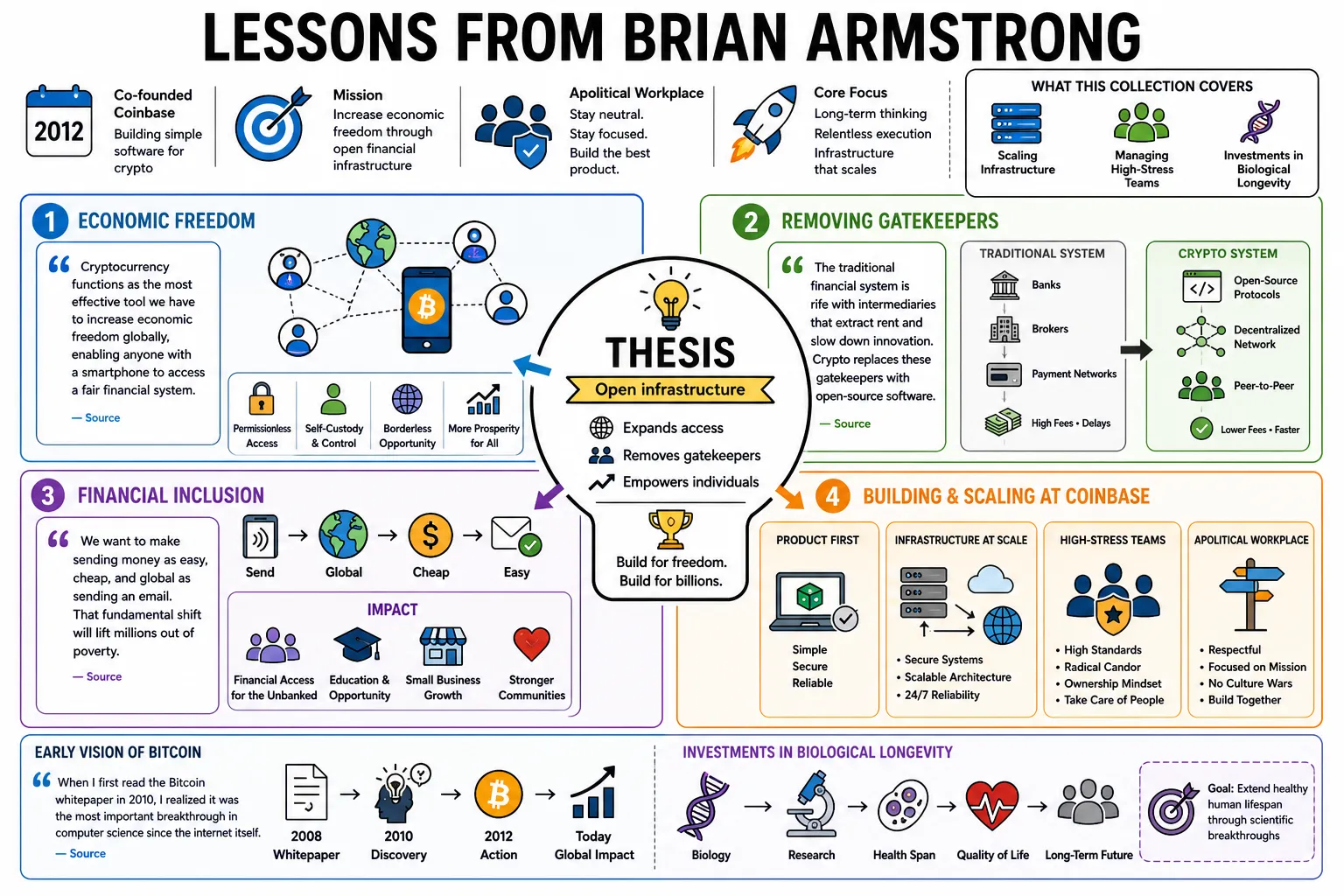
Lessons from Brian Armstrong
Brian Armstrong is the co-founder and CEO of Coinbase, the cryptocurrency exchange founded in 2012, and has also backed ResearchHub and NewLimit. — The Tim Ferriss Show: Brian Armstrong, CEO of Coinbase (2022, transcript).
Part 1: Cryptocurrency and Economic Freedom
- On the Mission: Asked what the mission of Coinbase is, Armstrong says "it's to increase economic freedom in the world." — Lex Fridman Podcast #307: "Brian Armstrong: Coinbase, Cryptocurrency, and Government Regulation" (2022, transcript).
- On What Economic Freedom Correlates With: Armstrong: "the really cool thing about economic freedom is that basically it positively correlates with things that we all want in society." — Lex Fridman Podcast #307: "Brian Armstrong: Coinbase, Cryptocurrency, and Government Regulation" (2022, transcript).
- On Not Sticking Your Head Up: Of Argentina under hyperinflation, Armstrong describes a vibe of "don't stick your head up, don't try too hard, because it could all be gone tomorrow." — Lex Fridman Podcast #307: "Brian Armstrong: Coinbase, Cryptocurrency, and Government Regulation" (2022, transcript).
- On Keeping the Upside: In high economic freedom countries, Armstrong says people "just try more stuff because they're like, if I do good for other people, I'll get to keep part of it for myself." — Lex Fridman Podcast #307: "Brian Armstrong: Coinbase, Cryptocurrency, and Government Regulation" (2022, transcript).
- On the Whitepaper Hunch: Armstrong: "I realized when I read the Bitcoin whitepaper a long time ago that, at least I had a hunch at the time, I was like, this might be a really powerful piece of technology." — Lex Fridman Podcast #307: "Brian Armstrong: Coinbase, Cryptocurrency, and Government Regulation" (2022, transcript).
- On a Secret in Plain Sight: Armstrong: "crypto is this secret hiding in plain sight that can create economic freedom for people all over the world and a more fair and free and global economy." — Lex Fridman Podcast #307: "Brian Armstrong: Coinbase, Cryptocurrency, and Government Regulation" (2022, transcript).
- On a Reserve Currency: Armstrong: "I do think Bitcoin could end up becoming a reserve currency of the world." — Lex Fridman Podcast #307: "Brian Armstrong: Coinbase, Cryptocurrency, and Government Regulation" (2022, transcript).
- On a Billion People: Armstrong: "we want to be the way that a billion people hopefully access the open financial system globally." — Lex Fridman Podcast #307: "Brian Armstrong: Coinbase, Cryptocurrency, and Government Regulation" (2022, transcript).
- On the Primary Account: Armstrong: "we're the primary financial account for people in the crypto economy. How they buy crypto, how they store it, how they use it increasingly in different ways." — Lex Fridman Podcast #307: "Brian Armstrong: Coinbase, Cryptocurrency, and Government Regulation" (2022, transcript).
- On Attaching a Business Model: On changing the world through a company, Armstrong says "If you don't have a business model, you're just collecting donations." — All-In E77: "Tech work culture, crypto regulation, stablecoins & more w/ Coinbase CEO Brian Armstrong" (2022, transcript).
Part 2: Building and Scaling Coinbase
- On the First Check: Armstrong: "Paul Graham and the Y Combinator group kind of wrote me the first check after I went and interviewed." — Lex Fridman Podcast #307: "Brian Armstrong: Coinbase, Cryptocurrency, and Government Regulation" (2022, transcript).
- On Wandering Lost: Armstrong: "there was definitely a feeling of just wandering lost in the desert, lots of self doubt." — Lex Fridman Podcast #307: "Brian Armstrong: Coinbase, Cryptocurrency, and Government Regulation" (2022, transcript).
- On Finding Product Market Fit: Once the buy button launched, Armstrong says "we finally had found product market fit after two years of wandering in the desert." — Lex Fridman Podcast #307: "Brian Armstrong: Coinbase, Cryptocurrency, and Government Regulation" (2022, transcript).
- On the Buy Bitcoin Button: Armstrong recalls asking an early user "if I put a buy Bitcoin button in there, would you have used it? And he was like, yeah, maybe." — Lex Fridman Podcast #307: "Brian Armstrong: Coinbase, Cryptocurrency, and Government Regulation" (2022, transcript).
- On Talking to Customers: Armstrong: "in Y Combinator, they often tell you like, talk to your customers and improve your product. That's all you're supposed to be doing." — Lex Fridman Podcast #307: "Brian Armstrong: Coinbase, Cryptocurrency, and Government Regulation" (2022, transcript).
- On Surviving Downturns: Armstrong says the team had to "manage our own psychology and the balance sheet to make sure we didn't like die in the downturn, which a lot of crypto companies did." — Lex Fridman Podcast #307: "Brian Armstrong: Coinbase, Cryptocurrency, and Government Regulation" (2022, transcript).
- On Professionalizing: Armstrong: "We had to basically professionalize a whole bunch of services that had been just very quickly thrown together by like 20-year-olds." — Lex Fridman Podcast #307: "Brian Armstrong: Coinbase, Cryptocurrency, and Government Regulation" (2022, transcript).
- On Messy Finances: Armstrong admits "Our finances were a mess. Like we didn't even really know how much money we had at certain times." — Lex Fridman Podcast #307: "Brian Armstrong: Coinbase, Cryptocurrency, and Government Regulation" (2022, transcript).
- On Fraud Labels: On fraud prevention, Armstrong says you "build up a labeled data set of all the different people who have turned out to be fraudulent and good actors." — Lex Fridman Podcast #307: "Brian Armstrong: Coinbase, Cryptocurrency, and Government Regulation" (2022, transcript).
- On Custody: Armstrong: "we've invented a lot of cool technology about how to do that securely that helps me sleep at night as one of the largest crypto custodians out there." — Lex Fridman Podcast #307: "Brian Armstrong: Coinbase, Cryptocurrency, and Government Regulation" (2022, transcript).
Part 3: The Mission-Driven Company
- On Being Laser Focused: Armstrong: "I want Coinbase to be laser focused on achieving its mission, because I believe that this is the way that we can have the biggest impact on the world." — Brian Armstrong, "Coinbase is a mission focused company," Coinbase blog (2020).
- On Focusing for a Decade: Armstrong: "Change happens in the world only when a smart, talented, group of people come together to focus on a hard problem for a decade or more." — Brian Armstrong, "Coinbase is a mission focused company," Coinbase blog (2020).
- On Dabbling: Armstrong: "Many companies never stand the test of time, because they decide to dabble in unrelated efforts, and distract and divide their workforce in the process." — Brian Armstrong, "Coinbase is a mission focused company," Coinbase blog (2020).
- On a Refuge: Armstrong says employees "want the workplace to be a refuge from the division that is increasingly present in the world." — Brian Armstrong, "Coinbase is a mission focused company," Coinbase blog (2020).
- On the Mission Statement: Armstrong: "Coinbase's mission is to create an open financial system for the world." — Brian Armstrong, "Coinbase is a mission focused company," Coinbase blog (2020).
- On Not Doing Everything: Armstrong: "I don't think companies can succeed trying to do everything." — Brian Armstrong, "Coinbase is a mission focused company," Coinbase blog (2020).
- On Life Being Too Short: Armstrong: "Life is too short to work somewhere that you aren't excited about." — Brian Armstrong, "Coinbase is a mission focused company," Coinbase blog (2020).
- On Being Honest: Armstrong: "I would rather be honest and transparent about that than equivocate and work in a company that is not aligned." — Brian Armstrong, "Coinbase is a mission focused company," Coinbase blog (2020).
- On the Exit Package: In his follow-up, Armstrong wrote that "about 5% of employees (60) have decided to take the exit package." — Brian Armstrong, "A follow up to Coinbase being a mission focused company" (2020).
- On Saying It Up Front: Armstrong: "if you're starting a company today, just make that clear up front. I didn't make it clear up front. And so the company culture started to diverge and drift." — All-In E77: "Tech work culture, crypto regulation, stablecoins & more w/ Coinbase CEO Brian Armstrong" (2022, transcript).
Part 4: Regulation, Policy, and Standing Up
- On Clarifying Securities Law: Armstrong: "the securities laws in the US need to be clarified about what, crypto is many different things. That's what people don't realize." — Lex Fridman Podcast #307: "Brian Armstrong: Coinbase, Cryptocurrency, and Government Regulation" (2022, transcript).
- On Commodities: Armstrong: "some crypto like Bitcoin and Ethereum and many others are probably more like commodities. They're not controlled by any one person." — Lex Fridman Podcast #307: "Brian Armstrong: Coinbase, Cryptocurrency, and Government Regulation" (2022, transcript).
- On the Shut It Down View: Armstrong: "there's a very unhelpful point of view out there by some folks, which is, hey, this is all, most of this is like bad activity. We need to shut it down." — Lex Fridman Podcast #307: "Brian Armstrong: Coinbase, Cryptocurrency, and Government Regulation" (2022, transcript).
- On Doing What Will Be Required: Armstrong: "we want to go do what we think is going to be required in the future, go get licenses, go do KYC, go do AML anti-money laundering." — All-In E77: "Tech work culture, crypto regulation, stablecoins & more w/ Coinbase CEO Brian Armstrong" (2022, transcript).
- On Threading the Needle: Armstrong: "You don't want to wait too long for clarity because sometimes these things take five ten years And so you'll just never launch a product. But if you're too aggressive, you can blow the place up." — All-In E77: "Tech work culture, crypto regulation, stablecoins & more w/ Coinbase CEO Brian Armstrong" (2022, transcript).
- On Being Regulated: Armstrong: "Coinbase is now a very regulated financial service business." — All-In E77: "Tech work culture, crypto regulation, stablecoins & more w/ Coinbase CEO Brian Armstrong" (2022, transcript).
- On Clarity Each Year: Armstrong: "the US has actually been pretty forward thinking on this. I'd say every year we get more and more clarity." — All-In E77: "Tech work culture, crypto regulation, stablecoins & more w/ Coinbase CEO Brian Armstrong" (2022, transcript).
Part 5: Science, Longevity, and ResearchHub
- On a False Economy of Reputation: On academia, Armstrong says "it's kind of like a false economy of reputation because there's not real money backing it." — Lex Fridman Podcast #307: "Brian Armstrong: Coinbase, Cryptocurrency, and Government Regulation" (2022, transcript).
- On Antiquated Research: Armstrong: "there's all kinds of things that feel very antiquated to me about scientific research." — Lex Fridman Podcast #307: "Brian Armstrong: Coinbase, Cryptocurrency, and Government Regulation" (2022, transcript).
- On Journals Holding Back Innovation: Armstrong: "there's like these big companies that have sort of, in my view, kind of held back innovation here." — Lex Fridman Podcast #307: "Brian Armstrong: Coinbase, Cryptocurrency, and Government Regulation" (2022, transcript).
- On a Passionate Community: Of ResearchHub, Armstrong says "we've got like a really passionate community on there." — Lex Fridman Podcast #307: "Brian Armstrong: Coinbase, Cryptocurrency, and Government Regulation" (2022, transcript).
- On Hiring at NewLimit: Armstrong: "I'm on the board at New Limit. We're hiring talented scientists that are interested in the cellular programming space." — Lex Fridman Podcast #307: "Brian Armstrong: Coinbase, Cryptocurrency, and Government Regulation" (2022, transcript).
Part 6: Leadership, Focus, and Resilience
- On the CEO Job Not Being Fun: Armstrong: "I was thinking, God, the CEO job is just not that fun, to be honest." — The Tim Ferriss Show: Brian Armstrong, CEO of Coinbase (2022, transcript).
- On What He Is Good At: Armstrong: "I want to build cool stuff with technology that changes the world. That's what I'm good at." — The Tim Ferriss Show: Brian Armstrong, CEO of Coinbase (2022, transcript).
- On Writing to Think: Armstrong: "I tried to write a blog post because when I'm trying to formulate my thinking, I try to write." — The Tim Ferriss Show: Brian Armstrong, CEO of Coinbase (2022, transcript).
- On Not Caring About Headlines: Armstrong: "I don't really care so much about a couple bad headlines. I care if we're, are we building an aligned culture that can actually accomplish this mission long term?" — The Tim Ferriss Show: Brian Armstrong, CEO of Coinbase (2022, transcript).
- On Failing as a Leader: Armstrong: "I realized the company was divided on this issue and I was kind of failing as a leader if I didn't come out and make it clear." — The Tim Ferriss Show: Brian Armstrong, CEO of Coinbase (2022, transcript).
- On Yes-Sayers: Armstrong: "you never want to become so surrounded by people who just work for you and will say yes." — Lex Fridman Podcast #307: "Brian Armstrong: Coinbase, Cryptocurrency, and Government Regulation" (2022, transcript).
- On Caring Too Much: Armstrong: "you also can't care so much about what people think because then you'll never do anything that's truly authentic to yourself." — Lex Fridman Podcast #307: "Brian Armstrong: Coinbase, Cryptocurrency, and Government Regulation" (2022, transcript).
- On Making It the Company You Want: Armstrong: "I need to make this the company that I want to work at." — Lex Fridman Podcast #307: "Brian Armstrong: Coinbase, Cryptocurrency, and Government Regulation" (2022, transcript).
Part 7: Hiring, Talent, and High-Performance Teams
- On Dropping Brain Teasers: Armstrong: "we put in like brain teasers and stuff, but we don't do that anymore. We do like normal interviews. We do references." — Lex Fridman Podcast #307: "Brian Armstrong: Coinbase, Cryptocurrency, and Government Regulation" (2022, transcript).
- On What the Role Requires: Armstrong: "I like to think about what do we need this person to accomplish in this role, right?" — Lex Fridman Podcast #307: "Brian Armstrong: Coinbase, Cryptocurrency, and Government Regulation" (2022, transcript).
- On the Hardest Problem: Armstrong asks "tell me about a time you did X and, or tell me about the hardest, the hardest kind of problem you've had to solve in Y and what did you do specifically to overcome it." — Lex Fridman Podcast #307: "Brian Armstrong: Coinbase, Cryptocurrency, and Government Regulation" (2022, transcript).
- On Concise Communicators: Armstrong looks for "concise communicators. Can they just give me a clear answer and stop talking?" — Lex Fridman Podcast #307: "Brian Armstrong: Coinbase, Cryptocurrency, and Government Regulation" (2022, transcript).
- On Blame: Armstrong asks "were they part of the solution or are they still holding on to like blame and criticism." — Lex Fridman Podcast #307: "Brian Armstrong: Coinbase, Cryptocurrency, and Government Regulation" (2022, transcript).
- On the Four Questions: Armstrong: "Can they get the job done? Will they work together on a team? Can they communicate effectively? Do they fit into our cultural values." — Lex Fridman Podcast #307: "Brian Armstrong: Coinbase, Cryptocurrency, and Government Regulation" (2022, transcript).
Part 8: The Future of Finance and Technology
- On Being a Critic: Armstrong: "it's easy to be a critic. It's hard to actually change these things and fix it." — Lex Fridman Podcast #307: "Brian Armstrong: Coinbase, Cryptocurrency, and Government Regulation" (2022, transcript).
- On the Arena: Armstrong: "be the person in the arena." — Lex Fridman Podcast #307: "Brian Armstrong: Coinbase, Cryptocurrency, and Government Regulation" (2022, transcript).
- On Joining or Starting: Armstrong: "either join a company that has a mission that is trying to fix the thing you're passionate about, or start that company if it doesn't exist, or start a charity." — Lex Fridman Podcast #307: "Brian Armstrong: Coinbase, Cryptocurrency, and Government Regulation" (2022, transcript).
- On Technology: Armstrong: "technology is actually one of the most important ways to improve the world." — Lex Fridman Podcast #307: "Brian Armstrong: Coinbase, Cryptocurrency, and Government Regulation" (2022, transcript).
- On Good People: Armstrong: "most people in the world are good, is at least my view." — Lex Fridman Podcast #307: "Brian Armstrong: Coinbase, Cryptocurrency, and Government Regulation" (2022, transcript).
- On Getting Started: Armstrong: "if you're not sure what to do, like just get started with anything. That's how you learn." — Lex Fridman Podcast #307: "Brian Armstrong: Coinbase, Cryptocurrency, and Government Regulation" (2022, transcript).
- On Power People Have: Armstrong: "people have more power than they realize." — Lex Fridman Podcast #307: "Brian Armstrong: Coinbase, Cryptocurrency, and Government Regulation" (2022, transcript).
- On Fulfilling Work: Armstrong: "most people want to do something important. They want to have fulfilling work, a way that they can feel like they're contributing." — Lex Fridman Podcast #307: "Brian Armstrong: Coinbase, Cryptocurrency, and Government Regulation" (2022, transcript).