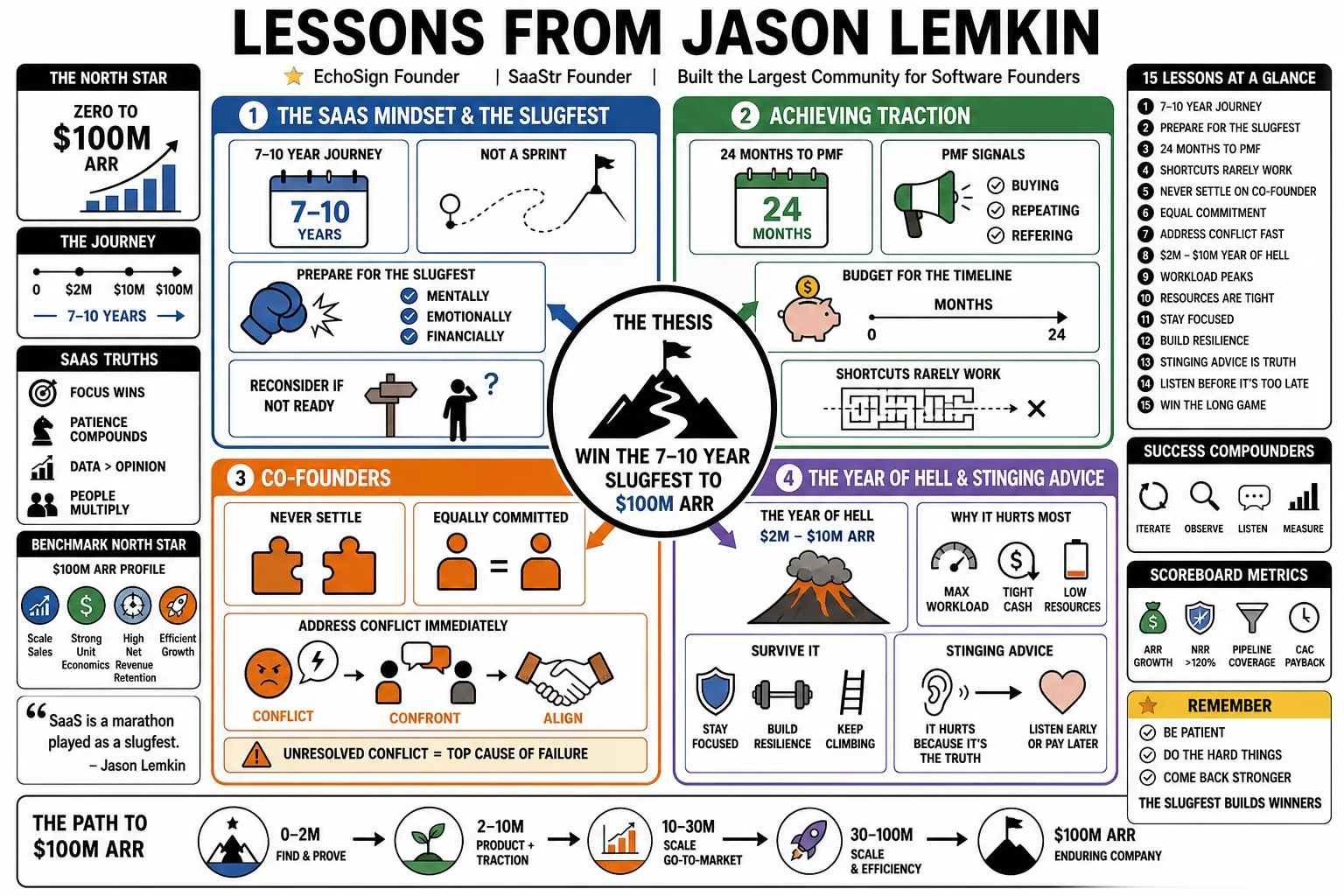
Lessons from Jason Lemkin
Jason Lemkin founded EchoSign and built SaaStr into the largest community for software founders. He defined the standard benchmarks for scaling a SaaS company from zero to $100 million in recurring revenue. This collection organizes his operating advice so founders can put his frameworks into practice.
Part 1: The SaaS Mindset and Early Days
- On The Slugfest: "SaaS is a 7 to 10-year journey to $100M ARR; if you aren't prepared for the multi-year slugfest, reconsider starting." — Source: [SaaStr]
- On Achieving Traction: "It often takes a full 24 months to achieve true product-market fit. Budget for this timeline because shortcuts rarely work in B2B." — Source: [Medium]
- On Co-Founders: "Never settle. A great, equally committed co-founder is required. Address conflict immediately rather than letting it simmer, as it is a primary cause of startup failure." — Source: [SaaStr]
- On The Year of Hell: "The best founders survive the 'Year of Hell', often between $2M and $10M ARR, when the workload peaks and resources are incredibly tight." — Source: [Medium]
- On Stinging Advice: "The criticism that hurts the most is usually the truth you need to hear. Listen to it before you run out of money or your competitive edge fades." — Source: [SaaStr]
- On Market Insight: "A founder’s understanding of their market must deepen over time. If your insight isn't getting sharper after a few years, your company will struggle." — Source: [SaaStr]
- On Customer Discovery: "Talk to 20 prospective customers before writing a line of code. The first ten reveal the white space and confirm patterns, while the final ten refine the pitch." — Source: [Predictable Revenue]
- On Avoiding Burnout: "As you scale, you must hire strong management teams to carry the load and prevent founder burnout. You can no longer be the VP of Everything." — Source: [SaaStr]
- On Transparency: "Aim for 90% transparency. Being mostly transparent helps the team understand the stakes and builds trust in leadership." — Source: [SaaStr]
Part 2: Achieving Product-Market Fit
- On Early Traction: "The primary focus from zero to $1M ARR is achieving product-market fit. Do not rush this stage or chase new markets yet." — Source: [SaaStr]
- On Building What Matters: "Avoid the 'set it and forget it' trap. Pushing one feature every year is dead; you must adapt and innovate faster to stay competitive." — Source: [SaaStr]
- On Outsourcing: "You can outsource experiments, but you cannot outsource your core technology and sales motion." — Source: [SaaStr]
- On Adding Layers: "As you mature, add new layers to your business to accelerate growth, like launching a second core product or expanding internationally." — Source: [SaaStr Europa AMA]
- On Continuous Recruiting: "Founders must commit to constant recruiting, spending 20% of their time on it, to build necessary leadership layers." — Source: [Medium]
- On Ignoring Feedback: "Many founders make the same mistakes repeatedly by ignoring what the market is telling them and cutting marketing budgets too aggressively." — Source: [SaaStr]
- On Focus: "Less is more. Avoid stretching resources thin by chasing every growth tactic. Prioritize one or two metrics that actually move the needle." — Source: [SaaStr]
- On Uniqueness: "Even in crowded markets, you must find a unique angle. Customers buy because you solve a specific pain point better than the legacy options." — Source: [SaaStr]
- On Pricing: "Your software was built for humans. As AI agents emerge, they don't care about seats, which will fundamentally break the traditional per-seat pricing model." — Source: [Substack]
Part 3: Sales Strategy and Closing
- On The CEO's Role in Sales: "Even as a founder and CEO, do not fully step away from sales until it is absolutely necessary." — Source: [SaaStr Sales Machine Deep Dive]
- On The First Salesperson: "Before hiring a VP of Sales, the CEO should act as the primary evangelist and the first salesperson." — Source: [Mattermark]
- On Sales Specialization: "Begin specializing your sales team by the time you reach $2M in ARR." — Source: [Paubox]
- On Frictionless Sales: "Relentlessly remove friction from the buying process. Buying should be easier than deploying." — Source: [Paubox]
- On Subject Matter Experts: "Being a true subject matter expert is the most important trait of a top-performing sales representative." — Source: [SaaStr]
- On The Best Salespeople: "The best reps make the customer feel like they matter and genuinely help solve their problems, rather than merely pushing a product." — Source: [SaaStr]
- On Rep Performance: "A great rep can close 9x more than a poor rep, and even 2.5x more than a good rep. Investing in top talent is a requirement." — Source: [SaaStr]
- On SMB vs Enterprise: "SMB and Enterprise sales have nothing in common. You cannot use the same playbook for different customer segments." — Source: [SaaStr]
- On Quotas: "Your quickest way to grow faster is to move from quarterly to monthly sales quotas." — Source: [SaaStr]
- On AI in Sales: "With the rise of AI, the number of human sales reps required to hit high-revenue targets may decrease as AI agents become more capable." — Source: [Substack]
Part 4: Hiring and Managing a VP of Sales
- On The Two-Rep Rule: "Don't hire a VP of Sales until you have at least two sales reps who are consistently hitting their quotas." — Source: [SaaStr AI Sales AMA]
- On Scaling Instead of Building: "A VP of Sales should generally be hired to take what is already working with your first reps and scale it from 3 to 300 reps." — Source: [SaaStr]
- On The Risk of Failure: "Roughly 70% of first-time VPs of Sales do not last a year; founders often have to get past the carcass of their first hire." — Source: [Medium]
- On The Popular Candidate Trap: "If everyone on your team loves a VP of Sales candidate, it is often the wrong hire. A great VP will likely be edgy and threatening to lower performers." — Source: [SaaStr]
- On Hiring Background: "Look for candidates whose previous experience involved a harder product to sell or higher churn. That prepares them to run at your startup." — Source: [SaaStr]
- On Check-the-Box Hires: "Do not lower the hiring bar to make a check-the-box hire because of the pressure to fill seats. Hold out for strong talent." — Source: [SaaStr]
- On Team Selection: "A key piece of advice for founders is to let their new, strong VP of Sales pick their own right-hand person." — Source: [SaaStr]
- On VP of Sales Compensation: "A basic structure for a VP of Sales compensation plan should follow a 50/50/25+ framework to align with startup growth." — Source: [SaaStr]
- On Executive Transparency: "Hiding misses or overpromising to the CEO leads to misalignment and, ultimately, failure for a VP of Sales." — Source: [SaaStr]
- On Unrealistic Expectations: "A VP of Sales cannot be a magician. Their primary function is to build the machine that turns individual sales efforts into a scalable engine." — Source: [SaaStr]
Part 5: Customer Success and Retention
- On Post-Sale Value: "Customer Success is where 90% of the revenue is. The vast majority of value is captured through retention and expansion after the initial sale." — Source: [SaaStr]
- On Core KPIs: "If your Customer Success team is mainly selling upsells, they are not about Customer Success." — Source: [SaaStr]
- On In-Person Visits: "I never lost a customer I actually visited in person. High-touch engagement is the best defense against churn." — Source: [Medium]
- On Reporting Structures: "Having Customer Success report directly to Sales often turns a success function into a sales function, damaging long-term trust." — Source: [SaaStr]
- On Silence as a Warning: "Silence is a retention killer. Complaints are a sign of engagement, while quiet customers are the ones most likely to churn unexpectedly." — Source: [SaaStr]
- On NPS as a North Star: "Making NPS a top-three company goal helps lower marketing costs and improves retention, which is required for sustainable scaling." — Source: [Paubox]
- On Internal Growth: "By year two, approximately 80% of growth should come from existing customers through upsells and upgrades." — Source: [SaaStr Customer Success AMA]
- On Lavishing Attention: "Lavishing existing customers with incredible attention is one of the most reliable strategies you can execute from the start." — Source: [Leveling Up]
- On Early CS Hires: "Customer success should be an early hire, ideally within your first nine employees, because you want customers for life." — Source: [SaaStr]
- On Losing Champions: "Quiet customers often leave because a decision was made by leadership above your champion. Build relationships at multiple levels." — Source: [Medium]
Part 6: Marketing and Growth
- On Content Marketing: "If you are talented at content creation, building a community is a powerful way to convert prospects into paying customers." — Source: [SaaStr Marketing Playbook]
- On User Conferences: "Once you have 100 customers, it is time for your first user conference. Bringing customers together in real life is a powerful marketing tool." — Source: [SaaStr]
- On Defensibility: "It is entirely possible to build a moat in SaaS by creating network effects and deep integrations." — Source: [SaaStr]
- On Personalized Outbound: "Personalized outbound always works in B2B marketing when done thoughtfully and consistently." — Source: [SaaStr]
- On Updating The Playbook: "The fundamentals of marketing remain effective, but relying solely on what worked five years ago will stall your growth today." — Source: [SaaStr]
- On Doubling Down: "When you find a marketing channel that works, double or triple your spend there before trying to invent a new channel." — Source: [SaaStr]
- On Brand Recognition: "At $10 million in ARR, you gain enough brand recognition to get a seat at any table, making marketing significantly easier." — Source: [SaaStr After $10M ARR]
- On Buying from People: "Look for people you would personally buy from rather than being swayed by impressive resumes or job titles when hiring marketing talent." — Source: [Lenny's Newsletter]
- On Compensating Performance: "Pay revenue teams well, but ensure compensation is tightly tied to actual performance and efficiency, rather than merely historical norms." — Source: [SaaStr]
Part 7: Venture Capital and Fundraising
- On The AI Supercycle: "The bar for VC funding has risen significantly. Capital is now heavily concentrated in AI-native startups that demonstrate substantial growth." — Source: [SaaStr]
- On Traditional B2B: "Traditional B2B companies that are not AI-native face a much harder path to funding. Focus on realistic unit economics to attract investors." — Source: [SaaStr]
- On The Bootstrapping Mentality: "Run your business as if you will not get venture funding; if you have a growing and highly efficient business, the funding will follow." — Source: [SaaStr]
- On Raising a Buffer: "Regardless of how much you raise, secure enough capital to last an extra six months. This de-stress buffer allows for better long-term decisions." — Source: [SaaStr]
- On Vetting Investors: "Perform thorough reference checks on investors. Ask them about their worst investments and whether they provide follow-on funding." — Source: [SaaStr]
- On High-Conviction Checks: "The best investors are high-conviction and willing to take a meaningful portion of the round, acting as partners rather than merely capital sources." — Source: [SaaStr]
- On Getting a Meeting: "To secure a VC meeting, ensure your pitch is compelling and backed by strong metrics. A warm referral remains primary, but data-driven cold outreach works." — Source: [SaaStr]
- On Founder Caliber: "Great investors look for founders who are better than they were, adjusted for experience, and who demonstrate superior unit economics." — Source: [SaaStr]
- On Early Stage Funding: "Post-revenue companies at a break-out stage are the ideal targets for Seed and Series A rounds in the modern B2B sector." — Source: [SaaStr]
Part 8: Long-Term Scaling and Exits
- On The Multi-Product Pivot: "To sustain growth past $100M ARR, you must operate like 2 to 5 distinct SaaS businesses by becoming multi-product." — Source: [SaaStr]
- On A+ Talent at Scale: "You cannot build a $100M company with mediocre people. If someone is not performing, help them succeed or replace them immediately." — Source: [SaaStr]
- On Stretch Hires: "Do not hire someone who has never been a manager for a management role, or someone who hasn't owned a process for a VP role." — Source: [SaaStr]
- On Hiring for the Logo: "Don't hire someone just because they worked at Slack or Google. Ask yourself if you would hire them without that brand on their resume." — Source: [SaaStr]
- On Supporting Top Performers: "When you find a rare, needle-moving VP, overcompensate them with equity and get out of their way." — Source: [SaaStr]
- On Being Too Cheap: "The market sets salaries. Trying to save money by hiring inexperienced talent for key roles is a mistake that slows down scale." — Source: [SaaStr]
- On The Cost of Settling: "Every hour spent managing a mediocre hire is an hour lost that could have been used to close a major customer or build a better product." — Source: [SaaStr]
- On Selling Too Early: "Selling EchoSign to Adobe early was a regret; founders often fail to grasp the massive potential scale of SaaS if they hold on and compound growth." — Source: [Mercury]
- On The $10M ARR Baseline: "Once a company crosses $10M in ARR, they can often fund more aggressive hiring through cash flow, aligning with venture-backed peers." — Source: [Medium]