Chip Conley is an entrepreneur, bestselling author, and founder of the Modern Elder Academy (MEA), the world’s first “midlife wisdom school.” After growing Joie de Vivre Hospitality into a major boutique hotel brand, he joined Airbnb as Head of Global Hospitality and Strategy. His experience mentoring younger founders while adapting to a tech-forward culture inspired the “modern elder” idea. Today, Conley’s work focuses on reframing aging as a phase of growth and helping people navigate midlife transitions with greater purpose. — Learning the Ropes Later in Life.
On Wisdom and Aging
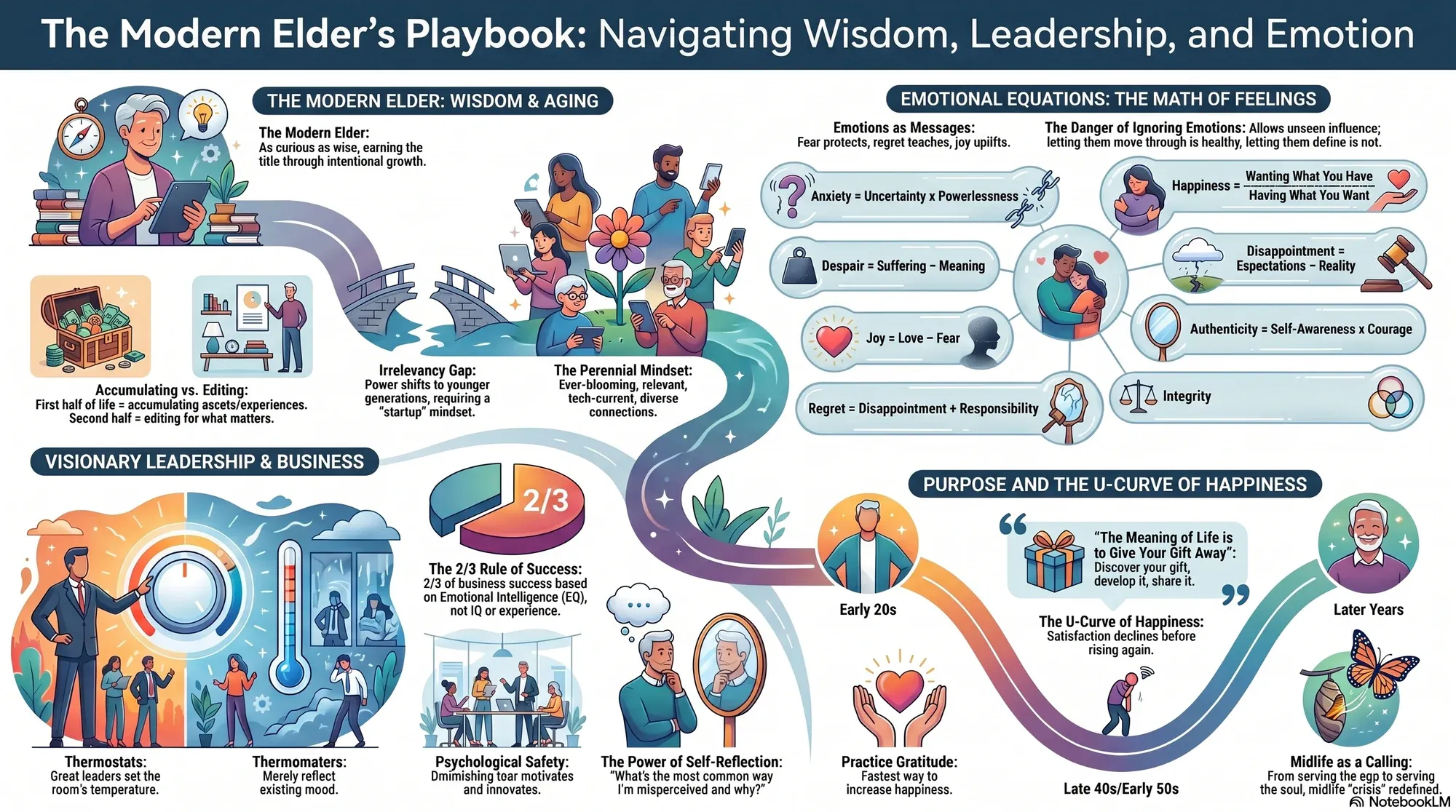
- Curiosity and wisdom: Conley says Airbnb colleagues defined a modern elder as someone who remains curious while sharing earned wisdom. — Big Think Modern Elder Interview.
- Mentor and intern: At Airbnb, Conley paired mentoring younger leaders with learning from their digital fluency. — Learning the Ropes Later in Life.
- Listen for wisdom: Conley describes an elder’s wisdom as depending on attentive listening, not simply giving advice. — Gratitude in Silicon Valley.
- Edit in midlife: Conley contrasts accumulating roles and responsibilities earlier in life with editing what no longer serves in midlife. — Advice at 10, 20, 30, 40, and 50.
- The relevance gap: Conley warned that longer working lives and younger digital-era leadership can leave older workers feeling irrelevant; he framed this as a risk, not an inevitable outcome. — Learning the Ropes Later in Life.
- Perennials across ages: Conley credits Gina Pell for defining perennials as people who stay curious and connected across age groups. — Four New Books to Check Out.
- Earn elderhood: Conley distinguishes simply getting older from becoming an elder through cultivated wisdom and relevance. — The Emerging Elder.
- Keep learning in new settings: Joining Airbnb at 52 required Conley to exchange expertise for a beginner’s mind and adapt his work identity. — Learning the Ropes Later in Life.
- Finite time clarifies priorities: Conley writes that awareness of limited time can make priorities clearer. — The Surprise of Aging.
- Presence over impressiveness: Conley describes becoming less concerned with appearing impressive and more concerned with being present. — The Surprise of Aging.
- Fear need not run aging: Conley urges readers not to let fear of growing older dictate how they live. — Want to Age Faster?.
On Emotional Intelligence and Equations
Chip Conley's book, Emotional Equations, breaks down complex feelings into understandable formulas: — Emotional Equations.
- Anxiety equation: Conley uses “Anxiety = Uncertainty × Powerlessness” as a reflective tool, not a clinical formula. — Anxiety = Uncertainty × Powerlessness.
- Despair equation: Conley developed “Despair = Suffering − Meaning” as a personal way to think about difficult emotions after reading Viktor Frankl. — Emotional Equations.
- Joy equation: In discussing Emotional Equations, Conley frames joy as love diminished by fear. — Chip Conley on Emotional Equations.
- Happiness equation: Conley contrasts gratitude for what one has with chasing gratification from what one wants. — Chief Emotions Officer.
- Disappointment equation: Conley frames disappointment as the gap between expectations and reality. — Disappointment = Expectations − Reality.
- Regret equation: Conley explains regret as disappointment plus a sense of responsibility and says the emotion can teach. — Chief Emotions Officer.
- Emotions as messages: Conley suggests treating emotions as information that invites a response; in his formulation, regret teaches and fear protects. — Chief Emotions Officer.
- Emotional fluency: Conley argues that understanding emotions gives people more room to respond deliberately instead of being driven by them. — Chief Emotions Officer.
On Leadership and Business
- Lead with curiosity: Conley treats curiosity as a leadership practice that helps people ask better questions and see new possibilities. — Curiosity Is the Elixir of Life.
- Make solutions shared: In a direct interview, Conley says people execute plans more effectively when they helped shape the solution. — Canopy Podcast Interview.
- Emotions are contagious: Conley says a leader’s mood can spread through a team and that leaders should be aware of the signals they send. — Canopy Podcast Interview.
- Practice what you advocate: Conley’s management advice focuses on observable habits—attention, gratitude and other interpersonal practices—rather than slogans alone. — The Five Fundamentals of Management Etiquette.
- Reduce fear to create: Conley says fear in stressful organizations can reduce creativity and innovation, so leaders should address it openly. — Canopy Podcast Interview.
- Value emotional intelligence: Conley emphasizes emotional intelligence alongside technical skill and experience when developing a career. — Advice at 10, 20, 30, 40, and 50.
- Hire for character: Conley’s hiring questions probe self-awareness and integrity, alongside competence, rather than relying on likability alone. — What Is Your Hire-archy of Needs?.
- Serve the people doing the work: Conley describes leadership as serving colleagues closer to the organization’s core work. — Canopy Podcast Interview.
- Be candid and confident in adversity: Conley advocates a combination of honest communication and confidence when leading through uncertainty. — Canopy Podcast Interview.
- Ask revealing interview questions: Conley favors asking candidates about a failure they learned from and how they are often misperceived at work. — My 10 Favorite Interview Questions.
On Life and Learning
- Meaning and purpose in giving: Conley explicitly credits David Viscott for the gift aphorism and offers his own distinction: discovering a gift gives personal meaning, while sharing it can serve a wider purpose. — Meaning and Purpose.
- Beyond doing and becoming: Conley distinguishes purposeful becoming from the quieter experience of being. — Doing to Becoming to Being.
- Improve rather than prove: Conley recommends a growth mindset focused on improvement rather than proving one’s worth. — Advice at 10, 20, 30, 40, and 50.
- Retell a life story: Conley quotes Bruce Feiler on changing our life story; Conley uses that idea to discuss agency during transitions. — The Agency to Write Our Own Script.
- Cultivate curiosity: Conley describes curiosity as fuel for learning, empathy and new possibilities. — Curiosity Is the Elixir of Life.
- Learn empathy across difference: Conley advises young people to experience what it means to be “the other” and learn from other cultures. — Advice at 10, 20, 30, 40, and 50.
- Notice how you learn: Conley advises people to identify the modes of learning that work for them and invest in those methods. — Advice at 10, 20, 30, 40, and 50.
- Keep a wisdom book: Conley proposes a weekly wisdom book to record meaningful observations and lessons. — Advice at 10, 20, 30, 40, and 50.
- Make room for ritual: Conley argues that as life becomes more digital, shared rituals can offer connection and predictability. — The Science of Gathering.
- Transitions over birthdays: Conley describes life stages through transitions rather than a fixed chronological threshold. — Middle Age Is Always Someone Else.
On Happiness and Gratitude
- Practice gratitude: Conley recommends making gratitude a regular practice at work. — The Five Fundamentals of Management Etiquette.
- Express thanks: Conley argues that gratitude should be communicated directly and specifically, not just felt privately. — The Five Fundamentals of Management Etiquette.
- Find happiness in presence: Conley describes later life as bringing greater selectivity and appreciation for presence. — The Surprise of Aging.
- Midlife satisfaction is not fixed: Conley discusses a U-shaped pattern of life satisfaction and uses it to challenge the assumption that later life must decline. — Millennials, Welcome to Middle Age!.
- Want what you have: Conley describes gratitude as appreciating what one has rather than making happiness depend on acquiring more. — What I Have Is All I Need.
- Keep some joys intrinsic: Conley cautions that some interests and experiences need not become projects or businesses to matter. — The Need to Make It a Thing.
On Purpose and Meaning
- Beyond happiness alone: Conley argues that a worthwhile life can include meaning, curiosity and experiences that change one’s perspective, not only pleasure. — Beyond Happiness and Meaning.
- Shift from ego to soul: Conley describes midlife as an opportunity to move from status and admiration toward quieter, more purposeful contribution. — From Big Ego to Beautiful Soul.
- Ask about future regret: Conley recommends asking what one would regret not learning or doing ten years from now as a prompt for action today. — The Origins of Your Wisdom.
- Think about what survives us: Conley credits Erik Erikson for the legacy phrase and applies it to relationships and work that outlast an individual. — The I AM That Will Help You Thrive After 50.
- Midlife as a calling: Conley reframes his own midlife crisis as a call to create MEA and help others find purpose. — How I See It with Chip Conley.
- Titles are not truths: Conley warns that status labels can obscure a person’s deeper identity. — We Are Egos in Search of Our Souls.
- Choose usefulness over admiration: Conley describes moving away from seeking admiration and toward being useful to others. — We Are Egos in Search of Our Souls.
- Some beginnings look like endings: Conley writes that a midlife change may look like an ending to others while opening a new chapter for the person living it. — Maybe You’re Not Lost.
Learn more:
- Learning the Ropes Later in Life
- A Modern Elder Muses on Gratitude in Silicon Valley
- The advice I wish I’d been given at 10, 20, 30, 40, and 50
- Mentorship, lifelong learning and the multigenerational workplace transcript
- The Case for the Emerging Elder (Part 3)
- Four New Books to Check Out
- The Surprise of Aging
- Anxiety = Uncertainty x Powerlessness
- Emotional Equations
- Chip Conley on Emotional Equations
- Measuring What Makes Life Worthwhile
- How to Become an Effective CEO: Chief Emotions Officer
- Episode 43: Interview with Chip Conley
- My 10 Favorite Interview Questions
- What Is Your Hire-archy of Needs?
- The Fear of Not Succeeding
- Meaning and Purpose
- The Five Fundamentals of Management Etiquette
- How I See It with Chip Conley