Chris Argyris is a renowned organizational theorist and Professor Emeritus at Harvard Business School. His work fundamentally changed our understanding of organizational learning, defensive behavior, and leadership.
Part 1: Top Quotes by Chris Argyris
On Learning and Competence
- "Success in the marketplace increasingly depends on learning.[1][2] Yet most people don't know how to learn."[2][3][4]
- "Most people define learning too narrowly as mere 'problem solving', so they focus on identifying and correcting errors in the external environment."[4]
- Source: Teaching Smart People How to Learn
- "Smart people don't learn... because they have too much invested in proving what they know and avoiding being seen as not knowing."[2][3]
- Source: Teaching Smart People How to Learn
- "Individual learning is a necessary but insufficient condition for organizational learning."
- Source: Organizational Learning II (with Donald Schön, 1996)[5]
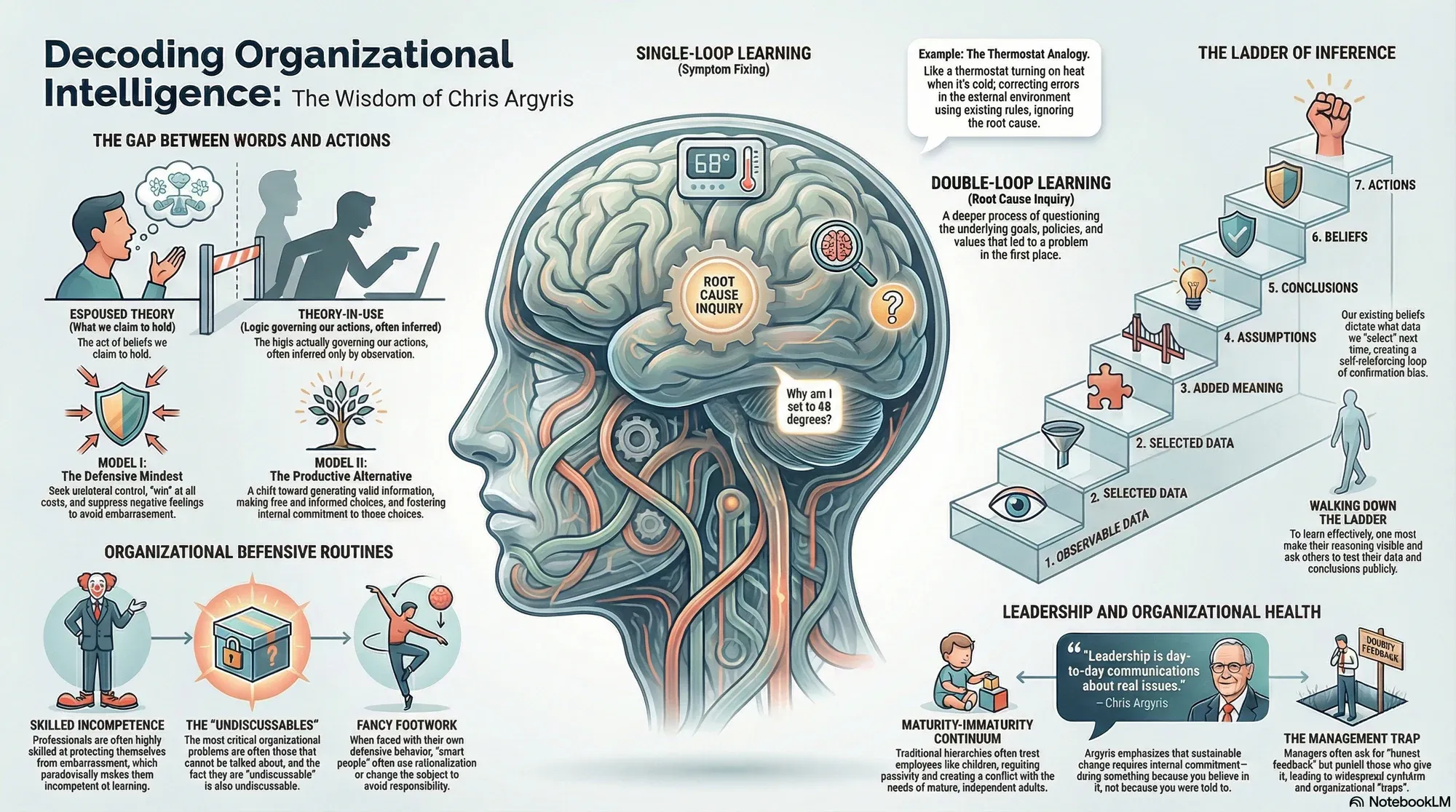
- Chris Argyris distinguished between the theory someone states they follow, their espoused theory, and their theory-in-use, the theory that actually governs their actions, arguing the second can only be inferred by observing behavior, not by asking someone to describe it. [20]
On Theories of Action (Espoused vs. In-Use)
6. "Human beings hold two types of theories of action.[6][7][8][9][10][11][12] There is the one that they espouse, which is usually expressed in the form of stated beliefs and values.[4][6][7] Then there is the theory that they actually use; this can only be inferred from observing their actions."[4][6]
* Source: Reasoning, Learning, and Action (1982)
7. "People are unaware of the inconsistency between their espoused theories and their theories-in-use."[13]
* Source: Overcoming Organizational Defenses (1990)[5][8]
8. "When people are asked how they would behave under certain circumstances, the answer they usually give is their espoused theory of action for that situation.[4][9] This is the theory of action to which they give allegiance, and which, upon request, they communicate to others. However, the theory that actually governs their actions is their theory-in-use."[10]
* Source: Theory in Practice (with Donald Schön, 1974)[5]
On Defensive Routines
9. "Organizational defensive routines are actions or policies that prevent individuals or segments of the organization from experiencing embarrassment or threat."
* Source: Overcoming Organizational Defenses (1990)[5][8]
10. "Defensive routines are anti-learning."
* Source: Strategy, Change and Defensive Routines (1985)[8]
11. "Managers who are skilled communicators may also be good at covering up real problems."[2][4]
* Source: Flawed Advice and the Management Trap (2000)
12. "In fact, people themselves are responsible for making the status quo so resistant to change.[2] We are trapped by our own behavior."[1][2][9][14]
* Source: Teaching Smart People How to Learn
13. "The purpose of all these [defensive] values is to avoid embarrassment or threat, feeling vulnerable or incompetent."
* Source: Teaching Smart People How to Learn
On Leadership and Communication
14. "Leadership is the day-to-day communications about the real issues."[3]
* Source: Flawed Advice and the Management Trap (2000)
15. "Trust is not a static quality; it is a dynamic quality of a relationship."
* Source: Integrating the Individual and the Organization (1964)[5][10]
16. "Autocratic leadership is not just a function of personality; it is a function of the organizational structure."
* Source: Personality and Organization (1957)[5][10]
17. "If you want to make a difference in your organization, you have to be willing to be uncomfortable."
* Source: Knowledge for Action (1993)[5][8][10]
18. "We cannot reason effectively if we are not aware of the reasoning processes we are using."
* Source: Action Science (1985)[5][8][10]
On Organizational Health
19. "An organization is like an organism... it must maintain its internal environment while adapting to the external environment."
* Source: Integrating the Individual and the Organization (1964)[5][10]
20. "Healthy organizations are those that can manage the tension between individual needs and organizational goals."
* Source: Personality and Organization (1957)[5][10]
Part 2: Key Learnings & Concepts
Double-Loop Learning
21. Single-Loop Learning: This occurs when we solve a problem using the same underlying assumptions or rules (like a thermostat turning on the heat).[15] It fixes the symptom but ignores the root cause.
* Concept Source: Organizational Learning: A Theory of Action Perspective
22. Double-Loop Learning: This occurs when we question the underlying goals, policies, and values that led to the problem in the first place (asking why the thermostat is set to that temperature).
* Concept Source: Organizational Learning: A Theory of Action Perspective
23. The Thermostat Analogy: A thermostat that turns on heat when it gets cold is single-loop learning.[15][16] A thermostat that asks "Why am I set to 68 degrees?" involves double-loop learning.[8][11][15][16][17][18][19]
24. Inhibition of Learning: Most organizations are good at single-loop learning (problem-solving) but terrible at double-loop learning because it requires questioning authority and established norms.
Theories of Action
25. Espoused Theory vs. Theory-in-Use: There is often a disconnect between what we say we believe (espoused) and the beliefs implied by our actual behavior (in-use).[13]
* Concept Source: Theory in Practice
26. Model I (Defensive): The default theory-in-use for most people. Its goals are: 1) Be in unilateral control,[7][8] 2) Win and do not lose, 3) Suppress negative feelings,[7][14] 4) Act rationally.
27. Model II (Productive): The alternative theory Argyris proposed. Its goals are: 1) Valid information,[12] 2) Free and informed choice,[12] 3) Internal commitment to the choice.[7][12]
28. The Doom Loop: Relying on Model I leads to defensive relationships, low trust, and low freedom of choice, which cycles back to reinforce Model I behaviors.
Organizational Defenses
29. Defensive Routines: These are standard operating procedures (often unwritten) that protect the organization from pain but prevent it from correcting errors.
* Concept Source: Overcoming Organizational Defenses
30. Mixed Messages: A common defensive routine is sending mixed messages (e.g., "Be innovative, but don't make mistakes") and making the mixed message "undiscussable."
31. The "Undiscussable": In many organizations, the most important problems are the ones that cannot be talked about. Furthermore, the fact that they cannot be talked about is also undiscussable.
32. Fancy Footwork: When confronted with their own defensive behavior, smart people often use "fancy footwork" (rationalization, changing the subject) to avoid taking responsibility.
33. Skilled Incompetence: People are often highly skilled at protecting themselves from embarrassment. This skill, paradoxically, makes them incompetent at learning and changing.
The Ladder of Inference
34. The Concept: Developed by Argyris (and later popularized by Senge), this model explains how we jump from observable data to beliefs and actions without realizing we are adding our own meaning.
* Concept Source: Reasoning, Learning, and Action[5]
35. Rungs of the Ladder: 1) Observable data -> 2) Selected data -> 3) Added meaning -> 4) Assumptions -> 5) Conclusions -> 6) Beliefs -> 7) Actions.
36. Recursive Loop: Our beliefs affect what data we select next time, creating a self-reinforcing loop (confirmation bias).
37. Testing Assumptions: To learn, one must "walk down the ladder" by making their reasoning visible and asking others to test their data and conclusions.
Personality and Organization[4][5][10][12]
38. The Maturity-Immaturity Continuum: As humans develop, they move from passivity/dependence (childhood) to activity/independence (adulthood).
* Concept Source: Personality and Organization[5][10]
39. Incongruence: Traditional hierarchical organizations often treat employees like children (requiring passivity and dependence), creating a conflict with the needs of a mature adult.
40. Responses to Incongruence: Employees react to this conflict by quitting, becoming apathetic, unionizing, or focusing only on money (instrumental orientation).
Action Science
41. Actionable Knowledge: Knowledge is only useful if it can be implemented in a way that produces the desired result. Academic research often fails this test.
* Concept Source: Action Science
42. Reflection-in-Action: The ability to think about what you are doing while you are doing it, allowing for real-time course correction.
43. Public Testing: For valid learning to occur, claims and assumptions must be subjected to public testing where they can be disconfirmed.
Organizational Traps[2]
44. The Management Trap: Managers often ask for "honest feedback" but punish those who give it, leading to cynicism.
* Source: Flawed Advice and the Management Trap[2]
45. Self-Sealing Logic: Defensive logic is often self-sealing; if you deny you are being defensive, your denial is seen by others as further proof of your defensiveness.
46. Bypassing: A common defense mechanism where managers bypass the threatening issue to save face, but the bypass itself is never discussed.
Intervention & Change
47. Valid Information: The foundation of any successful intervention is generating valid information that everyone agrees on.
48. Free Choice: Change cannot be effective if it is coerced; it requires free and informed choice by the participants.
49. Internal Commitment: Sustainable change requires internal commitment (doing it because you believe in it) rather than external commitment (doing it because you are told to).
50. The Role of the Interventionist: The goal of a consultant or leader should be to help the client system increase its competence in double-loop learning, eventually making the interventionist unnecessary.
Sources
- quotefancy.com
- toolshero.com
- peoplaid.com
- libquotes.com
- wikipedia.org
- libquotes.com
- thesystemsthinker.com
- zeno-organisatieontwikkeling.nl
- fuller.edu
- infed.org
- scribd.com
- changingminds.org
- resilientminds.co.nz
- goodreads.com
- actiondesign.com
- wikipedia.org
- maxlearn.com
- scribd.com
- ebsco.com
- infed.org: Chris Argyris, theories of action and organizational learning