Christopher Begg is the CEO, CIO and co-founder of East Coast Asset Management and teaches Security Analysis at Columbia Business School. His investment approach distinguishes the quality of a business from the quality of an investment, asking whether price and margin of safety make the business attractive to own. — Columbia Business School interview.
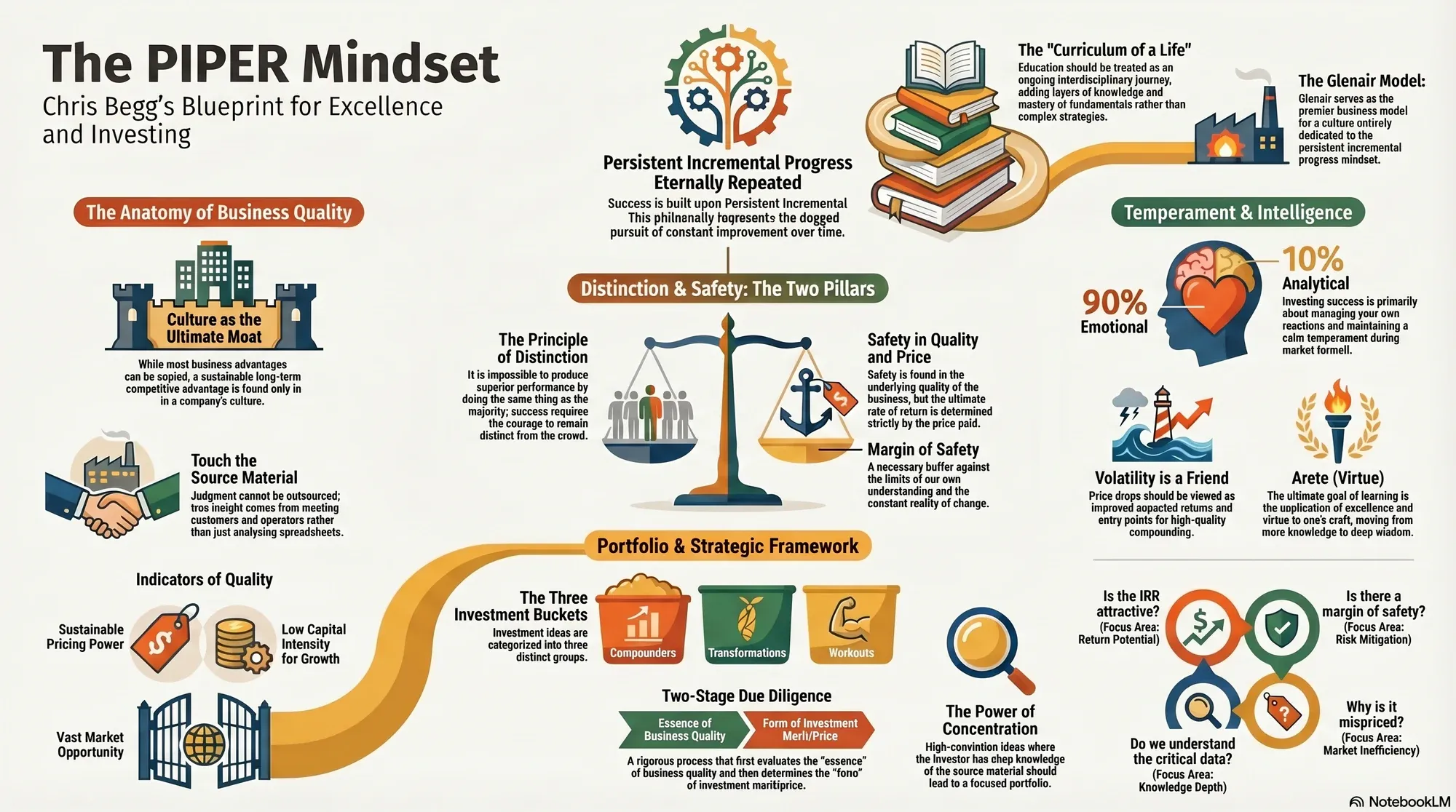
Part 1: The PIPER Mindset & Personal Excellence
- The PIPER Mindset: Begg calls his adaptation of Peter Kaufman's incremental-improvement principle PIPER—persistent incremental progress, eternally repeated—and applies it to learning and business evolution. — What Got You There interview.
- The Work Behind Improvement: Begg sees sustained, incremental work—rather than a secret formula—as an important feature of people and businesses that keep improving. — What Got You There interview.
- Choosing Heroes: When a close mentor is unavailable, Begg recommends studying carefully chosen heroes and adapting lessons from their work to one's own craft. — Columbia Business School interview.
- Build a Learning Practice: Begg describes deliberate, ongoing study across disciplines and building a knowledge scaffold so new ideas have context and can be applied over time. — What Got You There interview.
- Danaher and Continuous Improvement: Begg points to the Danaher Business System as an example of persistent incremental improvement embedded in a company's operating culture. — What Got You There interview.
- On Mastery of Fundamentals: Begg uses general principles drawn from several disciplines to organize investment reasoning, applying those lenses to businesses rather than relying on isolated examples. — East Coast — Grove of Titans Letter.
Part 2: The Anatomy of Business Quality
- Culture as a Moat Layer: Begg treats a culture of continuous improvement as one important layer of a durable competitive moat, alongside scale, industry structure, network effects and other advantages. — East Coast 2021 letter.
- Scale and Structural Advantages: In East Coast's moat framework, scale can strengthen research, distribution, data, systems and trust, while favorable industry structure may add a separate advantage. These are specific possible sources of resilience, not a universal trait of every outlier organization. — East Coast 2021 letter.
- Stay Close to Source Material: Begg says his team reads important primary materials and meets businesses and customers to understand their operations and culture first-hand; he also credits Todd Combs for shaping his view that judgment cannot simply be outsourced. — Investing the Templeton Way interview.
- Use Pricing Power Responsibly: East Coast considers pricing power when judging a business's resilience, while warning that large one-time increases can damage long-term customer relationships. — East Coast 2021 letter.
- On Market Opportunity: Begg treats secular tailwinds as a key attribute of an exceptional business and looks for companies still early in a potentially long compounding life cycle. — East Coast — Surfing Light Waves Letter.
- On Capital Intensity: Begg looks for businesses earning high returns on tangible assets with a sustainable competitive moat, particularly when short-term market focus obscures those economics. — East Coast — Grove of Titans Letter.
- Management as a Steward of the System: Begg looks beyond a manager's résumé to how leadership sustains the business system, culture and allocation of capital over time. — Columbia Business School interview.
- On Business Economics: Begg examines whether scale allows a company to share economic gains with customers through lower prices or better service, reinforcing its competitive position. — East Coast — Surfing Light Waves Letter.
- Study the Business as an Operator: Begg says understanding how a business works from an operator's perspective can sharpen investment judgment beyond analyzing its reported numbers alone. — Investing the Templeton Way interview.
- Favor Businesses That Keep Evolving: Begg's quality framework gives weight to businesses whose culture and systems support continuous improvement as conditions change; that is a potential advantage, not a guarantee of higher returns or lower risk. — East Coast 2021 letter.
Part 3: Distinction & Safety: The Two Pillars
- Distinction Requires Independent Thinking: Begg cites Sir John Templeton's argument for doing something different from the majority as a touchstone for East Coast's Distinction principle. He presents differentiation as part of an investment approach, not a promise of superior returns. — MOI Global interview.
- The Twin Lights: Begg calls business quality and investment quality the twin lights of his process: understanding a strong business is distinct from deciding whether its current price makes ownership attractive. — Columbia Business School interview.
- Insist on a Margin of Safety: For Begg, the safety of an investment depends in part on a margin of safety at the price paid, because businesses and circumstances change and an appraisal can be wrong. — MOI Global interview.
- Know Great Businesses Before the Price Is Right: Begg studies strong businesses even when their shares are too expensive, so that if a later sell-off creates a suitable price and margin of safety, the research is already in place. — Columbia Business School interview.
- Distinguish a Passing Scare from Lasting Damage: Begg studies whether a sell-off reflects a temporary concern or a lasting impairment of the business before treating the lower price as an opportunity. — Columbia Business School interview.
- On Graham's Foundations: Begg continues to use Graham's Mr. Market and margin-of-safety ideas when assessing the risk of permanent loss, alongside his own focus on how businesses treat their counterparties. — Richer, Wiser, Happier — Begg Interview.
Part 4: Temperament & Resilience
- Temperament in Market Declines: Begg acknowledges that lower prices can trigger loss aversion. His response is to evaluate the business and its valuation for a long-term purchase, rather than assume that a falling price alone makes it attractive. — East Coast Grove of Titans letter.
- Separate Business Quality from Market Panic: During a market scare, Begg's distinction-and-safety framework directs attention to the quality of the business and the price paid, instead of treating a fall in the quoted price as a change in underlying value. — East Coast Twin Lights letter.
- Volatility Can Create Opportunity: Begg argues that short-term volatility can sometimes improve prospective returns for a long-term investor who can buy an enduring business at a reasonable price; it is not automatically beneficial. — East Coast Grove of Titans letter.
- Learn from Trials and Errors: Begg says he built his investment process over years of his own trials and errors and by studying those of other investors. He cites Emerson's wounded-oyster metaphor to illustrate that learning. — MOI Global interview.
- Recognize Loss Aversion: Begg notes that falling market prices naturally feel uncomfortable. He suggests assessing whether the decline offers a better prospective return through a considered purchase or a company's buyback, not assuming that every decline is an opportunity. — East Coast Grove of Titans letter.
- On Patience: Begg describes spending much of the time observing companies on his watchlist and waiting for a short-term cloud to create an attractive entry price. — East Coast — Surfing Light Waves Letter.
- On Exploiting Panic: During the March 2020 selloff, Begg studied the balance-sheet risks of aerospace-parts holdings before allocating more capital at lower prices; dislocation was an opportunity only after that analysis. — Richer, Wiser, Happier — Begg Interview.
Part 5: The Spectrum of Intelligence & Learning
- From Knowledge toward Wisdom: In Begg's learning framework, knowledge and wisdom are stages on a continuum that also includes intelligence and Arete. He uses the sequence to think about moving beyond accumulated information toward better judgment and quality of action. — What Got You There interview.
- Simplify with Less Entropy: Within his spectrum of intelligence, Begg associates better reasoning with finding a simpler, less entropic way to understand and act—not with piling on complexity. — What Got You There interview.
- Aim for Arete: Begg treats Arete—quality and virtue in one's craft and dealings with others—as the aspirational end of his knowledge-to-wisdom-to-intelligence continuum. — What Got You There interview.
- Cultivate Creative Context: Begg encourages investors to develop creative, contextual thinking alongside analysis so they can step back and see a business in a wider setting. — Investing the Templeton Way interview.
- Look Across Disciplines: Begg suggests learning across subjects, including science, to build broader context and notice relationships that a narrow financial analysis may miss. — Investing the Templeton Way interview.
- On Analogical Reasoning: Begg compares enduring companies with coastal redwoods, using examples from biology and human history to examine adaptation, relationships and resilience over long periods. — East Coast — Grove of Titans Letter.
- Balance Breadth and Depth: Begg describes combining multidisciplinary reading with periods of focused study on one subject, so breadth of context does not come at the expense of depth. — Investing the Templeton Way interview.
- On Simplification: When evaluating a complex system, Begg recommends stepping back to distinguish its essential features from distracting detail and to look for overlooked simplicities. — East Coast — Grove of Titans Letter.
Part 6: Strategic Due Diligence & Portfolio Frameworks
- Three Investment Categories: Begg groups opportunities into compounders, transformations and workouts. He says compounders have supplied most of East Coast's ideas, while workouts have become a very small part of its concentrated portfolio. — Columbia Business School interview.
- Ask Why an Investment Is Mispriced: After understanding a business, Begg asks whether the price offers a margin of safety and why the market might be overlooking the opportunity—while allowing that his own thesis could be wrong. — Columbia Business School interview.
- Start with the Customer Problem: Begg begins evaluating a business by asking what problem it solves and what friction it removes for customers and other counterparties, before relying on a valuation model. — Columbia Business School interview.
- Concentrate on Well-Studied Businesses: Begg describes building a concentrated portfolio around a handful of exceptional businesses he follows closely, with substantial research often yielding only one or two compelling new ideas in a year. — Richer, Wiser, Happier interview.
- Evaluate Capital-Allocation Skill: East Coast treats management's capital-allocation judgment as a core quality of a business, looking for prudent decisions and economic alignment with owners. — East Coast 2021 letter.
- Assess Asymmetry Probabilistically: Begg estimates a range of possible investment returns rather than a single certain outcome, then weighs which opportunities offer attractive upside relative to their plausible downside. — Columbia Business School interview.
- Prefer Long-Duration Compounders: Begg prefers businesses with sustainable models and widening moats that he can hold and learn alongside for many years, rather than relying heavily on shorter-duration workouts. — Columbia Business School interview.
- Use a Checklist and Decision Log: Begg says East Coast used an investment checklist as part of its process and kept quarterly letters as a record of decisions from which the team could learn. — East Coast Navigating Beyond the Pillars letter.
Part 7: Price, Value, & Market Realities
- Separate Price from Value: Begg distinguishes the market price of a business from his estimate of the present value of its future cash flows; news and short-term sentiment can drive the two apart. — East Coast Grove of Titans letter.
- Look Past the Form of a Quote: Begg uses a form-versus-essence lens to ask whether a quoted share price reflects the underlying value of the business, rather than treating the price itself as the whole story. — East Coast Grove of Titans letter.
- Reason About Changing Systems: Begg applies dialectical reasoning to businesses as evolving systems: competitive positions can strengthen or decay, so an investor should look beyond a static description of what a company is today. — East Coast Grove of Titans letter.
- Use a Longer Business Horizon: Begg argues that investors' short-term focus can create room for a long-term, business-centered approach when price becomes disconnected from his estimate of value. — East Coast Grove of Titans letter.
- Use Uncertainty as a Research Lens: Begg draws an analogy between uncertainty in other complex systems and investing: a temporary cloud over a business can prompt closer research into whether its price has become attractive. — Investing the Templeton Way interview.
- Consider Buybacks at Lower Prices: Begg notes that when a company repurchases shares after a price decline, remaining owners can gain per-share ownership; whether that improves prospective returns depends on the business and price. — East Coast Grove of Titans letter.
Part 8: Mentorship, Culture, & The Infinite Game
- Learn from Peter Kaufman: Begg credits Peter Kaufman as a mentor who influenced both his PIPER view of improvement and his habit of connecting ideas across physics, biology and human history. — What Got You There interview.
- Teach Investing as a Laboratory: At Columbia, Begg brings investors, business operators and interdisciplinary thinkers into his Security Analysis course so students can compare approaches and develop judgment suited to their own temperament. — Richer, Wiser, Happier interview.
- Play a Long-Horizon Game: Drawing on James Carse, Begg contrasts finite, short-term goals with a no-finish-line approach to learning, investing and life that favors patience and continual development. — Richer, Wiser, Happier interview.