Lessons from Chris Davis
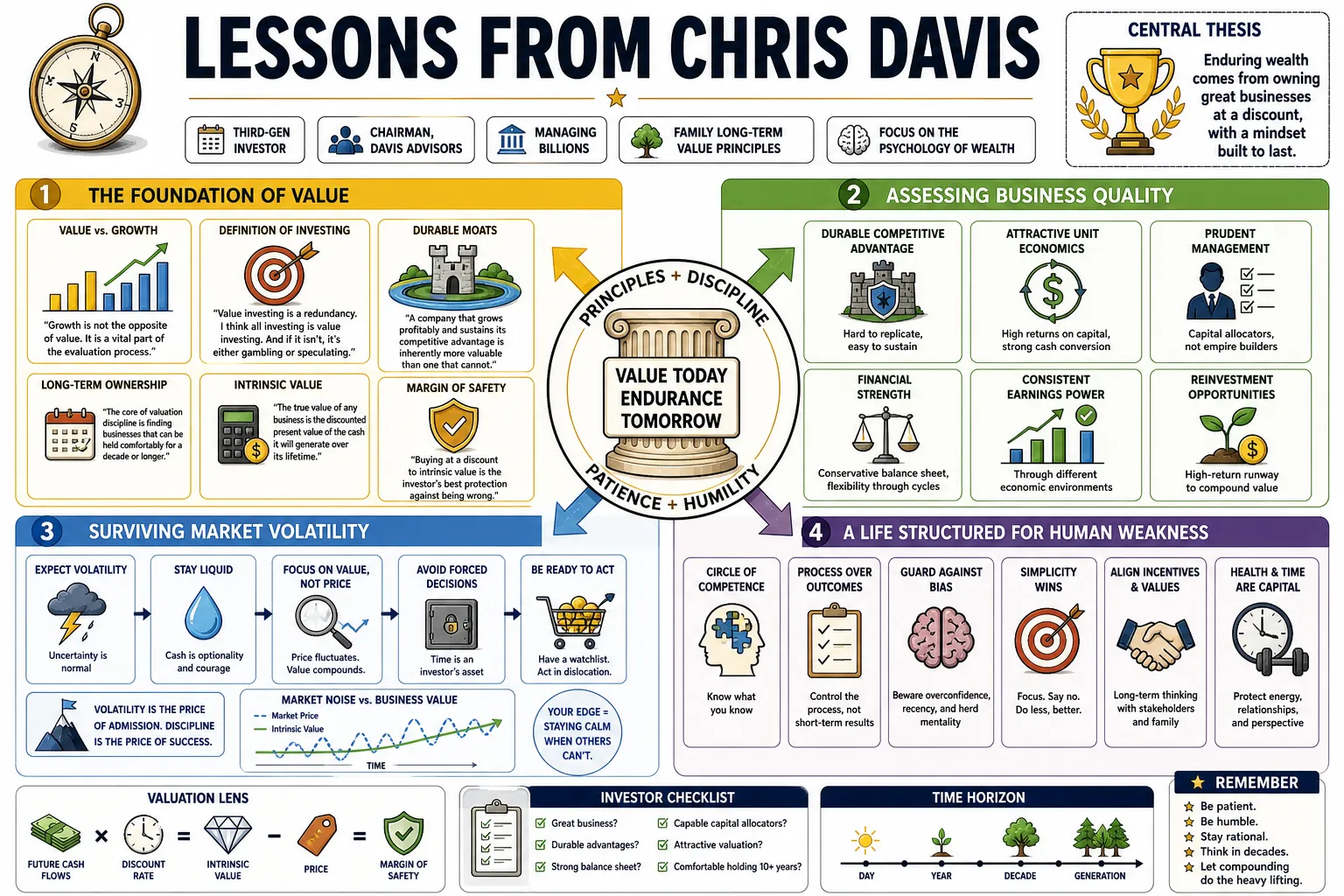
Chris Davis is the third generation of his family to lead Davis Advisors. His investment approach combines business quality, price discipline, long ownership, and attention to investor behavior during market swings. — Masters in Business interview.
Part 1: The Foundation of Value
- Value and Growth: Davis treats profitable growth as part of a business's value, not its opposite; the price paid still matters. — Barron's Live interview.
- What Investing Means: Davis calls value investing a redundancy: investing should involve assessing a business's value rather than speculating on a changing price. — David Rubenstein interview.
- Durable Moats: Davis Funds looks for businesses that can sustain advantages and attractive returns on capital over time. — Davis Funds investment criteria.
- Long-Term Ownership: Davis seeks businesses he can own through multi-year cycles instead of relying on a quick change in market sentiment. — David Rubenstein interview.
- Intrinsic Value: The firm estimates a business's intrinsic value using owner earnings, reinvestment prospects and long-term economics; the estimate remains uncertain. — Davis Funds valuation method.
- Margin of Safety: Davis Funds aims to buy below its estimate of intrinsic value to allow for uncertainty and error; the discount is not a guarantee. — Davis Funds valuation method.
- The Specific Business: Davis applies John Train's description of investing as 'the art of the specific' by studying particular businesses and their prices. — WEALTHTRACK interview.
- Capital Allocation: The firm evaluates whether managers allocate capital as owners would because reinvestment and other uses of cash shape business value. — Davis Funds investment criteria.
- Reinvestment Runway: The firm looks for strong returns on capital and considers whether the business can reinvest at attractive rates. — Davis Funds valuation method.
- Avoiding Fads: Davis's discipline is to compare business quality with the price paid, even when a company or industry has a compelling story. — Masters in Business interview.
Part 2: Navigating Market Volatility
- Bear Markets: Chris Davis repeats his grandfather Shelby Cullom Davis's observation that much of an investor's eventual gain may be earned during a bear market, though it is not apparent then. Lower prices can offer an opportunity, not a promise. — Davis Funds bear-market video.
- Pessimism: Davis notes that bearish arguments can sound sophisticated, but he cautions against letting pessimism eclipse the long record of business progress. — Stansberry Investor Hour #185.
- Preparation over Prediction: Davis favors preparing portfolios and plans for setbacks over relying on precise short-term forecasts. He credits 'you can't predict, you can prepare' to Howard Marks. — Davis Funds forecasting video.
- Crises and Durability: Because setbacks recur, Davis favors durable businesses and financial structures able to withstand them rather than betting on a particular crisis forecast. — Davis Funds forecasting video.
- Price and Perceived Risk: When fear drives a sound business's price lower, Davis sees potential for a better prospective return, subject to reassessing the business and its risks. — Davis Funds bear-market video.
- Expecting Corrections: Davis urges investors to plan for volatility so a selloff does not force an improvised decision. The original annual 10% statistic is omitted. — Davis Funds volatility video.
- Market Timing: Davis warns that relying on short-term forecasts can undermine long-term compounding. The original 'best 30 days' figure is omitted. — Davis Funds forecasting video.
- Volatility as Opportunity: Davis distinguishes market-price swings from permanent loss of business value: patient investors may use volatility to buy at more attractive prices. — Davis Funds volatility video.
- Forecasts: Davis finds short-term market forecasts of little reliable use for long-term owners and puts more emphasis on business durability and preparedness. — Davis Funds forecasting video.
Part 3: Behavioral Discipline
- The Biggest Threat: Davis warns that investor behavior can be a larger threat to long-term returns than the volatility of the underlying holdings. — David Rubenstein interview.
- Endurance: Davis emphasizes maintaining ownership through difficult periods rather than letting short-term underperformance break a long-term plan. — ETF.com direct interview.
- The Value of Advisors: Davis sees an advisor's behavioral coaching as especially valuable when clients might otherwise make costly timing decisions. — Meb Faber Show #221.
- Envy: Davis says he avoids situations in which envy can take hold; the original 'seven deadly sins' formulation is not verified as his quote. — Knowledge Project #189.
- Emotional Control: Davis's investment discipline depends on judgment and behavior as well as valuation calculations. The original 10/90 formula is omitted. — ETF.com direct interview.
- Inaction: Davis sees patient ownership and avoiding unnecessary trades as ways to give compounding time to work. — Davis Funds compounding video.
- Against the Crowd: Davis describes buying when fear pushes prices below his assessment of business value, even when prevailing sentiment is negative. — Meb Faber Show #221.
- Learning from Mistakes: Davis's team records investment mistakes and the transferable lessons from them, focusing on decision process rather than outcome alone. — ETF.com direct interview.
- Fear and Price: Davis distinguishes a panic-driven price decline from a permanent deterioration in the business; the investor must recheck which it is. — Davis Advisors shareholder letter.
Part 4: Assessing Businesses and Management
- Resilience: Davis places weight on business durability, balance-sheet strength and the capacity to withstand adverse conditions. — Davis Funds investment criteria.
- Management Quality: Davis Funds looks for capable managers with integrity and owner-like capital-allocation habits. — Davis Funds investment criteria.
- Financial Strength: Davis's signed fund report points to leverage and liquidity failures at AIG and Merrill Lynch as reasons to favor companies able to survive a cash crunch. — Davis Advisors shareholder letter.
- Skin in the Game: Davis stresses that his family's and colleagues' money is invested alongside clients, creating alignment between managers and fund holders. — ETF.com direct interview.
- Avoiding Bureaucracy: Davis designs his investment team's work environment so analysts can concentrate on studying businesses rather than spend most of their time in defensive client meetings. — Richer, Wiser, Happier interview.
- Pricing Power: Davis tests whether a business has durable pricing power and switching costs; uncertainty about either can make a promising growth story riskier than it appears. — Davis Funds AI investing webcast.
- Returns Without Fragility: Davis Funds seeks attractive returns on capital while checking balance-sheet resilience; high returns obtained through fragile leverage warrant caution. — Davis Funds investment criteria.
- Accounting and Transparency: Davis is wary when financial statements become difficult to interpret or management misrepresents facts; he treats such signals as reasons to reassess ownership. — ETF.com direct interview.
- Capital Discipline: In a signed shareholder report, Davis and a colleague described how overpriced acquisitions and low-return projects destroyed value in one holding. The lesson is to evaluate management's capital discipline, not claim acquisitions are always destructive. — Davis Advisors shareholder letter.
Part 5: Trust and Human Capital
- Trust Reduces Friction: Davis describes trust as an efficiency advantage: long-standing relationships can make decisions and deals simpler when the parties have confidence in one another. — ETF.com Chris Davis interview.
- Eating Your Own Cooking: Davis emphasizes that his family and colleagues invest alongside fund clients, aligning their economic interests. — ETF.com Chris Davis interview.
- Judging Character: Davis says investors must trust the people allocating a company's capital and watch for self-serving incentives or misrepresented facts. — ETF.com Chris Davis interview.
- Hiring for Curiosity: Davis says ravenous curiosity is the primary trait his team seeks in prospective analysts and describes a research exercise that tests it. — ETF.com Chris Davis interview.
- Culture of Learning: At Davis Advisors, the team openly reviews mistakes and records transferable lessons so it can adapt rather than defend past decisions. — ETF.com Chris Davis interview.
- Long-Term Partnerships: Davis argues that trust among investors, advisors and company managers helps preserve conviction through short periods of underperformance. — ETF.com Chris Davis interview.
- Honest Communication: Davis links candid communication with clients to the trust required for long-term investment relationships. — Meb Faber Show #221.
Part 6: Learning and Reading
- Writing to Think: Davis says writing is valuable for what the writer learns during the process, not only for the finished product a client reads. — Knowledge Project #189.
- Learning from Market History: Davis uses past market crises and his firm's recorded mistakes to test current judgments, while recognizing that future events need not repeat the past exactly. — Davis Advisors shareholder letter.
- Borrowed Wisdom: Davis recommends books outside conventional investment manuals, including business biographies, as sources of investing insight. — Meb Faber Show #221.
- Curiosity: Davis describes persistent curiosity about businesses as an essential quality for his research analysts. — ETF.com Chris Davis interview.
- Unexpected Reading: Davis values reading a physical newspaper partly because it exposes him to subjects he did not set out to search for; the original instruction to avoid daily news is not his. — Knowledge Project #189.
- Biographies: Davis recommends Ron Chernow's biography of John D. Rockefeller as an investment book because it illuminates the role of a driven business builder. — Meb Faber Show #221.
Part 7: Structuring Life and Weakness
- Design Around Weakness: Davis advises identifying weaknesses and arranging one's life so those traits do not repeatedly create avoidable failures. — Richer, Wiser, Happier interview.
- Know Your Blind Spots: Davis says self-knowledge about one's own limits matters because a good system should account for predictable personal mistakes. — Richer, Wiser, Happier interview.
- Pair Effort With Reward: Davis describes allowing himself a sauna after exercise as a way to reinforce a habit he wants to maintain. — Knowledge Project #189.
- Invert the Next Chapter: When considering later life, Davis asks what might prevent it from being fulfilling and uses that question to plan for health and relationships. — Richer, Wiser, Happier interview.
- Make Learning Visible: Davis's firm's wall of mistakes puts past decisions and transferable lessons in the physical workplace so the team revisits them. — ETF.com Chris Davis interview.
- The Cost of Minimum Effort: Davis argues that approaching work solely as the least effort for the most pay can undermine satisfaction, friendship and learning. — Knowledge Project #189.
- Build Buffers: Davis favors preparation and financial resilience so a market shock does not force decisions under pressure. — Davis Funds forecasting video.
Part 8: Generational Wisdom and Time
- Three 10,000-Day Phases: Davis describes life in approximate 10,000-day stretches: an exploratory first phase, a period of deeper building, and a later phase with room to widen perspective again. — Richer, Wiser, Happier interview.
- Parenting Across Ages: Davis distinguishes the boundaries a young child needs from the autonomy an adult child needs; the parent's role should change as the child grows. — Knowledge Project #189.
- Stewardship Across Generations: Davis recounts how his father and grandfather made financial literacy a priority for the family, not merely passing down assets. — Meb Faber Show #221.
- Generational Compounding: Davis argues that long ownership lets business value and reinvested returns compound across many years, provided owners can stay invested. — Davis Funds compounding video.
- Teach Through Experience: Davis says a summer working with his grandfather was one of the family's most powerful ways of teaching investing and financial independence. — Meb Faber Show #221.
- Avoiding Entitlement: Davis discusses how parents can raise children with resources without treating those resources as an entitlement; the original claim about friction and character is not retained as a universal causal rule. — Knowledge Project #189.