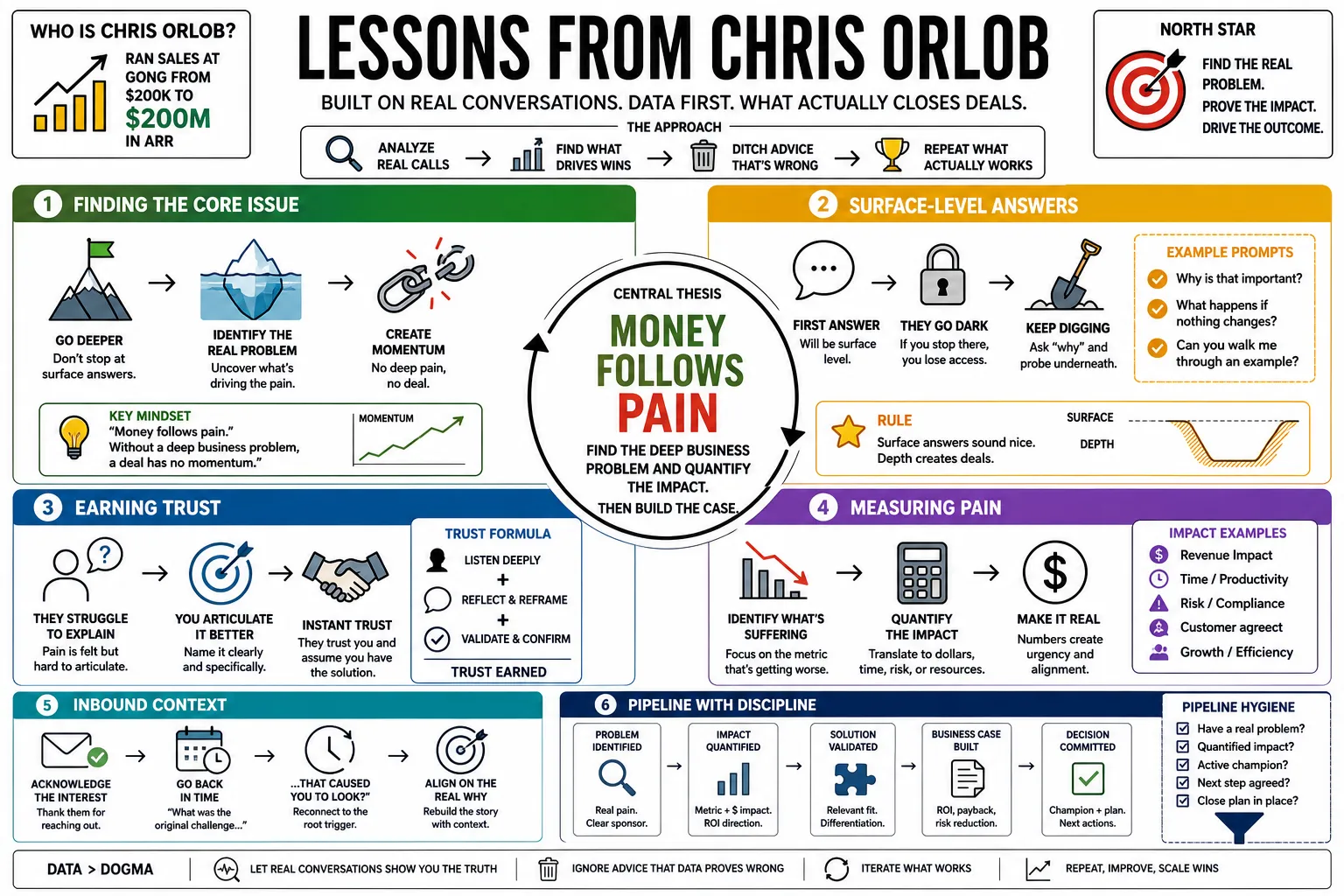
Lessons from Chris Orlob
Chris Orlob is a former Gong sales leader and the co-founder of Caliber (formerly pclub.io). His published advice draws on sales-call analysis and his experience in discovery, business cases, closing and sales management. The lessons below distinguish his recommendations from the observational data behind some of them. — Gong Cold-Calling Tips.
Part 1: The Psychology of Discovery & Pain
- Find a consequential business problem: Orlob advises identifying a business problem that matters enough to justify investment; his discovery course frames this as pain with a decision-maker-owned metric. — Orlob Discovery Transcript.
- Go beyond the first answer: A buyer’s first answer may describe a surface symptom. Orlob recommends follow-up questions that expose the need beneath it. — Orlob Discovery Transcript.
- Articulate the buyer’s pain: Orlob recommends reflecting a buyer’s problem back clearly enough to test shared understanding and demonstrate that the seller has listened. — Orlob Discovery Mistakes.
- Find the suffering metric: Once the underlying problem is clear, ask which business metric it affects and whether that metric matters to the decision-maker. — Orlob Discovery Transcript.
- Reconstruct inbound context: For an inbound inquiry, Orlob suggests going back in time to ask what original challenge prompted the buyer to explore solutions. — Orlob Discovery Transcript.
- Diagnose the root cause: A business case should connect the buyer’s problem to its root cause and show which capabilities are needed to address it before pitching a solution. — Orlob Business-Case Guide.
- Trace ripple effects: Ask how a challenge affects other parts of the buyer’s business so the scope of the problem is not limited to its first visible symptom. — Orlob Discovery in a Downturn.
- Earn outbound discovery: In outbound conversations, Orlob recommends offering a relevant point of view or short customer example before asking the buyer to discuss their own situation. — Orlob Discovery Transcript.
- Summarize and check understanding: Pause to summarize what the buyer has said, then ask whether the summary is accurate before moving into a solution. — Orlob Discovery Mistakes.
- Ask what drives priority now: After identifying a problem, ask what has made it important to address now, rather than assuming that interest alone implies urgency. — Orlob Discovery Questions.
Part 2: Engineering Urgency & Cost of Inaction
- Treat urgency as problem-specific: Orlob links buying urgency to a significant, current business problem; sellers should investigate the buyer’s actual cost of delay rather than assert a generic deadline. — Orlob Cost-of-Inaction Advice.
- Calculate the cost of inaction: With the buyer, trace a suffering metric to the financial consequence of letting the problem persist and estimate the cost over time. — Orlob Cost-of-Inaction Advice.
- Distinguish pain from ROI: In Orlob’s account, business pain can motivate a buyer to act while ROI often helps justify that decision internally; neither alone guarantees a purchase. — Reditus Interview.
- Test the affected metric: Ask which metric would improve if the buyer solved the problem, then explore what continuing deterioration would mean for the business. — Orlob Discovery in a Downturn.
- Use a four-slide discovery prompter: Orlob’s illustrated discovery prompter moves from a market change to buyer pain, a failed remedy and a brief customer narrative, then invites the buyer to react. It is not a one-slide pain deck. — Orlob Discovery Prompter.
- Test challenge priority: Ask which challenge, if left unresolved, would most threaten a buyer’s current priorities; use the answer to focus discovery on a real business issue. — Orlob Discovery Questions.
- Anchor urgency in the status quo: Orlob argues that a buyer’s present problem and the cost of leaving it unsolved can be more persuasive than excitement about product features. — Orlob Discovery in a Downturn.
Part 3: Mastering the Cold Call & Outbound
- Sell the meeting on a cold call: For an initial cold call, Orlob advises earning a few minutes of attention and selling a follow-up meeting rather than attempting a full discovery session. — Gong Cold-Calling Tips.
- Introduce yourself by full name: Orlob recommends using a full-name introduction on cold calls as a way to sound more credible; this is his advice, not a proven status effect in every context. — Gong Cold-Calling Tips.
- Avoid the bad-time opener: In the Gong cold-call dataset Orlob discusses, calls opening with “Did I catch you at a bad time?” were associated with lower meeting-booking rates. — Gong Cold-Calling Tips.
- State the reason for the call: Orlob recommends explaining the reason for a cold call early, so the buyer can quickly understand its relevance. — Gong Cold-Calling Tips.
- Prompt with a short customer story: Before asking outbound discovery questions, Orlob suggests a brief, pain-based story about a similar customer and an invitation for the buyer to compare it with their situation. — Orlob Discovery Transcript.
- Structure a cold email around one pain: One Orlob cold-email formula uses a relevant opening, buyer pain, a credible future state and an interest-based call to action. — Orlob Cold-Email Formula.
- Ask for interest before time: Rather than opening with a calendar request, Orlob recommends a short question that tests whether the buyer is interested in discussing the problem. — Orlob Cold-Email Formula.
- Check whether the agenda feels fair: Orlob closes his discovery agenda by asking whether the proposed conversation feels fair, giving the buyer a chance to agree or redirect it. — Orlob Discovery Transcript.
- One problem, one story, one CTA: Orlob’s later cold-email advice recommends focusing each message on one buyer problem, one relevant story and one clear call to action. — Orlob Cold-Email Advice.
- Cold-call talk ratios differ from discovery: Orlob reports that successful cold calls in Gong’s observational sample featured more seller talk than many discovery-call prescriptions would suggest; this association is not a causal rule. — Gong Cold-Calling Tips.
Part 4: Building the Business Case & ROI
- A calculator is not a business case: Orlob distinguishes a generic ROI calculator from a buyer-specific business case that documents the account’s own problem, assumptions and financial impact. — Orlob Business-Case Guide.
- Make the champion an author: Orlob recommends involving the buyer’s internal champion in writing the business case so it reads as an internal decision document rather than a vendor pitch. — Orlob Business-Case Guide.
- Connect root cause to capability: A business case should identify the cause of the buyer’s problem and connect it to the capability required, rather than assume agreement on the problem implies agreement on a solution. — Orlob Business-Case Guide.
- Show a range of scenarios: Orlob advises presenting worst-, base- and best-case outcomes to make the business case’s assumptions and uncertainty visible. — Orlob Business-Case Guide.
- State implementation dependencies: Make the customer-side time, resources and actions required to realize the projected outcome explicit in the business case. — Orlob Business-Case Guide.
- Trace soft metrics to business cost: When the buyer accepts the assumptions, a soft metric such as customer satisfaction can be traced through churn to a monetary cost of inaction. — Orlob Cost-of-Inaction Advice.
- Replace averages with buyer data: Industry averages and case studies can provide context, but Orlob says they cannot substitute for the buyer’s own problem and financial assumptions. — Orlob Business-Case Guide.
- Sequence the case from problem to solution: Orlob recommends building the case around the buyer’s problem, financial impact and root cause before introducing the proposed solution and ROI. — Orlob Business-Case Guide.
- Include stakeholder perspectives: An executive-ready business case should consider the financial impact and concerns of more than one affected stakeholder, not just the seller’s preferred metric. — Orlob Business-Case Guide.
Part 5: Navigating Objections & Price Resistance
- Prevent foreseeable objections: Orlob advises surfacing likely concerns during discovery and addressing them in the narrative before they harden into late-stage objections. — Orlob Objection Prevention.
- Pause after an objection: Orlob advises a calm pause after an objection; in Gong’s observational dataset, successful sellers tended to pause longer than average sellers. — Gong Objection-Handling Study.
- Clarify before answering: Ask what is behind the buyer’s stated concern before giving a rebuttal, since the first objection may not capture the full issue. — Orlob Objection Techniques.
- Acknowledge the concern: Orlob suggests validating a buyer’s concern and, when appropriate, naming the emotion behind it before offering a response. — Orlob Objection Techniques.
- Ask permission to offer a view: After understanding an objection, Orlob proposes asking permission to offer another perspective—for example, whether he can bounce a few thoughts off the buyer. — Orlob Objection Techniques.
- Diagnose price resistance: Orlob divides price pushback into three possible issues: unresolved value, payment logistics or bargaining. His advice is to find which problem the buyer actually has before responding. — Orlob Price-Resistance Buckets.
- Keep objection replies concise: In Gong’s observed calls, sellers with better outcomes tended to respond to objections with shorter explanations instead of extended monologues. — Gong Objection-Handling Study.
- Use invitational prompts: Orlob suggests prompts such as “Help me understand” or “Walk me through” to encourage a buyer to explain a situation in more depth. — Orlob Discovery Prompts.
Part 6: The Mechanics of Closing & Commitments
- Closing motion, not a magic line: Orlob rejects slick last-minute closing lines, while still advocating a structured process for reaching a signed decision after the buyer signals intent. — Orlob Closing Motion.
- Map every remaining step: When a buyer wants to move forward, Orlob recommends asking what still has to happen and then probing the subsequent steps until the decision path is clear. — Orlob Closing Motion.
- Use a readiness scale situationally: Orlob suggests asking a buyer to rate readiness to finalize from 1 to 10, then exploring the blocker if the answer is below 9. — Orlob Closing Techniques.
- Exchange a concession for commitment: If a buyer asks for a launch-timeline accommodation, Orlob suggests making the reciprocal next step explicit before agreeing—for example, asking whether meeting that timeline would allow finalization today. — Orlob Closing Techniques.
- Ask what could derail a healthy deal: For a deal that appears on track, Orlob advises asking what could still prevent it from closing on the expected timeline. — Orlob Closing-Risk Questions.
- Offer a limited choice when useful: For a buyer overwhelmed by options, Orlob suggests a concrete choice such as quarterly versus annual plans, while leaving room to reassess fit. — Orlob Closing Techniques.
- Co-create a mutual success plan: Orlob recommends mapping the buyer’s remaining steps, owners and timing together, including the paper process and work needed after signing. — Orlob Mutual Success Plan.
- Check whether the objection is resolved: After addressing a concern, Orlob recommends a brief check that the response made sense rather than assuming the objection has disappeared. — Gong Objection-Handling Study.
- Discovery shapes the close: Orlob argues that the quality of early discovery affects later demos, business cases and negotiations; a clever final line cannot compensate for a poorly understood problem. — Orlob Discovery Transcript.
Part 7: Managing Deals & Pipeline Health
- Review pipeline with context: Orlob’s weekly pipeline review starts with quarter-level results and opportunity data, then probes concrete risks in one or two important deals instead of relying only on a rep’s feeling. — Orlob Sales 1:1 Guide.
- Separate deal review from skill coaching: Orlob treats pipeline reviews and skill-coaching sessions as different management conversations, each with its own schedule and purpose. — Orlob Sales 1:1 Guide.
- Ground coaching in observed behavior: To choose a coaching focus, Orlob suggests combining conversion and stage metrics, call data and the manager’s own observation rather than inferring a skill gap from sentiment alone. — Orlob Sales 1:1 Guide.
- Diagnose skill gaps before process fixes: Orlob cautions that a new sales process cannot substitute for skills such as reaching economic buyers and uncovering business metrics; leaders should identify the execution gap before redesigning the process. — Orlob Sales Skills vs Process.
- Verify stakeholder coverage: In reviewing a deal, Orlob advises asking who else is involved, whether the current contact can move the decision, and how the team will gain access to other influential people. — Orlob Multi-Threading Plays.
- Verify the cost of the problem: Orlob recommends testing whether the team has identified a buyer-owned suffering metric and a plausible financial consequence, rather than asserting a dollar amount the buyer has not validated. — Orlob Cost-of-Inaction Advice.
- Test a tight timeline: For a deal whose intended date looks tight, Orlob suggests asking what conditions would need to be true for that date to hold. — Orlob Closing-Risk Questions.
Part 8: Scaling Teams & Hiring A-Players
- Treat hiring as a leadership priority: Orlob argues that, after product-market fit, choosing and developing strong sellers is a major driver of a sales organization’s results. — Orlob Hiring-Cost Example.
- Recognize the cost of a poor hire: Orlob uses a specific attrition-and-revenue example to argue that poor sales hiring can impose a substantial cost; it is an anecdote, not a guarantee of failure. — Orlob Hiring-Cost Example.
- Balance product strength and sales skill: Orlob recounts advice from Gong CEO Amit Bendov: a strong product and a capable sales team reinforce one another. Orlob’s own takeaway is to seek a product with real fit while investing in selling skill; the billion-dollar promise is not a verified outcome. — Orlob on Product and Sales Skill.
- Interview across the career timeline: Orlob’s chronological interview revisits roughly the same questions across a candidate’s earlier and later roles to reveal patterns, spending more time on recent roles. — Orlob Chronological Interview Guide.
- Examine prior manager relationships: When interpreting a candidate’s career history, Orlob recommends looking for patterns in their relationships with former bosses, without treating one difficult relationship as dispositive. — Orlob Chronological Interview Guide.
- Build a recurring management rhythm: Orlob lays out a quarterly cadence that combines performance review, pipeline inspection, focused skill coaching and follow-up, instead of treating training as a one-off event. — Orlob Sales 1:1 Guide.
- Identify the economic buyer: Orlob distinguishes a helpful internal champion from the person able to authorize spending, and recommends working with the champion to identify and engage that economic buyer when appropriate. — Orlob Champion and Buyer Guide.
- Do not lower the hiring bar to fill seats: In recounting Gong’s growth, Orlob cautions against relaxing the ideal rep profile merely to meet a headcount plan. — Orlob Gong-Scaling Lessons.
- Invest in sales skill deliberately: Orlob advises repeated, manageable skill practice as a controllable way to improve future opportunities; he describes his own daily learning habit without promising a particular income. — Orlob on Product and Sales Skill.