Christoph Janz co-founded Point Nine Capital and has written extensively about early-stage SaaS investing. His original essays on SaaS customer economics, product-market fit, and investor-founder relationships provide the direct evidence for the lessons below. — Sapphire Ventures — Interview with Point Nine Capital.
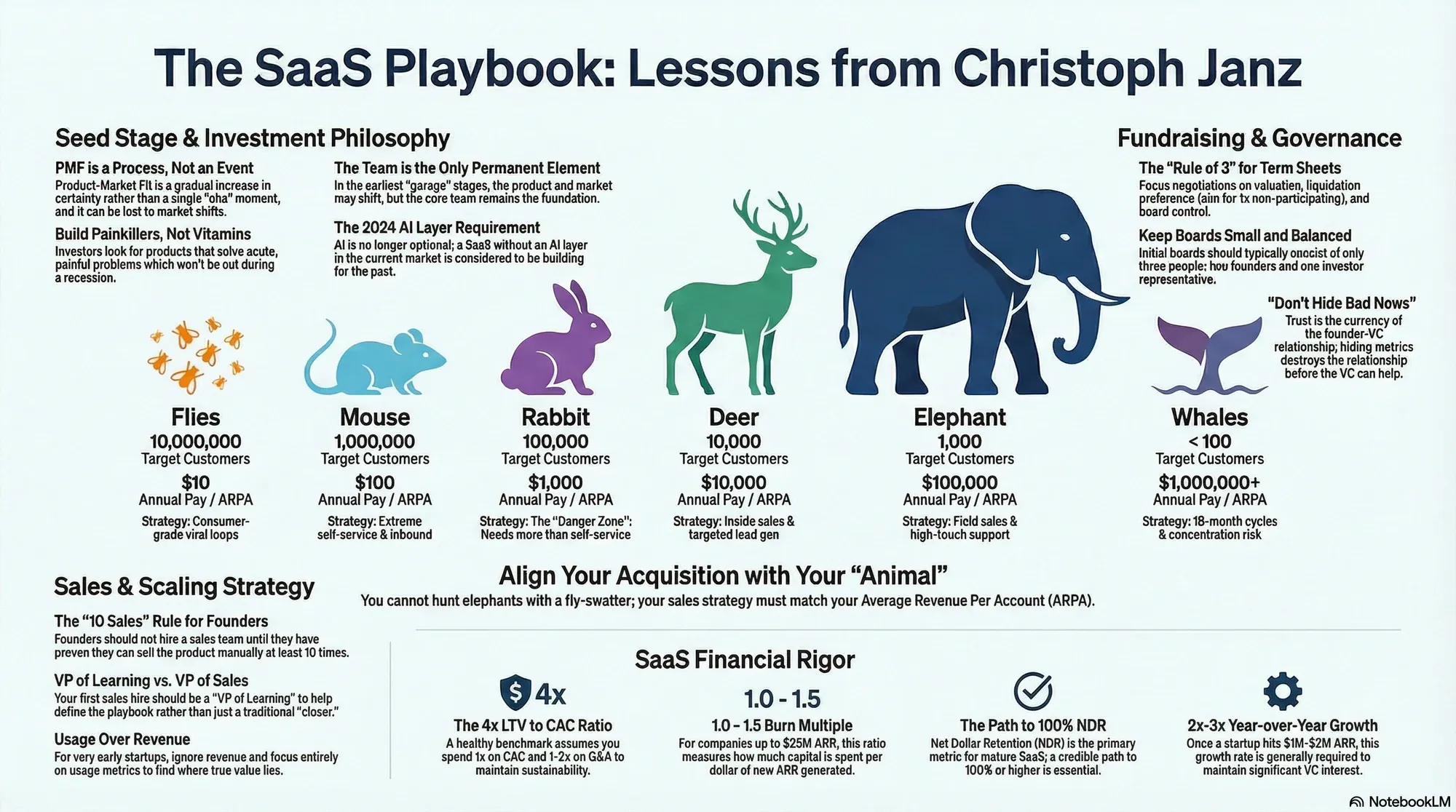
Part 1: The Animal Kingdom — Five Ways to $100M ARR
- On Hunting Flies: The original fly example models $100 million in revenue as roughly ten million users monetized at $10 each, often through advertising; Janz later removed flies from his SaaS-specific revision. — The Angel VC — Five Ways to Build a $100 Million Business.
- On Hunting Mice: At about $100 per customer per year, a million mouse-sized customers would be needed to reach $100 million, making low-touch acquisition crucial. — The Angel VC — Five Ways to Build a $100 Million Business.
- On Hunting Rabbits: The rabbit model requires roughly 100,000 customers paying $1,000 a year; acquisition must remain inexpensive enough for that annual value. — The Angel VC — Five Ways to Build a $100 Million Business.
- On Hunting Deer: The deer model uses about 10,000 customers at $10,000 a year, giving more room for sales effort than lower-ARPA categories. — The Angel VC — Five Ways to Build a $100 Million Business.
- On Hunting Elephants: The elephant model reaches $100 million with about 1,000 customers at $100,000 annually and can support a higher-touch enterprise sales motion. — The Angel VC — Five Ways to Build a $100 Million Business.
- On Strategy Alignment: Janz’s central test is whether acquisition channels can be both scalable and profitable at the customer’s annual value. — Point Nine — Five Years Later: Five Ways to Build a $100 Million SaaS Business.
- On The $100M North Star: Janz used $100 million ARR as a modelling target for a venture-scale SaaS company, not as a universal prerequisite for a worthwhile business or IPO. — The Angel VC — How Fast Is Fast Enough?.
- On Whale Hunting: Janz’s later SaaS revision adds whale-sized customers at roughly $1 million annual value; he does not prescribe a fixed sales-cycle length. — Point Nine — Five Years Later: Five Ways to Build a $100 Million SaaS Business.
- On The Missing Middle: Janz observes that outbound sales may not work when account value is too low, even when pure low-touch acquisition cannot scale enough. — Point Nine — Five Years Later: Five Ways to Build a $100 Million SaaS Business.
- On Market Size: The framework forces a market-size check: at each average revenue level, the required number of customers changes dramatically. — The Angel VC — Five Ways to Build a $100 Million Business.
Part 2: SaaS Metrics & Financial Rigor
- On The KPI Sheet: For Series A and B fundraising, Janz recommends a concise KPI model that investors can understand quickly; in his talk he says one main tab plus a few supporting assumptions is often enough. — SaaStr — 5 Metrics That Matter When Raising Your SaaS Series A and B.
- On Burn Multiples: In his 2022 SaaStr talk, Janz used net burn divided by net new ARR as a capital-efficiency measure and described a 1–1.5 burn multiple below $25 million ARR as good in that market context. — SaaStr — Growth vs. Efficiency with Christoph Janz.
- On Net Dollar Retention (NDR): Janz says Series A/B investors care about a credible path toward 100% net dollar retention, with exceptions for models that can offset higher churn through strong new acquisition. — SaaStr — 5 Metrics That Matter When Raising Your SaaS Series A and B.
- On CAC Payback: Janz recommends customer and revenue cohort analysis to understand retention, CAC payback and customer lifetime, including when a cohort recoups acquisition cost. — SaaStr — 5 Metrics That Matter When Raising Your SaaS Series A and B.
- On Negative Churn: In his 2017 unicorn-scale thesis, Janz argued that strong virality or significant negative net churn could help produce exceptional growth, while acknowledging simplifications and exceptions. — The Angel VC — What We’re Looking for in SaaS in 2017.
- On Growth Benchmarks: In a 2024 Series A/B fundraising talk, Janz offered 2–3× annual growth around $1–2 million ARR as a rough rule of thumb for attracting substantial investor interest, not a universal requirement. — SaaStr — 5 Metrics That Matter When Raising Your SaaS Series A and B.
- On Financial Planning: For a Series A/B fundraising KPI model, Janz suggests projections covering roughly two years of runway; one year may be too short and multi-year detail much further out adds little. — SaaStr — 5 Metrics That Matter When Raising Your SaaS Series A and B.
- On The CAC/LTV Ratio: Janz’s illustrative rabbit economics compare lifetime value with acquisition spend; the ratio is an example, not a universal healthy benchmark. — The Angel VC — Five Ways to Build a $100 Million Business.
- On Revenue Quality: Recurring SaaS revenue must be understood through retention and expansion, not merely a topline ARR number; Janz’s funding framework ties scale to defensible customer relationships. — The Angel VC — SaaS Funding Napkin: 2017 Edition.
- On Efficiency vs. Growth: Janz’s 2022 funding survey describes a shift from growth-at-all-costs toward balancing growth with efficiency, a period-specific observation. — Point Nine — What Does It Take to Raise Capital in SaaS in 2022?.
Part 3: The Seed Stage & Investment Philosophy
- On Pre-Seed Conviction: At an early stage Janz looks for a capable product-focused team and promising leading signals, even when lifetime economics cannot yet be calculated reliably. — The Angel VC — What We Look for in Early-Stage SaaS Startups.
- On Seed Readiness: Seed-stage companies often have evidence that product-market fit may be emerging rather than conclusive proof of it; customer enthusiasm and retention help test that case. — The Angel VC — WTF Is PMF? Part 2.
- On The Team: Janz emphasizes a founder team with product, technical, and domain strengths because the first hires must build and learn before specialist processes mature. — The Angel VC — The 2nd DO: Have the Right Team.
- On European Potential: Janz described Point Nine as investing internationally from Europe and cited Zendesk as an example of consumer-grade usability in enterprise software. — Sapphire Ventures — Interview with Point Nine Capital.
- On The Power Law: His funding napkin models the milestones that can support later venture rounds while explicitly recognizing that many good businesses are not venture-scale outliers. — The Angel VC — SaaS Funding Napkin: 2017 Edition.
- On "I Don't Know": Janz argues that useful investors should listen, remain humble about their role and leave operating decisions to founders. — The Angel VC — Good VCs, Bad VCs.
Part 4: Fundraising, Pitching & Deal Terms
- On Pitch Deck Clarity: Point Nine asks for a deck and key metrics first to understand fit and triage a large number of approaches; Janz does not claim complexity alone proves a poor business. — Point Nine — Why We Politely Ask for a Deck First.
- On Simple Term Sheets: Janz advocates short, straightforward early-stage term sheets and rejects punitive or exotic investor provisions. — Point Nine — Making European Venture Capital a Little More Human.
- On Explaining Anomalies: Janz says marked improvements between historical metrics and projections require explanation so investors can follow the connection from past performance to the forecast. — SaaStr — 5 Metrics That Matter When Raising Your SaaS Series A and B.
- On Valuation Realities: Janz cautioned in a 2024 Series A/B talk that founders whose previous rounds were priced in 2020–21 should recalibrate valuation expectations to the later market. — SaaStr — 5 Metrics That Matter When Raising Your SaaS Series A and B.
- On Liquidation Preferences: Point Nine’s published seed template uses a simple, nonparticipating 1x liquidation preference alongside customary protective rights. — Point Nine — Making European Venture Capital a Little More Human.
Part 5: Growth, Marketing & Sales Strategies
- On Content Marketing: Janz recommends nurturing trial users with useful newsletters, webinars or events when they are not yet ready to buy. — The Angel VC — The 7th DO: Build a Repeatable, Profitable Sales Process.
- On Viral Loops: Janz treats product virality as one possible acquisition advantage, not a universal property of B2B SaaS. — The Angel VC — Four More Things We Look for in SaaS Startups.
- On Sales Cycles: Sales economics must fit annual account value and cash constraints; Janz warns that the viability of a longer payback depends on customer lifetime and other factors. — The Angel VC — The 7th DO: Build a Repeatable, Profitable Sales Process.
- On Marketing Qualified Leads (MQLs): A useful SaaS fundraising model follows the funnel from visits or qualified leads through signups, trials and paying customers, with the steps adapted to the sales motion. — SaaStr — 5 Metrics That Matter When Raising Your SaaS Series A and B.
- On Inbound Sales: For lower-priced accounts, Janz emphasizes self-service or low-touch conversion; as account value rises, inside and field sales become easier to justify. — The Angel VC — The 7th DO: Build a Repeatable, Profitable Sales Process.
- On Scaling Sales: Before building a scalable sales organization, founders should spend substantial time with potential customers and learn what converts; Janz gives no ten-sales rule. — The Angel VC — The 7th DO: Build a Repeatable, Profitable Sales Process.
- On Global Ambition: Janz advises ambitious European founders to consider the US market and distribution requirements as part of a larger growth strategy, rather than assuming an automatic relocation rule. — SaaStock — AMA with Christoph Janz.
- On Product-Led Growth (PLG): Low-priced products need inexpensive lead generation and little human involvement in conversion if customer acquisition is to be profitable. — The Angel VC — The 7th DO: Build a Repeatable, Profitable Sales Process.
- On Pricing Strategy: Janz argues that both overly low and overly high prices can impede growth; price and packaging should match the value customers perceive. — The Angel VC — The Price Is Right (or Not).
Part 6: Product-Market Fit & Strategic Positioning
- On Gradual PMF: Janz rejects a razor-sharp numerical threshold for product-market fit: evidence accumulates as a product solves an important problem for independent customers. — The Angel VC — WTF Is PMF? Part 2.
- On AI Integration: Janz sees AI agents as potentially changing SaaS workflows, but frames the transition as uncertain rather than requiring every product to add an AI layer. — Point Nine — The Agents Are Coming, Winter Is Not.
- On Focus: Before product-market fit, Janz puts customer conversations and product learning ahead of scaling processes and a large dashboard. — The Angel VC — The 8th DO: Stay on Top of Your KPIs.
- On Usage Metrics: Earliest-stage SaaS teams should prioritize learning whether people use and value the product, while still understanding revenue and conversion signals. — The Angel VC — The 8th DO: Stay on Top of Your KPIs.
- On Building Moats: For defensibility, Janz points to products that become a system of record, platform or proprietary data asset, rather than relying on code alone. — The Angel VC — SaaS Funding Napkin: 2017 Edition.
- On Customer Feedback: Retention and engagement among early customers can reveal a product problem before aggregate signups do. — The Angel VC — What We Look for in Early-Stage SaaS Startups.
- On "Must-Have" vs. "Nice-to-Have": Janz’s product-market-fit test begins with an important customer problem solved better than alternatives, not a product that is merely pleasant to have. — The Angel VC — WTF Is PMF? Part 2.
Part 7: Hiring, Leadership & Human Capital
- On Reference Calls: Janz recommends reference checks beyond a candidate’s hand-picked contacts, while taking care not to jeopardize a candidate’s current employment. — The Angel VC — In God We Trust, All Others Bring References.
- On Asking the Right Questions: In reference conversations, Janz advises careful follow-up and attention to qualified praise rather than treating every polite endorsement as equally strong. — The Angel VC — In God We Trust, All Others Bring References.
- On Finding Builders: For early teams, Janz prioritizes strong product, engineering and domain talent that can build the initial product before mature functional layers exist. — The Angel VC — The 2nd DO: Have the Right Team.
- On The First Sales Hire: Early sales and support hires should help learn what makes trial users convert; a seasoned VP of Sales becomes more useful once a repeatable motion is ready to scale. — The Angel VC — The 7th DO: Build a Repeatable, Profitable Sales Process.
Part 8: The Founder-VC Dynamic & Boardroom Value
- On Value-Add: Janz argues that a good investor contributes active help and availability without taking over the founder’s job. — The Angel VC — Good VCs, Bad VCs.
- On Trust: Regular candid updates reduce the information gap that prevents investors from offering timely, useful input. — The Angel VC — Bored Meetings vs. Board Meetings.
- On Board Roles: A board meeting should use a pre-read and spend most of its time on a few consequential questions rather than repeating updates. — The Angel VC — Bored Meetings vs. Board Meetings.
- On Reporting: Janz recommends brief weekly KPI updates in a company’s early days, with less frequent updates as it grows; monthly is not a blanket rule. — The Angel VC — Bored Meetings vs. Board Meetings.
- On VC Ego: Janz emphasizes that founders create and run the business while the investor supports them and remains humble about that role. — The Angel VC — Good VCs, Bad VCs.
- On The Power of No: A professional investor should decline promptly and respectfully, rather than leaving a founder without a clear response. — The Angel VC — Good VCs, Bad VCs.
- On Listening: Janz places listening and practical support among the traits of a useful founder-investor relationship. — The Angel VC — Good VCs, Bad VCs.
- On Exit Alignment: Because venture investors seek outlier returns, founders should understand whether their own desired outcome fits a VC-backed growth path. — The Angel VC — SaaS Funding Napkin: 2017 Edition.
Part 9: Scaling to Unicorn Status & Beyond
- On Zendesk Lessons: Janz cited Zendesk’s consumer-grade ease of use as part of what made its enterprise software distinctive. — Sapphire Ventures — Interview with Point Nine Capital.
- On Churn in the Early Days: Janz recommends cohort analysis to distinguish early customer drop-off from longer-term retention and customer value. — The Angel VC — Learning More About That Other Half.
- On Growth vs. Spend: Janz warned in his 2022 SaaStr talk that when growth slows, continuing to spend to the original plan can shorten runway sharply; founders should adapt burn to actual net new ARR. — SaaStr — Growth vs. Efficiency with Christoph Janz.
- On Steady-State CAC: Janz advises watching steady-state acquisition economics and maintaining metrics that can attract the next financing round, even if temporary investment raises burn. — SaaStr — Growth vs. Efficiency with Christoph Janz.
- On The Path to $100M: Janz notes that some SaaS businesses move from lower-value customers toward larger accounts as their original acquisition channel reaches a growth ceiling. — Point Nine — Five Years Later: Five Ways to Build a $100 Million SaaS Business.
- On Revenue Churn vs. Logo Churn: Track both customer-count churn and dollar-based retention because different definitions answer different questions about account loss and expansion. — The Angel VC — How Public SaaS Companies Report Churn.
- On Market Timing: Janz’s product-market-fit framework requires an important problem and a sufficiently large market for the venture case; a good product before its market develops may not yet meet that test. — The Angel VC — WTF Is PMF? Part 2.
Part 10: The VC Mindset & Investing as a Craft
- On Angel Investing: Janz moved from entrepreneurship into angel and seed investing and co-founded Point Nine to concentrate on early software companies. — Sapphire Ventures — Interview with Point Nine Capital.
- On Continuous Learning: Revisiting his own animal framework after five years, Janz adjusted it for SaaS and documented where his view of low- and high-value customers had changed. — Point Nine — Five Years Later: Five Ways to Build a $100 Million SaaS Business.
- On The Power of Writing: Janz says the animal framework helped him challenge startups’ scaling strategies; he later revised it publicly in response to what he learned. — Point Nine — Five Years Later: Five Ways to Build a $100 Million SaaS Business.
- On The Funding Napkin: The SaaS Funding Napkin presents approximate stage-dependent revenue and funding expectations, with explicit caveats about exceptions and non-VC businesses. — The Angel VC — SaaS Funding Napkin: 2017 Edition.
- On The Long Game: Janz argues for sustainable investor behavior: fair terms, respectful founder treatment and long-term support rather than extracting every short-term advantage. — The Angel VC — Good VCs, Bad VCs.
- On The Future of SaaS: Janz’s recent writing explores where AI agents can replace or reshape specific SaaS workflows, without predicting that all horizontal products will disappear. — Point Nine — AI Killed My SaaS.
- On Success: For Janz, good venture investing includes helping founders build worthwhile companies through fair treatment and useful support, not merely closing deals. — The Angel VC — Good VCs, Bad VCs.